Alpine skiing disciplines: slalom, giant slalom, super-G, and downhill
Learn how alpine skiing disciplines differ, from slalom to downhill, including race formats, physical demands, safety, and practical training priorities.
Alpine skiing disciplines use the same basic challenge—descend a marked course as quickly as possible—but they reward different solutions. Slalom compresses many rapid turns into a short course. Giant slalom opens the rhythm and raises speed. Super-G combines long, fast turns with a one-run format. Downhill gives speed, terrain, gliding, jumps, and judgment their greatest influence.
Those differences are not just labels for spectators. Gate spacing and course length change how a skier manages line, edge angle, pressure, vision, fatigue, and risk. They also change what deserves attention in training. A technically sharp slalom skier needs fast transitions and precise rhythm; a downhill specialist needs exceptional high-speed skill, anticipation, strength, and risk management.
Quick answer
What are the main alpine skiing disciplines? The four core individual disciplines are slalom, giant slalom, super-G, and downhill. Slalom and giant slalom are technical events normally decided over two runs. Super-G and downhill are speed events normally decided in one race run. Combined formats join a speed run with slalom, while parallel formats place skiers on adjacent courses.
For recreational skiers, the lesson is not to imitate a race course. It is to recognize the skill continuum: short turns demand fast edge changes; wider turns demand stronger pressure control and better line planning; higher speed sharply increases the consequences of mistakes. Race-specific training belongs on closed courses with qualified coaching.
Key facts
- Slalom rewards rapid edge changes, rhythm, precision, and recovery between closely spaced gates.
- Giant slalom develops medium-to-long carved turns, line choice, pressure control, and sustained force.
- Super-G combines speed with long turns, terrain reading, gliding, and one-run execution.
- Downhill emphasizes maximum-speed judgment, aerodynamics, jumps, terrain absorption, and a rehearsed line.
- Course design changes the dominant technical and physical demands; the four events are not merely faster versions of one another.
Alpine skiing disciplines at a glance
The International Ski and Snowboard Federation competition rules define the course parameters for each event. Exact vertical drops and gate counts vary by competition level, age group, and sex, so the table below focuses on the stable distinction a reader needs.
| Discipline | Event family | Typical race format | Course rhythm | Main performance problem |
|---|---|---|---|---|
| Slalom | Technical | Two timed runs; times added | Shortest gate-to-gate distances, rapid combinations | Change edges and direction quickly without losing the line |
| Giant slalom | Technical | Two timed runs; gates reset | Wider spacing, medium and long turns | Build speed while managing pressure and choosing an efficient arc |
| Super-G | Speed | One timed race run | Long and medium turns, terrain features, possible jumps | Read the course, preserve speed, and control a fast line |
| Downhill | Speed | Usually one timed race run after official training | Longest course, wide gates, high speed, gliding and jumps | Integrate speed, terrain, aerodynamics, judgment, and risk |
| Team combined | Combined | One speed specialist plus one slalom specialist; times added | One speed run and one slalom run | Produce a complete team result across two contrasting skill sets |
In the July 2026 rules, slalom turning poles are generally 19.7–42.7 ft (6–13 m) apart, giant slalom uses at least 32.8 ft (10 m) between successive turning poles, and super-G uses at least 82 ft (25 m), outside specified exceptions. These numbers should not be copied into an informal public-slope setup. They illustrate why the rhythm, speed, and visual planning differ so much.
How gates, lines, and timing work
A gate defines where the skier must pass, but the fastest path is rarely a straight line from pole to pole. The skier chooses a trajectory that balances distance, speed, turn shape, snow grip, and the position needed for the next gate.
Three concepts explain most of what you see:
- Line: the path of the skis and center of mass through the course. A line that is too direct may force late braking; a line that is too round adds distance.
- Pressure: the skier manages force through the outside ski, legs, and snow across each turn rather than simply leaning inward.
- Transition: the interval between turns when the old edges release, the body moves across the skis, and the new edges engage.
Missing or incorrectly passing a gate can invalidate a run. At high levels, tiny timing differences accumulate across dozens of decisions. The discipline-specific question is therefore not just “How fast can this athlete ski?” but “How accurately can this athlete create and repeat the right turn shape at this speed?”
Slalom: the quickest technical rhythm
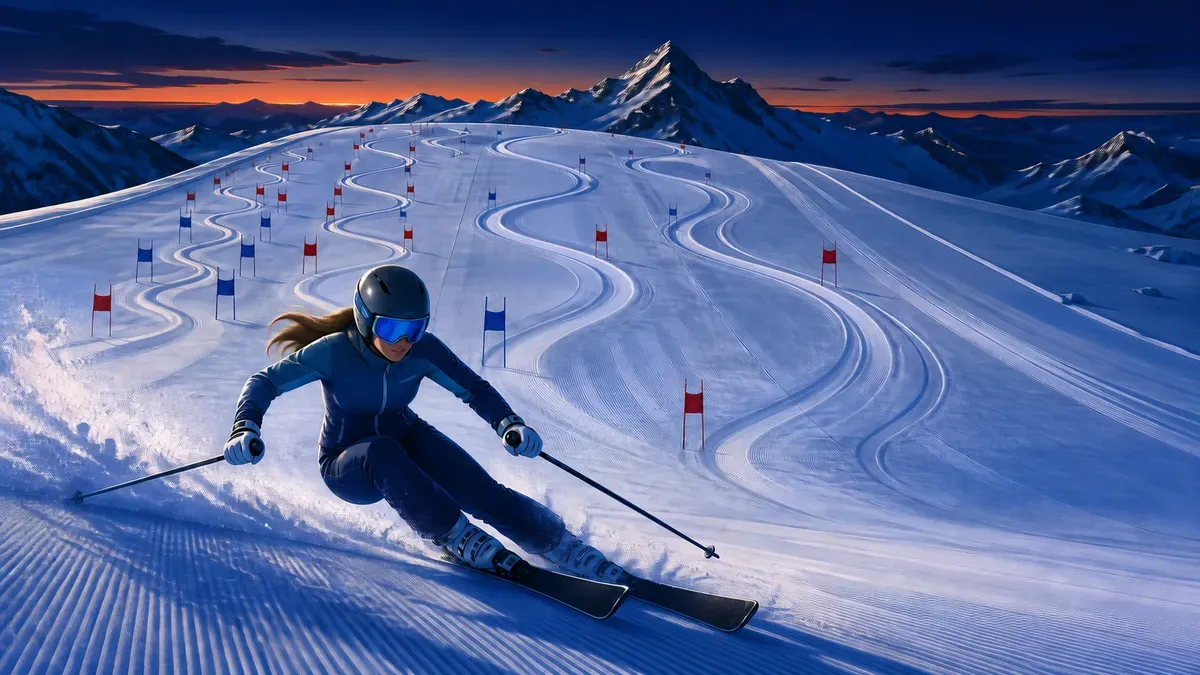
Slalom has the tightest spacing and the highest frequency of direction changes. The FIS rules set most successive turning poles 19.7–42.7 ft (6–13 m) apart and include special combinations such as hairpins and verticals. A race is decided over two differently set runs, with the times added.
The visual signature is rapid movement: short arcs, frequent pole contact at elite level, and very little time to repair a late turn. Yet slalom is not a sequence of frantic pivots. Fast skiing depends on keeping the upper body organized while the legs move quickly beneath it, establishing the new outside ski early, and completing enough of the turn before the next gate.
What slalom demands
- rapid edge release and re-engagement;
- short-radius turn control on firm snow;
- rhythm recognition and quick adaptation;
- lateral power and braking capacity;
- trunk stability while the legs change direction;
- concentration across two runs and two different course sets.
A skier who starts each turn late often has to brake below the gate, creating a repeated “late and defensive” pattern. Training should first improve clean, controlled short turns and line awareness—not merely increase movement speed.
Giant slalom: pressure, carving, and line choice
Giant slalom sits between slalom and the speed events. Gates are wider and farther apart, the vertical drop is greater, and the course should include long, medium, and short turns. Like slalom, it is normally decided over two runs with a reset course.
The wider rhythm allows more speed, but it also creates large turning forces. A systematic review of elite alpine racing identified trajectory, turn radius, ground-reaction force, friction, aerodynamic drag, and energy dissipation as important performance variables. More recent on-snow force measurements found that high-level giant slalom performance depends partly on producing large forces and changing how those forces are applied through the turn (Gilgien et al., 2025).
What giant slalom demands
- progressive edge angle rather than abrupt steering;
- strong outside-ski pressure and lower-body endurance;
- the ability to absorb and produce force through changing terrain;
- earlier visual planning than slalom;
- efficient line selection across a sequence, not one gate at a time;
- tolerance for repeated eccentric and isometric leg loading.
Giant slalom is often the clearest classroom for carved-turn mechanics because it gives more time than slalom without the extreme speed of super-G or downhill. That does not make a race course appropriate for self-teaching. Controlled drills on suitable terrain and professional feedback are the safer progression.
For recreational step-by-step practice, our ski carving technique guide moves from edge-awareness traverses to shallow arcs and controlled linked turns.
Super-G: speed plus technical decision-making
Super-G is a speed event with more turning than downhill. Current FIS rules specify long and medium turns, a minimum of 82 ft (25 m) between successive turning poles in standard settings, and a single race run. Jumps may be included where terrain allows.
One run changes the tactical problem. There is no first race run from which to correct a line. Athletes inspect the course, plan visual and terrain cues, then execute at speed. Because the turns are more frequent than in downhill, a skier must balance aerodynamic efficiency with active pressure control and line adjustment.
What super-G demands
- high-speed carving and terrain absorption;
- long-range vision and anticipation;
- disciplined line memory from inspection;
- calm decisions under time pressure;
- strength and stiffness control through long turns;
- enough aerobic and muscular capacity to preserve technique to the finish.
Super-G is not “giant slalom with fewer gates.” The higher speed increases the distance traveled during every moment of hesitation. It also changes injury mechanisms: an analysis of World Cup racing linked super-G and downhill risk more strongly with speed and jumps, while giant slalom showed particularly high turning loads (Gilgien et al., 2014).
Downhill: speed, terrain, and judgment
Downhill is the longest and fastest core discipline. The FIS describes it through technique, courage, speed, risk, physical condition, and judgment. Elite courses use substantial vertical drop, wide gates, variable speeds, gliding sections, turns, compressions, and jumps. Official training runs are important because athletes need direct experience of the terrain and line before racing.
The most visible position is the aerodynamic tuck, but downhill is not a passive glide. Skiers must reduce drag when possible, then rapidly become mobile enough to absorb a compression, shape a turn, handle a jump, or correct a line. Judgment determines where speed can be carried and where control must take priority.
What downhill demands
- stable high-speed technique and excellent snow feel;
- aerodynamic positioning without losing readiness;
- terrain memory and precise visual cues;
- jump takeoff, flight, and landing control;
- very high consequences awareness;
- the maturity to reduce speed when the line or conditions deteriorate.
This is the least transferable discipline for unsupervised recreational imitation. A public piste is not a closed, inspected race course. Other skiers, changing visibility, surface variation, and limited run-out make racing speed inappropriate even for technically strong recreational skiers.
Combined and parallel formats
Combined events test range rather than one narrow specialty. Under current rules, an alpine combined uses one downhill or super-G run plus one slalom run. A team combined assigns the speed and slalom runs to two same-gender teammates, and their times are added. This makes specialization visible: one athlete solves the speed problem and the other solves the rapid-turn problem.
Parallel events use adjacent, closely matched courses and head-to-head progression. They remain part of alpine competition rules, but slalom, giant slalom, super-G, and downhill are the clearest foundation for understanding the sport’s technical-to-speed spectrum.
For an ice-sport contrast, short track speed skating turns repeated left bends, pack position, and legal passing into the central performance problem.
The broader speed skating disciplines guide separates the time-trial logic of long track from short-track pack racing and inline track or road formats.
For a Nordic contrast, ski jumping rules and scoring turn takeoff, aerodynamic flight, distance, and landing style into the judged performance rather than obstacles inside a timed descent.
Formats can change between circuits and championships. When a specific event matters, check the current organizer and federation rules rather than assuming that every combined or parallel race uses the same structure.
The physical demands behind the four disciplines
Alpine skiing blends strength, power, balance, coordination, endurance, vision, and decision-making. There is no single “ski muscle” or laboratory number that predicts every discipline. A 2025 international consensus on competitive snow sports recommends a multidimensional approach covering strength, endurance, speed, agility, mobility, balance, neuromuscular control, proprioception, mental skills, technique, and tactics (Spörri et al., 2025).
Legs brake as well as push
The quadriceps and hamstrings repeatedly control flexion, absorb terrain, and resist collapse. Much of this work is isometric or eccentric: the muscle produces force while holding length or lengthening. After four hours of recreational skiing, one study found reductions in eccentric quadriceps and hamstring torque that remained measurable 24 hours later (Niederseer et al., 2016). Another field study found that prolonged skiing changed quadriceps activation timing in a way consistent with less-controlled technique (Kröll et al., 2011).
That evidence supports a practical rule: finish the day before fatigue turns every descent into a technical rescue. Off snow, progressive eccentric training can build braking capacity, but it should be introduced gradually because it can also create substantial soreness.
Balance is dynamic, not stillness
Ski balance means controlling the center of mass while the support surface moves, the slope changes, and forces rise and fall. Static single-leg stance is a starting point, not the complete skill. Useful preparation includes dynamic balance, lateral stepping, trunk control, landing mechanics, and reactions to unpredictable cues. Our balance training guide gives a safe foundation before sport-specific drills.
Aerobic fitness protects technique
Individual race runs are brief, but training days contain repeated descents, inspections, warm-ups, recoveries, and exposure to cold and altitude. Aerobic fitness helps an athlete recover between efforts and preserve concentration. Heart rate on snow is influenced by isometric effort, cold, altitude, emotion, and stop-start movement, so road-running zones do not transfer perfectly; use the heart rate zones by sport guide to interpret the signal in context.
For a Nordic-skiing contrast, biathlon combines repeated cross-country efforts with controlled range transitions and precision shooting. It rewards a different blend of endurance, pacing, recovery, and technical accuracy than alpine gate racing.
For the movement contrast itself, our classic vs skate cross-country skiing guide explains parallel-track grip and glide, lateral skating pushes, terrain-specific gears, and the beginner pathway into each Nordic style.
A practical off-snow training framework
The plan below is a general preparation framework for healthy recreational skiers and developing racers. It is not a substitute for an individualized program, medical clearance, or on-snow coaching.
| Quality | Why it matters | Useful off-snow examples |
|---|---|---|
| Maximal and submaximal strength | Supports force production and joint control | Squat pattern, split squat, step-up, hip hinge, calf raise |
| Eccentric endurance | Helps absorb turns and terrain repeatedly | Slow step-downs, controlled squat lowering, progressive hamstring work |
| Lateral power | Supports edge changes and recovery | Skater bounds, lateral hops, controlled deceleration drills |
| Trunk control | Keeps the torso organized over moving legs | Anti-rotation press, side plank, loaded carry |
| Dynamic balance | Connects vision, feet, and corrective movement | Single-leg reach, perturbation, multidirectional step drills |
| Aerobic base | Improves recovery across a full day | Easy cycling, hiking, running, rowing, or incline walking |
| High-intensity capacity | Prepares repeated hard efforts | Short intervals progressed after an aerobic base |
| Mobility | Allows usable positions without compensation | Ankle, hip, and thoracic mobility matched to individual limits |
Two full-body strength sessions per week are a reasonable starting structure for many adults, but the best frequency depends on experience, volume, and recovery. The strength-training frequency guide explains how to distribute work without treating frequency as a magic number.
Progress from control to speed
Build the qualities in this order:
- Establish pain-free movement and consistent aerobic work.
- Develop strength with controlled bilateral and single-leg exercises.
- Add eccentric volume and landing control.
- Introduce lateral power and reaction drills.
- Convert fitness into skiing skill with coached on-snow progression.
Do not add heavy strength, high-volume plyometrics, and hard intervals simultaneously. Increase one major stressor at a time and use the training load curve to recognize why abrupt spikes often create fatigue faster than readiness.
For a contrast with runner-based ice-track sports, see how bobsleigh, skeleton, and luge differ in their starts, steering, and physical demands.
Warm-up, safety, and risk management
A ski warm-up should raise temperature and rehearse movement without exhausting the legs. Start with easy aerobic movement, then use dynamic ankle, hip, trunk, squat, and lateral patterns. Long passive holds immediately before explosive skiing are not a complete prevention plan; our review of stretching and injury prevention explains why strength, neuromuscular preparation, and load management matter more than static stretching alone.
Before the first hard run:
- inspect weather, visibility, snow, and traffic;
- start on an easy piste and progress gradually;
- wear a correctly fitted helmet and appropriate eye protection;
- have bindings checked and adjusted by a qualified technician;
- take a lesson when moving to steeper terrain or carved turns;
- stop when coordination, judgment, or visibility deteriorates;
- never use an open public slope as a race course.
Helmet research in recreational skiers and snowboarders has found a lower risk of head injury among users, while clinical reviews emphasize that helmets do not eliminate injury risk (Sulheim et al., 2006; Davey et al., 2019). Safety still depends on speed choice, skill, spacing, conditions, and behavior.
Altitude adds another load. People with relevant cardiovascular, respiratory, or metabolic conditions should seek individualized clinical advice before sudden vigorous exercise at elevation. Learn the symptom and ascent basics in our altitude sickness guide. Stop skiing and obtain urgent help for chest pain, fainting, severe breathlessness, confusion, a suspected head or spinal injury, or inability to bear weight after a fall.
How to choose a discipline focus
Choose by current skill and coaching access, not only personality.
- Slalom may appeal if you enjoy precision, rhythm, rapid decisions, and repeated technical practice.
- Giant slalom may appeal if you enjoy carved turns, pressure control, and optimizing a line across varied terrain.
- Super-G may appeal only after advanced foundations, because it requires speed-event coaching, appropriate terrain, and formal course safety.
- Downhill may appeal as a specialist goal within a supervised racing pathway, not as a recreational speed challenge.
Developing skiers usually benefit more from broad fundamentals than early specialization. Clean turns at manageable speed, consistent balance, and reliable stopping create the base for every discipline. Speed should be an outcome of better control, never a shortcut around it.
Track adaptation with SuperAge
Once technique, terrain, and coaching are in place, recovery data can add context. SuperAge can bring together Apple Health activity, sleep, resting heart rate, heart-rate variability, and cardio-fitness trends so you can compare preparation with how you actually recover across a ski block.
The app cannot measure gate technique, certify race readiness, set bindings, or diagnose an injury. Its useful role is longitudinal: noticing whether a demanding weekend followed a poor-sleep week, whether resting signals normalize after travel, and whether your off-snow conditioning is becoming more consistent.
Use the data to ask better questions, not to override symptoms. New knee instability, swelling, concussion symptoms, chest discomfort, fainting, or unusual breathlessness needs appropriate professional assessment regardless of a reassuring score.
Download SuperAge to compare fitness and recovery trends with your own baseline across off-snow training and ski days.
Frequently asked questions
What is the difference between slalom and giant slalom?
Slalom uses closer gates and many rapid direction changes, while giant slalom uses wider spacing, greater speed, and medium-to-long turns. Both are normally decided over two runs with the times added. Slalom emphasizes transition speed and rhythm; giant slalom places more emphasis on pressure, carving, and line choice.
What is the difference between super-G and downhill?
Super-G has more turning and more closely spaced gates than downhill. Downhill is longer and generally faster, with greater emphasis on gliding, terrain, jumps, aerodynamics, and rehearsed course knowledge. Both are speed events normally decided in one race run.
Which alpine skiing discipline is the fastest?
Downhill is the fastest of the four core disciplines. Course design, snow, terrain, weather, and athlete level all affect actual speed, so one internet speed figure should not be treated as universal or as a target for recreational skiing.
Are slalom and giant slalom two-run events?
Yes. Under current FIS rules, both are normally decided over two runs, and the course is reset for the second run. The two times are added. Event-specific qualification and start-order rules can vary, so consult the relevant competition rules.
What is team combined in alpine skiing?
Team combined pairs two same-gender teammates. One completes the speed run and the other completes the slalom run; their times are added. Each athlete starts only one run, making the format a test of complementary specialization.
Which discipline is best for a beginner?
Beginners should learn general alpine skiing rather than enter a speed discipline. Lessons should prioritize stopping, speed control, linked turns, balance, lift use, slope etiquette, and terrain progression. Introductory race training usually begins only after these foundations are reliable.
Does skiing count as strength or cardio exercise?
It includes both. The legs repeatedly produce and absorb force, while a full ski day creates aerobic and recovery demands. Intensity varies enormously with skill, terrain, altitude, snow, pace, and rest time. It should complement rather than automatically replace a balanced strength and aerobic program.
How should I train before ski season?
Build aerobic consistency, full-body strength, eccentric leg endurance, dynamic balance, lateral control, and mobility. Progress toward power and sport-specific work only after basic control is established. On-snow technique still requires qualified instruction; gym fitness cannot substitute for skiing skill.
Key takeaways
- Slalom and giant slalom are two-run technical disciplines; super-G and downhill are one-run speed disciplines.
- Wider spacing and greater speed shift the problem from rapid transitions toward anticipation, terrain management, aerodynamics, and risk.
- Strength, eccentric endurance, balance, aerobic fitness, vision, technique, and judgment all matter; no single test defines ski readiness.
- Recreational skiers should borrow the training principles, not imitate race speed or build informal courses on public slopes.
- Technique comes first, speed follows control, and fatigue is a reason to stop rather than a test of courage.
References
- International Ski and Snowboard Federation. International Competition Rules: Alpine Skiing, July 2026. 2026.
- Spörri J, et al. International Ski and Snowboard Federation consensus statement on training and testing in competitive alpine and freestyle skiers and snowboarders. BMJ Open Sport & Exercise Medicine. 2025.
- Hébert-Losier K, et al. Biomechanical factors influencing the performance of elite alpine ski racers. Sports Medicine. 2014.
- Gilgien M, et al. Kinetic keys to alpine skiing performance: a 3-D analysis of ground reaction forces and torques. 2025.
- Gilgien M, et al. Mechanics of turning and jumping and skier speed are associated with injury risk in men’s World Cup alpine skiing. British Journal of Sports Medicine. 2014.
- Supej M, et al. Recent kinematic and kinetic advances in Olympic alpine skiing. Frontiers in Physiology. 2019.
- Gilgien M, et al. Performance parameters in slalom, giant slalom, and super-G. International Journal of Environmental Research and Public Health. 2021.
- Kröll J, et al. Changes in quadriceps muscle activity during sustained recreational alpine skiing. Journal of Sports Science and Medicine. 2011.
- Niederseer D, et al. Decrease in eccentric quadriceps and hamstring strength after prolonged recreational skiing. BMJ Open Sport & Exercise Medicine. 2016.
- Kröll J, et al. Quadriceps muscle function during recreational alpine skiing. Medicine & Science in Sports & Exercise. 2010.
- Hébert-Losier K, Holmberg HC. Exercise-based injury-prevention recommendations for recreational alpine skiing and snowboarding. Sports Medicine. 2013.
- Davey A, et al. Alpine skiing injuries. Sports Health. 2019.
- Sulheim S, et al. Helmet use and risk of head injuries in alpine skiers and snowboarders. JAMA. 2006.
- Rossi VA, et al. Cardiovascular effects and risks of recreational alpine skiing in older adults. Journal of Science and Medicine in Sport. 2019.
Related Articles

How running changes your body: a realistic timeline
How does running change your body? Learn which fitness, heart, muscle, bone, and mood changes are plausible, when they appear, and what the scale misses.