Ski fitness exercises: a progressive preseason routine
Build ski fitness with a progressive strength, balance, and cardio routine. Learn exercise doses, recovery checks, and how to prepare before the first snow day.
Ski fitness exercises work best when they build a capacity you can repeat: controlled leg loading, steady trunk support, balance during movement, and enough aerobic endurance to recover between efforts. A demanding leg circuit on the weekend before departure cannot replace weeks of preparation, and being fit does not teach you to stop or choose a safe slope.
This guide offers an adaptable off-snow routine for generally healthy adult recreational downhill skiers. The exercise doses are practical starting examples, not a tested injury-prevention package or a return-to-sport prescription. Your current training, symptoms, and recovery determine where you start.
Quick answer
Which exercises improve ski fitness? Start with a squat or chair rise, supported split squat, hip hinge, low step-down, calf raise, side plank, and supported single-leg reach. Combine two nonconsecutive strength sessions with gradually increasing walking, cycling, or another comfortable aerobic activity. Progress control and tolerance before adding load, speed, or small lateral hops.
If you have six to eight weeks, use that time to establish consistency and progress gradually. That window is a planning example, not a guaranteed readiness deadline. If your trip is next week, favor familiar movement, sleep, easier first-day terrain, and lessons rather than a sudden training surge.
Key facts
- Ski turns load the legs repeatedly through holding, lowering, and direction changes.
- Progressive resistance training improves strength and physical function in healthy adults.
- Balance practice develops control during reaches and steps; it does not reproduce snow or edge grip.
- Aerobic activity supports general conditioning and recovery between repeated efforts.
- Fatigue changes the day’s training decision; a gym milestone cannot certify safe skiing.
Decide what preparation needs to solve
Downhill skiing asks the legs to manage force while the terrain and direction change. A skier may feel comfortable on the first easy run, then lose control as repeated efforts accumulate. Off-snow preparation should help you tolerate those demands while leaving enough attention for instruction and the surroundings.
The 2025 FIS training and testing consensus treats preparedness as physical, technical, tactical, and psychological. It concerns competitive skiers and snowboarders, so it cannot validate a recreational home program. Its useful principle here is to match preparation to the task rather than treating one strength score as complete readiness.
Keep your goal specific: arrive able to perform familiar movement comfortably, recover from ordinary training, and approach the first snow day without avoidable soreness. If you are learning, our adult beginner skiing guide explains the separate stopping, turning, and lesson milestones. Gym fitness supports that process; it cannot substitute for it.
Start with a repeatable movement check
Before adding training, observe ordinary tasks on a stable surface near support. Try a comfortable chair rise, a shallow supported split squat, and a small step down. Note whether you can move smoothly on both sides, breathe normally, and finish without joint pain, instability, or unusual symptoms.
These are exercise-selection observations, not a diagnostic screen. There is no validated pass mark in this guide that clears you for skiing. A pain-free chair rise does not prove that your knee will tolerate a fall or a difficult descent.
Begin with the easiest variation you can repeat. Use hand support for balance work and a sturdy chair that cannot slide. If you have a recent injury, surgery, recurrent joint swelling, a significant balance disorder, or a condition affecting exercise tolerance, obtain individualized advice before following a generic routine. Return after injury needs its own rehabilitation and sport-clearance process.
Seven movement patterns for an off-snow session
Warm up with easy walking or cycling and several comfortable practice repetitions. Then choose a manageable selection from the table. For a first session, one set of each selected movement may be enough. Rest until breathing and movement are controlled rather than rushing through a timed circuit.
| Movement | Starting example | Main cue | Easier or harder option |
|---|---|---|---|
| Chair rise or squat | 1–2 sets of 6–10 repetitions | Lower smoothly; stand through the whole foot | Higher chair and support; later add a modest held load |
| Supported split squat | 1–2 sets of 5–8 per side | Use a short comfortable range and stable front foot | More hand support; later increase range or load |
| Hip hinge | 1–2 sets of 8–10 | Move the hips back while keeping the trunk controlled | Practice unloaded; later hold light weights close to the body |
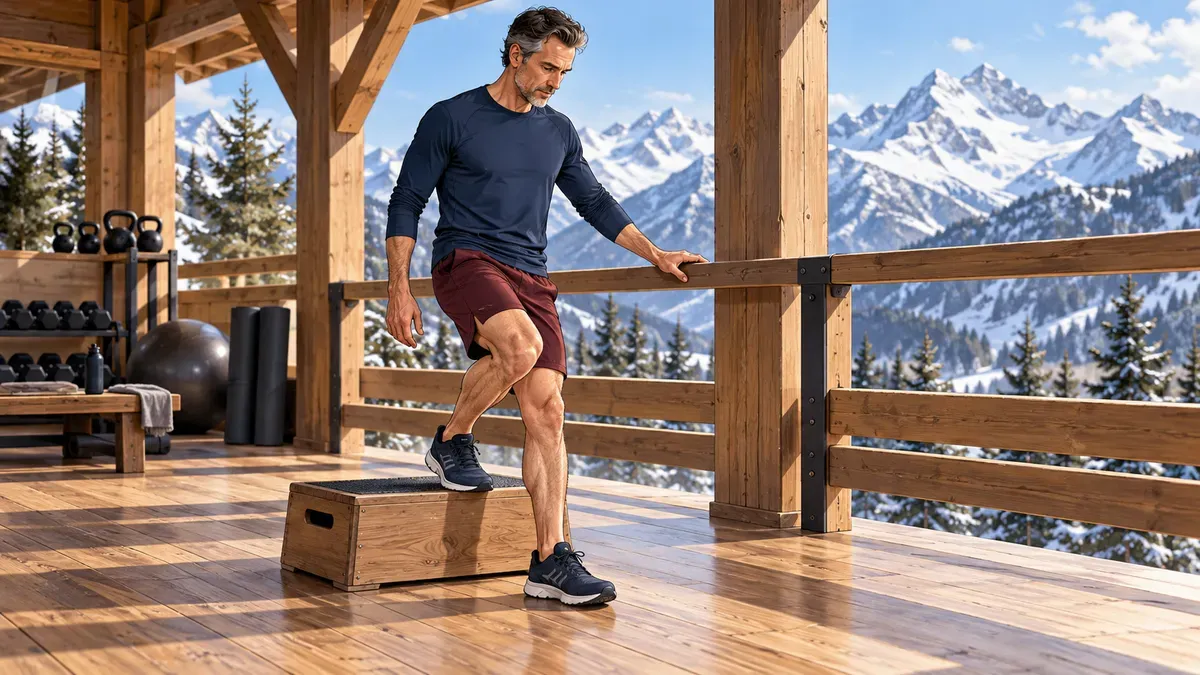
| Low step-down | 1 set of 5–8 per side | Lower slowly without dropping onto the other foot | Use a 2–4 in (5–10 cm) stable step and hand support |
| Calf raise | 1–2 sets of 8–12 | Rise and lower without bouncing | Use both feet and support; later shift more work to one side |
| Side plank from knees | 1–2 holds of 10–20 seconds per side | Keep the ribs, pelvis, and supporting shoulder organized | Shorter hold; later use a longer lever if comfortable |
| Supported single-leg reach | 1–2 rounds of 3–5 small reaches per side | Keep support within reach and return with control | Smaller reach and more support; later change reach direction |
The numbers organize a modest entry session. They are not minimum standards, and doing every row is unnecessary when it creates excessive fatigue. Add a comfortable upper-body push and pull to make strength work more complete. The 2026 ACSM resistance-training update recommends engaging all major muscle groups at least twice weekly and emphasizes consistency, individualization, and meaningful effort. It does not require training to failure or a particular type of equipment for the average healthy adult.
Give the lowering phase attention
A low step-down or controlled squat lowering trains force while the muscle lengthens. Start with a small dose: unfamiliar eccentric work can leave substantial soreness. Our eccentric training guide explains this loading pattern in more detail.
In a primary study, 24 healthy recreational skiers completed four hours of skiing. Eccentric hamstring torque on both sides and quadriceps torque on the left side decreased, and reductions remained at the 24-hour measurement (Koller et al., 2015). This small experiment supports attention to fatigue and braking capacity. It does not prove that a particular step-down dose prevents injury, or that four hours is a safe limit for everyone.
Use balance as control practice
Reach toward a small target, return to the starting position, and repeat without grabbing unexpectedly or twisting through the knee. Keep your eyes open and practice on the floor. An unstable board or a heavily loaded single-leg exercise is not necessary for a beginner.
If balance is the limiting factor, separate it from demanding strength work: support can let the legs train without the fear of falling. The balance training guide provides a general foundation, while an instructor develops the on-snow skill of managing moving skis.
Build a week you can recover from
A simple week might put strength on Monday and Thursday, comfortable aerobic activity on Tuesday and Saturday, and short supported balance practice on a few other days. Change the days to fit your life. Avoid turning every session into a hard workout merely because a trip is approaching.
For general adult health, WHO guidance recommends 150–300 minutes of moderate aerobic activity, or 75–150 minutes of vigorous activity, each week, plus muscle-strengthening work on at least two days. Those are health targets, not a skiing clearance threshold. Someone returning from inactivity should build toward them rather than force the entire target into week one.
Try a comfortable walk or bike ride that fits your current capacity, perhaps 10–20 minutes initially. At moderate intensity, the CDC talk test uses the ability to talk but not sing as a practical guide. If even easy movement produces unexpected breathlessness or other concerning symptoms, stop and obtain advice rather than increasing the dose.
| Preparation stage | Strength focus | Aerobic focus | Progression decision |
|---|---|---|---|
| Establish a baseline | Learn supported variations; use a small number of sets | Repeat comfortable short bouts | Repeat until movement and next-day function remain comfortable |
| Build consistency | Maintain two nonconsecutive sessions when tolerated | Add a little time to selected sessions | Change one variable; check the response before the next increase |
| Add capacity | Increase repetitions, then modest load when appropriate | Extend some sessions without making all of them harder | Keep technique stable and recovery adequate |
| Approach departure | Keep familiar work; reduce volume if fatigue accumulates | Maintain comfortable activity | Avoid novel exhausting sessions and arrive recovered |
This is an editorial planning framework, not a week-by-week protocol tested in skiers. Some people need several weeks in the first stage. Others already train consistently and can begin with more demanding variations under appropriate coaching.
Progress using the response, not the calendar
Finish a set while you can still perform several clean repetitions. If the starting dose feels easy over repeated sessions and next-day walking or stairs remain normal, increase one element: a few repetitions, a little range, or a modest load. Keep the other elements steady while you learn how that change feels.
Reduce the next session when soreness changes your gait, stairs become unexpectedly difficult, or fatigue makes the movement sloppy. Joint pain, swelling, catching, or a sense of giving way is different from mild muscle soreness and should not be trained through. Persistent or recurrent symptoms need assessment.
Small lateral steps can be added once ordinary strength and balance movements are comfortable. Later, an experienced exerciser may practice a few low lateral hops with quiet landings and a stable floor. Hops are optional; they should not become a compulsory test for adults with pain, poor balance, or low impact tolerance. Large jumps, heavy loads, and exhaustion do not belong in an improvised first session.
Your progress record can be simple: exercise variation, dose, how it felt, and function the following day. The same movement at a comfortable effort with better control is useful progress even before the load rises.
Prepare the first snow day as carefully as the gym session
Begin on terrain that allows reliable speed control and use lessons when needed. Our alpine skiing disciplines guide explains why racing demands differ from recreational preparation; a public slope is not a place to imitate race intensity. For a later technical goal, the ski carving guide describes a separate on-snow progression.
Before the first run, use easy movement, comfortable ankle and hip motion, a few shallow squats, and light side steps. Increase the effort gradually without tiring the legs. The 2025 FIS warm-up consensus supports structured physical and mental preparation in competitive snow sports, while acknowledging limited direct evidence for several outcomes. A recreational warm-up can borrow that organization without promising that it prevents every injury.
After a long cold wait, move gently again before restarting. Take breaks while you still have reliable control; repeated loss of balance, delayed reactions, or difficulty completing an ordinary turn are reasons to stop. A watch reading or a gym achievement cannot overrule these observations.
For a first ski trip, our age and readiness guide explains how to assess children’s and adults’ starting needs before choosing lessons or terrain.
Put training and recovery in a longer view
After the exercise plan, lessons, and safety decisions are in place, SuperAge can help organize the wider activity and recovery picture. Sleep, activity, resting heart rate, and heart-rate variability trends from Apple Health may help you notice how a new training block compares with your usual baseline.
Use those trends alongside symptoms and movement quality. They cannot diagnose knee stability, measure ski technique, clear you after injury, or decide whether a slope is safe. A biological-age estimate also cannot certify readiness for a ski trip.
Keeping this routine after winter supports a broader habit of strength, aerobic activity, and balance. Our exercise and longevity guide connects those habits with year-round fitness rather than a short seasonal deadline.
Common preparation mistakes to avoid
- Doing a last-minute leg challenge: unfamiliar volume may leave you less comfortable for travel and the first lesson.
- Training only a deep static crouch: use several movement patterns rather than treating thigh burning as complete preparation.
- Combining every progression at once: adding load, jump volume, and hard cardio together makes the response difficult to interpret.
- Using soreness as proof of effectiveness: discomfort is not a readiness score or a necessary training goal.
- Expecting stretching to erase fatigue: comfortable mobility can be useful, but it does not replace gradual loading, rest, or skill instruction.
- Treating fitness as injury insurance: equipment checks, instruction, slope decisions, and stopping when tired still matter.
The AAOS winter-sports safety guidance recommends conditioning, warming up, checking equipment, using appropriate protective gear, taking lessons, and avoiding participation when exhausted or in pain. Seek urgent care for chest pain, fainting, severe unexpected breathlessness, or a significant injury; do not attempt to solve those problems by adjusting an exercise table.
Frequently asked questions
How early should I start ski fitness exercises?
Start as early as practical so training can become consistent. Six to eight weeks is a useful planning window for gradual preparation, not a proven minimum or a guarantee. Your starting capacity and recovery may require more time.
Are squats enough to prepare for skiing?
Squats can help develop leg strength, but a useful routine also includes a hinge, unilateral work, controlled lowering, trunk support, balance, and aerobic activity. On-snow instruction develops the separate skill of managing skis and terrain.
Can I prepare at home without equipment?
Yes. A sturdy chair, stable low step, and nearby support allow several starting variations. Bodyweight may become insufficient for some strength goals later, but you do not need specialized ski-training equipment to begin.
Should I do wall sits until my legs fail?
No. A comfortable short hold may fit an individual routine, but failure is unnecessary for general preparation. Repeated thigh burning does not demonstrate safe ski technique or complete fitness; use controlled movements and recoverable doses.
Is running required for ski conditioning?
No. Walking, cycling, swimming, or another tolerable aerobic activity can build general conditioning. Choose something you can repeat and progress. None reproduces every demand of downhill skiing or replaces balance and strength work.
What if my ski trip is only one week away?
Use familiar light activity, protect sleep, and avoid novel hard leg sessions. Arrange lessons, equipment checks, and conservative first-day terrain. A week cannot compress months of training, and arriving sore is not a useful shortcut.
Should adults over 50 use a different routine?
Adapt the routine to current capacity, joint symptoms, balance, and training history rather than age alone. More support, smaller ranges, fewer sets, and longer recovery may help. Medical conditions or recent injuries need individualized guidance.
Do these exercises prevent knee injuries?
No routine can guarantee that. Strength and control are sensible preparation goals, but this specific program has not been tested as an injury-prevention intervention. Falls, technique, snow, equipment, and decisions also influence risk.
Key takeaways
- Begin with supported, controlled movement and a dose you can recover from.
- Combine leg strength, lowering control, balance, trunk work, and aerobic activity.
- Increase one variable at a time and check next-day function.
- Avoid exhausting unfamiliar sessions shortly before departure.
- Treat lessons, equipment checks, appropriate terrain, and fatigue decisions as separate essentials.
Keep your preparation consistent
Download SuperAge to keep activity and recovery trends in view while you build a sustainable training routine. Let symptoms, qualified instruction, and on-snow control guide the skiing decisions.
References
- American College of Sports Medicine. 2026 resistance-training guidelines update. 2026.
- World Health Organization. WHO guidelines on physical activity and sedentary behaviour. 2020; current guidance checked October 2026.
- Koller A, Fuchs B, Leichtfried V, Schobersberger W. Decrease in eccentric quadriceps and hamstring strength in recreational alpine skiers after prolonged skiing. BMJ Open Sport & Exercise Medicine. 2015.
- Spörri J, et al. FIS consensus statement on training and testing in competitive alpine and freestyle skiers and snowboarders. BMJ Open Sport & Exercise Medicine. 2025.
- Spörri J, et al. FIS consensus statement on warm-up and cool-down in competitive alpine and freestyle skiers and snowboarders. BMJ Open Sport & Exercise Medicine. 2025.
- Centers for Disease Control and Prevention. How to measure physical activity intensity. Current page checked October 2026.
- American Academy of Orthopaedic Surgeons. Winter sports injury prevention. Current page checked October 2026.
Related Articles
Skateboard tricks for beginners: skills, safety, and progression
Learn skateboard tricks for beginners with a five-skill progression, safety setup, practice schedule, common fixes, and readiness checks for the ollie.