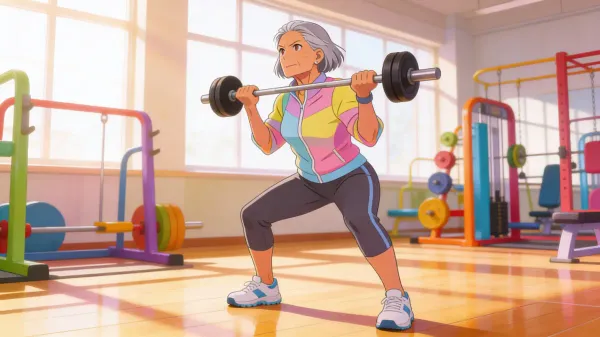
Eccentric training and aging: why lowering weight matters after 40
Eccentric training emphasizes lowering under control. Learn how it supports strength, tendons, sarcopenia resistance and safe progress after 40.
Every rep has two halves. The lift gets the attention, but the lowering phase matters because eccentric contractions let muscle produce high force while lengthening under load.
That makes eccentric training useful after 40, especially for strength, tendon loading, stair descent, balance recovery and sarcopenia resistance. The evidence is strongest when eccentric work is progressed gradually and compared with no training or standard resistance training in older adults.
The nuance: eccentric training is not magic and it can create more delayed soreness at first. The goal is controlled exposure, not chasing maximal negatives. Used well, slow lowering gives aging muscles and tendons a strong stimulus with a manageable cardiovascular cost.
What you’ll learn:
- Why eccentric strength declines slower than other forms of strength with age
- How eccentric training protects tendons and prevents the injuries that sideline older adults
- A practical eccentric protocol for adults over 40
Quick answer
Eccentric training means emphasizing the lowering or braking phase of a movement: lowering a dumbbell, descending stairs, stepping down or controlling the return of a squat.
For adults over 40, it can be useful because eccentric strength is important for tendon resilience, deceleration, stair descent and fall recovery. Reviews in older adults suggest eccentric-biased training can improve strength and function, but results vary by protocol, supervision and baseline fitness.
Start conservatively. Slow lowering increases mechanical tension and can cause more DOMS in the first weeks, so progress tempo, volume and load one step at a time.
Key facts
- Eccentric training -> lowering phase: muscles produce force while lengthening, such as during controlled descent.
- Aging -> function: eccentric control supports stairs, sitting down, slowing a fall and changing direction.
- Strength -> evidence: meta-analyses support eccentric-biased training for strength and function in older adults, but exact gains vary.
- Tendon -> loading: progressive eccentric calf work is a classic Achilles tendinopathy protocol, not a universal cure.
- Recovery -> caution: eccentric work often creates more early soreness, so start with low volume and build gradually.
- Safety -> context: joint pain, tendon tears, uncontrolled cardiovascular disease or neurological symptoms warrant professional guidance.
What is eccentric training?
Every muscle action falls into three categories:
Quick definition: Eccentric training emphasizes the lengthening phase of muscle contraction — lowering a weight, descending stairs, or decelerating your body — where muscles produce force while being stretched.
| Phase | What happens | Example |
|---|---|---|
| Concentric | Muscle shortens under load | Lifting a dumbbell up |
| Eccentric | Muscle lengthens under load | Lowering a dumbbell down |
| Isometric | Muscle produces force without changing length | Holding a plank |
Eccentric contractions can generate 20–60% more force than concentric contractions with the same muscle. This is why you can always lower more weight than you can lift — and why the lowering phase is where the strongest growth stimulus occurs.
Why eccentric strength matters more after 40
Eccentric strength is preserved with age
One of the most important findings in aging research is that eccentric force declines 2–3 times slower than concentric force with age. While older adults may lose 30–50% of their concentric strength by age 70, their eccentric strength may decline only 10–25%.
This has profound functional implications. Daily activities that require eccentric control — walking downstairs, sitting down into a chair, catching yourself from a stumble — are the movements most associated with fall prevention and functional independence.
The same braking function matters in sport. Our alpine skiing disciplines guide shows how eccentric leg demand changes as turns open and speed rises from slalom to downhill.
If you are learning how that capacity is expressed on snow, the ski carving technique guide connects outside-ski support, turn shape, and safe drill progression.
The sarcopenia connection
Sarcopenia — age-related muscle loss — is one of the strongest predictors of disability and mortality after 60. Eccentric training is uniquely effective at combating it:
- 12 weeks of eccentric training increases muscle thickness by 9–18% in older adults
- Eccentric protocols produce greater type II (fast-twitch) fiber hypertrophy than concentric — critical because type II fibers decline fastest with age
- Even once-weekly eccentric training produces significant strength gains in previously untrained older adults
Metabolic efficiency
Eccentric exercise requires less oxygen consumption and lower heart rate compared to concentric exercise at equivalent force output. This means older adults with cardiovascular limitations can achieve significant muscle loading without the cardiovascular strain that makes traditional lifting challenging.
Tendon health: the hidden benefit
Tendons — the connective tissue connecting muscle to bone — are among the structures most vulnerable to aging. They lose elasticity, accumulate micro-damage, and heal more slowly. Tendon injuries are a leading cause of exercise cessation in adults over 40.
Why eccentric training strengthens tendons
Eccentric loading produces unique mechanical stress patterns that stimulate tendon adaptation:
- Increased collagen synthesis: Eccentric loading triggers collagen production and cross-linking, improving tendon tensile strength
- Restored tendon stiffness: Age-related loss of tendon stiffness is partially reversible with eccentric protocols
- Improved elastic energy storage: Stiffer tendons store and release elastic energy more efficiently, improving walking speed and stair climbing power
The rehabilitation gold standard
Eccentric exercise is already the established treatment for tendinopathy (Achilles, patellar, lateral epicondyle). The Alfredson protocol — heavy slow eccentric calf raises — has been the go-to rehabilitation method for Achilles tendinopathy for over two decades. The same mechanisms that heal injured tendons also prevent healthy tendons from deteriorating with age.
6 eccentric exercises for adults over 40
1. Eccentric squats (tempo: 4 seconds down)
Why it works: Strengthens quadriceps, gluteals, and patellar tendons while improving sit-to-stand capacity.
How to do it:
- Stand with feet shoulder-width apart
- Lower yourself over 4 full seconds to parallel or below
- Pause 1 second at the bottom
- Stand up at normal speed (2 seconds)
- 3 sets of 8–10 reps, 2–3 times per week
2. Eccentric Romanian deadlifts
Why it works: Targets hamstrings and lower back — the posterior chain most affected by sitting-dominant lifestyles.
How to do it:
- Hold dumbbells at hip level
- Hinge at hips, lowering weights over 4 seconds
- Feel a deep hamstring stretch at bottom position
- Return to standing at normal speed
- 3 sets of 8 reps
3. Eccentric calf raises (Alfredson protocol)
Why it works: Strengthens the Achilles tendon and improves ankle stability — critical for balance and fall prevention.
How to do it:
- Stand on the edge of a step, heels hanging off
- Rise onto toes (concentric)
- Lower heels below step level over 4–5 seconds (eccentric)
- 3 sets of 12 reps, daily
4. Eccentric push-ups
Why it works: Builds upper body pressing strength with lower shoulder injury risk.
How to do it:
- Start in push-up position (from knees if needed)
- Lower chest to floor over 5 seconds
- Push up at normal speed (or reset from knees)
- 3 sets of 6–8 reps
5. Eccentric step-downs
Why it works: Directly trains the stair descent movement pattern — one of the most functionally important movements for independent living.
How to do it:
- Stand on a 6–8 inch (15–20 cm) step on one leg
- Lower the opposite foot to the ground over 4 seconds
- Tap the ground lightly, then push back up
- 3 sets of 8 per leg
6. Eccentric Nordic hamstring curls (modified)
Why it works: The single most effective exercise for hamstring injury prevention — particularly important for runners and anyone starting exercise after 40.
How to do it:
- Kneel with ankles secured (partner or furniture)
- Lean forward, controlling the descent with hamstrings (3–5 seconds)
- Catch yourself with hands when you can no longer control the fall
- Push back to start position with hands
- 3 sets of 3–5 reps (build gradually)
The eccentric training protocol
Weekly schedule
| Day | Training | Eccentric focus |
|---|---|---|
| Monday | Lower body eccentric emphasis | Eccentric squats, step-downs, calf raises |
| Tuesday | Zone 2 cardio or rest | — |
| Wednesday | Upper body eccentric emphasis | Eccentric push-ups, rows, pull-ups |
| Thursday | Zone 2 cardio or rest | — |
| Friday | Full body strength (standard tempo) | Normal training |
| Weekend | Active recovery | Walking, mobility |
Progression principles
- Start conservative: Use lighter weight with slow eccentrics. The muscle damage is greater than you expect.
- Increase tempo before load: Go from 3-second to 5-second eccentrics before adding weight
- Expect soreness: Eccentric training produces more delayed-onset muscle soreness (DOMS), especially initially. This decreases significantly after 2–3 weeks (the repeated bout effect)
- Increase frequency gradually: Start with 1–2 eccentric sessions per week, progressing to 3 over 4–6 weeks
- Monitor recovery: Use HRV and training readiness to ensure adequate recovery between sessions
Eccentric training and biological aging
Eccentric exercise addresses several mechanisms of aging simultaneously:
- Sarcopenia: Directly combats muscle mass and strength loss through superior hypertrophy stimulus
- Tendon degeneration: Restores collagen integrity and elastic properties
- Fall prevention: Improves balance, walking steadiness, and eccentric control — the primary mechanism of fall recovery
- Functional capacity: Improves grip strength, chair stand performance, stair performance, and walking step length
- Metabolic efficiency: Achieves significant training load with lower cardiovascular demand
The net effect: better functional capacity with less physiological cost — exactly what aging bodies need.
How SuperAge helps you train eccentrically
SuperAge tracks the functional outcomes that eccentric training improves, helping you see whether your training is translating to real-world performance.
Movement quality monitoring
SuperAge monitors stair descent speed, walking steadiness, and double support time — metrics that directly reflect eccentric control and improve with targeted eccentric training.
Recovery tracking
Since eccentric training creates more muscle damage than concentric, monitoring recovery is essential. SuperAge’s training readiness score and HRV trends help you time your next eccentric session optimally.
Your biological age, tracked
As eccentric training improves your strength, balance, and functional capacity, you’ll see these changes reflected in your biological age — the comprehensive metric that captures how well your body is aging.
Frequently asked questions
Is eccentric training safe for beginners over 40?
Yes, with proper progression. Start with bodyweight exercises, use 3-second lowering phases, and begin with 2 sessions per week. Expect more soreness than traditional training for the first 2–3 weeks. Consult a healthcare provider if you have joint or tendon injuries.
How much DOMS should I expect?
Significant soreness is normal in the first 1–2 weeks, particularly 24–48 hours after training. This is the “repeated bout effect” — your muscles adapt quickly, and soreness decreases dramatically by week 3–4. Don’t increase volume until initial soreness subsides.
Can eccentric training replace traditional strength training?
It should complement, not replace, conventional training. Eccentric emphasis adds a powerful stimulus, but you still need concentric and isometric work for comprehensive strength development. A good split: 2 eccentric-emphasis sessions + 1 standard strength session per week.
How does eccentric training help with running injuries?
Eccentric exercises strengthen the tendons (Achilles, patellar, hamstring) that are most vulnerable in runners. The Nordic hamstring curl reduces hamstring injury risk by up to 65%. Eccentric calf raises are the gold standard for Achilles tendinopathy prevention and treatment.
Key takeaways
- Eccentric training emphasizes the lowering phase: it trains muscles while they lengthen under load.
- It is especially relevant after 40: stairs, sitting, deceleration and fall recovery all depend on eccentric control.
- Evidence is supportive, not magical: reviews show benefits for older adults, but gains depend on dose, progression and supervision.
- Tendons need gradual loading: eccentric protocols can help some tendinopathies, but pain and tears need clinical evaluation.
- Progress slowly: start with bodyweight or light loads, 3-5 second lowers and enough recovery between sessions.
Slow down to get stronger
The secret to training longevity isn’t lifting heavier — it’s lowering slower. Eccentric training builds the strength, tendon resilience, and functional capacity that keep you moving confidently for decades.
Ready to train smarter? Download SuperAge and track how eccentric training improves your balance, walking steadiness, and biological age over time.
References
- Stöckel, T. et al. (2025). The effects of eccentric versus traditional resistance training in older adults: systematic review and multilevel meta-analysis. Sports Medicine.
- Katsura, Y. et al. (2022). The Effect of Eccentric vs. Traditional Resistance Exercise on Muscle Strength, Body Composition, and Functional Performance in Older Adults. Frontiers in Physiology.
- Roig, M. et al. (2009). The effects of eccentric versus concentric resistance training on muscle strength and mass in healthy adults. British Journal of Sports Medicine.
- Gault, M.L. and Willems, M.E.T. (2013). Aging, functional capacity and eccentric exercise training. Aging and Disease.
- LaStayo, P.C. et al. (2003). Eccentric muscle contractions: their contribution to injury, prevention, rehabilitation, and sport. Journal of Orthopaedic & Sports Physical Therapy.
- Alfredson, H. et al. (1998). Heavy-load eccentric calf muscle training for chronic Achilles tendinosis. American Journal of Sports Medicine.
Last updated: 2026-06-07. This article is regularly reviewed for accuracy.
Related Articles

30-second chair stand test: safe setup, scores, and longevity
Learn the 30-second chair stand test setup, non-slip safety tips, age norms, and what sit-to-stand scores reveal about strength, fall risk, and longevity.