Frailty index: How to measure and prevent the silent progression of aging
Frailty predicts falls, hospitalization, and loss of independence better than age alone. Learn screening tools, risk factors, and prevention steps.
Frailty is not the same as aging. A 75-year-old marathon runner and a 65-year-old who can barely climb stairs may sit on opposite ends of the frailty spectrum — and it’s the frailty score, not the birth date, that predicts who ends up in the hospital first.
Frailty is a clinical syndrome characterized by decreased physiological reserve across multiple organ systems. It can be the difference between recovering from a fall in a week and spending months in rehabilitation, or between tolerating surgery and struggling to regain independence afterward.
The good news: frailty is measurable, and in early or pre-frail stages it can often improve with the right training, nutrition, medical review, and fall-prevention work. Understanding where you fall on the frailty spectrum is a useful health assessment, not a diagnosis to make in isolation.
Quick answer
Frailty is reduced physiological reserve: the body has less capacity to recover from infection, surgery, falls, medication changes, or inactivity. The two most practical screens are the Fried phenotype, which counts weight loss, exhaustion, low activity, slow gait, and weak grip, and the Clinical Frailty Scale, which grades function from very fit to terminally ill. A low score is not inevitable aging. Start with strength training, adequate protein, balance practice, walking speed, medication review, and treatment of nutrition, mood, vision, hearing, and chronic disease issues.
Key facts
- Frailty - definition - vulnerability from low reserve across multiple body systems.
- Fried phenotype - screen - weight loss, exhaustion, low activity, slow gait, and weak grip.
- Clinical Frailty Scale - use case - fast clinical grading of fitness, function, and dependence.
- Prevention - strongest levers - resistance training, protein adequacy, balance work, and medical review.
- SuperAge - tracking role - monitors gait, steadiness, HRV, recovery, and biological-age context.
What you’ll learn:
- What frailty is and how it differs from normal aging
- How to assess your frailty status using validated clinical scales
- The five pillars of frailty and what drives each one
- Evidence-based interventions that can reverse early frailty
What is frailty?
Frailty is a state of increased vulnerability to stressors — infections, surgeries, falls, medication changes — that results from cumulative decline across multiple body systems. A frail person lacks the physiological reserve to bounce back from events that a robust person handles easily.
Quick definition: Frailty is a clinical syndrome where age-related declines in strength, endurance, balance, and physiological reserve accumulate to the point where even minor stressors can trigger disproportionate health consequences.
Frailty vs. normal aging vs. disability
| Concept | Definition | Key difference |
|---|---|---|
| Normal aging | Gradual decline in organ function with intact reserve | Can still handle stress |
| Frailty | Accelerated decline with depleted reserve across systems | Vulnerable to minor stressors |
| Disability | Inability to perform specific tasks | May or may not be frail |
You can be disabled without being frail (e.g., a wheelchair athlete), and you can be frail without being disabled (e.g., someone who manages daily tasks but would collapse under any additional stress). Frailty is about reserve capacity, not current function.
The frailty cascade
Frailty rarely appears overnight. It follows a predictable progression:
- Pre-frailty — 1–2 criteria present (often unnoticed)
- Frailty — 3+ criteria, significantly elevated risk
- Severe frailty — dependence on others for daily activities
- Major decline — a single event (fall, infection, surgery) can trigger lasting loss of independence
The critical window for intervention is pre-frailty. Once severe frailty develops, reversal becomes much harder — though slowing progression is still possible.
How to assess your frailty: Two major approaches
The Fried Frailty Phenotype (Physical Frailty)
The most cited frailty model, developed by Linda Fried in 2001. You meet the criteria if you have 3 or more of these five markers:
| Criterion | How it’s measured | Threshold |
|---|---|---|
| Unintentional weight loss | > 10 lbs (4.5 kg) lost in the past year | Yes/No |
| Exhaustion | Self-reported — “everything I do is an effort” on most days | Yes/No |
| Low physical activity | Below the lowest 20th percentile for age/sex | Yes/No |
| Slow walking speed | Gait speed below 0.8 m/s (or takes >7 sec to walk 15 ft / 4.6 m) | Yes/No |
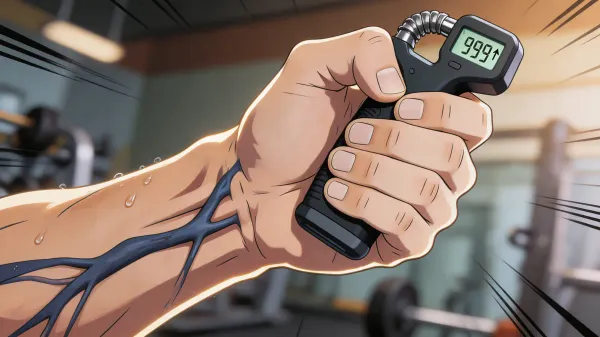
| Weak grip strength | Grip strength below age/sex-adjusted norms | Yes/No |
Scoring:
- 0 criteria = Robust
- 1–2 criteria = Pre-frail (35–45% of adults over 65)
- 3+ criteria = Frail (10–15% of adults over 65)
The Clinical Frailty Scale (CFS)
Developed by Kenneth Rockwood, the CFS is a 9-point observational scale widely used in hospitals:
| Score | Category | Description |
|---|---|---|
| 1 | Very fit | Robust, active, exercises regularly, among the fittest for their age |
| 2 | Fit | No active disease, exercises occasionally or seasonally |
| 3 | Managing well | Well-controlled medical problems, not regularly active |
| 4 | Very mild frailty | Slowed down, not dependent on others for daily activities |
| 5 | Mild frailty | Needs help with complex tasks (finances, housework, medications) |
| 6 | Moderate frailty | Needs help with all outside activities and some housekeeping |
| 7 | Severe frailty | Completely dependent for personal care |
| 8 | Very severe frailty | Approaching end of life |
| 9 | Terminally ill | Life expectancy < 6 months |
Clinical cut-off: A score of 5 or higher generally indicates at least mild frailty and should prompt clinical review, especially before surgery, hospitalization, or major medication changes.
Which assessment should you use?
- For self-assessment: The Fried criteria are more practical — you can evaluate each marker yourself
- For clinical settings: The CFS is faster and more commonly used in hospitals
- For research: The Frailty Index (a cumulative deficit model counting 30+ health deficits) provides the finest resolution
The five pillars of frailty
Frailty isn’t caused by one thing — it emerges from the convergence of multiple declining systems. Understanding each pillar reveals where to intervene.
1. Sarcopenia — muscle loss
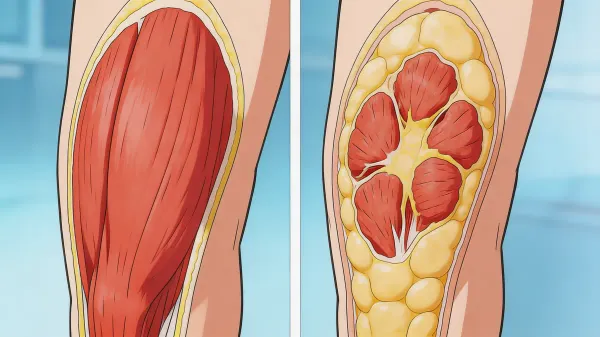
Sarcopenia is the single largest driver of frailty. After age 30, you lose approximately 3–8% of muscle mass per decade, accelerating after 60. Less muscle means:
- Slower walking speed (frailty criterion)
- Weaker grip strength (frailty criterion)
- Higher fall risk
- Reduced metabolic reserve
2. Chronic inflammation
Elevated inflammatory markers — CRP, IL-6, TNF-α — are often found in frail individuals. This “inflammaging” can create a catabolic environment that breaks down muscle, impairs immune function, and disrupts hormonal balance. Senescent cells may contribute to this inflammatory state, which is one reason fisetin and other senolytic candidates are being studied in frailty research. They are not established clinical treatments for frailty.
3. Hormonal decline
Testosterone, estrogen, growth hormone, DHEA-S, and IGF-1 all decline with age. The combined hormonal shift reduces anabolic capacity, impairs recovery, and accelerates the sarcopenia-inflammation cycle.
4. Nutritional deficiency
Frail individuals frequently exhibit:
- Inadequate protein intake (the #1 nutritional contributor)
- Vitamin D deficiency (linked to muscle weakness and falls)
- Low B12 (affects energy and neurological function)
- Poor micronutrient status overall
5. Cognitive and psychological factors
Depression, social isolation, and cognitive decline both contribute to and result from frailty, creating a vicious cycle. Fear of falling leads to activity avoidance, which accelerates muscle loss, which increases fall risk.
Frailty and biological age
Frailty is one visible expression of accelerated biological aging. Two people who are chronologically 70 can have very different biological-age profiles, and frailty scores often capture the functional side of that gap.
Research has consistently shown that:
- Frailty Index scores correlate strongly with epigenetic age acceleration
- Blood biomarkers used in biological age calculators (albumin, creatinine, CRP, white blood cells) overlap heavily with frailty predictors
- Functional tests like the TUG test, sitting-rising test, and chair stand test capture the same reserve capacity that frailty scales measure
The key insight: frailty makes biological aging functional and observable. Improving frailty markers does not prove that every aging clock has slowed, but it does show that reserve capacity is improving.
How to prevent and improve frailty
1. Resistance training — the non-negotiable
If frailty has a central training lever, it is strength training. Resistance exercise targets sarcopenia, one of the biggest drivers.
Evidence: Cochrane evidence supports progressive resistance training for improving strength and physical function in older adults. In frail or pre-frail adults, supervised resistance training is one of the best-supported interventions, with functional changes often seen within 8-12 weeks.
Protocol:
- 2–3 sessions per week, targeting all major muscle groups
- Progressive overload: increase weight or reps over time
- Include eccentric movements — they build strength faster in older adults
- Prioritize functional movements: squats, deadlifts, rows, presses
2. Protein optimization
Frail and pre-frail adults need more protein than the general RDA suggests.
Target: Many frail or pre-frail adults benefit from roughly 1.2-1.6 g/kg/day, sometimes higher during rehabilitation, distributed across 3-4 meals. People with advanced kidney disease or complex medical conditions need clinician-guided targets.
Practical tips:
- Include a protein source at every meal
- Aim for 25–40 g of protein per meal to trigger muscle protein synthesis
- Consider protein with leucine-rich sources (whey, eggs, chicken, fish)
3. Balance and mobility training
Fall prevention is frailty prevention. Include:
- Balance exercises — single-leg stance, tandem walking, tai chi
- Functional mobility drills — sit-to-stand, stair climbing
- Flexibility and mobility work — daily stretching, yoga
4. Address the inflammation-nutrition axis
- Anti-inflammatory diet — Mediterranean or MIND pattern
- Adequate omega-3 fatty acids
- Minimize ultra-processed foods
- Correct micronutrient deficiencies (vitamin D, B12, zinc, magnesium)
5. Maintain social connection and purpose
Social isolation is as strong a frailty predictor as sarcopenia. Maintaining social networks, engaging in purposeful activity, and treating depression are essential — not optional — components of frailty prevention.
How SuperAge helps you monitor frailty risk
Frailty develops gradually — often invisible until a crisis reveals it. SuperAge helps you detect the early warning signs by tracking the metrics that correlate with frailty risk:
Gait and mobility metrics
SuperAge monitors walking speed, walking steadiness, double support time, and step length — all validated frailty indicators.
Cardiovascular fitness
Your resting heart rate, HRV, and heart rate recovery trends reflect the cardiovascular reserve that frailty depletes.
Biological age tracking
SuperAge’s biological age algorithm integrates several health dimensions that frailty affects. A rising biological-age trend can be an early signal to review activity, recovery, labs, and function.
Frequently asked questions
At what age does frailty typically begin?
Pre-frailty can begin before old age, though it is most commonly identified after 65. Prevalence varies by population and definition. Frailty is a biological and functional state, not a fixed age threshold: sedentary or medically complex adults can show early signs earlier, while active adults may avoid it much longer.
Can frailty be reversed?
Often, especially in the pre-frailty stage. Targeted interventions such as resistance training, protein adequacy, balance training, medication review, and treatment of deficiency or depression can move some people from frail to pre-frail, or pre-frail to robust, over months. Once severe frailty develops, full reversal is less common, but slowing progression and preserving function still matter.
How is frailty different from sarcopenia?
Sarcopenia (age-related muscle loss) is one component of frailty, but frailty is broader. Frailty includes sarcopenia plus chronic inflammation, hormonal changes, nutritional deficits, and cognitive/psychological factors. You can have sarcopenia without being frail, but almost all frail individuals have sarcopenia.
Should I get a formal frailty assessment?
If you’re over 65, a clinical frailty assessment should be part of your regular healthcare. If you’re 40–65, self-assessment using the Fried criteria (walking speed, grip strength, activity level, weight changes, energy) gives you a useful baseline. Any score above 0 is worth investigating further.
Key takeaways
- Frailty is not inevitable aging — it is low reserve across multiple systems, and it is measurable.
- Pre-frailty is the key window — early gait, grip, activity, weight, and exhaustion changes deserve attention.
- The five pillars are sarcopenia, chronic inflammation, hormonal change, nutritional deficiency, and cognitive/social decline.
- Resistance training is central — especially when combined with protein, balance work, and medical review.
- Early frailty can often improve over months with targeted training, nutrition, and lifestyle changes.
Don’t wait for a crisis to reveal your frailty status
Frailty is measurable, trackable, and in its early stages often modifiable. The sooner you know your status, the more options you have.
Ready to monitor the metrics that matter? Download SuperAge and start tracking gait speed, balance, cardiovascular fitness, and biological age from your Apple Watch.
References
- Fried, L. P., et al. (2001). “Frailty in older adults: evidence for a phenotype.” Journals of Gerontology. https://pubmed.ncbi.nlm.nih.gov/11253156/
- Rockwood, K., et al. (2005). “A global clinical measure of fitness and frailty in elderly people.” CMAJ. https://pmc.ncbi.nlm.nih.gov/articles/PMC1188185/
- Clegg, A., et al. (2013). “Frailty in elderly people.” The Lancet. https://pubmed.ncbi.nlm.nih.gov/23395245/
- Cochrane. (2022). “Progressive resistance strength training for improving physical function in older adults.” https://www.cochrane.org/evidence/CD002759_progressive-resistance-strength-training-improving-physical-function-older-adults
- Liu, C. K., & Fielding, R. A. (2011). “Exercise as an intervention for frailty.” Clinics in Geriatric Medicine. https://pmc.ncbi.nlm.nih.gov/articles/PMC3179711/
Last updated: 2026-06-08. This article is regularly reviewed to ensure accuracy.
Related Articles

Single leg balance test: The 10-second test that predicts mortality
Failing the single leg balance test is associated with 84% higher adjusted mortality risk. Learn age benchmarks, caveats, and 8 exercises to improve balance.