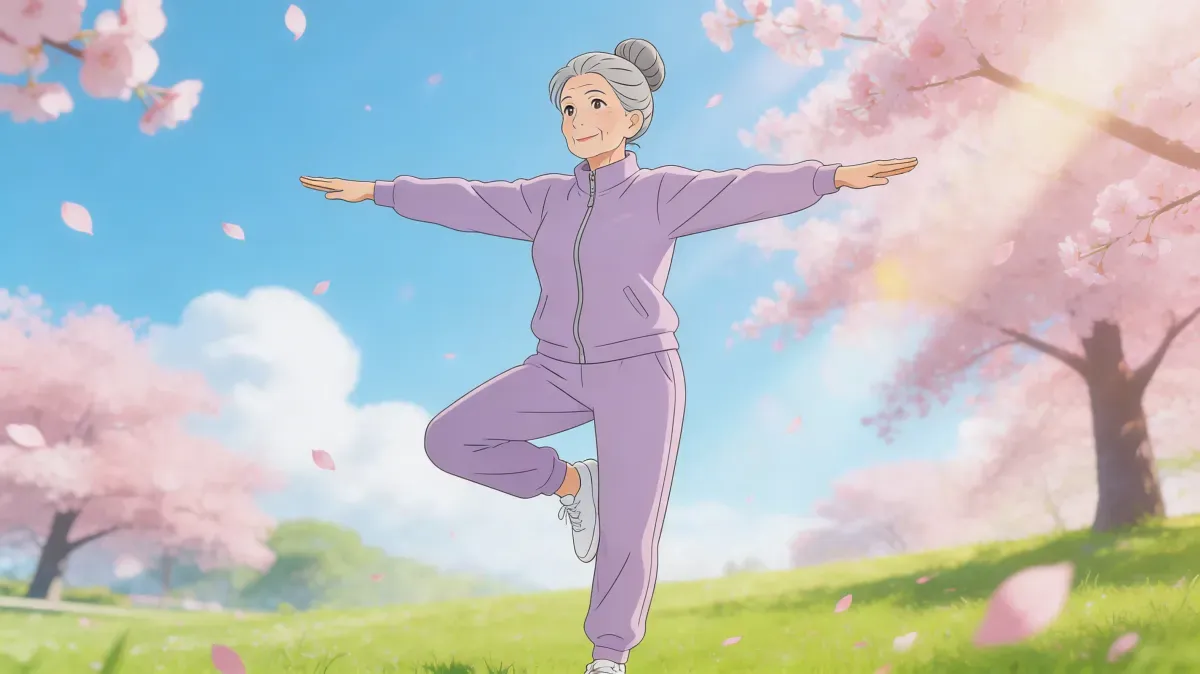
Single leg balance test: The 10-second test that predicts mortality
Failing the single leg balance test is associated with 84% higher adjusted mortality risk. Learn age benchmarks, caveats, and 8 exercises to improve balance.
What if standing on one leg for 10 seconds could tell you more about your longevity than most blood tests?
If balance testing makes you avoid movement, the next step is not panic but a safe plan for fear of falling after 60.
To see how balance interacts with chair stands, gait speed, ankle mobility, and floor transfers, use the mobility screen after 50 as a broader home assessment.
A landmark 2022 study published in the British Journal of Sports Medicine tracked 1,702 adults aged 51 to 75 for an average of 7 years. Those who couldn’t hold a single leg stance for 10 seconds had an 84% higher adjusted risk of dying from any cause within the following decade — even after accounting for age, sex, BMI, and existing health conditions. Among those who failed the test, 17.5% died during follow-up, compared to just 4.6% of those who passed.
Then in 2024, Mayo Clinic researchers reported that one-leg balance was the most age-sensitive measure among the gait, balance, grip strength, and knee strength tests they studied. A March 2026 PLOS ONE correction clarified the normalized decline rates: non-dominant single-leg stance fell by about 21% per decade, and dominant-leg stance by about 17% per decade. The practical takeaway did not change: balance is one of the clearest functional signals of neuromuscular aging.
In this article, you’ll learn exactly how to perform and score the test, what your results mean for your biological age, and 8 evidence-based exercises to rebuild the balance you’re losing.
What you’ll learn:
- How the 10-second single leg balance test predicts all-cause mortality
- Normative performance scores by age and sex
- Why balance deteriorates faster than strength or endurance
- 8 progressive exercises to improve your balance at any age
What is the single leg balance test?
The single leg balance test — also called the single leg stance (SLS) test or unipedal stance test — measures how long you can stand on one foot without losing your balance. It’s one of the simplest and most powerful assessments of neuromuscular health in clinical medicine.
Quick definition: The single leg balance test measures static postural control by timing how long you can stand unsupported on one foot. Inability to hold 10 seconds was linked to an 84% higher adjusted risk of all-cause mortality in one cohort of middle-aged and older adults.
How to perform the test correctly
The standard clinical protocol is straightforward:
- Stand barefoot on a firm, flat surface
- Place your hands on your hips
- Fix your gaze on a point at eye level approximately 6.5 ft (2 m) away
- Lift one foot off the ground and place it behind the standing leg’s ankle
- Start timing when the foot leaves the ground
- Stop timing when any of the following occurs:
- Your raised foot touches the ground
- Your hands leave your hips
- Your standing foot shifts position
- You reach 60 seconds (maximum score)
Perform three trials on each leg. Your best time on each side is your score. Test both your dominant and non-dominant leg — the difference between them matters.
Why this test matters for your health
Balance isn’t just about not falling. It’s an integrated readout of your entire neuromuscular system — the coordination between your brain, nerves, muscles, joints, inner ear, and visual system. When balance degrades, it signals decline across multiple body systems simultaneously.
That’s why the single leg balance test predicts mortality so powerfully: it doesn’t measure one isolated function. It captures how well your entire body communicates internally — a process that deteriorates with biological aging far earlier than most people realize.
The science: why balance predicts death
The relationship between balance and mortality isn’t coincidental. It reflects deep biological processes that accelerate with age.
How balance works in your body
Maintaining balance on one leg requires the seamless integration of three sensory systems:
1. The vestibular system (inner ear) detects head position and movement relative to gravity. Age-related loss of vestibular hair cells — approximately 3% per decade after age 30 — progressively degrades this input.
2. The somatosensory system (proprioception) uses pressure sensors in your feet, joint position sensors, and muscle spindles to map your body in space. Peripheral neuropathy, reduced joint flexibility, and declining nerve conduction velocity all impair this system with age.
3. The visual system provides spatial reference points. Age-related changes in visual acuity, depth perception, and contrast sensitivity reduce its contribution to balance — which is why closing your eyes makes balancing dramatically harder.
Your brain’s cerebellum and motor cortex must process all three inputs simultaneously, make split-second corrections, and send commands to dozens of muscles in precise sequences. This neural processing speed declines approximately 1-2% per year after age 50.
The mortality connection
The 2022 Brazilian study (Araujo et al.) wasn’t the first to link balance with survival, but it was the most definitive. Key findings:
- 17.5% mortality in the group that failed the 10-second test vs. 4.6% in those who passed
- After adjusting for age, sex, BMI, coronary artery disease, hypertension, diabetes, and dyslipidemia, the hazard ratio remained 1.84 — meaning failure nearly doubled death risk
- The association held across all subgroups regardless of pre-existing conditions
Why does balance predict death so accurately? Because poor balance is a compound signal of:
- Sarcopenia — loss of muscle mass and strength (especially in the lower body)
- Neurodegeneration — declining nerve conduction and cerebellar processing
- Cardiovascular dysfunction — impaired blood flow regulation during postural changes
- Metabolic disease — diabetes-related neuropathy and vestibular damage
- Chronic inflammation — systemic inflammatory processes that impair neural and muscular function
In other words, if your balance is failing, multiple body systems are failing simultaneously — and that’s exactly what kills.
Important caveat: the 2022 study was observational. It cannot prove that poor balance caused the deaths. The cohort also included stable-gait adults from one Brazilian clinical cohort, and the analysis did not have every possible confounder, such as recent falls, physical activity, smoking, diet, or medications that affect balance. Use the test as a screening and trend signal, not as a diagnosis or a standalone forecast.
Balance and longevity: what the research says
The Mayo Clinic/PLOS ONE study (2024, corrected in 2026) added a critical dimension. Researchers tested 40 healthy, independent adults over 50 on walking speed, single leg balance, grip strength (test yours at home), and knee strength. Single leg balance showed the steepest age-related decline of all four metric groups.
Specifically, the corrected PLOS ONE values show the normalized duration of one-leg stance declining by about 21% per decade on the non-dominant side and 17% per decade on the dominant side. That makes the exact stopwatch number personal to your starting point, but the direction is clear: one-leg balance tends to age faster than ordinary walking speed or maximal strength in healthy older adults.
This matters because it means balance is an early warning system. It can decline before walking speed changes and before most people notice anything wrong. By the time you struggle to stand on one leg for 10 seconds, meaningful neuromuscular aging may already be visible. Your iPhone’s walking steadiness score captures a related decline continuously — providing a passive daily window into your gait stability before it becomes a clinical concern. Another related signal worth tracking is walking asymmetry: if your steps are becoming less symmetrical over time, the walking asymmetry normal values chart gives you age-based benchmarks to interpret your Apple Health data. For the broader test battery around balance, strength, gait speed, and chair stands, use the functional fitness tests that predict longevity as your hub. If you want a structured program to rebuild this balance capacity, see our guide to balance training after 50 — it covers a progressive 4-week protocol with 8 evidence-based exercises.
Normative scores: where do you stand?
Your single leg balance time should be interpreted relative to your age. The following benchmarks are practical ranges compiled from published single-leg stance norms, clinical balance references, and the corrected Mayo Clinic/PLOS ONE aging study. They are not diagnostic cutoffs.
Eyes-open single leg stance (best of 3 trials)
| Age group | Good | Average | Below average | Concerning |
|---|---|---|---|---|
| 18-39 | 60 sec | 45+ sec | 30-44 sec | <30 sec |
| 40-49 | 45+ sec | 40-44 sec | 25-39 sec | <25 sec |
| 50-59 | 40+ sec | 30-39 sec | 20-29 sec | <20 sec |
| 60-69 | 30+ sec | 20-29 sec | 10-19 sec | <10 sec |
| 70-79 | 25+ sec | 15-24 sec | 5-14 sec | <5 sec |
| 80+ | 10+ sec | 5-9 sec | 2-4 sec | <2 sec |
Critical thresholds to know
- Less than 10 seconds (ages 51-75 in the BJSM cohort): Associated with 84% higher adjusted mortality risk
- Less than 6.5 seconds: Associated with elevated fall risk in longitudinal cohort studies
- Less than 5 seconds: A practical fall-risk flag in older adults and clinical balance references
- Unable to hold tandem stance for 10 seconds: The CDC STEADI four-stage balance screen treats this as increased fall risk; this is related to, but not identical with, the single-leg mortality test
- Greater than 5-second difference between dominant and non-dominant legs: May indicate unilateral neurological or musculoskeletal issues
Eyes-closed test: the advanced version
Once you can comfortably hold 60 seconds with eyes open, closing your eyes removes visual input and dramatically increases the challenge. This tests your vestibular and proprioceptive systems in isolation.
| Age group | Good | Average | Concerning |
|---|---|---|---|
| 20-49 | 30+ sec | 15-29 sec | <15 sec |
| 50-59 | 20+ sec | 10-19 sec | <10 sec |
| 60-69 | 10+ sec | 5-9 sec | <5 sec |
| 70+ | 5+ sec | 2-4 sec | <2 sec |
A significant gap between your eyes-open and eyes-closed performance suggests you’re relying too heavily on vision to compensate for declining vestibular and proprioceptive function — a pattern that increases fall risk in low-light conditions.
Why balance declines with age
Balance doesn’t deteriorate randomly. It follows predictable biological pathways, and understanding them is the key to reversing the decline.
1. Vestibular degeneration
You’re born with approximately 30,000 vestibular hair cells in each inner ear. By age 70, you may have lost 40% of them. These cells don’t regenerate. The result: progressively weaker gravitational orientation signals reaching your brain. For a deeper look at why the vestibular system ages faster than almost any other sensory structure — and what that means for longevity — see our guide on balance decline after 50 and vestibular aging.
2. Proprioceptive loss
The mechanoreceptors in your feet — Meissner’s corpuscles and Merkel cells — decline in density by approximately 30% between ages 20 and 80. Meanwhile, nerve conduction velocity in your legs drops by about 15% over the same period. Your brain receives less information about foot position, and receives it more slowly.
3. Muscle fiber loss
Type II (fast-twitch) muscle fibers — the ones responsible for rapid postural corrections — decline preferentially with age. This is the same process driving sarcopenia. You lose the fibers that make split-second balance adjustments possible, even before you notice general strength loss.
4. Cerebellar processing slowdown
The cerebellum — your brain’s balance command center — loses approximately 25% of its Purkinje cells between ages 50 and 80. These are the neurons that coordinate real-time motor adjustments. Fewer Purkinje cells means slower, less precise balance corrections.
5. Reduced ankle mobility
Ankle dorsiflexion range of motion decreases by approximately 30% between ages 30 and 70. Since your ankle is the primary joint for postural sway corrections (the “ankle strategy”), reduced mobility forces your body to use compensatory hip and stepping strategies — which are slower and less efficient.
8 exercises to improve your single leg balance
Balance is highly trainable at any age. Research shows that even adults over 80 can make significant improvements with consistent practice. A systematic review of single leg balance training protocols found meaningful gains in as little as 4 weeks.
The current fall-prevention evidence also supports acting on the signal. In 2024, the U.S. Preventive Services Task Force recommended exercise interventions for community-dwelling adults 65 and older who are at increased fall risk. The most common effective programs combined gait, balance, functional training, and strength work. That does not prove that training erases the mortality association from the BJSM study, but it does support using a poor balance result as a prompt to train, reassess, and seek clinical guidance when appropriate.
The key is progressive overload: systematically increasing the difficulty as your balance improves. Start at your current level and progress through these exercises in order.
1. Tandem stance (heel-to-toe stand)
Why it works: Narrows your base of support, forcing your vestibular and proprioceptive systems to work harder without the full challenge of a single leg stance.
How to do it:
- Stand with one foot directly in front of the other, heel touching toe
- Hold for 30-60 seconds
- Switch which foot is in front
- Progress: close your eyes once you can hold 60 seconds
Expected results: Noticeable improvement in stability within 1-2 weeks of daily practice.
2. Supported single leg stand
Why it works: Builds single leg balance with a safety net, allowing you to practice the exact movement pattern without fear of falling.
How to do it:
- Stand near a wall or sturdy chair
- Lift one foot off the ground
- Use fingertip contact for minimal support only when needed
- Hold for 30-60 seconds per leg
- Progress: reduce to one-finger contact, then no contact
Expected results: Most people progress to unsupported standing within 2-3 weeks.
3. Single leg stance with head turns
Why it works: Challenges your vestibular system by changing head position while maintaining balance — mimicking real-world conditions.
How to do it:
- Stand on one leg unsupported
- Slowly turn your head left and right while maintaining balance
- Then tilt your head up and down
- Perform 10 turns in each direction per leg
Expected results: Significant vestibular adaptation within 3-4 weeks.
4. Single leg stance on unstable surfaces
Why it works: Forces your proprioceptive system to work overtime, strengthening the neural pathways that detect and correct postural sway.
How to do it:
- Stand on a folded towel on one leg (beginner)
- Progress to a balance pad or foam cushion (intermediate)
- Progress to a BOSU ball (advanced)
- Hold for 30-60 seconds per leg
Expected results: Proprioceptive gains measurable within 4-6 weeks.
5. Single leg Romanian deadlift
Why it works: Combines balance with hip hinge movement, strengthening the posterior chain muscles (glutes, hamstrings) that are critical for postural stability.
How to do it:
- Stand on one leg with a slight knee bend
- Hinge at the hip, extending the free leg behind you
- Reach toward the ground with opposite hand (no weight initially)
- Return to standing
- Perform 8-12 repetitions per leg
Expected results: Improved dynamic balance and hip stability within 4-6 weeks.
6. Calf raises on one leg
Why it works: Strengthens the ankle stabilizers — the first line of defense in postural balance corrections. The ankle strategy is your body’s primary balance mechanism.
How to do it:
- Stand on one leg near a wall for safety
- Rise onto your toes, hold 2 seconds at the top
- Lower slowly (3-second descent)
- Perform 12-15 repetitions per leg
- Progress: do them on a step with heel hanging off the edge
Expected results: Noticeable ankle stability gains within 3-4 weeks.
For a detailed progression from two legs to supported single-leg work and added load, see the calf exercise guide.
7. Tai chi single leg postures
Why it works: Tai chi has one of the strongest evidence bases for balance improvement in older adults — comparable to what yoga and Pilates offer for core stability and proprioception. A 2024 systematic review and meta-analysis of 28 trials in 2,000 healthy older adults found that tai chi improved single-leg stance time by about 5 seconds on average and improved Timed Up and Go, functional reach, Berg Balance Scale, and gait speed. Programs performed more than twice weekly for sessions longer than 45 minutes showed larger effects.
How to do it:
- Learn the “Golden Rooster Stands on One Leg” posture
- Practice slow, controlled weight transfers between legs
- Hold each posture for 10-30 seconds
- Perform daily for at least 15 minutes
Expected results: Research shows measurable balance improvements after 8 weeks of regular practice.
8. Eyes-closed single leg stance
Why it works: The ultimate balance challenge. Removing visual input forces your vestibular and proprioceptive systems to function independently — building resilience for real-world situations like navigating in dim lighting.
How to do it:
- Stand near a wall (do not attempt without a safety backup)
- Stand on one leg with eyes open, establish stability
- Close your eyes and maintain balance
- Start with 5-second holds and build gradually
- Goal: 30 seconds per leg with eyes closed
Expected results: This is the slowest progression — expect 6-8 weeks for significant improvement.
If you are deciding whether static balance or a chair-walk-turn test belongs in your routine, use the single-leg balance vs timed up and go comparison.
How to track and measure your balance
Consistent testing is the only way to know if your training is working. Test yourself monthly using this protocol.
Testing protocol
| Parameter | Standard |
|---|---|
| Surface | Hard, flat floor (no carpet) |
| Footwear | Barefoot |
| Hand position | On hips |
| Eyes | Open, fixed gaze at eye level |
| Trials | 3 per leg |
| Score | Best of 3 trials |
| Equipment | Stopwatch or phone timer |
Key metrics to monitor
| Metric | What it tells you | Target |
|---|---|---|
| Best time (dominant leg) | Primary balance capacity | Age-appropriate “Good” range |
| Best time (non-dominant leg) | Asymmetry detection | Within 5 seconds of dominant |
| Left-right difference | Unilateral issues | <5 seconds difference |
| Eyes-closed time | Vestibular/proprioceptive health | >50% of eyes-open time |
| Month-over-month trend | Training effectiveness | Positive trend |
When to be concerned
Seek medical evaluation if you experience:
- Sudden decline in balance (days to weeks, not months)
- Persistent dizziness or vertigo alongside poor balance
- Significant asymmetry between legs (greater than 10 seconds)
- Balance worsening despite consistent training
- Falls or near-falls during daily activities
How SuperAge helps you track balance and functional fitness
Tracking balance test results with stopwatch notes and paper logs is tedious — and most people stop doing it within weeks. SuperAge integrates functional fitness tracking into a comprehensive biological age monitoring system.
Functional fitness monitoring
SuperAge tracks the physical metrics that matter most for longevity — including the sit-to-stand test and other functional tests that research shows are the strongest mortality predictors. Log your single leg balance time alongside other key metrics and watch your trends over time. For a comprehensive mobility snapshot that combines balance, gait, and chair-transfer ability into one timed assessment, the Timed Up and Go (TUG) test is the clinical benchmark used to screen fall risk alongside single-leg balance.
Your biological age, calculated
Single leg balance is one piece of the biological aging puzzle. SuperAge calculates your biological age using validated algorithms that incorporate multiple data streams from Apple Watch and HealthKit — including HRV, resting heart rate, VO2 max, and activity patterns. When your balance improves, you can see how it fits into the bigger picture of your overall biological age.
Personalized insights
SuperAge doesn’t just collect data — it connects the dots. See how your functional fitness correlates with your other health metrics, identify patterns, and get actionable guidance to reduce your biological age.
Frequently asked questions
How long should I be able to stand on one leg for my age?
Adults in their 30s and 40s should hold 45-60 seconds easily. In your 50s, 30-40 seconds is average. In your 60s, 20-30 seconds is typical. The most studied mortality threshold is 10 seconds in adults aged 51-75; below that, the BJSM cohort found significantly higher adjusted mortality risk.
Can you actually improve balance after 60?
Yes, and the research is strong. A systematic review of single-leg balance training found that protocols improved balance control in healthy adults, with progressions ranging from short sessions to larger training blocks. The 2024 USPSTF review also supports exercise programs that combine gait, balance, functional, and strength training for older adults at increased fall risk. Tai chi has especially good evidence for improving balance performance, including single-leg stance time.
Is the 10-second balance test scientifically valid?
Yes, as a practical screening signal. The 2022 British Journal of Sports Medicine cohort linked failure of a standardized 10-second one-leg stance to higher adjusted mortality risk in adults aged 51-75, and the 2024 Mayo Clinic/PLOS ONE study found one-leg balance to be the most age-sensitive neuromuscular measure it tested. It is still observational: a failed test is a reason to investigate and train, not a diagnosis.
Does balance on one leg predict falls?
It can help identify fall risk, but the exact protocol matters. CDC STEADI uses a four-stage balance test and treats inability to hold tandem stance for 10 seconds as increased fall risk. Single-leg stance is a related static-balance measure; very short holds, especially around 5 seconds or less in older adults, should prompt fall-risk review, strength and balance training, and clinical guidance if there are falls, dizziness, neurological symptoms, or rapid decline.
Should I test my dominant or non-dominant leg?
Both. The corrected Mayo Clinic/PLOS ONE analysis found that normalized one-leg stance declined faster on the non-dominant side than the dominant side, roughly 21% versus 17% per decade. Testing both legs reveals asymmetries that may indicate unilateral neurological or musculoskeletal issues.
Key takeaways
- The 10-second test matters: Inability to stand on one leg for 10 seconds nearly doubles your risk of death within the next decade, according to a study of 1,702 adults.
- Balance declines faster than strength: Mayo Clinic/PLOS ONE research found one-leg balance to be the most age-sensitive neuromuscular measure it tested, with corrected normalized declines of roughly 21% per decade on the non-dominant leg and 17% on the dominant leg.
- Multiple systems drive the decline: Vestibular hair cell loss, proprioceptive degradation, fast-twitch muscle fiber loss, cerebellar neuron decline, and reduced ankle mobility all contribute — and all are trainable.
- You can reverse it at any age: Systematic balance training produces measurable improvements in 4-12 weeks, even in adults over 80. Start with supported standing and progress to eyes-closed single leg stance.
Start your balance journey today
Your ability to stand on one leg is one of the most powerful, accessible, and underutilized indicators of how well you’re aging. The test takes 10 seconds. The training takes minutes a day. And the mortality data is impossible to ignore.
Ready to take control? Download SuperAge and start tracking your functional fitness alongside your biological age — so you can measure real progress, not just hope for it.
References
- Araujo CG, et al. (2022). “Successful 10-second one-legged stance performance predicts survival in middle-aged and older individuals.” British Journal of Sports Medicine, 56(17), 975-980.
- Rezaei A, Bhat SG, Cheng C-H, Pignolo RJ, Lu L, Kaufman KR. (2024). “Age-related changes in gait, balance, and strength parameters: A cross-sectional study.” PLOS ONE, 19(10), e0310764. Correction: Rezaei A, et al. (2026). PLOS ONE, 21(3), e0344583.
- Springer BA, et al. (2007). “Normative values for the unipedal stance test with eyes open and closed.” Journal of Geriatric Physical Therapy, 30(1), 8-15.
- Marcori AJ, Monteiro PHM, Oliveira JA, Doumas M, Teixeira LA. (2022). “Single Leg Balance Training: A Systematic Review.” Perceptual and Motor Skills, 129(2), 232-252.
- U.S. Preventive Services Task Force. (2024). “Falls Prevention in Community-Dwelling Older Adults: Interventions.” JAMA / USPSTF Final Recommendation Statement.
- Cui ZC, Xiong J, Li Z, Yang C. (2024). “Tai chi improves balance performance in healthy older adults: a systematic review and meta-analysis.” Frontiers in Public Health, 12, 1443168.
- CDC STEADI Framework. “Stopping Elderly Accidents, Deaths & Injuries — Four-Stage Balance Assessment and Clinical Resources.”
Last updated: June 27, 2026. This article is regularly reviewed to ensure accuracy.
Related Articles

DHEA-S: The youth hormone that declines with age (and how to slow it down)
DHEA-S declines with age, but it is not a proven anti-aging target. Learn how to interpret levels, cortisol balance, lifestyle levers, and supplement risks.