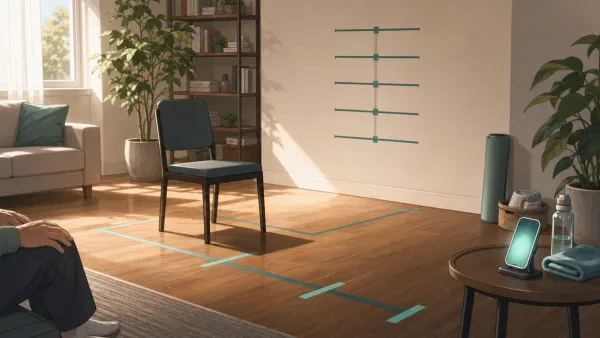
Fear of falling after 60: how to rebuild confidence safely
Fear of falling after 60 can shrink activity and raise fall risk. Learn a safe confidence plan using balance, strength, exposure, and tracking.
Fear of falling after 60 is not just a feeling. It can become a feedback loop.
You feel less steady, so you walk less. You avoid stairs, uneven sidewalks, social outings, and carrying things. That avoidance feels safer in the short term, but it quietly reduces leg strength, balance reactions, walking speed, and confidence. Then everyday movement feels even riskier.
The goal is not to “just be brave.” The goal is to rebuild confidence in a way that respects real fall risk. That means combining safer environments, strength and balance training, gradual exposure to avoided activities, and clear stop signs for when you need a clinician, physical therapist, or fall-risk evaluation.
If your main need is an exercise list, start with balance training after 50. This guide is narrower: how to break the fear-avoidance cycle safely after 60.
Key takeaways:
- Fear of falling is common and consequential. It can reduce activity, social participation, strength, and mobility even if you have not fallen recently.
- Avoidance can raise risk. Long-term activity restriction contributes to deconditioning, slower walking, weaker legs, and less practice with balance challenges.
- Confidence should be rebuilt gradually. Use small, repeatable exposures such as walking to the mailbox, turning in a hallway, stepping off a curb, or climbing one flight of stairs with support.
- Do not ignore real red flags. New dizziness, fainting, one-sided weakness, repeated falls, medication side effects, or unsafe walking need professional evaluation.
- The safest plan combines environment, body, and mind: home setup, balance and strength, gait practice, exposure, and recovery tracking.
- SuperAge can help connect passive mobility trends with your confidence plan, so you can see whether walking steadiness, gait speed, and training notes are moving together.
Quick answer
To rebuild confidence after 60, use a four-part plan:
- Check safety first: recent falls, dizziness, vision, medications, footwear, home hazards, and symptoms that need medical review.
- Measure baseline function: walking steadiness, chair stands, single-leg or staged balance, timed up and go, and comfortable walking speed.
- Train the physical base: balance, lower-body strength, stepping, turning, stairs, and safe power.
- Practice feared tasks gradually: repeat easy versions until confidence rises, then increase difficulty in controlled steps.
Confidence is not positive thinking. Confidence is evidence your body collects through safe repetition.
Why fear of falling becomes a health risk
A cautious response after a fall or near-fall is normal. If you slipped on ice, tripped on a rug, or felt dizzy on stairs, your brain is doing its job by paying attention.
The problem starts when caution becomes broad avoidance.
Fear can make people stop doing the exact activities that maintain fall resistance:
- walking outside
- standing from low chairs
- carrying groceries
- climbing stairs
- turning quickly
- visiting friends
- exercising in a group
- stepping onto uneven ground
That avoidance can start a physical decline. Less movement means less leg strength, lower aerobic capacity, slower gait, poorer balance reactions, and more fatigue. It can also shrink social life and mood, which further reduces activity.
Research on fear-of-falling-related activity restriction describes this as a deconditioning pathway: fear reduces activity, and reduced activity worsens the physical capacity that protects against falls.
So the right question is not “Am I afraid or not?” It is:
Is fear helping me make safer choices, or is it shrinking my life in a way that makes me less safe over time?
First: know when not to self-manage
Do not treat fear of falling as a simple confidence issue if any of these are present:
- two or more falls in the past year
- any fall with head impact, loss of consciousness, fracture, or new pain
- dizziness, fainting, vertigo, or blacking out
- chest pain, shortness of breath, or heart palpitations with walking
- new one-sided weakness, numbness, facial droop, or speech change
- sudden change in walking, balance, vision, or cognition
- numb feet, burning pain, or known neuropathy
- unsafe medication side effects such as sedation or lightheadedness
- you need furniture or walls to cross a room
Those situations need a clinician, physical therapist, vestibular therapist, vision check, medication review, or formal fall-risk evaluation. The CDC STEADI framework exists for exactly this reason: fall risk is often multi-factorial, not just “weak legs.”
If you are safe to start at home, keep the setup conservative: clear floor, shoes with grip, stable counter or rail nearby, good lighting, and no testing when ill, dizzy, or exhausted.
Measure the fear-function mismatch
Before rebuilding confidence, separate three things:
- Objective function: what your body can do today
- Perceived risk: how unsafe the task feels
- Avoidance: what you have stopped doing
This matters because people can be mismatched in both directions.
Some people feel very afraid but test reasonably well. They may need graded exposure and confidence practice more than a major physical rebuild.
Others feel only mildly concerned but test poorly. They may need supervised fall-prevention work even if they do not feel anxious.
Use a simple baseline.
| Signal | What to check | Useful article |
|---|---|---|
| Chair stand | Can you stand and sit repeatedly with control? | 30-second chair stand test |
| Static balance | Can you hold a staged or single-leg balance safely? | single-leg balance test |
| Turning and walking | Can you stand, walk 10 ft (3 m), turn, and sit? | Timed Up and Go test |
| Daily gait | Is your normal walking becoming less stable? | walking steadiness |
| Full screen | Are multiple systems involved? | mobility screen after 50 |
Also rate confidence for common tasks from 0 to 10:
- walking across the room
- showering
- stepping off a curb
- climbing stairs
- walking on grass
- walking while carrying a bag
- getting up at night
- visiting a crowded place
The goal is not to shame low scores. The goal is to choose the right starting point.
The confidence ladder
Fear shrinks when the brain gets repeated evidence that a task can be done safely. The safest way to create that evidence is a confidence ladder.
Pick one avoided task, then create levels from easiest to hardest.
Example: walking outside again.
| Level | Task | Safety setup |
|---|---|---|
| 1 | Stand at the doorway for 2 minutes | Phone nearby, shoes on |
| 2 | Walk to the end of the driveway | Daylight, no carrying |
| 3 | Walk 3 minutes on flat pavement | Companion optional |
| 4 | Walk 5-8 minutes and turn around twice | Same route |
| 5 | Add a gentle curb step | Rail, pole, or companion |
| 6 | Walk 10-15 minutes on a familiar route | Good weather only |
| 7 | Carry a light bag | Keep one hand free |
| 8 | Walk in a busier area | Choose low-traffic time |
Rules:
- Start at a level that feels 3-5 out of 10 for fear, not 9 out of 10.
- Repeat the same level until fear drops by at least 2 points.
- Increase only one variable at a time: distance, surface, speed, crowding, carrying, or lighting.
- Stop if your gait becomes unsafe, symptoms appear, or you start grabbing for support.
This is exposure, not recklessness. You are teaching your nervous system that movement can be safe again, one controlled repetition at a time.
Train the physical base
Confidence grows faster when the body actually becomes more capable. The best plan combines balance, strength, gait, and task practice.
1. Balance practice
Use a stable support nearby. Start with:
- feet together stance
- semi-tandem stance
- tandem stance
- weight shifts
- side steps along a counter
- single-leg stance only if safe
If you need a full progression, use the program in balance training after 50.
2. Lower-body strength
Fear often rises when standing, stepping, and turning feel effortful. Train:
- sit-to-stands
- step-ups
- supported split squats
- calf raises
- hip hinges
- glute bridges
- loaded carries if safe
Strength work should feel controlled, not chaotic. If you cannot complete clean reps without holding your breath, pain, or wobbling, lower the difficulty.
3. Gait and turning
Many falls happen during transitions: turning, starting, stopping, stepping around objects, or changing direction.
Practice:
- slow 180-degree turns
- figure-eight walking around two objects
- start-stop walking
- side steps
- backwards walking only with supervision or a rail
- stepping over a low object
Do this in a clear hallway, not a cluttered room.
4. Stairs and curbs
Stairs combine strength, power, vision, balance, and confidence. Start with:
- one step up and down with a rail
- slow stair descent with control
- step-ups with a pause
- carrying nothing at first
If stair descent feels especially unsafe, read stair descent speed and eccentric control. Going down often feels scarier because the body must brake, not just push.
Reduce environmental triggers
Confidence is not only internal. The environment can either support recovery or keep your nervous system on alert.
Start with the high-yield changes:
- remove loose rugs or secure them
- add night lights between bed and bathroom
- keep floors clear of cords, shoes, and pet items
- use non-slip mats in the bathroom
- keep frequently used items at waist-to-shoulder height
- wear shoes or slippers with grip, not loose socks
- use stair rails and improve stair lighting
- avoid carrying bulky items that block your view
Do not turn your home into a zero-challenge environment. You still need movement practice. The goal is to remove unpredictable hazards so training can happen safely.
Rebuild social confidence
Fear of falling often grows outside the house because the environment is less controllable: crowds, uneven sidewalks, rushed crossings, dim restaurants, unfamiliar stairs.
Use the same ladder idea socially:
- Invite someone to walk a familiar route.
- Choose daylight and good weather.
- Go to a quiet cafe before a crowded event.
- Sit where you can stand without squeezing past people.
- Use handrails without embarrassment.
- Leave before fatigue peaks.
The target is not maximum independence on day one. It is repeated success without a setback.
Track progress without overtesting
Retest every 4-8 weeks, not every day.
Track:
- fear score for one or two specific tasks
- weekly walking minutes
- chair-stand count
- balance hold time or staged-balance level
- Timed Up and Go time if safe
- walking steadiness or mobility trends
- number of avoided tasks you have restarted
- any near-falls or stumbles
The best sign is not zero fear. It is more movement with stable or improving control.
Watch for these positive trends:
- you walk farther without scanning the ground constantly
- you turn more smoothly
- you use the rail but do not pull yourself up the stairs
- chair stands feel easier
- you recover from small wobbles without panic
- you restart social outings you had dropped
If fear improves but function worsens, slow down and reassess. If function improves but fear stays high, graded exposure or cognitive-behavioral support may be the missing piece.
How SuperAge helps
Fear of falling is partly subjective, but the trend does not have to be vague.
SuperAge can help you pair confidence notes with objective Apple Health and training signals:
- walking speed
- stair speed
- walking steadiness
- step consistency and mobility trends
- resting heart rate and HRV during training blocks
- sleep and recovery context
- notes from chair stands, balance work, and confidence ladders
That combination matters because confidence can lag behind physical improvement. Seeing your gait speed, steadiness, or stair trends improve can give your brain evidence that the plan is working.
It also helps catch the opposite problem: feeling confident while mobility data is declining.
FAQ
Is fear of falling normal after 60?
It is common, especially after a fall, near-fall, illness, surgery, or balance change. It becomes a problem when it causes broad activity restriction, social withdrawal, or deconditioning.
Should I avoid activities that make me afraid of falling?
Avoid activities that are genuinely unsafe right now. But do not avoid every activity that creates mild fear. Use a graded ladder: easier version, safer setup, repeat until confidence improves, then progress.
What is the best exercise for fear of falling?
No single exercise fixes fear. The best evidence supports balance and functional exercise, often paired with education, home safety, and gradual practice of feared tasks. For many people, sit-to-stands, supported balance work, walking practice, and step-ups are a strong start.
Can walking alone rebuild confidence?
Walking helps, but it may not be enough if the fear is driven by poor balance, weak legs, stairs, turning, or previous falls. Pair walking with strength, balance, and task-specific practice.
When should I see a physical therapist?
See a physical therapist if you have repeated falls, near-falls, unsafe gait, fear that keeps you home, dizziness, new weakness, or trouble progressing alone. A PT can test balance systems and build a safer plan.
How long does confidence take to improve?
Many people notice early confidence gains in 2-4 weeks if the starting level is appropriate. Bigger changes in strength, gait, and balance often take 8-12 weeks. The key is steady exposure without setbacks.
References
- CDC. STEADI: Older Adult Fall Prevention.
- CDC. Facts About Falls.
- Kendrick D, et al. Exercise for reducing fear of falling in older people living in the community. Cochrane Database of Systematic Reviews. 2014.
- Hadjistavropoulos T, et al. Activity, Balance, Learning, and Exposure: a new intervention for fear of falling. Clinical Interventions in Aging. 2018.
- Deshpande N, et al. Physical deconditioning in older persons with prolonged fear of falling-induced activity restriction. Archives of Physical Medicine and Rehabilitation. 2008.
- Denkinger MD, et al. Fear of falling in older adults: a scoping review of recent literature. Canadian Geriatrics Journal. 2021.
- Clemson L, et al. Frailty, falls and poor functional mobility predict new onset of activity restriction due to concerns about falling. BMC Geriatrics. 2023.
Related Articles
Functional fitness tests to repeat every 6 months after 40
A practical 6-month checklist for functional fitness tests after 40: what to measure, how to standardize conditions, and when to retest sooner.