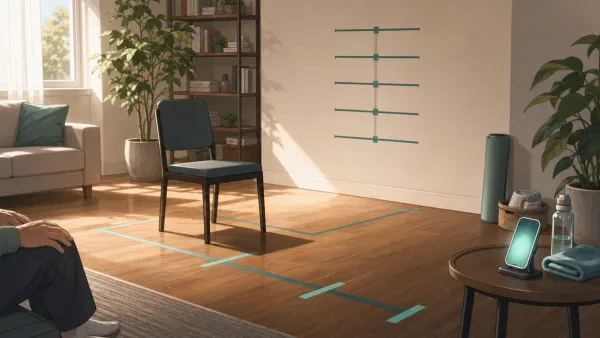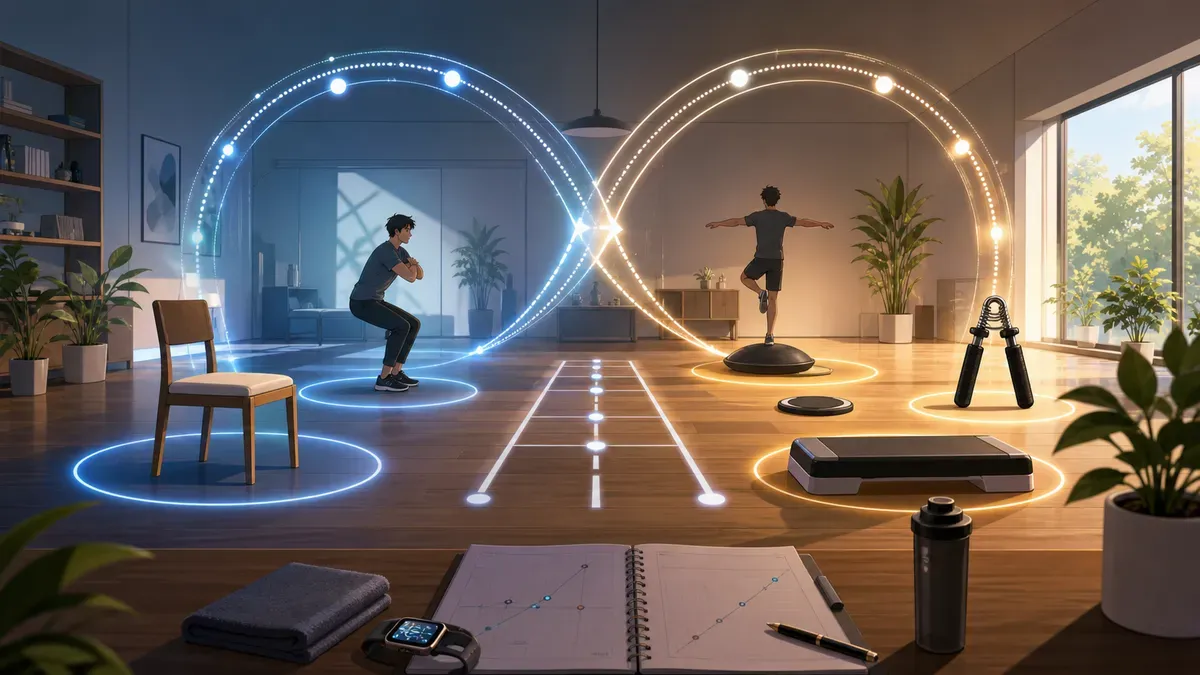
Functional fitness tests to repeat every 6 months after 40
A practical 6-month checklist for functional fitness tests after 40: what to measure, how to standardize conditions, and when to retest sooner.
The best functional fitness tests are not useful because you do them once. They become useful when you repeat them under the same conditions, compare the trend, and notice decline early enough to change training, recovery, or medical follow-up.
For readers over 50, the focused mobility screen after 50 turns chair stands, gait speed, balance, and floor transfers into one repeatable home checklist.
For most adults after 40, a practical default is to run a small functional fitness checklist every 6 months. That interval is long enough for strength, balance, walking speed, and aerobic capacity to change in a meaningful way, but short enough to catch a quiet slide before it turns into a daily-life limitation.
This guide is not a general overview of the functional fitness tests that predict longevity. Use that article if you want the wider science behind grip strength, gait speed, chair stands, and balance. Here, the focus is narrower: exactly what to test twice per year, how to keep the results comparable, when to retest sooner, and how to combine home test results with Apple Health trends.
What you’ll learn:
- The 6 functional tests worth repeating every 6 months after 40
- The exact conditions to standardize before each test day
- A practical scorecard you can reuse at baseline, 6 months, and 12 months
- What changes deserve an earlier retest or clinician conversation
- Where SuperAge and Apple Health trends fit after the manual tests are done
Quick answer
For routine tracking after 40, repeat a compact functional fitness checklist every 6 months if the tests are safe for you and conditions are standardized. Prioritize the 30-second chair stand, 4-meter walking speed, Timed Up and Go, and a balance test; add grip strength or a dead hang plus a 6-minute walk or 2-minute step when safe. Retest sooner after rehab, a fall, sudden mobility change, or a matching Apple Health decline, and seek clinical guidance for falls, chest symptoms, faintness, neurological symptoms, or repeated multi-test decline.
Key facts
- Functional fitness testing works best as a trend, not a one-time score.
- A 6-month cadence is a practical default for routine monitoring because it reduces day-to-day noise while still creating a midyear correction point.
- Chair stand, gait speed, TUG, and balance cover the core daily-life domains of standing, walking, turning, and staying upright.
- Falls, unsteadiness, walking-aid use, chest symptoms, dizziness, or neurological symptoms mean testing should be supervised or replaced by clinical evaluation.
- Apple Health trends can support the interpretation, but they do not replace standardized manual tests.
The 6-month rule: test in snapshots, track in trends
For routine tracking, repeat your functional fitness tests every 6 months unless you are actively rehabbing an injury, starting a new training block, or investigating a sudden change. A twice-yearly rhythm works because most functional capacity changes slowly. Testing every week creates noise. Testing every few years misses the slope.
Think of the 6-month test as a physical audit. It asks:
- Can your legs still produce usable power?
- Can your walking speed and turning speed stay stable?
- Can your balance system handle simple challenges?
- Is your upper-body strength drifting down?
- Is your aerobic capacity improving, stable, or declining?
- Do your manual test results agree with your Apple Health trends?
The CDC’s older-adult activity guidance gives the broader training frame: adults 65 and older need aerobic activity, muscle-strengthening work, and balance activity each week. Adults in their 40s and 50s should not wait until 65 to build those capacities. A 6-month checklist helps you see whether your weekly routine is protecting the functions you will need later.
Why not test monthly?
Monthly testing is useful only when you are running a specific intervention and the test is safe to repeat. For example, a physical therapist may retest a chair stand or Timed Up and Go score after 4 to 8 weeks because the program is designed around that change.
For general longevity tracking, monthly testing is usually too frequent. Sleep, soreness, illness, motivation, footwear, caffeine, and the previous day’s workout can all move a score. A 6-month interval reduces false alarms and puts attention on the trend that matters.
Why not wait a year?
Annual testing is better than nothing, but it gives you fewer chances to catch an avoidable decline. After 40, a year is long enough for a small strength loss, joint limitation, or walking-speed slowdown to become normal in your mind. A 6-month cadence creates a midyear correction point.
Your twice-yearly functional fitness checklist
Run the same checklist every 6 months. Keep it short enough to finish in 30 to 45 minutes without turning the session into a workout.
| Test | What it tracks | Output | Repeat cadence |
|---|---|---|---|
| 30-second chair stand | Lower-body strength and endurance | Complete stands in 30 seconds | Every 6 months |
| 4-meter walking speed | Usual gait speed | ft/s and m/s | Every 6 months |
| Timed Up and Go | Rise, walk, turn, return, and sit | Seconds | Every 6 months |
| Four-stage balance or single-leg stance | Static balance and fall-risk signal | Best position or seconds held | Every 6 months |
| Grip strength or dead hang | Upper-body and neuromuscular strength | lbs (kg) or seconds | Every 6 months |
| 6-minute walk or 2-minute step | Aerobic functional capacity | Distance or step count | Every 6 months |
If you only have 15 minutes, do the first four. Chair stand, walking speed, TUG, and balance cover the biggest everyday movement domains: getting up, walking, turning, and staying upright.
If you are over 65, have fallen in the past year, feel unsteady, or use a walking aid, do not test alone. Use a clinician, physical therapist, trainer, or spotter.
Test 1: 30-second chair stand
The 30-second chair stand test is the cleanest twice-yearly lower-body screen because it is simple, repeatable, and sensitive to the strength you use every day. APTA describes it as counting how many times a person can stand from a chair in 30 seconds without assistance.
Setup
- Use the same firm chair each time, ideally 17 in (43 cm) high.
- Put the chair against a wall or on a non-slip surface.
- Wear the same type of shoes.
- Cross your arms over your chest.
- Stand fully, sit fully, and count only complete stands.
What to record
- Total stands in 30 seconds
- Chair height
- Footwear
- Any arm use, pain, dizziness, or breathlessness
- Whether you tested after a hard workout or poor sleep
Use our 30-second chair stand test score chart for detailed protocol and age norms. For this checklist, the most important number is your own 6-month change. Losing several reps without a clear reason is more important than being slightly below a generic chart once.
Test 2: 4-meter walking speed
Walking speed is a practical whole-body signal. It reflects leg power, balance, cardiovascular reserve, coordination, confidence, vision, pain, and sometimes cognition. Mayo Clinic notes that fall-risk screening often uses timed movement tests because walking speed is linked with survival in older adults.
Setup
- Mark 13 ft (4 m) on a flat hallway.
- Add about 6.5 ft (2 m) before and after the measured zone so you are not timing acceleration or braking.
- Walk at your normal comfortable pace, not your fastest pace.
- Perform 3 trials and average them.
How to calculate
Divide distance by time. If you walk 13 ft in 4 seconds, your speed is 3.25 ft/s (1.0 m/s). If you walk 13 ft in 5 seconds, your speed is 2.6 ft/s (0.8 m/s).
What to record
- Time for each trial
- Average speed in ft/s (m/s)
- Footwear
- Pain, limp, short steps, or hesitation
- Whether you were carrying anything or talking
Use our full guide to walking speed and aging if you want age benchmarks. For your 6-month checklist, watch for a consistent slowdown, especially if Apple Health walking speed is drifting the same direction.
Test 3: Timed Up and Go
The Timed Up and Go test combines rising from a chair, walking 10 ft (3 m), turning, walking back, and sitting down. It is more complete than flat walking speed because it adds the chair transfer and turn.
AAFP’s 2024 falls review states that further fall-risk evaluation should include Timed Up and Go, 30-second chair stand, and four-stage balance tests when screening questions are positive. The same review reports that a TUG result of 12 seconds or more indicates increased fall risk in older adults.
Setup
- Use the same chair each time.
- Place a marker 10 ft (3 m) away.
- Start seated, back against the chair.
- On “go,” stand, walk to the marker, turn, walk back, sit, and stop the timer.
- Use your usual walking aid if you normally use one, and record it.
What to record
- Time to the nearest 0.1 seconds
- Whether you used arms to stand
- Turn direction
- Any stumble, hesitation, dizziness, or pain
- Walking aid use
Read the detailed Timed Up and Go test protocol before using the score clinically. For a healthy adult in their 40s or 50s, the test is mostly a baseline. For an older adult or anyone with falls, the 12-second threshold deserves more attention.
Test 4: Balance: four-stage balance or single-leg stance
Balance should be on every 6-month checklist because decline can hide until a turn, curb, dark room, or slippery floor exposes it. The four-stage balance test is a practical clinical screen. It uses progressively harder foot positions and asks you to hold each for 10 seconds: feet together, semi-tandem, tandem, and single-leg stance.
Setup
- Stand near a counter, wall, or spotter.
- Wear shoes unless your clinician uses a barefoot protocol.
- Keep your eyes open.
- Do not test on an unstable surface for the standard score.
- Stop if you feel unsafe.
What to record
- Hardest position held for 10 seconds
- Single-leg stance time on left and right, if you add it
- Any side-to-side difference
- Fear, wobble, foot movement, or need for support
AAFP’s falls review describes the four-stage balance test as a quick static-balance assessment and notes that losing balance during any stage indicates increased fall risk in that screening context. For midlife adults, the value is trend detection: if your right leg held 35 seconds last time and 12 seconds today, that is worth investigating before it becomes a fall.
Test 5: Grip strength or dead hang
Lower-body function dominates fall risk, but upper-body strength still matters. Grip strength is one of the best-studied functional markers, and it pairs well with chair stand and walking speed because it gives you a separate neuromuscular signal.
Best option: hand dynamometer
Use the same dynamometer each time. Sit or stand in the same position, keep the elbow angle consistent, squeeze maximally for 3 to 5 seconds, and record the best of 3 attempts per hand in pounds (kg).
No dynamometer: use a dead hang
A dead hang is not the same as grip strength, but it is repeatable if you standardize it. Hang from a pull-up bar with both hands, shoulders active, and feet off the floor or lightly supported only if needed. Record seconds held with good form.
What to record
- Best right and left grip in lb (kg), or dead-hang seconds
- Device used
- Elbow/shoulder position
- Pain, hand numbness, or large side difference
- Recent upper-body training
If upper-body performance drops while chair stand and walking speed are stable, the issue may be local: shoulder pain, hand arthritis, nerve symptoms, detraining, or a device inconsistency. If all functional tests drop together, think bigger: illness, recovery debt, medication changes, sleep loss, or a broader training gap.
Test 6: 6-minute walk or 2-minute step
The ACSM Health & Fitness Journal guide to assessing function and fitness highlights the Senior Fitness Test battery, including chair stand, arm curl, flexibility, 8-foot up-and-go, and either a 2-minute step or 6-minute walk for aerobic capacity. For home use, choose the aerobic test you can repeat safely and consistently.
Option A: 6-minute walk
Use a flat, safe route. Walk as far as possible in 6 minutes without running. Record distance in feet (meters), average pace if available, and symptoms.
This is the better option if you have a hallway, track, or measured outdoor route. It reflects sustained walking capacity more directly than a step-in-place test.
Option B: 2-minute step
Stand near support. Step in place for 2 minutes, lifting each knee to a target height halfway between the kneecap and hip crease. Count right-knee lifts only.
This is useful when weather, space, or safety makes a 6-minute walk impractical.
What to record
- 6-minute distance in ft (m), or 2-minute step count
- Heart rate before and after, if available
- Breathlessness, chest discomfort, dizziness, or unusual fatigue
- Route, shoes, and weather for outdoor walks
Stop the test and seek medical guidance if you develop chest pain, severe breathlessness, faintness, or symptoms that feel unusual for you.
When deciding whether to include one or both balance screens on your 6-month test day, use the single-leg balance vs timed up and go guide.
How to standardize your 6-month test day
The number one rule is not “try harder.” It is “make the next test comparable.”
Use the same test window
Test at the same time of day, ideally in the morning or early afternoon when you are alert but not already fatigued. Avoid testing immediately after a heavy meal, alcohol, a red-eye flight, or a hard workout.
Keep equipment consistent
Use the same chair, hallway, route, shoes, timer, dynamometer, and walking aid. Small equipment changes can create fake progress or fake decline.
Use the same warm-up
Do 5 to 8 minutes of easy walking, light mobility, and a few practice sit-to-stands. Do not use an intense warm-up that turns the test into a performance session.
Record context, not just scores
Your scorecard should include:
- Date and time
- Body weight, if relevant
- Sleep quality the previous night
- Soreness or pain
- Recent illness
- New medications
- Hard workouts in the past 48 hours
- Travel, jet lag, or unusual stress
Context prevents overreaction. A slower TUG after the flu means something different from a slower TUG after 6 quiet months of normal health.
When to retest sooner than 6 months
Six months is the default. Retest sooner when the situation changes enough that the old baseline is no longer useful.
| Situation | Retest timing | Why |
|---|---|---|
| New strength or mobility program | 8-12 weeks | Enough time for measurable adaptation |
| Physical therapy or rehab | Follow clinician plan, often 4-8 weeks | The test may be part of care |
| Fall, near fall, or new fear of falling | As soon as safely supervised | Fall-risk context changed |
| Sudden walking-speed slowdown | Repeat within 1-2 weeks if no obvious cause | Confirms whether it was noise |
| Illness, surgery, or major injury | After recovery and clearance | Establishes a new baseline |
| New dizziness, chest symptoms, faintness, or neurological symptoms | Do not self-retest first | Medical evaluation matters more |
| Big Apple Health mobility decline | Repeat the matching manual test within 2-4 weeks | Checks whether passive data matches performance |
Do not use repeated self-testing to push through pain. If a test produces sharp pain, dizziness, chest discomfort, or a feeling that you might fall, stop.
When passive Apple Health metrics disagree, the stair ascent speed vs walking speed comparison helps decide whether to prioritize power, gait, or a broader retest.
How to interpret 6-month changes
The goal is not to chase perfect scores. The goal is to keep the slope visible.
Green: stable or improving
You are in a good zone if most scores are stable or modestly improving and you feel safe during the tests. Keep training, keep the same cadence, and avoid adding tests just to make the scorecard look bigger.
Yellow: one test changed
One changed test usually points to a specific bottleneck.
- Chair stand down, walking speed stable: lower-body strength, knee pain, or chair setup
- Walking speed down, chair stand stable: gait mechanics, pain, confidence, aerobic fitness, or daily activity
- TUG slower, walking speed stable: turning, chair transfer, balance, or fear
- Balance worse, everything else stable: vestibular, foot/ankle, vision, medication, or practice gap
- Grip down only: local upper-body or device issue
Retest once under clean conditions. If the same result repeats, address the bottleneck directly.
Red: multiple tests declined
Multiple declines across strength, gait, balance, and aerobic capacity deserve more attention. Common explanations include detraining, poor sleep, recovery debt, illness, medication side effects, pain, weight change, and low activity volume. For adults over 65, repeated decline across TUG, chair stand, and balance should be discussed with a clinician because those are standard fall-risk domains.
Where SuperAge and Apple Health fit
Manual tests answer one question: what can your body do under standardized conditions today? Apple Health trends answer a different question: how is your body moving in real life between test days?
Use the manual checklist first. Then use SuperAge and Apple Health to interpret the months between snapshots.
Relevant passive trends include:
- Walking speed
- Step count and active minutes
- VO2 max estimate
- Flights climbed
- Walking asymmetry
- Double support time
- Walking steadiness, when available
- Resting heart rate, HRV, and sleep trends
If your 6-month walking speed test is worse and Apple Health walking speed has also drifted down, the signal is stronger. If your chair stand score improved but your recovery markers worsened, your training may be effective but too costly. If your TUG is stable while walking steadiness declines, balance or gait quality may need attention before speed changes.
SuperAge is useful here because it keeps Apple Health and Apple Watch signals in one trend view. The point is not to replace manual tests. The point is to connect home performance tests with the daily signals that explain why the test changed.
For a wider data view, see our guide to Apple Health mobility metrics and our comparison of strength age vs biological age.
Your 6-month scorecard
Copy this table into a note, spreadsheet, or health journal. Keep the columns the same at every test day.
| Test | Baseline | 6 months | 12 months | Notes |
|---|---|---|---|---|
| 30-second chair stand | Chair height, shoes, pain | |||
| 4-meter walking speed | Average of 3 trials | |||
| Timed Up and Go | Better of 2 trials | |||
| Four-stage balance | Hardest stage held 10 sec | |||
| Single-leg stance L/R | Optional seconds per side | |||
| Grip strength L/R or dead hang | Device or bar used | |||
| 6-minute walk or 2-minute step | Route, step target, symptoms | |||
| Apple Health walking speed trend | 30- or 90-day average | |||
| VO2 max trend | Apple Watch estimate if available | |||
| Recovery notes | HRV, sleep, soreness, illness |
Add one final line after every test day: “What changed since last time?” That sentence often matters more than the raw score.
FAQ
Should adults after 40 really do functional fitness tests every 6 months?
Yes, if the tests are safe for you. Every 6 months is frequent enough to catch meaningful changes in strength, mobility, balance, and aerobic function, but not so frequent that normal day-to-day noise dominates the results.
Which functional fitness test should I repeat first?
Start with the 30-second chair stand, 4-meter walking speed, Timed Up and Go, and a balance test. Together, they cover the daily-life basics: standing, walking, turning, and staying upright. Add grip strength and a 6-minute walk if you have time and can do them safely.
Is every 3 months better than every 6 months?
Only in specific situations. If you are training to improve a low score, rehabbing, or checking a concerning change, 4 to 12 weeks can be appropriate. For routine monitoring after 40, every 6 months is cleaner and easier to maintain.
What change is large enough to matter?
There is no single universal cutoff for every test and age group. A repeated decline matters more than one noisy result. As practical flags, watch for several fewer chair stands, a slower TUG on repeat testing, a consistent drop in walking speed, or a balance score that falls sharply on one side.
Can Apple Health replace manual functional tests?
No. Apple Health is excellent for passive trend detection, but it does not standardize chair height, turning speed, balance stance, or grip strength. Use Apple Health to fill the months between test days, then use manual tests to confirm what your body can do under repeatable conditions.
When should I talk with a clinician?
Talk with a clinician if you have falls, near falls, new dizziness, chest pain, fainting, unexplained weakness, neurological symptoms, or a repeated decline across multiple tests. If you are over 65 and TUG, chair stand, or balance results are abnormal, clinical fall-risk evaluation is a better next step than more self-testing.
Key takeaways
- Repeat a compact functional fitness checklist every 6 months after 40.
- Keep the test day standardized: same chair, shoes, route, timer, warm-up, and time of day.
- Prioritize chair stand, walking speed, TUG, and balance; add grip and aerobic capacity when safe.
- Retest sooner after rehab, a new training block, a fall, sudden mobility change, or a matching Apple Health trend decline.
- Interpret trends, not single numbers. One changed test points to a bottleneck; multiple declines deserve a broader review.
- Use SuperAge and Apple Health after the manual checklist to connect test results with real-world movement, recovery, and biological-age trends.
Ready to track the bigger pattern? Download SuperAge and compare functional fitness snapshots with the Apple Health trends that shape them.
References
- CDC. “Older Adult Activity: An Overview.” Updated Dec. 4, 2025. https://www.cdc.gov/physical-activity-basics/guidelines/older-adults.html
- American Physical Therapy Association. “30-Second Chair Stand Test.” https://www.apta.org/patient-care/evidence-based-practice-resources/test-measures/30-second-chair-stand-test
- Thompson WR. “A Guide to the Assessment of Function and Fitness in Older Adults.” ACSM’s Health & Fitness Journal. 2022;26(5):45-57. https://journals.lww.com/acsm-healthfitness/fulltext/2022/09000/a_guide_to_the_assessment_of_function_and_fitness.9.aspx
- Mayo Clinic. “Evaluating patients for fall risk.” https://www.mayoclinic.org/medical-professionals/clinical-updates/physical-medicine-rehabilitation/evaluating-patients-for-fall-risk
- Hoffman GJ, et al. “Falls in Older Adults: Approach and Prevention.” American Family Physician. 2024. https://www.aafp.org/afp/2024/0500/falls-older-adults
- CDC STEADI. “Clinical Resources.” https://www.cdc.gov/steadi/hcp/clinical-resources/index.html
This article is educational and does not replace medical evaluation. If you have falls, unexplained weakness, chest symptoms, dizziness, or neurological changes, seek professional care before self-testing.
Related Articles

Sit-to-stand test vs gait speed: which predicts healthy aging better?
Compare sit-to-stand test vs gait speed for healthy aging, longevity risk, fall screening, and what each result tells you to test, track, and train next.