Single-leg balance vs timed up and go: which test should you track?
Single-leg balance vs timed up and go tests measure different fall-risk signals. Learn which to use, how to interpret results, and when to track both.
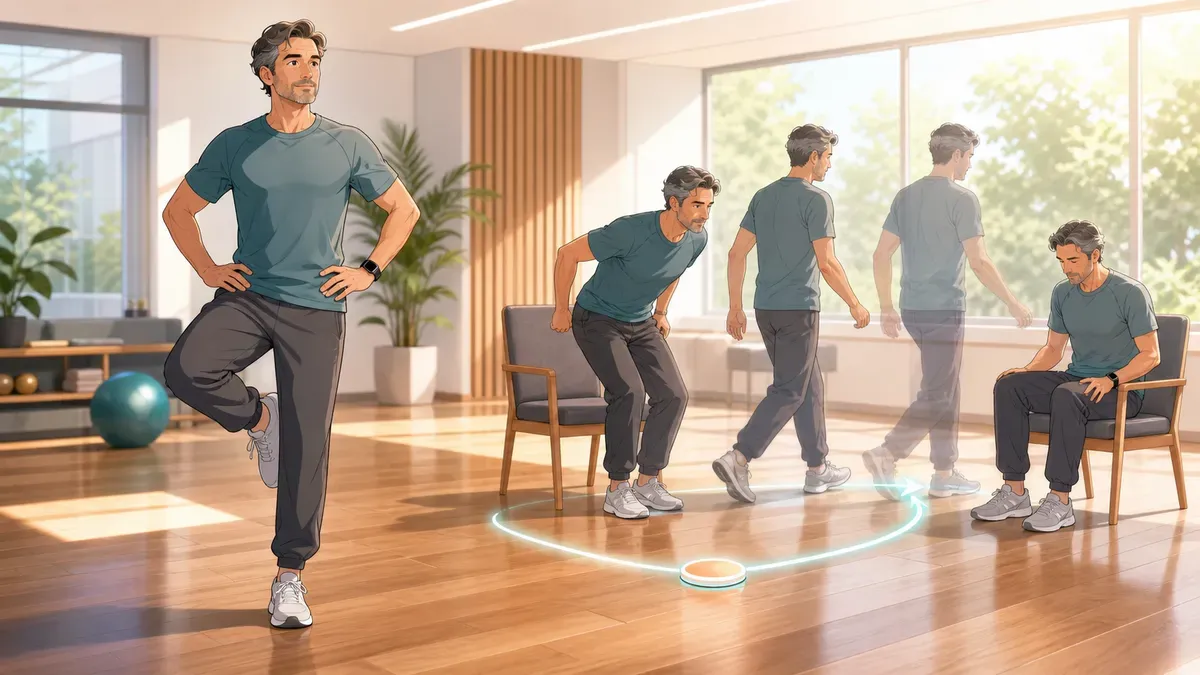
Single-leg balance and the Timed Up and Go test both get grouped under “fall risk,” but they do not measure the same thing.
The single-leg balance test asks a narrow question: can your nervous system keep you stable on one leg without stepping, grabbing, or shifting? It is a static balance test. It is simple, sensitive, and surprisingly powerful as an aging signal.
The Timed Up and Go test asks a broader question: can you rise from a chair, walk, turn, return, and sit down smoothly? It is a dynamic mobility test. It captures balance, gait speed, chair-rise power, turning control, confidence, and coordination in one short sequence.
The practical answer: track single-leg balance if you want an early neuromuscular balance signal; track TUG if you want a functional mobility and fall-risk screen. Track both if you are over 60, have fallen, feel unsteady, or want a fuller picture.
What you’ll learn:
- What each test actually measures
- Which test is better for early warning versus real-world mobility
- How to interpret four common result patterns
- How often to test and when to escalate
- How SuperAge connects these tests with passive Apple Health mobility trends
Quick answer
If you can only pick one test, choose based on the question you care about.
| Your question | Better first test |
|---|---|
| “Is my balance aging faster than expected?” | Single-leg balance |
| “Am I at functional fall-risk during daily movement?” | Timed Up and Go |
| “Can I screen myself in 10 seconds with no equipment?” | Single-leg balance |
| “Can I test chair rise, walking, turning, and sitting together?” | Timed Up and Go |
| “Which test is more useful after a fall?” | Timed Up and Go, plus balance testing |
| “Which test should I repeat every few months?” | Both, if you are over 60 or training balance |
The simplest rule:
- Single-leg balance is an early static-balance signal.
- TUG is a real-world dynamic-mobility signal.
Neither replaces the other. They are complementary pieces of the functional fitness tests that predict longevity cluster.
What single-leg balance measures
Single-leg balance, also called single-leg stance, measures how long you can stand on one foot without losing position. A common home version uses a 10-second pass/fail target. More detailed versions record maximum time up to 30 or 60 seconds.
The test is simple, but the biology is not. Standing on one leg requires:
- vestibular input from the inner ear
- proprioception from the feet, ankles, knees, and hips
- visual stability
- ankle and hip strategy
- fast postural corrections from the nervous system
- enough lower-leg and hip strength to control sway
That is why a static test can be meaningful. It removes gait, chair rise, and turning from the picture, leaving a clean view of postural control.
Why single-leg balance is useful
Single-leg balance is especially useful when the question is early decline. A 2022 British Journal of Sports Medicine study followed 1,702 adults aged 51 to 75 and found that inability to complete a 10-second one-legged stance was associated with higher all-cause mortality after adjustment for clinical risk factors.
The key point is not that balance magically causes longevity. It is that balance reflects the combined health of nerves, muscles, sensory input, reaction speed, and confidence. Those systems often start changing before everyday mobility looks obviously impaired.
Use single-leg balance when you want to know:
- whether static balance is declining
- whether one side is worse than the other
- whether balance training is working
- whether you rely heavily on vision for stability
- whether your neuromuscular system is aging faster than your gait suggests
What the Timed Up and Go test measures
The Timed Up and Go test, or TUG, measures how long it takes to:
- stand from a chair
- walk 10 ft (3 m)
- turn around
- walk back
- sit down again
The standard test uses your normal comfortable pace. It is not a sprint.
TUG is broader than single-leg balance because it includes multiple phases of daily movement:
- chair-rise power
- gait speed
- dynamic balance
- turning control
- lower-body coordination
- confidence while moving
- safe sitting control
That makes TUG a better test when you care about real-world function. Many falls happen during transitions: standing up, turning, reaching, changing direction, or sitting down. TUG puts several of those transitions into one timed sequence.
Why TUG is useful
The original TUG test was designed as a quick clinical screen for functional mobility. The CDC STEADI fall-prevention materials use a TUG time of 12 seconds or greater as a marker of increased fall risk in older adults. A widely cited meta-analysis also notes that TUG alone has limited ability to predict every future fall, which is exactly why it should be read with balance, strength, medication, vision, and fall-history context.
Use TUG when you want to know:
- whether mobility is still functionally efficient
- whether turning or chair rise slows you down
- whether a fall-risk screen is needed
- whether rehab or strength work is improving daily movement
- whether a balance problem is showing up during actual motion
Which test should you track?
The best test depends on age, baseline mobility, and what has changed.
| Situation | Best test to prioritize | Why |
|---|---|---|
| Age 40-59, no falls, training for prevention | Single-leg balance | Sensitive early balance baseline |
| Age 60+, no falls, active and independent | Both | Static balance and dynamic mobility can diverge |
| Recent fall or near fall | TUG plus balance test | Functional transition risk matters |
| Good walking speed but poor stability | Single-leg balance | Isolates postural control |
| Slow walking, weak chair rise, or cautious turns | TUG | Captures mobility sequence |
| One side feels weaker or less stable | Single-leg balance on both sides | Reveals asymmetry |
| You use a cane or walker | TUG with usual aid | Tests actual daily mobility |
| You want one repeatable home screen | TUG plus 10-second balance | Fast and more complete together |
For most healthy adults over 40, start with single-leg balance because it is easy and sensitive. Add TUG when you want to test real-world mobility or when balance, gait, or confidence becomes a concern.
How to interpret the four result patterns
1. Single-leg balance poor, TUG normal
This is a common early-warning pattern.
You can still move through a chair-walk-turn sequence quickly, but your static balance reserve is lower than expected.
Possible causes:
- ankle proprioception decline
- vestibular sensitivity
- weak hip stabilizers
- one-sided balance asymmetry
- overreliance on vision
- poor single-leg confidence
What to do:
- Add daily single-leg stance practice near a wall.
- Track left and right sides separately.
- Progress to head turns, softer surfaces, or eyes-closed only when safe.
- Watch Apple Health signals such as walking steadiness, asymmetry, and double support time.
This pattern is usually trainable. It is a good reason to start balance training after 50 before a fall happens.
2. Single-leg balance normal, TUG slow
This pattern means static balance may be fine, but functional mobility is limited.
Possible causes:
- slow chair rise
- lower-body weakness
- cautious turning
- pain
- low walking speed
- fear of falling during movement
- medication or dizziness effects
What to do:
- Break the TUG into phases: chair rise, walk out, turn, walk back, sit.
- Add a 30-second chair stand test to isolate lower-body endurance.
- Check walking speed and step length.
- Practice controlled turns and sit-to-stand transitions.
Do not assume “my balance is fine” if TUG is slow. Dynamic mobility can fail even when static stance looks normal.
3. Both tests are poor
This is the highest-priority pattern.
It suggests both static postural control and functional mobility are affected.
Possible causes:
- detraining
- frailty risk
- recent illness
- neuropathy
- vestibular issues
- pain
- medication burden
- strength and gait decline together
What to do:
- Retest under safe, consistent conditions.
- Use a spotter or clinician if there is any fall concern.
- Review medications, vision, dizziness, foot sensation, and recent health changes.
- Start a combined program: balance, lower-body strength, walking, and sit-to-stand work.
- Discuss the pattern with a healthcare professional, especially if the decline is sudden.
If both tests are poor, also track whether walking steadiness, double support time, or asymmetry has changed.
4. Both tests are strong
This is reassuring, but still worth tracking.
Strong results suggest that static balance, chair rise, gait, turning, and sitting control are all functioning well. Keep a baseline so future changes are visible.
Retest:
- every 6 months if you are over 60
- every 3 months if you are actively training balance
- after illness, injury, medication changes, or a fall
- yearly if you are under 60 and low risk
Use the functional fitness tests every 6 months after 40 checklist to place these tests next to chair stand, walking speed, grip, and aerobic capacity.
How to test both at home
Single-leg balance protocol
- Stand near a wall or sturdy surface.
- Keep eyes open and gaze forward.
- Place hands on hips or relaxed at your sides, but keep the same setup every time.
- Lift one foot off the ground.
- Stop timing when the raised foot touches down, your stance foot shifts, you grab support, or you reach 60 seconds.
- Test both legs. Record the best of 3 trials per side.
Use these practical thresholds:
| Result | Meaning |
|---|---|
| 30-60 seconds | Strong static balance for most adults |
| 10-29 seconds | Track and train |
| Under 10 seconds | Concerning if under 75; needs attention |
| Side-to-side gap over 5 seconds | Investigate asymmetry |
Do not perform eyes-closed testing unless you can do it safely near support.
Timed Up and Go protocol
- Use a stable chair, ideally with arms.
- Mark a 10 ft (3 m) distance.
- Sit with your back against the chair.
- On “go,” stand, walk to the marker, turn, walk back, and sit.
- Stop timing when your back touches the chair.
- Use your normal walking aid if you normally use one.
Use these practical thresholds:
| TUG time | Meaning |
|---|---|
| Under 10 seconds | Normal functional mobility |
| 10-12 seconds | Monitor trend |
| 12-20 seconds | Elevated risk; assess why |
| Over 20 seconds | Functional limitation likely |
| Over 30 seconds | High fall-risk category |
If your time changes by more than about 2 seconds without a clear reason, retest and look for the phase that changed.
Which result should guide training?
Train the weaker system first, but do not ignore the other one.
If single-leg balance is the weak link
Focus on static balance and sensory control:
- supported single-leg stance
- tandem stance
- single-leg stance with head turns
- calf raises
- hip abductor strengthening
- barefoot foot-strength drills on safe surfaces
- tai chi or slow balance-flow practice
Most people improve fastest with short daily practice, not one long weekly session.
If TUG is the weak link
Focus on transitions and dynamic mobility:
- sit-to-stand practice
- chair stand intervals
- brisk walking
- turn practice around a cone or marker
- step-ups
- lower-body strength training
- gait-speed practice
If the turn is slow, train turning. If standing is slow, train chair rise. If walking is slow, train gait speed. TUG is useful because it tells you where the sequence breaks down.
If both are weak
Use a combined 15-minute routine 4 to 5 days per week:
- Single-leg balance near support: 2 minutes
- Sit-to-stand: 2 sets of 8 to 12
- Heel-to-toe walking: 2 minutes
- Brisk walking intervals: 6 minutes
- Controlled turns: 10 each direction
Add strength training 2 to 3 times per week if safe.
How SuperAge helps connect the tests
Manual tests give snapshots. SuperAge helps you connect those snapshots with the trends your phone and watch already collect.
Passive mobility context
Apple Health mobility data includes walking speed, step length, walking asymmetry, double support time, walking steadiness, and stair-speed metrics. These do not replace single-leg balance or TUG, but they show whether your daily movement is changing between test days.
Better interpretation
If your single-leg balance worsens but passive walking metrics are stable, you may have an early balance-specific issue. If TUG worsens while walking speed and chair-stand performance also decline, the issue may be broader functional reserve.
Biological-age context
Balance and mobility are not side notes. They are how cardiovascular fitness, muscle, nerves, sensory systems, and recovery show up in real life. SuperAge places these movement trends alongside sleep, HRV, activity, and other health signals so you can see whether your interventions are changing your broader aging trajectory.
Frequently asked questions
Is single-leg balance better than TUG?
No. Single-leg balance is better for isolating static postural control. TUG is better for dynamic functional mobility. The better test depends on the question.
Which test predicts falls better?
TUG is more directly tied to functional fall-risk screening because it includes standing, walking, turning, and sitting. But TUG alone is not enough to predict every fall. Single-leg balance adds a useful static-balance signal, and both should be read with fall history, medications, vision, strength, and gait.
Should younger adults do TUG?
Yes, but it is most useful as a baseline. Younger adults usually score quickly, so single-leg balance may reveal more variation before age 60. TUG becomes more discriminating as mobility limitations become more common.
What if I pass single-leg balance but feel unsteady walking?
Add TUG and check walking metrics. Static balance can look fine while dynamic balance, turning, gait speed, or confidence is changing.
How often should I test?
Every 3 to 6 months is enough for most adults over 60. Test monthly only if you are actively training balance or recovering from a fall, injury, or illness.
Key takeaways
- Single-leg balance is the cleaner static-balance test: it isolates postural control, side-to-side asymmetry, and early neuromuscular decline.
- Timed Up and Go is the stronger functional-mobility test: it includes chair rise, gait, turning, and sitting control.
- Disagreement is useful: poor balance with normal TUG suggests early static-balance decline; normal balance with slow TUG suggests dynamic mobility or strength limitations.
- Track both after 60 or after any fall: one test rarely captures the whole risk picture.
- Use trends, not one-off scores: consistent retesting is what turns simple home tests into useful aging signals.
Start tracking balance and mobility together
The best functional test is the one you repeat consistently and interpret in context.
Ready to connect your balance, gait, recovery, and biological-age trends? Download SuperAge and see how your daily movement metrics change over time.
References
- Araújo, C.G. et al. “Successful 10-second one-legged stance performance predicts survival in middle-aged and older individuals.” British Journal of Sports Medicine. 2022. https://pubmed.ncbi.nlm.nih.gov/35728834/
- Podsiadlo, D. and Richardson, S. “The Timed Up & Go: a test of basic functional mobility for frail elderly persons.” Journal of the American Geriatrics Society. 1991. https://pubmed.ncbi.nlm.nih.gov/1991946/
- CDC. “STEADI Clinical Resources.” Updated 2025. https://www.cdc.gov/steadi/hcp/clinical-resources/index.html
- Barry, E. et al. “Is the Timed Up and Go test a useful predictor of risk of falls in community dwelling older adults: a systematic review and meta-analysis.” BMC Geriatrics. 2014. https://pmc.ncbi.nlm.nih.gov/articles/PMC3924230/
- Ferraz, D.D. et al. “Comparison of the Ability of Static and Dynamic Balance Tests to Determine the Risk of Falls among Older Community-Dwelling Individuals.” Journal of Functional Morphology and Kinesiology. 2023. https://www.mdpi.com/2411-5142/8/2/43
Related Articles

Sit-to-stand test vs gait speed: which predicts healthy aging better?
Compare sit-to-stand test vs gait speed for healthy aging, longevity risk, fall screening, and what each result tells you to test, track, and train next.