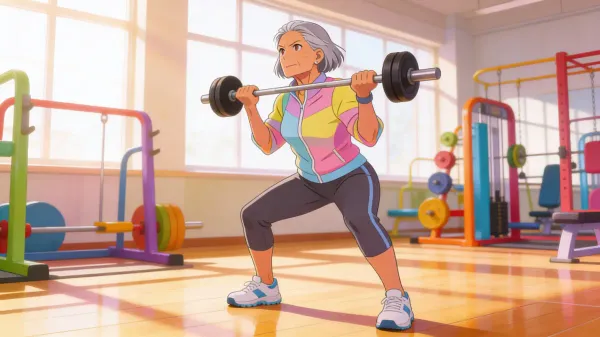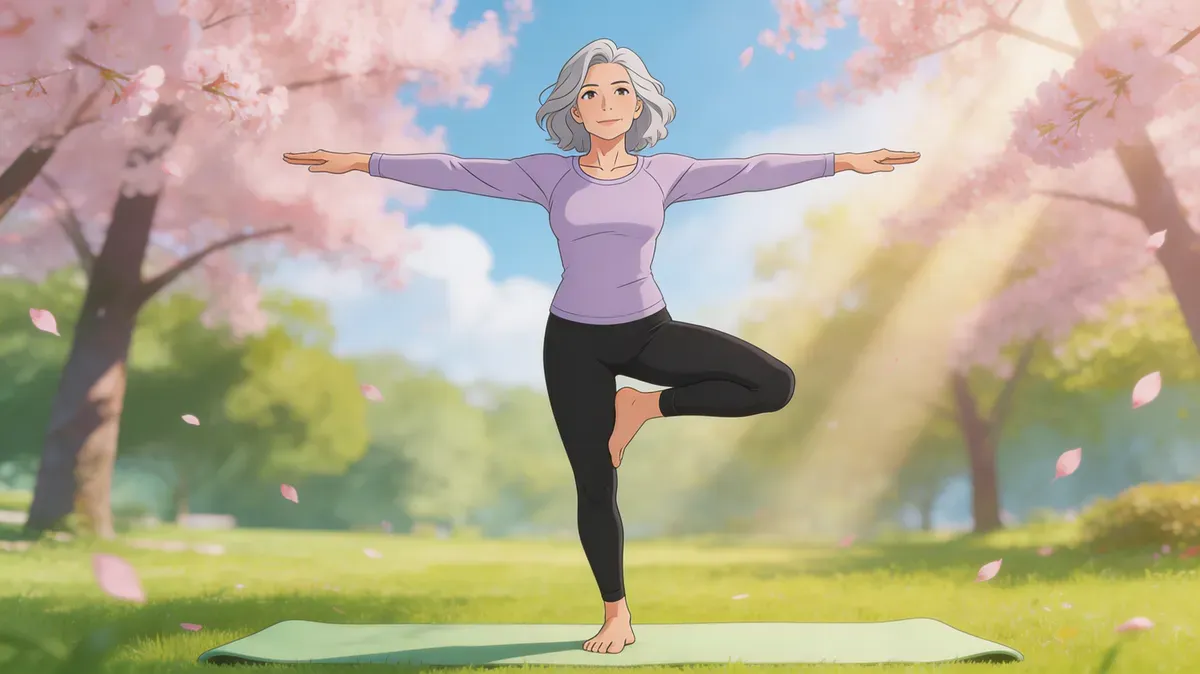
Balance training after 50: the exercise that prevents falls and extends life
Balance training after 50 can reduce fall risk and protect independence. Learn safe exercises, a 4-week progression, warning signs, and how to track gains.
Falls are the leading cause of injury-related death in adults over 65 — and the second leading cause worldwide for unintentional injury deaths across all ages. Every year, one in three adults over 65 falls at least once. One in five of those falls causes a serious injury: a broken hip, a head trauma, or the beginning of a rapid functional decline that many never recover from.
If fear is already causing avoidance, pair these exercises with a graded plan for fear of falling after 60 so confidence rebuilds with strength.
Yet the single most effective intervention against falls is not a medication, a surgery, or a piece of safety equipment. It is balance training — a category of exercise that most people over 50 have never been prescribed, rarely practice, and dramatically underestimate.
A Cochrane review of 108 randomized trials involving over 23,000 participants found that balance and functional exercises reduce the rate of falls by 24% and the number of people experiencing falls by 13%. When combined with resistance training, that number climbs to 34%. These are not marginal improvements — they represent the difference between independence and institutionalization.
What you’ll learn:
- Why balance declines with age and what systems are responsible
- The strongest evidence-based exercises for fall prevention
- How balance predicts biological age and mortality risk
- A progressive 4-week balance training program you can start today
Quick answer
Balance training after 50 is one of the best-supported exercise strategies for fall prevention, especially when it combines balance, functional movement, and strength. That does not mean every drill directly extends lifespan; the evidence is strongest for reducing falls, injuries, and functional decline. Start near a wall or chair, progress from single-leg stance to step drills and tai chi-style movement, and stop for clinical review if dizziness or falls are present.
Key facts
- Balance training = balance + strength + gait + reaction practice.
- Strongest evidence = fewer falls from multi-component exercise programs.
- Practical dose = 10-20 minutes, 3-5 times weekly, with progression.
- Support nearby = lower training risk and better adherence.
- Recent falls, vertigo, fainting, or neurological symptoms = get assessed before harder drills.
Evidence note
Cochrane and USPSTF evidence supports exercise interventions for older adults at increased fall risk, especially programs that include balance, gait, functional tasks, and strength. The clearest claim is fall reduction. Claims that balance training alone extends life or lowers biological age should be framed as indirect and functional, not proven mortality treatment.
Safety note
Use a wall, counter, or sturdy chair. Save eyes-closed drills, foam pads, and partner perturbations until the basic version is easy. Seek medical advice after a recent fall, new vertigo, fainting, chest pain, neurological symptoms, neuropathy, severe osteoporosis, medication changes, or fear of falling that makes you avoid movement.
Balance training can support confidence on ice, but curling for beginners still requires club instruction, appropriate footwear, and sport-specific technique.
Why balance deteriorates after 50
Balance is not a single ability — it is the integrated output of three sensory systems, your brain, and your musculoskeletal system working together in real time.
Quick definition: Balance (postural control) is the ability to maintain your center of mass over your base of support during static positions and dynamic movements.
The three balance systems
1. Visual system: Your eyes provide spatial orientation — where you are relative to walls, floors, and objects. After 50, reduced visual acuity, depth perception, and contrast sensitivity degrade this input.
2. Vestibular system: The inner ear detects head position and acceleration. Age-related loss of vestibular hair cells begins around 40, accelerating after 55. By 70, you may have lost 40% of these irreplaceable sensors. (For a detailed breakdown of why the vestibular apparatus declines faster than other sensory systems — and what the mortality data shows — see balance decline after 50: vestibular aging and longevity.)
3. Proprioceptive system: Receptors in your muscles, tendons, and joints tell your brain where your limbs are in space. Proprioceptive acuity declines 20–30% between ages 20 and 70, partly driven by reduced muscle mass and peripheral nerve changes.
What makes it worse
Several factors accelerate balance decline:
- Muscle weakness: Sarcopenia — age-related muscle loss — particularly affects the ankle dorsiflexors and hip stabilizers that are critical for recovery from a stumble
- Sedentary behavior: Prolonged sitting weakens postural muscles and reduces sensory calibration
- Medications: Blood pressure drugs, sedatives, and antidepressants increase fall risk by affecting blood pressure regulation and reaction time
- Cognitive decline: Dual-task ability (walking while talking) deteriorates because balance increasingly demands conscious attention rather than running on autopilot
The good news: all three sensory systems and the neuromuscular responses that connect them are trainable at any age. The brain’s ability to recalibrate balance — neuroplasticity — remains active well into the 80s and beyond.
8 evidence-based balance exercises
These exercises are organized from foundational to advanced. Start at whatever level challenges you without causing a fall risk. Always have a wall, chair, or countertop within arm’s reach when starting out.
Level 1: Foundation (weeks 1–2)
1. Single-leg stance
The gold standard balance assessment doubles as an excellent training tool. A 2022 study in the British Journal of Sports Medicine found that inability to stand on one leg for 10 seconds after age 50 was associated with an 84% higher risk of all-cause death over 7 years.
How to do it:
- Stand near a wall or sturdy chair for safety
- Lift one foot 6 inches (15 cm) off the floor
- Hold for 10–30 seconds
- Switch legs
- Repeat 3 times per side
Progression: Close your eyes (removes visual input, forcing vestibular and proprioceptive systems to work harder). Advanced: stand on a folded towel or foam pad.
2. Heel-to-toe walk (tandem walking)
This exercise narrows your base of support, challenging lateral stability — the type most involved in sideways falls.
How to do it:
- Place one foot directly in front of the other, heel touching toe
- Walk forward 15–20 steps in a straight line
- Keep your gaze forward (not at your feet)
- Turn around and repeat
Progression: Walk backward in heel-to-toe pattern. Advanced: do it with eyes closed (have a spotter nearby).
3. Weight shifts
Trains the ankle strategy — the first-line balance recovery mechanism your body uses for small perturbations.
How to do it:
- Stand with feet hip-width apart
- Slowly shift your weight to the right foot until the left foot barely lifts
- Hold 3 seconds
- Return to center and shift left
- Repeat 10 times each direction
Progression: Add forward-backward shifts. Advanced: perform on a balance pad.
Level 2: Intermediate (weeks 2–3)
4. Step-ups with pause
Combines balance with stair-climbing strength — a functional movement that predicts independence in older adults.
How to do it:
- Stand facing a sturdy step (6–8 inches / 15–20 cm)
- Step up with the right foot
- Bring the left knee up to hip height and pause for 3 seconds
- Step down slowly (control the eccentric phase)
- Repeat 8 times per leg
Progression: Increase step height. Advanced: hold light dumbbells.
5. Lateral step-overs
Trains the hip strategy — the second-line recovery mechanism for larger balance disturbances.
How to do it:
- Place a rolled towel or low object (4–6 inches / 10–15 cm) on the floor
- Step laterally over the object with the lead leg
- Follow with the trailing leg
- Step back the other direction
- Repeat 10 times each direction
Progression: Increase obstacle height. Advanced: add a pause standing on one leg over the obstacle.
Level 3: Advanced (weeks 3–4)
6. Clock reaches
A dynamic single-leg exercise that challenges stability in multiple planes of movement.
How to do it:
- Stand on your right leg
- Imagine you are at the center of a clock face
- Reach your left foot forward to 12 o’clock, tap the floor, return to center
- Reach to 3 o’clock (right side), tap, return
- Reach to 6 o’clock (behind you), tap, return
- Complete the full clock (9, 10, 11, etc.)
- Switch standing legs
Progression: Hold a light weight. Advanced: perform with eyes closed at each position.
7. Reactive step training
Trains the stepping strategy — the third-line recovery mechanism that prevents the actual fall.
How to do it:
- Stand with a partner or next to a wall
- Have a partner gently push you (or lean intentionally) in unpredictable directions
- React by taking one quick recovery step
- Return to starting position
- Repeat 10–15 perturbations
Progression: Close your eyes before the push. Advanced: perform on a foam surface.
8. Tai chi-inspired slow-motion lunges
Tai chi has the strongest evidence of any single exercise modality for fall prevention — a Cochrane analysis found it reduces fall rates by 19% independently.
How to do it:
- Start in a wide stance
- Shift your weight slowly to the right leg (4-second count)
- Lift the left foot and step forward into a lunge (4-second count)
- Pause at the bottom for 2 seconds
- Push back slowly to standing (4-second count)
- Repeat alternating legs, 6 times per side
Progression: Add arm movements (reaching overhead during the lunge). Advanced: perform with eyes closed during the static phases.
Before choosing drills, decide which deficit you are tracking with the single-leg balance vs timed up and go comparison.
The 4-week progressive balance program
| Week | Exercises | Sets × Duration | Frequency |
|---|---|---|---|
| 1 | #1, #2, #3 | 3 × 30 sec each | Daily, 10 min |
| 2 | #1, #2, #4, #5 | 3 × 30 sec / 8 reps | 5x/week, 15 min |
| 3 | #1 (eyes closed), #4, #5, #6 | 3 × 30 sec / 8 reps | 5x/week, 15 min |
| 4 | #1 (foam), #6, #7, #8 | 3 × 30 sec / 6-8 reps | 5x/week, 20 min |
Important: This program supplements — not replaces — your regular exercise routine. Combine it with strength training for maximum fall prevention benefit. The Cochrane evidence shows that combined balance + resistance training reduces falls by 34%, compared to 24% for balance alone.
Dynamic balance also transfers to snow sports, where the support surface, speed, and turn radius keep changing. Our alpine skiing disciplines guide maps those demands from rapid slalom transitions to downhill terrain management.
For a technique-specific application, the ski carving guide uses traverses, shallow arcs, and progressive terrain to connect dynamic balance with edge control.
Balance gains also support sure-footed movement on wet, uneven terrain, but they do not replace technical leadership. If you are considering a higher-consequence outdoor activity, our canyoning in Italy guide explains how to match a route to water, rope, and commitment rather than fitness alone.
Balance as a predictor of biological age and longevity
Balance is not just a fitness metric — it is one of the strongest predictors of mortality and biological age in people over 50.
The 10-second one-leg stand test
The landmark 2022 study by Araujo et al. followed 1,702 adults (aged 51–75) for seven years. Those who could not hold a single-leg balance for 10 seconds had an 84% higher risk of all-cause death — even after adjusting for age, sex, BMI, and comorbidities. This makes balance ability a stronger mortality predictor than many blood tests.
Walking steadiness and fall risk
Walking steadiness — how stable you are during walking — declines predictably with age and correlates with fall risk, frailty, and cognitive decline. Apple Watch now measures walking steadiness using accelerometer data, classifying it as “OK,” “Low,” or “Very Low.” To understand how walking steadiness fits alongside the other six metrics Apple tracks, see the Apple Health mobility metrics overview.
Double support time
Double support time — the percentage of your gait cycle spent with both feet on the ground — increases with age as the body compensates for reduced balance. Higher double support time is associated with slower walking speed, greater fall risk, and accelerated biological aging. See the full double support time chart by age to check your numbers against age-based norms. Related: as balance declines, step length by age also shortens — reference charts help you understand whether your stride is within the expected range for your decade.
How balance connects to biological age
Balance integrates multiple systems that deteriorate with aging: neuromuscular coordination, proprioception, vestibular function, visual processing, and cognitive executive function. When your balance improves, it signals that these systems are functioning at a biologically younger level. This is why balance metrics are increasingly being incorporated into biological age calculations and functional age assessments.
Like grip strength — another composite mortality biomarker — balance reflects the simultaneous function of multiple organ systems. When both metrics decline together, it signals accelerated aging across the board. Functional tests like the sit-to-stand test capture similar integrated decline, which is why combining balance training with lower-body strength work produces the strongest longevity results. The Timed Up and Go (TUG) test ties these elements together — it measures how quickly you can rise from a chair, walk a short distance, turn, and return to seated, making it the standard clinical screen for fall risk and functional mobility in older adults.
How SuperAge helps you track balance and stability
Balance training works — but how do you know if your balance is actually improving? SuperAge uses your Apple Watch data to objectively track the metrics that matter.
Walking steadiness monitoring
SuperAge tracks your walking steadiness score over time, showing you whether your balance training is translating into real-world stability improvements. A rising steadiness score directly reflects improved proprioception and postural control.
Gait analysis metrics
The app monitors walking asymmetry, step length, double support time, and walking speed — all of which improve with consistent balance training and all of which factor into your functional age profile.
Your biological age, tracked
All of these balance and mobility metrics feed into SuperAge’s biological age calculation. When your stability improves, your gait normalizes, and your functional capacity increases, your biological age reflects these gains — giving you concrete evidence that your balance training is working.
Frequently asked questions
How often should I do balance training after 50?
Evidence supports daily balance practice for the fastest improvements, with a minimum of 3 times per week to maintain gains. Each session can be as short as 10–15 minutes. The key is consistency — balance is a perishable skill that regresses quickly without practice.
Can balance training actually reverse age-related balance decline?
Yes. Multiple randomized trials show that older adults can improve balance to levels comparable to people 10–20 years younger within 8–12 weeks of consistent training. The neuroplasticity required for balance adaptation remains active well into the 80s. However, the improvements require ongoing training to maintain.
Is yoga or Pilates enough for balance training?
Yoga and Pilates both improve static balance and body awareness, but they may not adequately train reactive balance — the ability to recover from unexpected perturbations (stumbles, pushes, slips). For comprehensive fall prevention, supplement yoga or Pilates with exercises that include reactive components (exercises #7 and #8 in this guide).
At what age should I start balance training?
Ideally, in your 40s — before significant decline occurs. The vestibular system begins losing hair cells around age 40, and proprioceptive acuity starts declining even earlier. Starting balance training at 40–50 is preventive; starting at 60+ is therapeutic. Both are valuable, but earlier is better.
What is the single best balance exercise?
If you could only do one exercise, the single-leg stance with eyes closed is the most efficient choice. It challenges all three balance systems simultaneously (vestibular and proprioceptive are forced to compensate for removed visual input), and it doubles as an assessment tool — tracking how long you can hold it reveals your progress over time.
Key takeaways
- Falls are the leading cause of injury death over 65 — but balance training reduces fall rates by 24–34%, making it one of the most impactful exercises you can do
- Balance requires three systems working together: visual, vestibular, and proprioceptive — all are trainable at any age
- The 10-second one-leg test predicts mortality: inability to hold 10 seconds after age 50 is associated with 84% higher death risk over 7 years
- Combined balance + strength training is most effective: produces 34% fall reduction vs 24% for balance alone
- Start now: 10–15 minutes daily of progressive balance exercises can reverse decades of decline within 8–12 weeks
Start building better balance today
You do not need a gym, equipment, or a physical therapist to begin. The 8 exercises in this guide require nothing more than a wall for safety and 10 minutes of your day.
Ready to track your progress? Download SuperAge and start monitoring your walking steadiness, gait metrics, and biological age — all from your Apple Watch.
References
- Sherrington C et al. Exercise for preventing falls in older people living in the community. Cochrane Database of Systematic Reviews. 2019.
- U.S. Preventive Services Task Force. Falls Prevention in Community-Dwelling Older Adults: Interventions. June 2024.
- CDC. Clinical Resources for STEADI.
- CDC. Older Adult Falls Data. Updated February 26, 2026.
- CDC. Compendium of Effective Fall Interventions.
- Araújo CG et al. Successful 10-second one-legged stance performance predicts survival in middle-aged and older individuals. British Journal of Sports Medicine. 2022.
- Apple Support. Monitor your walking steadiness in Health on iPhone.
Last updated: March 2026. This article is regularly reviewed to ensure accuracy.
Related Articles

30-second chair stand test: safe setup, scores, and longevity
Learn the 30-second chair stand test setup, non-slip safety tips, age norms, and what sit-to-stand scores reveal about strength, fall risk, and longevity.