Curling rules, scoring, strategy, and beginner technique
Learn curling rules, scoring, hammer strategy, delivery, sweeping, safety, and a practical beginner plan for playing your first games safely and confidently.
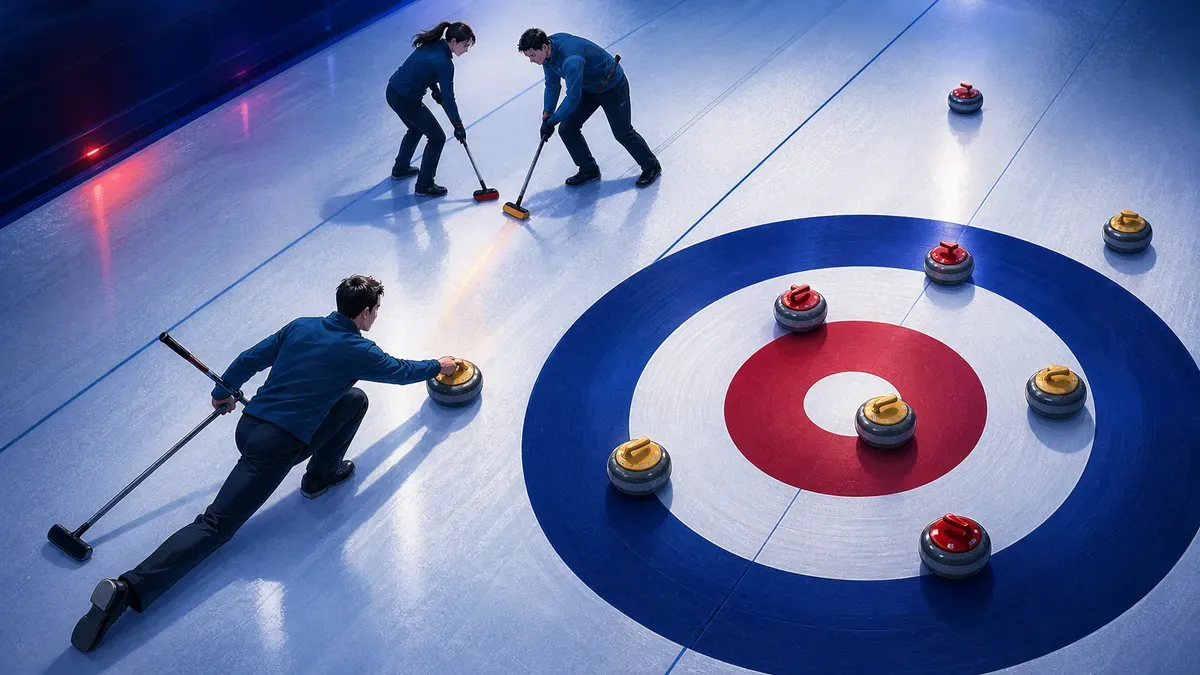
Curling is a precision team sport in which two sides alternate sliding granite stones toward a circular target called the house. The nearest stone to the button can score, but placement matters more than simply reaching the rings: guards protect space, draws build scoring positions, take-outs remove threats, and sweeping helps manage a moving stone’s distance and path.
The basic scoring rule takes a minute to learn. Reading the ice, controlling weight, communicating, and choosing a shot for the game situation take much longer. This guide focuses on traditional four-person curling and gives beginners a practical route from understanding an end to playing safely. Mixed doubles, wheelchair curling, youth leagues, and local recreational formats have important variations, so the current rulebook and club briefing always take precedence.
Quick answer
How do you play and score curling? Two four-person teams alternate delivering eight stones each during an end. When all 16 stones have stopped, only the team with the stone closest to the button scores. It receives one point for every stone in or touching the house that lies closer to the button than the opponent’s closest stone. A traditional game usually lasts eight or ten ends. The team with the hammer delivers last, loses that advantage after scoring, and normally keeps it after a blank end.
Key facts
- A curling end awards points to only one team.
- The closest counting stone determines which team scores the end.
- The hammer gives one team the final delivery of an end.
- Sweeping changes the interaction between a moving stone and pebbled ice.
- Safe beginner progress starts with footwear, balance, controlled delivery, and clear communication.
Curling in one table
The World Curling introduction to the sport describes a sheet more than 148 ft (45 m) long with a house at each end. A competition stone weighs almost 44 lb (20 kg), yet players slide it rather than lift or throw it.
| Term | Plain-language meaning | Why it matters |
|---|---|---|
| End | One round in which both teams deliver all their stones | Points are settled after the end, then play reverses direction |
| House | The four concentric rings around the button | A stone must touch the house to be eligible to score |
| Button | The center of the house | Distance to the button decides the counting order |
| Hammer | The last stone delivered in an end | It creates the final opportunity to score or change the arrangement |
| Guard | A stone in front of the house | It protects a scoring stone or blocks an opponent’s path |
| Draw | A controlled shot intended to stop in play, often in the house | It builds position without relying on a collision |
| Take-out | A faster shot intended to remove another stone | It reduces a threat or clears space |
| Sweep | Brush action in front of a moving stone | It can extend travel and help manage trajectory |
How curling scoring works
After the last stone of an end, first identify the stone nearest the button. Its team is the only team that can score. Then count that team’s stones in or touching the house until you reach an opponent’s stone that is closer than the next potential scorer.
Imagine red has the closest and second-closest stones, blue has the third-closest stone, and all three touch the house. Red scores two. If blue has the closest stone, blue scores, even if red has several stones elsewhere in the rings. A stone entirely outside the house cannot score. When visual judgment is too close, the teams use a measuring device rather than guessing.
The score accumulates across ends. A blank end has no counting stone for either team and awards zero points. If a scheduled game finishes tied, extra-end rules determine the winner. The official Rules of Curling 2025 govern competition details; a club may shorten games or modify procedures for learn-to-curl sessions.
What happens to the hammer?
The hammer is an advantage, not an automatic point. In traditional team curling:
- The hammer team delivers the final stone of the end.
- If either team scores, the other team receives the hammer for the next end.
- If the end is blank, the same team normally retains the hammer.
That creates a strategic tension. With hammer, a team often wants a route to two or more points rather than being forced to take one. Without hammer, a common objective is to steal or limit the opponent to one. Analyses of elite match data have found that blanking instead of taking a single point is favorable in many late-game states (Willoughby and Kostuk, 2005; Brenzel et al., 2019). That is context, not a command for every recreational end: score, remaining ends, team skill, ice, and shot difficulty change the decision.
The rules that shape an end
Four-person teams normally rotate in a fixed delivery order. Each player delivers two stones, and the teams alternate one stone at a time. A delivered stone must be released before it reaches the hog line at the delivery end and must completely cross the far hog line to remain in play unless it has contacted a stone already in play.
The first stones also receive special protection. Under the current five-stone free-guard-zone rule, an opponent’s stone resting between the far hog line and tee line, outside the house, cannot be knocked out of play before the sixth stone of the end. The current rules also protect certain center-line guards from an early tick shot. These constraints preserve options and discourage an immediate sequence of clearing shots. Beginners should learn the principle from an instructor before trying to adjudicate unusual collisions themselves.
Sportsmanship is part of the operating system. Players call their own touched stones in non-officiated play, avoid distracting an opponent, keep equipment clear, and agree on the score before moving stones. Do not reposition a stone based on memory when a skip, vice-skip, coach, or official should settle the ruling.
Shot types and beginner strategy
Curling is often called chess on ice, but a beginner needs a small, dependable vocabulary before a complicated playbook.
Draw and freeze
A draw is delivered with enough weight to stop at a chosen location. It may aim for the front of the house, the button, or a space behind cover. A freeze is a draw that stops directly against another stone, making a clean removal difficult. These shots test line and weight control more than speed.
Guard
A guard stops in front of the house. A center guard can create traffic and support a steal; a corner guard can help the hammer team build multiple scoring positions away from the center. A guard is useful only when the team understands what it is protecting or what route it is denying.
Take-out, hit and roll, and peel
A take-out removes another stone. A hit and roll continues moving after contact toward a useful position. A peel removes a guard and usually sends the delivered stone out too, clearing space. These shots add collision geometry and demand more weight, so beginners should develop a balanced release before treating speed as the solution.
A simple decision sequence
Before each delivery, ask four questions:
- What is the score and who has hammer? The game state defines acceptable risk.
- Which stone is currently counting? Protect it, improve it, or remove it.
- What miss can the team tolerate? A simpler draw or guard may be better than a low-probability double.
- What does this shot leave next? Good strategy manages the opponent’s likely reply, not only the current stone.
Elite expected-score models emphasize that curling decisions contain uncertainty: identical intentions can create different outcomes because execution, ice, collisions, and sweeping vary (Yamamoto et al., 2026). For beginners, the practical lesson is to prefer a clear team plan and a playable miss over an impressive call nobody can execute consistently.
Delivery technique: line before force
A conventional delivery begins in the hack with one foot supported and the slider foot prepared to travel under the body. The player organizes the intended line, initiates a controlled forward slide, stabilizes the trunk and hips, then releases the handle cleanly before the near hog line. The stone receives gentle rotation; it is not spun hard.
The delivery should become quiet and repeatable:
- set the body and stone on the intended line before accelerating;
- drive only as strongly as needed for the selected weight;
- keep the slider foot and center of mass organized rather than collapsing inward;
- use the support arm or brush as taught, without placing it where it can slip away;
- release without pushing the stone sideways;
- hold the finish long enough to learn from balance and line.
Different slide techniques load the lower limb differently. A 2025 biomechanical study of 16 male professional curlers found meaningful differences in hip, knee, ankle, and subtalar mechanics across three sliding-foot positions (Hua et al., 2025). The sample was small and elite, so it does not identify one universal beginner stance. It does support coached technique and progressive hip, knee, and ankle capacity instead of copying an extreme slide from video.
If deep knee flexion, a prior joint issue, or balance makes the classic slide inappropriate, ask the club about alternatives. World Curling publishes recommendations for delivery sticks in recreational play, but local permission and procedures govern their use.
Sweeping: manage weight, line, and communication
Sweeping is both physical work and real-time information. The thrower provides the initial line, speed, and rotation. Sweepers judge how quickly the stone is traveling, listen for the skip’s line call, and communicate weight so the team can decide whether to brush.
Current rules allow the delivering team to sweep its moving stone in front of the tee line. Behind that line, privileges narrow, and only designated players may sweep an opponent’s stone. The brush must not leave debris, be raised in front of the moving stone, or finish directly in its path. Read the current sweeping rule before competition because equipment and officiating requirements can change.
Sweeping generally reduces effective friction and can extend a stone’s travel. Directional influence is more complex. Recent experimental work found that the mechanisms and consistency of curl control remain incompletely understood (Honkanen et al., 2024), while a 2024 scoping review mapped continuing debate across stone physics, sweeping, delivery, tactics, injury, and training (Zacharias et al., 2024). Avoid absolute promises such as “this brush angle always makes the stone move right.” Learn the club’s ice, use legal technique, and let an experienced skip calibrate the call.
For efficient beginner sweeping:
- walk or slide with eyes up and a stable base;
- keep feet out of the stone’s path;
- place pressure through the brush without folding at the lower back;
- use short, controlled strokes taught by the coach;
- communicate observed weight in consistent words or numbers;
- stop immediately when the caller says off;
- never chase a stone beyond your balance or awareness.
Roles and communication
The traditional positions are lead, second, third or vice-skip, and fourth or skip, although the person who skips does not have to throw fourth. The lead establishes the end, the middle players handle developing traffic, the vice-skip supports house management and scoring, and the skip calls shots and holds the target brush. Every player delivers and sweeps; every player also supplies information.
A useful communication loop is concise:
- The skip names the shot, intended turn, target, and expected weight.
- The thrower confirms the call and delivers.
- The sweepers report weight while the skip judges line.
- The team calls sweep or off without competing instructions.
- After the stone stops, the team notes the miss and recalibrates.
Blame slows learning. “Heavy by three feet” is actionable; “bad shot” is not. Treat each delivery as feedback about ice speed, release, sweeping, and team language.
Curling relies on controlled stone delivery and sweeping rather than continuous skating. For an ice sport built around puck roles, line changes, offside, icing, and penalties, read our ice hockey beginner guide.
Physical demands and off-ice preparation
Curling is not continuous running, but it is not physically empty. Delivery requires single-leg balance, hip and knee control, trunk stability, and joint range. Sweeping adds repeated upper-body work while the player travels on low-friction ice. A game also demands concentration across many intermittent efforts.
Research remains narrower than in running or football. In one study of eight Olympic-level curlers, session rating of perceived exertion—session RPE multiplied by duration—showed useful relationships with external and physiological load measures, but it did not replace sport-specific context (Wu et al., 2025). A separate 2024 analysis of eight elite athletes also underlines how small the evidence base remains (Wu et al., 2024). Recreational players should not import elite workload formulas as personalized injury predictions.
A practical off-ice foundation can include:
| Quality | Why curling uses it | Beginner options |
|---|---|---|
| Single-leg control | Stabilizes the delivery and movement on ice | Supported split squat, step-down, single-leg balance reach |
| Hip and leg strength | Supports a controlled slide and repeated rising | Squat to a box, split squat, hip hinge, calf raise |
| Trunk endurance | Transfers force while sweeping and delivering | Dead bug, side plank, anti-rotation press, loaded carry |
| Upper-body endurance | Supports repeated brush pressure | Incline push-up, row, light interval circuits |
| Aerobic base | Supports recovery across a long game | Brisk walking, cycling, rowing, or easy jogging |
| Mobility | Makes useful positions available without forcing range | Ankle rocks, hip rotations, thoracic rotation |
Our balance-training guide can support general stability, while the strength-training frequency guide helps place two weekly sessions around sport. Neither teaches delivery mechanics; the ice coach owns that progression.
For a contrast with high-speed ice-track sports, see our guide to the differences between bobsleigh, skeleton, and luge.
Curling safety for a first session
Falls are the clearest preventable hazard. A retrospective Canadian injury-surveillance study found that more than 90% of acute curling injuries presenting for emergency care followed a fall, and 31.7% involved a head impact; surveyed participants frequently linked falls to inadequate footwear (Ting and Brison, 2015). An earlier survey of competitive curlers found knee, back, and shoulder symptoms were common among respondents, with delivery and sweeping often provoking pain (Reeser and Berg, 2004). Both studies have design and age limitations, but they identify sensible areas for prevention.
Before stepping on the sheet:
- use a clean gripper over the slider except during a taught delivery;
- choose clothing that stays warm without restricting the slide;
- clean shoe soles and brush heads so debris does not contaminate the ice;
- step onto and off the ice with support;
- never walk backward casually or step over a moving stone;
- keep hands free when learning to move rather than carrying several objects;
- warm up ankles, hips, trunk, and shoulders off the ice;
- stop when fatigue makes foot placement or awareness unreliable.
Multicomponent neuromuscular warm-ups can improve movement readiness and may reduce injury risk in several sports, although programs and populations vary and curling-specific trials are scarce (Kłobuchowski et al., 2026). Use a short progression—easy pulse-raising movement, ankle and hip range, controlled squats and lunges, trunk rotation, and rehearsal of the day’s pattern—rather than relying on one stretch as protection. Our guide to stretching and injury prevention explains that distinction.
After a head impact or suspicious fall, headache, dizziness, confusion, balance change, vision disturbance, vomiting, unusual behavior, weakness, or numbness warrants immediate removal and assessment. The international concussion consensus advises removing an athlete when concussion is suspected and avoiding same-day return unless an experienced clinician determines the sign was unrelated. Chest pain, fainting, severe breathlessness, or acute joint injury also overrides the session plan.
A four-week beginner progression
This example assumes a healthy adult attending one coached club session per week. A coach should adapt it for the venue, mobility, prior experience, and any medical or musculoskeletal concern.
| Week | On-ice priority | Off-ice support | Progress only when |
|---|---|---|---|
| 1 | Enter and exit safely, use gripper and slider, learn scoring, deliver from a stable shortened position | Two short balance and basic-strength sessions | You can move, stop, and handle equipment without surprise slips |
| 2 | Repeat line and weight with simple draws; introduce sweeping footwork slowly | Add rows, anti-rotation work, and easy aerobic activity | Delivery direction and sweeping path remain controlled |
| 3 | Practice guards, draws, and gentle take-outs; use consistent weight calls | Keep strength steady; add no maximal fatigue | The team communicates before and during each shot |
| 4 | Play short ends with hammer awareness and simple shot planning | Review soreness and recovery; progress one variable | Technique remains stable late in the session |
Do not increase ice time, sweeping intensity, delivery depth, take-out weight, and gym load in the same week. The training-load guide provides a broader framework for changing one stressor at a time. The fitness library is the hub for conditioning that supports sport without pretending general workouts replace instruction.
The speed-skating disciplines guide is a useful lateral comparison: both take place on ice, but racing edges, high speed, and pack risk create a fundamentally different skill and safety problem from curling’s prepared sheet, slider, delivery, and stone management.
Track adaptation without turning data into a shot call
Once coaching and a repeatable week are established, SuperAge can help you compare activity, sleep, resting signals, and recovery trends against your own baseline. Add context such as session duration, number of ends, delivery practice, hard sweeping, soreness, and perceived exertion so a demanding club night is not mistaken for an unexplained change.
A favorable score cannot decide whether the ice is fast, your gripper is clean, a slide is technically sound, or a collision requires assessment. Use trends to guide questions and recovery habits; use a coach for technique and a clinician for symptoms.
Download SuperAge to follow fitness and recovery patterns as your curling skills develop on the ice.
Frequently asked questions
How many points can a team score in one curling end?
In traditional four-person curling, a team can theoretically score up to eight because it delivers eight stones. Only one team scores in an end, and only stones in or touching the house that are closer than the opponent’s nearest stone count.
What is the hammer in curling?
The hammer is the final stone of an end. In traditional curling, the team that scores gives the hammer to its opponent for the next end; a team that blanks the end normally retains it. Mixed doubles handles blank ends differently.
Why do curlers sweep the ice?
Sweeping modifies the stone-ice interaction and generally helps the stone travel farther. It can also influence the path, but the physics and consistency of directional control are more complex than simple slogans suggest. Sweep only when called and with legal club-taught technique.
What is the five-rock rule?
It is the free-guard-zone protection in the current traditional game. Before the sixth stone of an end, an opponent’s stone in the free guard zone cannot be removed from play. The exact restoration procedure and no-tick provision belong to the official rulebook.
Is curling difficult for beginners?
Scoring is easy to understand, but the slider, delivery balance, weight control, sweeping footwork, ice reading, and team decisions require practice. A learn-to-curl session reduces the problem to safe movement and a few basic shots.
Do you need to be strong to curl?
Maximum strength is not an entry requirement. Balance, controlled range, coordination, and repeatable submaximal effort matter first. General strength and aerobic fitness can support delivery, sweeping, and recovery, but technique determines how well that capacity reaches the stone.
Is curling safe after 50?
Many older adults can participate, especially with coaching, correct footwear, progressive delivery options, and an honest review of balance, joints, medications, bone health, and cardiovascular symptoms. Ask a clinician for individualized guidance when health conditions or fall risk make vigorous activity or ice exposure uncertain.
What should I wear to a first curling session?
Wear warm, flexible layers and clean footwear that follows the club’s instructions. The venue may provide a slider, gripper, brush, and helmet or may specify what to bring. Avoid dirty soles, restrictive jeans, and loose items that can fall onto the ice.
Key takeaways
- Curling scores one team per end according to distance from the button, not the number of stones merely touching the house.
- Hammer, guards, and the free guard zone turn simple placement into a sequence of risk and response.
- A repeatable line and weight matter before deep slides, hard take-outs, or aggressive sweeping.
- Falls, head impacts, and repetitive knee, back, or shoulder symptoms deserve active prevention and prompt assessment.
- Coaching teaches the ice-specific skill; balance, strength, aerobic work, sleep, and progressive load help you tolerate and repeat it.
References
- World Curling. What is curling?. Accessed August 12, 2026.
- World Curling. Rules of Curling 2025. July 2025.
- World Curling. Rules and technical documents. Accessed August 12, 2026.
- World Curling. Recommendations for delivery sticks in recreational play. 2020.
- Zacharias A, Robak P, Passmore M. An examination of studies related to the sport of curling: a scoping review. Sports Biomechanics. 2024.
- Honkanen V, et al. Sweeping effects on curling and friction estimation. Sports Engineering. 2024.
- Yanagi H, et al. Measurement of forces exerted during sweeping in curling. International Conference on Biomechanics in Sports. 2008.
- Hua L, et al. Effects of sliding techniques on lower limb biomechanics and muscle synergy during curling delivery. Frontiers in Human Neuroscience. 2025.
- Wu J, et al. Session-RPE for quantifying workload in Olympic curling athletes. 2025.
- Wu J, Zhao F, Li C. Analyzing activity and injury risk in elite curling athletes. Frontiers in Public Health. 2024.
- Reeser JC, Berg RL. Self-reported injury patterns among competitive curlers. British Journal of Sports Medicine. 2004.
- Ting DK, Brison RJ. Injuries in recreational curling include head injuries and may be prevented by proper footwear. Health Promotion and Chronic Disease Prevention in Canada. 2015.
- Willoughby KA, Kostuk KJ. An analysis of a strategic decision in the sport of curling. Decision Analysis. 2005.
- Brenzel P, Shock W, Yang H. An analysis of curling using a three-dimensional Markov model. Journal of Sports Analytics. 2019.
- Yamamoto K, et al. Building an all-shot expected-score distribution model from real-match curling boards. Applied Sciences. 2026.
- Kłobuchowski W, et al. Exercise-based strategies from warm-up to training. Sports. 2026.
- Patricios JS, et al. Consensus statement on concussion in sport. British Journal of Sports Medicine. 2023.
- World Health Organization. Guidelines on physical activity and sedentary behaviour. 2021.
Related Articles

Working out but not losing weight? How to find the cause
Working out but not losing weight? Check the weight trend, activity, food intake, body composition, and medical factors before changing your routine.