Ice hockey rules, positions, and penalties: a beginner guide
Learn ice hockey rules, positions, penalties, offside, icing, game length, equipment, and a safe path from first skate to first shift with confidence.
Ice hockey becomes easier to follow when you stop tracking every skater and start reading three things: which team controls the puck, which zone the puck occupies, and how many players each team has on the ice. Five skaters and one goalkeeper normally defend one net, attack the other, and substitute in short shifts while play continues.
The objective is simple: send the puck completely across the opponent’s goal line more times than the other team. The systems around that objective—offside, icing, face-offs, penalties, line changes, and specialized positions—create the speed and structure that can initially look like chaos.
This guide uses the current international rule framework as its baseline. Professional, national, youth, recreational, and small-area leagues can differ, especially on rink dimensions, body checking, overtime, protective equipment, and penalty administration. The rulebook and safety briefing for the competition you are actually watching or joining always take precedence.
Quick answer
How does ice hockey work? Two teams try to score with a puck while skating on an enclosed ice rink. At full strength, each side normally has three forwards, two defense players, and one goalkeeper on the ice. Regulation international games use three 20-minute stop-time periods. Players may change during play, so short, intense shifts form a continuous rotation. Offside prevents attackers from entering the offensive zone before the puck; icing generally prevents an equal-strength team from sending the puck from its own half beyond the opponent’s goal line simply to escape pressure. Rule violations can produce a stoppage, a face-off, a timed penalty, a penalty shot, or removal from the game.
Key facts
- An ice hockey team fields five skaters and one goalkeeper at full strength.
- Three regulation periods contain 20 minutes of stop time each under IIHF rules.
- The blue lines divide the rink into defending, neutral, and attacking zones.
- A minor penalty usually removes one player for two minutes and creates a power play.
- Short shifts preserve repeated skating speed, decision quality, and defensive coverage.
Ice hockey at a glance
The IIHF rules and regulations library identifies its latest rulebook as the authoritative version for IIHF events. The 2026/27 IIHF Official Rule Book permits a game roster of up to 20 skaters and two goalkeepers, although only six players per team are normally on the ice at full strength.
| Element | Beginner meaning | What to watch |
|---|---|---|
| Goal | The whole puck crosses the goal line between the posts and under the crossbar | A shot, rebound, deflection, or legal tip can score |
| Period | One of three 20-minute stop-time segments in regulation | The clock stops after whistles and goals |
| Shift | One player’s short spell on the ice before substituting | Changes often happen while the puck remains live |
| Face-off | An official drops the puck between two opponents to restart play | Teammates arrange for possession, pressure, or coverage |
| Power play | One team has more skaters because an opponent is serving a penalty | The advantaged team spreads out to create passing lanes |
| Penalty kill | The short-handed team defends during a penalty | Clearances, compact spacing, and controlled pressure matter |
| Offside | Attackers enter the offensive zone before the puck | Read the puck and both skates at the attacking blue line |
| Icing | A team sends the puck from its own half beyond the far goal line under specified conditions | The whistle brings the face-off back and can block a line change |
The rink explains the game
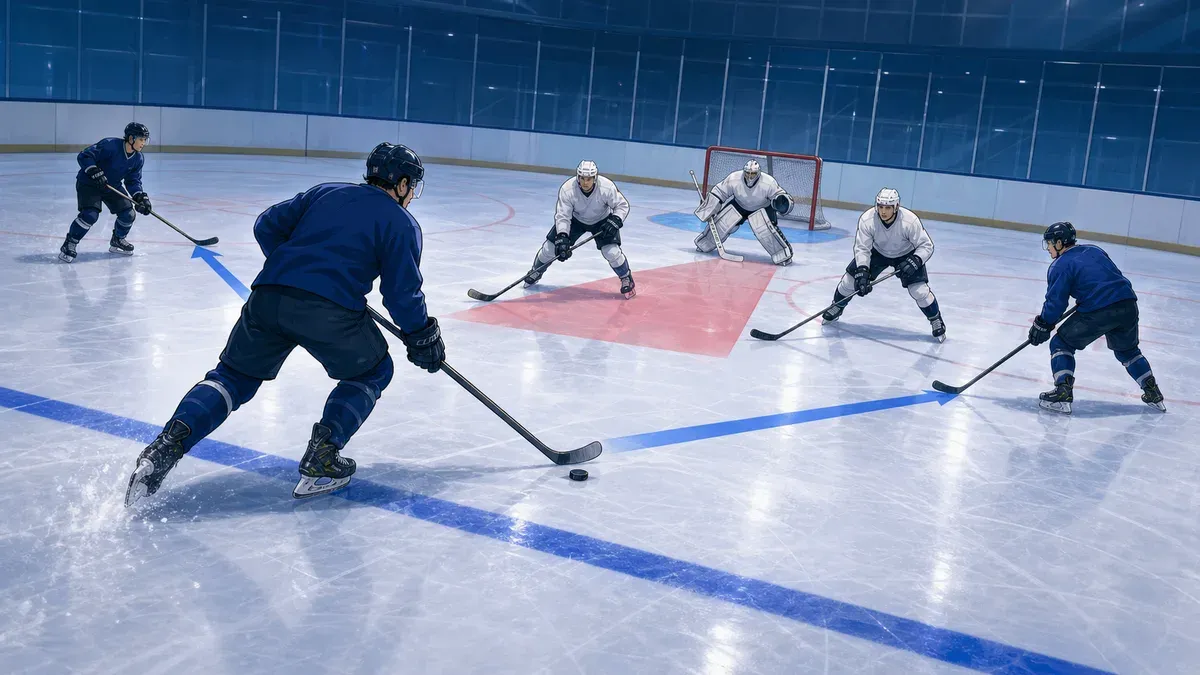
Two blue lines split the surface into three zones. The area around a team’s own net is its defending zone. The middle is the neutral zone. The far end is its attacking zone. Because direction reverses for the other team, the same patch of ice is one side’s attacking zone and the other’s defending zone.
The center red line divides the rink lengthwise for icing decisions. Each goal has a crease that protects the goalkeeper’s opportunity to play the position. Face-off circles and spots tell officials where to restart after goals, penalties, offside, icing, frozen pucks, and other stoppages. Boards and glass keep most pucks in play, which allows pressure to continue after a pass or shot misses its target.
Rink dimensions are not universal. International and North American professional surfaces can differ, and community facilities may use modified areas for youth or instruction. Spatial principles transfer better than memorized dimensions: blue lines control legal zone entry, the slot in front of goal is dangerous scoring space, and the boards can be used for passing, shielding, and exits.
How a game starts, stops, and ends
Every period and most stoppages restart with a face-off. The official drops the puck; the two centers contest immediate control; wingers and defense players position for the next likely pass, battle, or defensive assignment. A clean face-off win helps, but the second touch often decides real possession.
A goal counts when the entire puck legally crosses the line. One scorer and up to two assisting players may receive credit, but the scoreboard gives the team one goal. Goals can be disallowed for reasons such as a preceding offside, illegal contact with the goalkeeper, a distinct kicking action, or contact with the puck above the allowed height. The exact review standard depends on the competition.
After three periods, the team with more goals wins. A tied game may continue with sudden-death overtime and possibly a shootout, but formats vary across leagues, tournament stages, and regular-season versus playoff play. For example, IIHF preliminary-round overtime and elimination overtime do not use the same duration. Learn the event format rather than assuming one universal tiebreaker.
Ice hockey positions and responsibilities
Positions define starting responsibilities, not fenced territories. Modern play constantly rotates as teammates support the puck and cover one another.
Center
The center commonly takes face-offs, supports the puck through the middle, links defense to attack, and works low in the defensive zone. Good centers scan before receiving, offer a close outlet, and recover through the middle when possession changes. They are not simply the forward who stands in front of goal.
Left and right wing
Wingers attack lanes, pressure opposing puck carriers, support along the boards, and protect assigned areas during defensive-zone coverage. On a breakout, one wing may provide a wall option while the other stretches the defense. In the attacking zone, a wing can retrieve, screen, pass from below the goal line, or find quiet space for a shot.
Defense players
Two defense players usually protect the space between attackers and their net, retrieve pucks, start breakouts, manage the attacking blue line, and decide when one partner can join the rush. The job requires gap control: too much distance gives an attacker time; too little control can allow the attacker to skate past.
Goalkeeper
The goalkeeper protects the net with position, angle, depth, movement, rebound control, and communication. The role uses specialized equipment and rules. A save does not finish the defensive task if the rebound lands in dangerous space, so skaters must locate opponents and clear the next puck rather than admire the first stop.
Teams normally organize forwards into lines of three and defense players into pairs. Coaches rotate these units, alter matchups, and create special-team groups for power plays and penalty kills. The official IIHF ice hockey terminology guide provides plain-language definitions for many of these roles and game situations.
Why players change so often
Ice hockey combines acceleration, braking, turns, contact, puck decisions, and repeated high-intensity skating. A physiology review describes typical on-ice shifts of roughly 30–80 seconds, with longer recovery between shifts and about 15–25 minutes of total ice time for many players. Both aerobic and anaerobic systems contribute, and fatigue can reduce high-intensity work late in a game (Vigh-Larsen and Mohr, 2024).
That is why a well-timed change is tactical, not a sign of weakness. Players can substitute while play continues, but the outgoing player must be close enough to the bench and out of the play before the replacement becomes involved. A poor change can create an odd-player rush or a too-many-players penalty.
For a beginner, the useful rule is simple: change before technique, awareness, and recovery skating collapse. Skate directly to the bench when called, communicate the position being replaced, and do not chase one last puck that traps tired teammates on the ice.
Offside and icing without the jargon
These rules both shape territory, but they solve different problems.
Offside controls zone entry
Attacking players must not precede the puck into the attacking zone. Under the current IIHF rule, skate position determines offside: an attacker remains onside if a skate is in contact with or has not completely crossed the plane of the blue line when the puck fully crosses. A player with possession and control may skate across ahead of the puck under the rule’s control exception.
In a delayed offside, attackers can clear the zone and allow play to continue. If an offside attacker deliberately touches the puck or the situation cannot be cleared, the whistle stops play and a neutral-zone face-off usually follows.
Icing limits pressure-free clearances
Icing generally occurs when a team at equal or greater numerical strength sends the puck from its own half beyond the opponent’s goal line without a legal touch or exception. Modern international play uses a race judgment: the linesperson determines which player would reach the puck first by the designated decision point. The goal is to prevent dangerous full-speed races while preserving a legitimate attacking chase.
Icing is waved off when a valid exception applies, including when the defending team could reasonably play the puck or when the offending team is short-handed. After icing, the offending team normally cannot substitute before the defensive-zone face-off. That turns an impatient clearance into a fatigue and territory cost.
The NHL video rulebook offers visual examples of offside, delayed offside, icing, hand passes, and common fouls. Use it to learn what officials watch, while remembering that NHL and IIHF wording is not identical.
Penalties, power plays, and player strength
A penalty changes both time and space. The penalized player may go to the penalty box while the team plays with fewer skaters, giving the opponent a power play. If both teams receive matching penalties, on-ice strength may remain even.
| Penalty type | Typical IIHF consequence | Beginner interpretation |
|---|---|---|
| Minor | Two minutes; the short-handed segment can end after an eligible power-play goal | Common fouls such as tripping, hooking, holding, or interference often enter here |
| Double minor | Two consecutive minor penalties | Certain infractions carry a longer but segmented consequence |
| Major | Five minutes; the team remains short-handed for the full major | Reserved for more serious conduct under the applicable rule |
| Misconduct | The player is removed for ten minutes but the team does not automatically lose on-ice strength | Conduct consequence for the individual |
| Game misconduct | The player is removed for the rest of the game | Often accompanies severe or specified infractions |
| Penalty shot | One attacker gets an unopposed attempt against the goalkeeper | Restores a major scoring chance illegally denied under defined conditions |
Do not reduce penalty recognition to whether someone falls. Legal body contact, allowed body checking, and prohibited contact depend on age group, competition, angle, puck possession, point of contact, force, and intent. Boarding, charging, checking from behind, illegal checks to the head, elbowing, kneeing, tripping, slashing, and cross-checking are distinct decisions.
Youth and recreational leagues often restrict body checking more than elite adult competition. The current USA Hockey rulebook resources include 2025–29 rules, body-checking standards, and safety points of emphasis. A local no-check league is not a no-contact environment: incidental contact can still happen, so balance, awareness, and respect remain essential.
Equipment and safety for a first session
Joining hockey should begin with coached skating and correctly fitted protective equipment, not with a full-speed scrimmage. Requirements vary, but a skater commonly uses an approved helmet and facial protection appropriate to the league, mouthguard where required, neck protection where required, shoulder and elbow pads, gloves, protective pants, shin guards, skates, and a stick. Goalkeeping equipment is specialized and should be fitted with experienced help.
Equipment reduces risk but does not make dangerous technique safe. A 2024 systematic review of professional men’s ice hockey reported much higher injury incidence in games than training, with traumatic injuries forming the majority and lower-extremity injuries the largest regional group (Cattaneo et al., 2024). Professional data cannot predict an individual recreational player’s risk, but they reinforce a simple hierarchy: learn to skate, stop, turn, fall, rise, and protect space before adding speed and contact.
After a blow to the head or body, remove a player immediately when concussion is suspected. Headache, dizziness, confusion, memory change, balance trouble, vision symptoms, vomiting, unusual behavior, weakness, or worsening symptoms require assessment. The CDC HEADS UP program advises against same-day return after suspected concussion until an appropriate healthcare professional has cleared the athlete. Emergency signs such as repeated vomiting, a worsening headache, seizure, increasing drowsiness, weakness, slurred speech, or loss of consciousness need urgent care.
Chest pain, fainting, unexplained severe breathlessness, a visibly deformed limb, inability to bear weight, or severe neck pain also overrides the practice plan. A coach teaches sport skill; a clinician evaluates injury and medical risk.
Physical preparation that transfers to hockey
Skating speed is multifactorial. A 2025 systematic review found relationships between on-ice speed and measures including sprinting, jumping, body composition, and anaerobic power, while warning that no single test captures skating performance (Silvestri et al., 2025). Off-ice fitness supports hockey, but it cannot replace edge control, puck skill, scanning, and decisions on ice.
A practical foundation includes:
- lower-body strength for acceleration, braking, and stable contact;
- single-leg control for edges and direction changes;
- trunk strength for transferring force without losing posture;
- upper-body strength for stick battles and safe positional contact;
- aerobic capacity for recovery between shifts;
- repeated-sprint exposure added progressively after a base exists.
Two consistent strength sessions can be enough for many recreational schedules; our strength-training frequency guide helps organize that work. The heart-rate-zones-by-sport guide explains why a wrist-derived average can miss the stop-start character of rink sports. Use the training-load guide when increasing ice time, gym load, or game frequency, and avoid raising all three in the same week.
For edge and pack-racing contrasts, read the short-track speed skating guide and the broader speed-skating disciplines comparison. Those articles teach racing logic; hockey adds a stick, puck, teammates, opponents, rapid substitution, and contested territorial play. Our curling beginner guide is another useful lateral comparison: it shares ice and team decisions but uses controlled stone delivery rather than continuous skating and contact.
A four-stage beginner pathway
This progression is a framework, not a promise that every adult advances on the same schedule.
| Stage | On-ice priority | Off-ice support | Ready to progress when |
|---|---|---|---|
| 1. Movement | Safe entry and exit, stance, glide, stop, turn, controlled fall and rise | Basic balance, squat pattern, calf and ankle capacity | You can stop on request and look up without losing control |
| 2. Puck skill | Carry, forehand and backhand pass, receive, wrist shot at low speed | Two simple strength sessions and easy aerobic work | You control the puck without abandoning skating posture |
| 3. Shared ice | Lane awareness, support triangles, defensive side, legal change | Short intervals with full recovery | You scan, communicate, and leave the ice before form collapses |
| 4. Structured play | Face-offs, breakouts, forecheck, backcheck, special-team basics | Gradual repeated-sprint work and recovery tracking | You follow league rules and remain predictable to teammates |
An introductory program or adult learn-to-play class is safer and faster than self-teaching in open ice. The IIHF introduction to ice hockey and its coaching resources can help with vocabulary, but a qualified instructor must adapt drills to the rink, equipment, age, and ability in front of them.
The fitness article hub can support general capacity. It does not replace skating instruction or your league’s rule and safety orientation.
Use SuperAge after the sport problem is solved
Once you have coaching, safe equipment, and a repeatable weekly schedule, SuperAge can help place ice hockey inside the rest of your life. Compare session duration, perceived effort, sleep, resting trends, soreness, and next-day recovery against your own baseline. Add context such as practice, game, hard skating drill, late finish, or return after illness.
No readiness score can rule on offside, fit a helmet, diagnose a concussion, or decide whether pain is safe. Use trends to improve questions and habits; use coaches for technique, officials for rules, and clinicians for symptoms.
Download SuperAge to follow fitness and recovery patterns as you build a sustainable hockey routine.
Frequently asked questions
How many players are on an ice hockey team?
At full strength, six players per side are on the ice: one goalkeeper and five skaters, normally organized as three forwards and two defense players. The game roster is larger because players rotate in lines and pairs. Competition limits vary; IIHF rules allow up to 20 skaters and two goalkeepers on the game roster.
How long is an ice hockey game?
IIHF regulation uses three 20-minute stop-time periods, with 15-minute intermissions unless the event defines otherwise. Because the clock stops for whistles and intermissions separate periods, elapsed arena time is much longer than 60 minutes. Youth and recreational formats may use shorter periods or running time.
What is offside in ice hockey?
Offside occurs when an attacking player enters the attacking zone before the puck under the applicable skate-and-blue-line test. The rule makes puck entry the leading event and prevents attackers from waiting deep near the opponent’s net.
What is icing in ice hockey?
Icing generally occurs when a team at equal or greater numerical strength sends the puck from its own half beyond the opponent’s goal line without a qualifying touch or exception. Play stops, the face-off returns to the offending team’s end, and that team normally cannot change players before the face-off.
What is a power play?
A power play occurs when one team has more skaters because an opponent is serving a penalty. The advantaged team tries to use extra width and passing options; the short-handed team uses a penalty-kill structure. Not every penalty changes player strength, and matching penalties can cancel the numerical effect.
Can players substitute while the puck is in play?
Yes. Hockey permits changes during live play, which are often called changes on the fly. The outgoing player must be sufficiently close to the bench and out of the play before the replacement becomes involved. Too many players or an early involvement can produce a bench minor penalty.
Is body checking required in ice hockey?
No. Whether body checking is allowed depends on the league, age, category, and rules. Even no-check hockey includes incidental contact and contested space. Beginners should learn body position, awareness, balance, and the local standard before any contact drill.
What should an adult learn before playing a first game?
Learn to stop, turn both directions, rise after a fall, skate with your head up, control the stick, make and receive a short pass, change safely, and understand offside, icing, penalties, and the league’s contact rule. A coached learn-to-play program is the most reliable route.
Key takeaways
- Full-strength hockey normally means three forwards, two defense players, and one goalkeeper per team on the ice.
- Blue lines organize territory; offside controls entry and icing discourages pressure-free clearances.
- Short shifts protect speed, decisions, and defensive coverage in a repeated high-intensity sport.
- Penalties change player strength, but their duration and effect depend on penalty type and competition rules.
- Equipment, skating control, progressive load, and immediate removal after suspected concussion matter more than rushing into a game.
- General fitness supports hockey; coached ice skill and local rules determine whether that fitness can be used safely.
References
- International Ice Hockey Federation. Rules, Regulations & Guidelines. Accessed August 13, 2026.
- International Ice Hockey Federation. IIHF Official Rule Book 2026/27. June 2026.
- International Ice Hockey Federation. Ice hockey terminology. Accessed August 13, 2026.
- International Ice Hockey Federation. Intro to ice hockey. June 2020.
- USA Hockey. Rule Book & Resources. Accessed August 13, 2026.
- National Hockey League. Video Rulebook. Accessed August 13, 2026.
- Vigh-Larsen JF, Mohr M. The physiology of ice hockey performance: an update. Scandinavian Journal of Medicine & Science in Sports. 2024;34(1):e14284.
- Silvestri MA, et al. Examining the determinants of skating speed in ice hockey athletes: a systematic review. Journal of Strength and Conditioning Research. 2025;39(4):507–514.
- Cattaneo M, et al. What is the injury incidence and profile in professional male ice hockey? A systematic review. International Journal of Sports Physical Therapy. 2024.
- Centers for Disease Control and Prevention. HEADS UP. Accessed August 13, 2026.
- Centers for Disease Control and Prevention. Managing return to activities after mild traumatic brain injury. July 2025.
Related Articles

Working out but not losing weight? How to find the cause
Working out but not losing weight? Check the weight trend, activity, food intake, body composition, and medical factors before changing your routine.