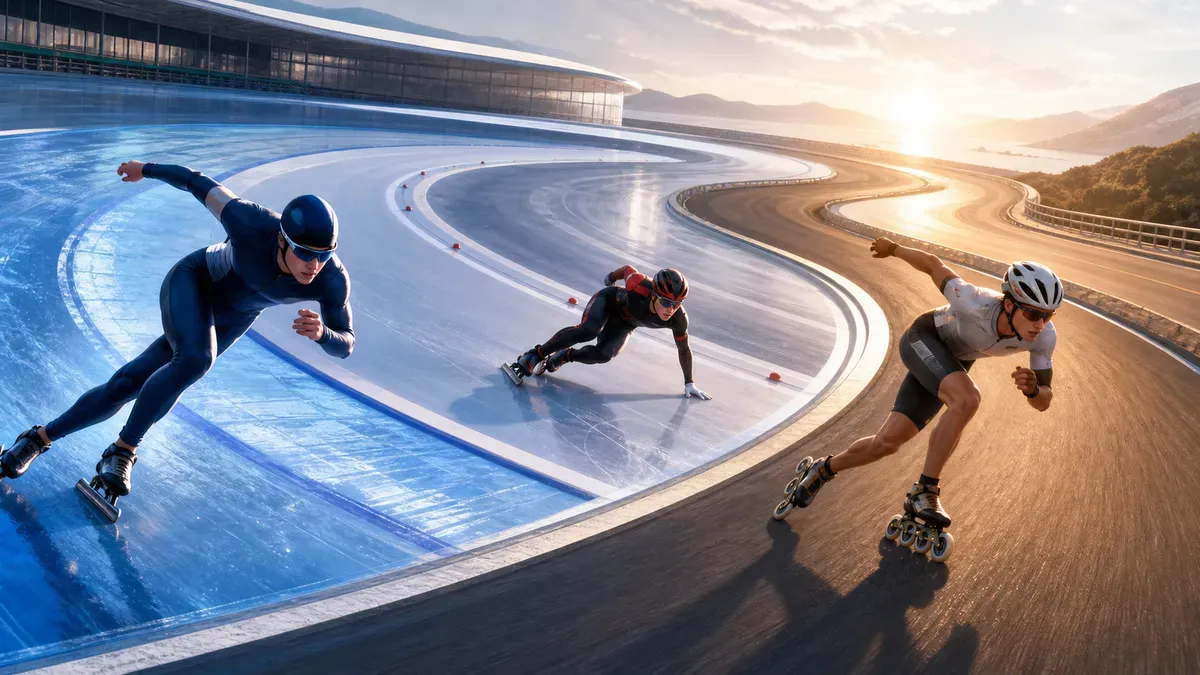
Speed skating disciplines: long track, short track, and inline
Compare speed skating disciplines, rules, race formats, physical demands, safety, and a practical path from first lesson to structured training.
Speed skating is a family of racing sports, not one single format. Long track pairs skaters against the clock on a 1,312.3 ft (400 m) ice oval. Short track places a pack on a compact 364.6 ft (111.12 m) ice oval. Inline speed skating moves the contest to wheeled skates on a banked track or road circuit, with sprints, points races, eliminations, relays, and a road marathon.
The fastest-looking discipline is not automatically the best starting point. Surface, traffic, turn radius, event length, equipment, and access to qualified coaching all change what a skater must learn. This guide compares those demands so you can watch the sports with more understanding—or choose a realistic entry route without confusing elite racing with beginner practice.
Quick answer
What are the main speed skating disciplines? The three broad families are long track speed skating, short track speed skating, and inline speed skating. Long track usually uses paired time trials and lane changes on a 400 m ice oval. Short track uses mass-start knockout races on a 111.12 m oval. Inline racing takes place on track or road and includes both time-based and pack-based events. All three reward lateral force, balance, efficient aerodynamics, and repeatable technique, but their tactics and safety environments differ.
Key facts
- Long track speed skating uses separate competition lanes for most classic-distance time trials.
- Short track speed skating turns shared ice, positioning, and legal passing into central race skills.
- Inline speed skating includes track and road events ranging from short sprints to a 26.2 mi (42.195 km) marathon.
- A low skating posture increases aerodynamic efficiency and local muscular demand at the same time.
- Beginner progress depends on controlled stopping, turning, falling, and group awareness before race speed.
Speed skating disciplines at a glance
The word “speed skating” often means long track in an Olympic ice context, but the broader family contains formats with very different race logic.
| Discipline | Surface and course | Typical race logic | What most shapes the result |
|---|---|---|---|
| Long track | Ice, usually a 1,312.3 ft (400 m) oval | Paired time trial for classic distances; also mass start and team formats | Pace, lane exchange, aerodynamic position, corner technique, sustained power |
| Short track | Ice, 364.6 ft (111.12 m) oval inside a rink | Pack racing through knockout rounds | Position, passing, acceleration, tight turns, traffic judgment |
| Inline track | Wheels, closed banked or flat track | Sprints, time trials, points, elimination, pursuit, relay | Drafting, pack position, repeated acceleration, surface grip |
| Inline road | Wheels, closed road circuit or marathon route | Sprint, points, elimination, endurance, marathon | Pack efficiency, terrain, wind, surface changes, late-race decisions |
This comparison is about the dominant formats, not every national or age-group variation. Event programs change, and the current federation rulebook plus the organizer’s communication always governs a specific competition.
Long track: race the clock and manage the exchange
Classic long-track races place two skaters on the oval at once, but each is fundamentally chasing time. The International Skating Union’s current speed skating overview lists races from 500 m through 10,000 m, alongside team sprint, team pursuit, mass start, and mixed relay formats.
For classic distances, one skater starts in the inner lane and one in the outer lane. They switch lanes on the backstretch each lap so both cover equal distance. That exchange is not a casual merge. The outside-lane skater has priority when both reach the crossing together, and interference can affect the result. The ISU explanation of backstretch rules shows why awareness matters even in a time-trial discipline.
Distance changes the performance problem:
- 500 m: start mechanics, early acceleration, top speed, and one clean lap dominate.
- 1000 m and 1500 m: the skater must distribute a very high effort without losing technique as fatigue rises.
- 3000 m to 10,000 m: lap consistency, aerodynamic economy, and aerobic support matter more, while poor pacing compounds.
- Team pursuit: three athletes coordinate pace and drafting; the team’s time is tied to the required finishing skater.
- Mass start: the pack, intermediate points, positioning, and the final sprint replace pure time-trial logic.
The classic long-track posture is low because reducing frontal area lowers aerodynamic drag. Yet the position is costly. Experimental work found that the long force-producing phase and high intramuscular pressure can restrict working-muscle blood flow, especially at deeper knee angles (Foster et al., 1999). “Get lower” is therefore not a complete technique cue: the position must remain mechanically useful and repeatable.
Power also matters beyond the first steps. A 2025 study using 635 tests from 120 national-level long-track skaters found strong relationships between relative peak or mean Wingate power and 500 m or 1000 m performance (Sitkowski et al., 2025). Those data describe trained racers, not a threshold a recreational skater needs to meet.
Short track: shared space changes everything
Short track uses a smaller oval and puts several skaters on the same line. The first blade tip across the finish wins, but reaching it requires safe overtaking, position, anticipation, and the ability to accelerate after repeated tight bends.
Current senior individual distances are 500 m, 1000 m, and 1500 m. The ISU short track rules explainer describes them as roughly 4.5, 9, and 13.5 laps, plus mixed 2000 m, women’s 3000 m, and men’s 5000 m relays. Skaters normally advance through successive knockout rounds rather than posting one time against the full field.
Legal passing is not permission for uncontrolled contact. Leaving the track, impeding, receiving prohibited assistance, an improper skate kick at the finish, or simulating an infringement can bring a sanction. The overtaking athlete needs enough speed, a real opening, and control of the exit—not merely the intention to pass.
Physiology shifts with distance too. In a small 2026 study of nine national-level male short-track skaters, estimated aerobic contribution rose from 22.2% in the 500 m to 35.3% in the 1000 m and 44.3% in the 1500 m (Kıyıcı et al., 2026). The sample is too narrow for universal prescriptions, but the direction is practical: longer short-track races still require explosive actions while leaning more heavily on aerobic support.
For a detailed treatment of pack rules, technique, equipment, and a beginner training week, use our short track speed skating guide. The boundary matters: this article compares the discipline family; that guide teaches the short-track pathway in depth.
Inline speed skating: track and road create more formats
Inline speed skaters use long-frame skates with wheels in a single line. Competition takes place on dedicated tracks and road circuits, so wind, pavement, course width, elevation, and pack size can influence the race more than they do on controlled indoor ice.
The World Skate speed rulebook lists official track and road distances from 100 m to 20,000 m, with the 26.2 mi (42.195 km) marathon reserved for road. Formats include individual and team time trials, sprints, pursuit, points, elimination, points-elimination, relays, and endurance races.
That variety produces two broad tactical worlds:
- Short, time-based events prioritize the start, acceleration, clean lines, and maximal speed.
- Pack events reward drafting, position, economical movement, anticipation, and the ability to sprint after variable pacing.
Drafting is not a small detail. In a study of eight top national-level male inline skaters, following another skater reduced measured oxygen demand by about 14–15% at 18.6–20.5 mph (30–33 km/h) (Krieg et al., 2006). The exact saving varies with position, body size, speed, wind, and group formation, but the mechanism explains why a tactically patient skater can beat someone with a higher isolated cruising speed.
Ice and inline skating transfer some general qualities—lateral push, single-leg control, trunk organization, and aerobic capacity—but they are not interchangeable. Wheel grip, braking, surface imperfections, corner geometry, equipment behavior, and fall consequences require specific instruction.
The shared movement problem: push sideways, travel forward
Running creates forward propulsion partly by pushing backward against the ground. Speed skating directs force more laterally because a narrow blade or rolling wheel must preserve glide. The skater shifts pressure over one support leg, pushes away from that edge, and returns the free leg without disturbing the body’s path.
Across disciplines, four qualities interact:
- Edge or wheel control: force is useful only if the contact point holds its intended line.
- Single-leg strength: each support phase must accept body weight and redirect force.
- Lateral hip capacity: abductors and adductors control push, recovery, and pelvic position.
- Trunk endurance: a stable, low posture lets the legs work without excessive vertical motion.
The deeper and faster the position, the more demanding it becomes. A beginner who cannot stop reliably gains little from imitating an elite crouch. Build usable range gradually, and use our adductor exercise progressions to support general inner-thigh strength without pretending gym work teaches skating technique.
How to start without importing race risk
Choose the discipline you can learn safely and consistently, not the one with the most dramatic championship footage. Access to a qualified coach, appropriate venue, compatible equipment, and a sensible group matters more than theoretical fit.
Stage 1: establish basic control
Before speed work, learn to stand, glide, turn both directions, regulate speed, stop on command, fall without reaching into another skater’s path, and get up. Inline beginners should practice on a closed, clean, dry surface away from traffic. Ice beginners should use a supervised rink session rather than open public ice for race drills.
Stage 2: build repeatable technique
Add lateral push, controlled recovery, longer glides, stable vision, progressive cornering, and basic starts. Keep the torso quiet enough to avoid wasting movement. A coach should decide when speed, low posture, crossovers, lane exchanges, or pack proximity are ready to progress.
Stage 3: add fitness around skill
A practical week may include two coached skating sessions, two full-body strength sessions, and one or two easy aerobic sessions. Hard intervals belong after basic technique is repeatable; fatigue amplifies poor alignment and late decisions. The WHO physical activity guidance gives adults a health baseline of 150–300 minutes of moderate aerobic activity or 75–150 minutes of vigorous activity per week, plus strength work on at least two days. Race training can exceed that baseline, but more load is not automatically better adaptation.
Use the fitness library as the hub for general conditioning. Our VO2 max guide explains aerobic development, while the training-load guide helps separate a progressive week from an abrupt spike.
Safety differs by surface and race format
Speed increases both technical demand and the energy of a fall. Protective equipment must match the discipline, venue, governing rules, and coaching environment. A helmet, well-fitted skates, and venue-specific protection are a starting point—not permission to practice competition maneuvers in an uncontrolled space.
A 20-year US emergency-department analysis estimated that upper-extremity injuries dominated inline and roller skating presentations, while head, face, and neck injuries were most common in ice skating presentations; fractures were the most frequent injury type across all three categories (Turgut et al., 2023). Those surveillance data include recreational activity and cannot predict one person’s risk, but they reinforce surface-specific protection and fall skills.
Elite exposure tells a different but complementary story. A prospective season in 84 highly trained young long-track skaters found substantial burdens from repetitive knee, thoracic-spine, lower-leg, and lower-back problems as well as acute injuries (Hendricks et al., 2024). Monitor pain patterns and workload instead of treating soreness as proof of productive training.
Stop skating and seek appropriate assessment after a fall involving worsening headache, confusion, repeated vomiting, neck pain, weakness, numbness, or loss of consciousness. Persistent swelling, inability to bear weight, a visibly deformed joint, chest pain, fainting, or unusual breathlessness also needs prompt evaluation.
From speed skating to long-term fitness
Speed skating can combine vigorous aerobic work, lower-body strength, coordination, balance, and skill learning. Those qualities support healthspan when the practice is sustainable. The longevity value comes from years of regular movement and preserved function—not from copying elite race intensity or chasing a single maximal session.
Adults returning after 40, 50, or a long layoff should increase one stressor at a time: session duration, technical complexity, speed, pack density, or gym load. Leave room for recovery, especially when a new low posture creates unfamiliar hip, knee, back, or groin fatigue. General balance training can support confidence, but it does not certify readiness for fast ice or road packs.
Speed skating centers race formats and edge speed; our ice hockey beginner guide explains how puck possession, positions, live changes, offside, icing, and penalties reshape movement on the same surface.
For a slower, precision-team contrast on ice, see our curling rules and beginner guide; club coaching, footwear, and sport-specific technique still matter.
For a high-speed ice comparison using sleds rather than skates, see our guide to the differences between bobsleigh, skeleton, and luge.
Track recovery without confusing data with technique
Once coaching and a sensible program are in place, SuperAge can help you compare sleep, resting signals, activity, and recovery trends against your own baseline. Add simple notes—discipline, session duration, hard efforts, surface, soreness, and whether technique deteriorated late—so the numbers retain context.
A favorable score cannot judge blade sharpness, wheel condition, cornering control, traffic awareness, or concussion symptoms. Use the app to notice patterns, then let a qualified coach assess technique and a clinician assess symptoms.
Download SuperAge to follow fitness and recovery trends while your skating skills progress in the appropriate venue.
Frequently asked questions
What is the difference between speed skating and short track?
“Speed skating” commonly refers to long track: usually paired time trials on a 1,312.3 ft (400 m) oval. Short track places several skaters together on a 364.6 ft (111.12 m) oval and advances them through knockout rounds, so traffic, position, and passing play larger roles.
Is inline speed skating the same as ice speed skating?
No. They share lateral propulsion, low posture, and many fitness demands, but wheels behave differently from blades. Inline racing also uses track and road surfaces, more varied race formats, different braking skills, and different protective requirements.
Which speed skating discipline is best for beginners?
The best option is the one with qualified beginner coaching, a controlled venue, correctly fitted equipment, and a progressive group. Basic recreational skating may precede discipline-specific training. Do not choose solely by top speed or equipment availability.
Do speed skaters race in lanes?
Classic long-track time trials use separate lanes with a backstretch exchange. Short track and many inline formats use shared racing space. Long track also has team and mass-start events whose rules differ from paired classic distances.
Is speed skating aerobic or anaerobic?
It is both. Starts, accelerations, and sprints demand high anaerobic power, while longer distances and repeated races depend increasingly on aerobic energy and recovery. The balance changes with discipline, distance, tactics, and training status.
Can speed skating improve balance?
Skating challenges dynamic single-leg control, but improvement is task-specific. General balance work can support the foundation; it does not replace coached edge or wheel skills, stopping, cornering, or safe group behavior.
What muscles does speed skating use most?
The quadriceps, gluteal muscles, adductors, abductors, calves, and trunk all contribute. Their roles change through the push, glide, recovery, start, and turn. Training should build the whole movement system rather than isolate one “skating muscle.”
Is speed skating safe after 50?
It can be appropriate for many adults, but prior skating skill, bone health, cardiovascular status, medications, balance, vision, and fall history matter. Start with a coached beginner setting and seek medical guidance if symptoms or relevant conditions make vigorous exercise or falls a concern.
Key takeaways
- Long track primarily rewards time-trial pacing and efficient lane exchanges; short track adds pack tactics and tight-turn passing; inline expands racing onto track and road.
- All three disciplines combine lateral force, single-leg control, posture, speed, and aerobic support in different proportions.
- Rules and equipment are format-specific, so use the current federation rulebook and local organizer requirements.
- Beginners need stopping, turning, falling, and group awareness before race posture, intervals, or pack speed.
- Sustainable training supports fitness and healthspan; pain, concussion signs, chest symptoms, or loss of control override a planned session.
References
- International Skating Union. Speed skating overview and current disciplines. Accessed August 12, 2026.
- International Skating Union. Speed skating: the rules of the backstretch. 2026.
- International Skating Union. Short track: rules, regulations and disqualifications. 2026.
- World Skate. Speed Technical Commission rulebook 2025. 2025.
- Foster C, et al. Evidence for restricted muscle blood flow during speed skating. Medicine & Science in Sports & Exercise. 1999.
- Sitkowski D, et al. Reference levels of mean and peak anaerobic power for male and female long-track speed skaters. Biology of Sport. 2025.
- Kıyıcı F, et al. Physiologic responses and energy system contributions in competitive short track speed skating across race distances. Journal of Strength and Conditioning Research. 2026.
- Krieg A, et al. Characteristics of inline speedskating: incremental tests and effect of drafting. International Journal of Sports Medicine. 2006.
- Turgut E, et al. Orthopaedic injury patterns related to ice skating, inline skating, and roller skating. Orthopaedic Journal of Sports Medicine. 2023.
- Hendricks M, et al. Health problems among elite Dutch youth long track speed skaters. British Journal of Sports Medicine. 2024.
- World Health Organization. Physical activity fact sheet. 2024.
Related Articles

How running changes your body: a realistic timeline
How does running change your body? Learn which fitness, heart, muscle, bone, and mood changes are plausible, when they appear, and what the scale misses.