Short track speed skating: rules, technique, and beginner training
Learn short track speed skating rules, race distances, passing, technique, equipment, safety, and a practical beginner training plan for ice and gym today.
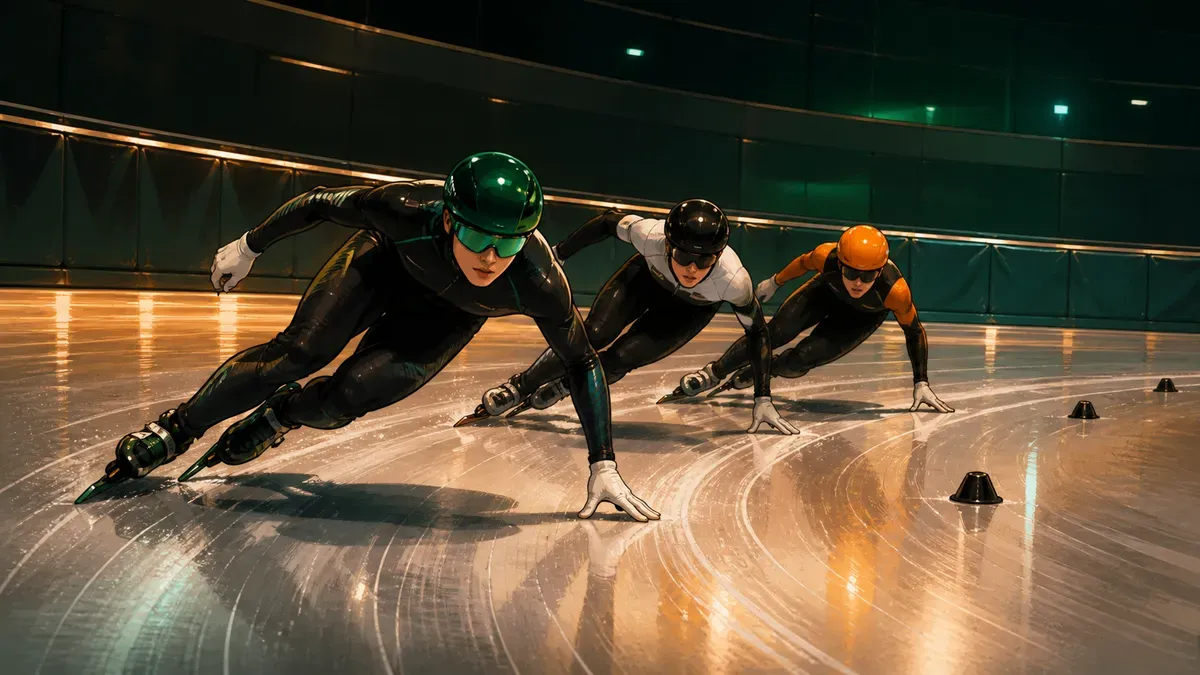
Short track speed skating is a head-to-head ice race on a compact oval. Several skaters share the same track, race counter-clockwise, choose when to pass, and advance through elimination rounds. The first blade tip across the finish line wins, but getting there demands much more than raw speed: starts, cornering, positioning, judgment, repeated acceleration, and safe interaction with the pack all matter.
The sport is easy to recognize and difficult to learn. A standard elite track measures only 364.6 ft (111.12 m), so a skater is almost always preparing for, entering, or leaving a bend. That geometry creates the low posture, leftward lean, crossovers, tactical traffic, and high physical load that distinguish short track from recreational skating and long-track time trials.
Quick answer
How does short track speed skating work? Skaters race together on a 364.6 ft (111.12 m) oval in individual 500 m, 1000 m, and 1500 m events, plus team relays. Position at the finish determines the result. Passing is allowed, but the overtaking skater is responsible for avoiding obstruction or collision until the skaters are alongside each other. Major infringements include leaving the track, impeding, receiving assistance, kicking out a skate at the finish, and simulating an infringement.
For a beginner, the safe route is basic skating first, then a recognized short track club with a qualified coach, a protected rink, and sport-specific safety equipment. Do not copy elite lean angles, pack passes, or race starts during a public skating session.
Short track is a pack race on ice, whereas our beginner guide to ice hockey explains how a shared rink also adds puck possession, positions, live substitutions, offside, icing, and penalties.
Key facts
- Short track races use a mass start, so tactics and interactions affect pace as well as finishing position.
- The compact oval rewards low posture, efficient crossovers, edge control, and precise corner entry.
- Race distance changes the balance among explosive power, glycolytic work, aerobic contribution, and tactical patience.
- The passing skater carries responsibility for a safe overtake until the two skaters are alongside each other.
- Protective equipment reduces specific hazards but never makes unsupervised high-speed skating safe.
What makes short track different?
Short track is not simply long-track speed skating on a smaller rink. The 2026 International Skating Union rules define a 364.6 ft (111.12 m) oval inside an enclosed rink at least 197 × 98 ft (60 × 30 m). The straight must be at least 23 ft (7 m) wide, and protective padding surrounds the skating surface.
In long track, two athletes usually skate in separate lanes on a 400 m oval and race primarily against the clock. In short track, several competitors share one line. A fast lap is useful only if it produces or protects a qualifying position. Drafting, passing space, traffic, an opponent’s move, and fall risk can all change the sensible pace.
For a wider comparison of race formats, surfaces, and tactics, see our guide to long track, short track, and inline speed skating disciplines.
That produces four defining differences:
- Turns dominate the lap. Tight bends arrive quickly and place large, asymmetric demands on the legs.
- Position has tactical value. The shortest line is attractive, but it can also be blocked by traffic.
- Passing is a technical and legal skill. Speed alone does not create a safe opening.
- Racing is variable. Two heats over the same distance may unfold at very different speeds.
Research supports that tactical distinction. Analyses of elite races describe positioning as a sequence of interactions rather than a set of isolated lap ranks, because finishing place—not the fastest possible time—is the immediate goal (Hext et al., 2023). Studies of 500 m, 1000 m, and 1500 m racing also show that pacing changes with distance, round, and competitive situation (Noorbergen et al., 2016; Konings et al., 2016).
Race distances, laps, and elimination rounds
The current ISU program uses three individual distances and three main relay distances. Official distance names remain metric because they are event names.
| Event | Approximate laps | Race character | Central challenge |
|---|---|---|---|
| 500 m | 4.5 | Sprint | Start, early position, acceleration, and clean high-speed passing |
| 1000 m | 9 | Sprint-endurance | Balance position, pace changes, and a sustained finish |
| 1500 m | 13.5 | Tactical endurance | Read the pack, conserve options, and time late moves |
| Mixed 2000 m relay | 18 | Short team relay | Fast exchanges, traffic management, and team order |
| Women’s 3000 m relay | 27 | Team relay | Repeat efforts, exchanges, and recovery between turns |
| Men’s 5000 m relay | 45 | Team relay | Longer tactical sequence, repeat speed, and error control |
Competitions progress by elimination. Depending on the field, skaters may move through heats, quarterfinals, semifinals, repechage rounds, and finals. The exact qualification table can vary by event, so “top two always advance” is not a universal rule. A skater who was clearly impeded while in a direct qualifying position may be advanced, while the responsible competitor can be penalized.
At current major events, 500 m and 1000 m quarterfinals, semifinals, and finals are normally scheduled for five skaters. The 1500 m semifinals and finals are normally scheduled for seven. Exceptions occur when athletes are advanced or when an event uses a different approved format. The ISU’s spectator guide offers a useful overview, but the sport rules and event communication govern a specific competition.
How relays work
Four skaters compete for a relay team. A racing skater hands responsibility to a teammate by touch; the familiar push exchange helps the incoming athlete gain speed, but the rules define the exchange through contact rather than the size of the push. In standard relay races, an exchange may occur at almost any time, but one skater must complete the last two laps unless a fall triggers the exception in the rules.
Inactive teammates circle inside the marked race track and must stay clear of active racers. Exchanges must move forward without obstructing another team. That makes relay practice a coached skill: timing, line, awareness, and communication matter as much as fitness.
Short track rules that decide races
Short track allows close competition, not uncontrolled contact. The 2026 rules organize clear infringements into five broad codes.
| Infringement | Plain-language meaning |
|---|---|
| Off-track | Shortening the distance by skating inside the track markers |
| Impeding | Blocking, pushing, colliding, or changing line in a way that interferes with another skater |
| Assistance | Giving or receiving prohibited help during a race |
| Kicking-out | Deliberately driving the skate forward at the finish in a dangerous or improper way |
| Embellishment | Simulating or exaggerating an incident to influence a decision |
Overtaking is legal at any time. Until the two skaters are alongside each other, however, responsibility for obstruction or collision lies with the overtaking skater, assuming the athlete being passed does not act improperly. A pass therefore needs three things at once: enough relative speed, a real opening, and control of the exit line.
The race runs counter-clockwise, and the leading tip of the blade determines the finish. Referees can use video replay. Sanctions may include a penalty, yellow card, or red card depending on severity and conduct; an impeded athlete may be advanced. A result can therefore change after the visible finish while officials review an incident.
Starts also follow a defined procedure. At major ISU events the “zero false start” system applies, so a false start can bring an immediate penalty. Some international competitions may announce an alternative in which one false start is allowed for the race. The event announcement and current rules are the correct source; a casual summary should never replace the starter’s instructions.
Technique: build control before speed
Short track technique solves a continuous problem: produce sideways force against the ice while keeping the body’s path smooth enough to carry speed through repeated left turns. The fastest posture is not automatically the best posture for a novice. Range, edge angle, and speed must grow together under coaching.
Athletic position and glide
Skaters lower the hips, flex the knees and trunk, and keep the center of mass ready to move over the support skate. A low posture can reduce aerodynamic drag and improve push direction, but it also increases local muscular demand. Dropping lower than you can control usually produces a rounded back, unstable hips, short pushes, or rapid fatigue rather than free speed.
A useful beginner cue is quiet torso, active legs. The head stays level enough for vision, the trunk remains organized, and each push travels sideways rather than backward. The recovery foot returns close to the support foot so the next step begins from a controllable position.
Corner entry, crossovers, and exit
The turn begins before the visible apex. A skater approaches with a line and speed that make the desired edge angle possible, leans the whole system inward, and crosses the outside skate over the inside skate to keep producing force through the bend. The left hand may touch the ice at high level, but the hand is not a kickstand and should not be a beginner’s primary balance strategy.
Three phases are worth separating in practice:
- Entry: settle the line, vision, and speed before the tightest part of the bend.
- Middle: maintain edge grip and crossover rhythm without standing up abruptly.
- Exit: finish the final push toward the straight and accelerate without drifting into traffic.
Recent wearable-sensor research in elite and junior-elite skaters found associations between lap time and modifiable lower-body kinematics, including inter-foot spacing and pelvic height (Claudel and Clément, 2025). That does not turn a correlation into a universal cue. Body proportions, speed, ice, fatigue, and coaching model all affect the useful position.
Passing and pack skills
An inside pass travels a shorter path but demands a genuine gap and a controlled exit. An outside pass covers more distance and often requires more speed, yet may preserve a clearer line. A pass near the finish may look dramatic, but a desperate move with no established overlap can become impeding.
Beginners should learn passing progressively:
- first, hold a predictable line alone;
- then skate side by side at low speed;
- practice following distance and controlled deceleration;
- rehearse one designated passing zone with a coach;
- add pack decisions only after edge control is reliable;
- review video for line and timing rather than judging success only by position.
Tactical studies show why no single “always lead” or “always draft” rule works. Opponents, starting lane, distance, round, and moment-to-moment position change the available choices. The transferable skill is perception: see the opening early enough to act without converting urgency into contact.
What the sport demands physiologically
Short track combines explosive and aerobic work rather than belonging to one energy system. A 2026 laboratory study of nine national-level male skaters measured oxygen uptake and blood lactate during maximal 500 m, 1000 m, and 1500 m time trials. The estimated relative aerobic contribution rose from 22.2% in the 500 m to 35.3% in the 1000 m and 44.3% in the 1500 m (Kıyıcı et al., 2026). The small, elite, male-only sample limits generalization, but the direction is useful: longer races demand progressively more aerobic support without becoming easy endurance efforts.
The crouched skating posture adds a special constraint. High local force and sustained knee flexion can restrict muscle blood flow. Research in elite skaters found different deoxygenation and recovery patterns in short track versus long track, with greater asymmetry related to repeated left turns (Knobbe et al., 2016). Earlier work also documented right-left differences in quadriceps oxygenation during elite short track skating (Hesford et al., 2012).
That evidence explains why training needs more than repeated all-out laps:
- Acceleration and power support starts, exits, and passes.
- Strength and isometric endurance help hold position under load.
- Single-leg and lateral control support edges and crossovers.
- Aerobic fitness improves recovery between hard laps, races, and sessions.
- Repeat-sprint capacity helps produce speed after previous efforts.
- Technique under fatigue protects efficiency when the legs become heavy.
Our guide to improving VO2 max explains the aerobic side, while adductor exercises can support progressive inner-thigh strength. Neither replaces sport-specific coaching or proves readiness for pack racing.
A safe beginner pathway
The first goal is not a race time. It is enough control to learn inside a short track environment without endangering yourself or other skaters.
If you are still building the general capacity behind the sport, use the fitness library to separate broad conditioning from the ice-specific skills that require a coach.
Phase 1: general skating control
Before specialist blades or pack drills, learn to:
- stand, fall, and get up under instruction;
- glide on each foot;
- stop reliably on both sides;
- turn in both directions;
- control speed without grabbing another person;
- look ahead while maintaining a predictable path.
Public skating can help basic comfort, but it is not the place for speed starts, deep corner drills, or passing practice. Use a club session with padded boards and separated skill groups.
Phase 2: short track fundamentals
A coach can then introduce the low position, side push, recovery, corner entry, crossover sequence, and start mechanics at appropriate speed. Skill quality should determine progression. If posture collapses, blades chatter, or the skater cannot stop on command, more speed is not the next drill.
Phase 3: controlled traffic
Only after individual lines are consistent should practice add paired skating, following distance, designated passes, exchanges, and small packs. The purpose is not merely confidence. It is to make behavior readable to other skaters.
The same principle appears in balance training: stable performance grows from progressively harder sensory and movement demands, not from skipping directly to the most chaotic version.
Equipment and rink safety
Current ISU competition equipment includes an approved safety helmet, cut-resistant gloves, shin protection, long-sleeved and long-legged cut-resistant clothing, knee protection, cut-resistant neck protection, eye protection that meets approved standards, and fixed blades with closed tubes and rounded ends. The ISU equipment overview explains how offset blades, protective fabrics, gloves, and modern helmets support speed and safety.
Club requirements may be stricter or adapted for beginners. Follow the club and national federation checklist rather than buying from a generic list. A coach should inspect fit and compatibility, especially:
- helmet shape and secure strap;
- full neck coverage without gaps;
- cut-resistant gloves and clothing;
- knee and shin protection that stays in place;
- eye protection suitable for the session;
- correctly mounted, sharp, undamaged blades with rounded ends;
- boots that hold the foot securely without causing numbness.
Protective gear does not justify an unsafe rink. Proper padding, clear track markers, trained supervision, controlled group size, and an emergency plan remain essential. A 2024 scoping review found that injury-prevention evidence in competitive ice speed skating is limited and methodologically uneven; reported competition injury proportions varied substantially, and the authors called for better surveillance and prevention research (Gouttebarge et al., 2024). An older short track survey found the knee, ankle, spine, leg, and groin among common injury sites, with lacerations and ankle fractures prominent in prior on-ice injuries (Quinn et al., 2003).
After any fall, stop for neck pain, worsening headache, dizziness, confusion, vision change, vomiting, weakness, numbness, or unusual behavior. A suspected concussion requires removal from sport and assessment; the international concussion consensus states that sport-related concussion can follow a blow to the head, neck, or body. Do not return to skating the same day because symptoms briefly settle.
Off-ice training for short track
Off-ice work should make coached skating easier to tolerate and repeat. It cannot teach blade feel or pack judgment. For a healthy beginner training two days on ice, a simple foundation can use two strength sessions, two easy aerobic sessions, and small doses of lateral power after landing control is established.
| Quality | Why it matters | Beginner examples |
|---|---|---|
| Lower-body strength | Supports push force and posture | Squat, split squat, step-up, hip hinge, calf raise |
| Lateral strength | Supports side push and pelvic control | Lateral lunge, controlled crossover step, banded side step |
| Trunk control | Keeps force transfer organized | Side plank, dead bug, anti-rotation press, loaded carry |
| Single-leg control | Prepares the support phase | Single-leg hinge, low step-down, balance reach |
| Aerobic base | Improves recovery between efforts | Easy cycling, brisk incline walking, rowing, or jogging |
| Power and deceleration | Supports starts and changes of pace | Low skater bound, snap-down, small lateral hop and stick |
Use a range of motion you can control. Short track already loads the hips and knees in flexion; gym training does not need to reproduce the deepest skating position under fatigue on day one. Our training-load guide explains why adding ice volume, heavy lifting, and hard intervals simultaneously can produce a spike in stress rather than faster adaptation.
Example foundation week
This example is for a healthy adult beginner whose coach has approved the workload. Session order should change around rink access, competition, school or work, and individual recovery.
| Day | Session | Main purpose |
|---|---|---|
| Monday | Full-body strength, 45–60 minutes | Controlled strength and trunk stability |
| Tuesday | Coached ice skills, easy to moderate | Position, edges, turns, and stopping |
| Wednesday | Easy aerobic work, 30–45 minutes | Aerobic base and recovery |
| Thursday | Rest or light mobility | Absorb training and monitor soreness |
| Friday | Strength plus a few low-volume lateral jumps | Force, landing control, and power |
| Saturday | Coached ice session | Technique, then limited faster work |
| Sunday | Easy aerobic work or rest | Base training only if recovery is good |
Keep at least one true easy or rest day. A novice does not need a maximal 500 m effort after every technique session. Progress one variable at a time: more clean laps, slightly greater speed, denser intervals, or more demanding pack work—not all four in the same week.
Warm up for the task
Begin with 5–10 minutes of easy movement, then rehearse ankles, hips, trunk position, side steps, and controlled single-leg loading. On ice, start with easy laps and build speed through technique drills before starts or hard intervals. A recent systematic review supports a multicomponent approach using dynamic preparation, neuromuscular work, eccentric strength, and progressive loading, while noting substantial variation among studies (Kłobuchowski et al., 2026).
Static stretching alone is not a complete injury-prevention plan. Our evidence review on stretching and injury prevention explains why preparation, strength, skill, and load management matter together.
Track recovery with SuperAge
Once coaching, equipment, and a sensible program are in place, recovery trends can help decide how hard the next session should be. Short track creates both whole-body strain and intense local leg fatigue. A normal resting heart rate does not prove that edge control, groin tolerance, or reaction quality has recovered.
Use SuperAge to compare sleep, resting signals, activity, and recovery patterns with your own baseline across several weeks. Pair the data with simple sport notes:
- session type and hard laps;
- perceived exertion;
- groin, knee, back, and ankle symptoms;
- whether technique deteriorated late in practice;
- readiness reported before the next ice session.
The useful question is not “Did the app clear me to skate?” It is “Does the trend agree with how I move and feel?” Pain, swelling, instability, concussion symptoms, chest discomfort, fainting, or unusual breathlessness overrides a favorable readiness score and needs appropriate assessment.
Download SuperAge to follow fitness and recovery trends against your own baseline while your coach manages skating technique and progression.
Frequently asked questions
What is the difference between short track and speed skating?
Short track uses a 364.6 ft (111.12 m) oval with several skaters racing together. Long-track speed skating normally uses a 400 m oval, separate lanes, and pairs racing primarily against time. Short track places more emphasis on pack position, passing, tight left turns, and elimination-round tactics.
How long is a short track speed skating lap?
The standard ISU oval is 364.6 ft (111.12 m). Individual 500 m, 1000 m, and 1500 m races are approximately 4.5, 9, and 13.5 laps. Other formats and distances may be used in some competitions.
Is contact allowed in short track?
Close racing is allowed, but pushing, blocking, improper lane changes, and other clear impeding actions can be penalized. The overtaking skater is responsible for avoiding obstruction or collision until the skaters are alongside each other, unless the skater being passed acts improperly.
Why do short track skaters put a hand on the ice?
At high cornering speeds, elite skaters may touch the ice with protected fingertips while leaning through a tight bend. The hand is not meant to carry body weight like a support post. Beginners should develop edge control, body alignment, and coached corner progression before copying the gesture.
What protective equipment do short track skaters wear?
Competition equipment includes an approved helmet, cut-resistant gloves and clothing, neck protection, knee and shin protection, eye protection, and fixed blades with closed tubes and rounded ends. A club or national federation may add requirements, and equipment must fit correctly.
Is short track good cardio?
Yes, but it is not purely aerobic. Starts, accelerations, and fast laps require substantial anaerobic power, while aerobic contribution and recovery become increasingly important over longer distances and repeated races. Technique and local muscular endurance also shape how hard a lap feels.
Can an adult beginner learn short track speed skating?
Many clubs offer adult or masters pathways, but availability and entry standards vary. A beginner should first establish basic skating control, then learn in a coached short track session with padding, protective equipment, and an appropriate skill group. Medical guidance may be appropriate before vigorous training for people with relevant conditions or symptoms.
How many days per week should a beginner train?
Two coached ice sessions plus two strength sessions and one or two easy aerobic sessions can be a reasonable foundation for some healthy adults, provided hard days are separated and total load progresses gradually. The right frequency depends on skating experience, rink access, age, health, recovery, and coaching advice.
Key takeaways
- Short track is a tactical mass-start race on a 364.6 ft (111.12 m) oval, not a smaller copy of long-track time trials.
- The 500 m, 1000 m, and 1500 m reward different blends of start speed, positioning, aerobic support, and finishing power.
- Legal passing requires relative speed, a real opening, and control; urgency does not transfer collision responsibility to the skater ahead.
- Beginners need general skating control, qualified coaching, padded ice, and complete protective equipment before speed or pack drills.
- Strength, lateral control, aerobic fitness, repeat speed, and technique under fatigue should progress together without abrupt load spikes.
- Recovery data can support decisions, but symptoms and skating quality remain more important than any single readiness score.
References
- International Skating Union. Sports Rules: Short Track, effective June 12, 2026.
- International Skating Union. Short Track: rules, regulations and disqualifications. 2026.
- International Skating Union. Short Track equipment: speed and safety from head to toe. 2026.
- Kıyıcı F, et al. Physiologic responses and energy system contributions in competitive short track speed skating across race distances. Journal of Strength and Conditioning Research. 2026.
- Claudel J, Clément J. Analysing short-track speed skating performance factors. Sports Biomechanics. 2025.
- Hext A, Hettinga FJ, McInerney C. Tactical positioning behaviours in short-track speed skating. Journal of Sports Sciences. 2023.
- Noorbergen OS, et al. Pacing behavior and tactical positioning in 500- and 1000-m short-track speed skating. International Journal of Sports Physiology and Performance. 2016.
- Konings MJ, et al. Pacing behaviour and tactical positioning in 1500 m short-track speed skating. International Journal of Sports Physiology and Performance. 2016.
- Knobbe A, et al. Differences in muscle oxygenation, perceived fatigue and recovery between long-track and short-track speed skating. Frontiers in Physiology. 2016.
- Hesford CM, et al. Asymmetry of quadriceps muscle oxygenation during elite short-track speed skating. Medicine & Science in Sports & Exercise. 2012.
- Gouttebarge V, et al. Epidemiology, etiology and prevention of injuries in competitive ice speed skating. BMJ Open Sport & Exercise Medicine. 2024.
- Quinn A, et al. Injuries in short track speed skating. American Journal of Sports Medicine. 2003.
- Patricios J, et al. Consensus statement on concussion in sport. British Journal of Sports Medicine. 2023.
- Kłobuchowski W, et al. Exercise-based strategies from warm-up to training. Sports. 2026.
- Solli GS, et al. Olympic ice sports: a narrative review and perspectives toward Milano-Cortina 2026. Scandinavian Journal of Medicine & Science in Sports. 2026.
Related Articles
Ski jumping rules, technique, scoring, and beginner pathway
Learn ski jumping rules, K-point scoring, flight and telemark technique, hill anatomy, safety, and a coached beginner pathway from first drills.