What causes avalanches? Types, warning signs, and safer decisions
Learn what causes avalanches, how major types differ, which red flags matter, and how forecasts, terrain choices, training, and rescue reduce risk today.
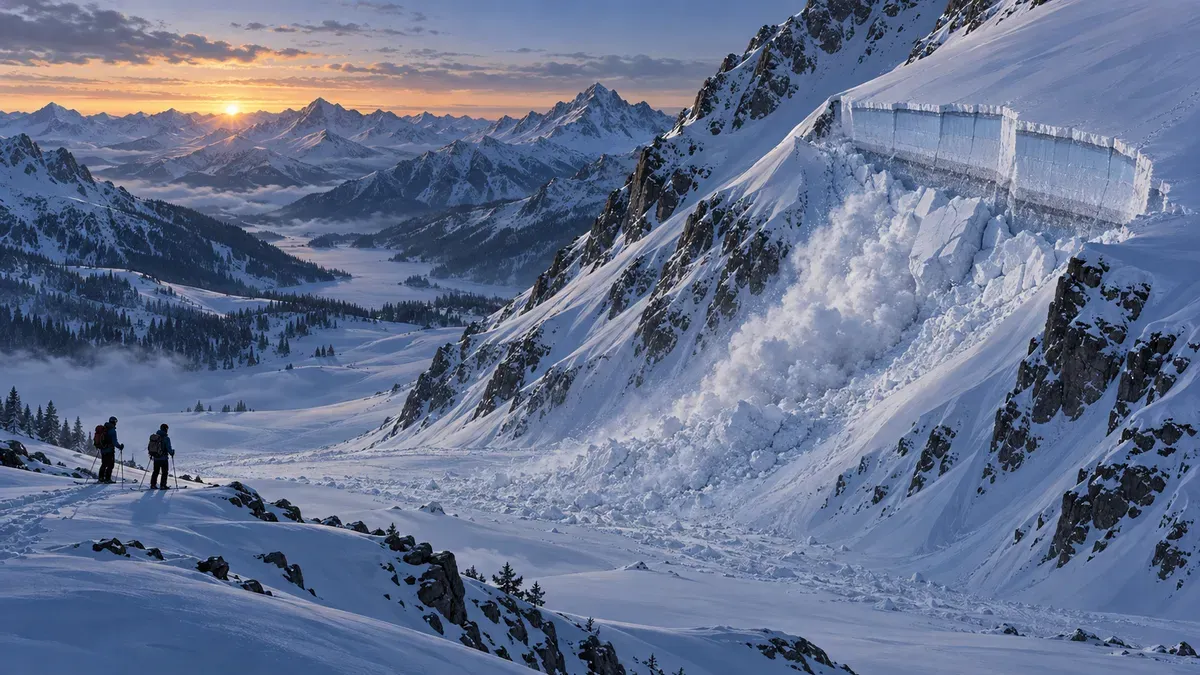
An avalanche begins when snow can no longer resist the forces pulling it downhill. The most dangerous recreational pattern is often a cohesive slab resting over a weaker layer: a crack starts, spreads through that weak layer, and releases a connected sheet of snow. New snow, wind loading, persistent weak grains, rain, warming, and a person crossing the wrong part of a slope can all contribute.
That explanation is useful, but it is not a field clearance. Avalanche risk depends on the day’s snowpack, weather, terrain, and exposure. Check the official local forecast, choose terrain that matches both the bulletin and your training, travel with trained partners, and practise rescue. An online guide cannot evaluate a specific slope.
Quick answer
Avalanches need snow that can move, terrain steep or connected enough to let it move, and a trigger or loss of strength. In a slab avalanche, a cohesive layer sits above a weak layer. Added load or weakening initiates a crack; if that crack propagates, the slab detaches and slides. Loose-snow avalanches start at a point and fan outward, while wet avalanches involve liquid water weakening the snow. Cornice fall, wind transport, heavy snowfall, rain, rapid warming, and people can initiate or amplify the process.
The safest response is not to diagnose stability from one sign. Combine the regional forecast, avalanche problem, aspect and elevation, recent weather, observed red flags, terrain consequence, and a conservative alternative. If those pieces do not agree—or you cannot interpret them—stay outside avalanche terrain.
Key facts
- A cohesive snow slab transmits a fracture across an underlying weak layer and can release around the person who triggered it.
- Wind redistributes snow into dense drifts and slabs on lee slopes, below ridges, and across gullies.
- Most slab avalanches start on steep terrain while their debris can run far into gentler ground below.
- Recent avalanches, shooting cracks, and collapsing sounds reveal instability and call for an immediate move to lower-consequence terrain.
- Companion rescue compresses the response time because organized rescuers may not reach a completely buried person soon enough.
The avalanche system: snowpack, terrain, weather, and trigger
Think of avalanche formation as an interacting system rather than a single cause. The snowpack supplies layers with different hardness, grain shape, temperature history, and bonding. Terrain supplies slope angle, aspect, elevation, shape, anchors, and runout. Weather adds or removes load and strength through snowfall, wind, rain, sun, and temperature change. A trigger supplies the final stress—or the snowpack fails naturally when its strength falls below the load.
The system changes across space. A sheltered slope may preserve fragile surface hoar while a nearby wind-exposed ridge destroys it. Wind can scour one side of a ridge and load the other. Sun can weaken a south-facing surface while a shaded aspect preserves cold persistent grains. Elevation changes precipitation type, temperature, and wind exposure. A stable observation on one small feature is therefore not proof that the next slope is stable.
This is why a careful winter plan is a sequence of decisions, not one test. Start with the forecast, identify where the stated problem exists, choose terrain with a wide margin, and keep comparing field conditions with what you expected. The broader winter hiking safety guide covers clothing, traction, turnaround rules, and cold exposure around this avalanche-specific process.
How a slab avalanche releases
A slab is a relatively cohesive layer of snow. Beneath it sits a weaker layer or interface that cannot carry the imposed stress. Avalanche.org describes the essential structure as cohesive snow over less cohesive snow; slabs may be soft or hard, thin or thick, and can contain several layers that act together (slab structure).
Release usually unfolds in four linked steps:
- Failure begins. New snow, wind-drifted snow, a skier, rider, climber, snowshoer, cornice fall, or another load damages a weak spot.
- A crack reaches critical size. The initial failure becomes large enough to propagate rather than stopping locally.
- The fracture travels. The crack can race across tens or hundreds of metres (yards), including from a flatter trigger point into connected steep terrain.
- The slab detaches and slides. The crown and side boundaries fail; gravity overcomes friction and the mass accelerates downhill.
The critical fact is propagation. A person does not have to stand exactly where the deepest debris will run, and the slope does not need to fail beneath only one ski or boot. Avalanche.org’s fracture summary explains how a person can create the critical crack and how dynamic propagation can spread far beyond that point (slab release mechanics).
Weak layers can be short-lived or persistent
Some storm interfaces strengthen within hours or days. Persistent weak layers—such as buried surface hoar, depth hoar, or faceted grains—can remain capable of propagating fractures for weeks or months. Their distribution can be patchy, feedback can be absent, and earlier tracks do not prove stability. Avalanche.org therefore recommends wide margins and conservative terrain when a persistent slab problem exists (persistent slabs).
That uncertainty matters more than confidence. Five people crossing without an incident may simply mean none found the trigger point; the sixth can still release the slope.
Major avalanche types and problems
“Avalanche” describes several release patterns. The local bulletin’s named avalanche problem is more useful than a generic danger number because it helps you ask where the problem is, how likely it is to release, how large it could become, and which terrain choice manages it.
| Type or problem | How it forms | Practical clue | Safer response |
|---|---|---|---|
| Storm slab | Cohesive new snow fractures within the storm snow or at the old-snow interface | Rapid loading, fresh cracking, recent soft slabs | Give new snow time to settle and avoid affected steep terrain |
| Wind slab | Wind deposits dense, cohesive snow on lee or cross-loaded features | Blowing snow, smooth rounded pillows, hollow feel, cracks | Avoid loaded slopes below ridges and cross-loaded gullies |
| Persistent slab | A slab rests over a long-lived weak layer | Collapses, shooting cracks, remote triggers—or no obvious feedback | Use large terrain margins; avoid slopes and runouts where the problem exists |
| Deep persistent slab | A thick slab overlies a deeply buried persistent weakness | Sparse clues, very large potential, remote triggering | Choose terrain that removes exposure rather than trying to out-test uncertainty |
| Wet slab | Liquid water weakens a buried layer or interface beneath cohesive snow | Poor overnight refreeze, rain, rapid warming, deep boot penetration | Finish before warming, move to colder aspects, or avoid avalanche terrain |
| Dry or wet loose | Cohesionless snow releases from a point and fans downhill | Small surface sluffs, rollerballs or pinwheels when wet | Avoid being swept into cliffs, trees, gullies, or other terrain traps |
| Cornice fall | An overhanging wind-built mass breaks | Large overhang, warming, cracking; true edge hidden from above | Stay well back from the top and away from the fall line below |
| Glide avalanche | The entire snowpack slides on the ground | Glide cracks, often called “fish mouths” | Do not linger below; timing is difficult to predict |
Storm slabs commonly last from hours to a few days, but a storm slab over a persistent weak layer can evolve into a longer-lived problem (storm slabs). Wind slabs form where transported snow is deposited, often on the lee side of ridges or in cross-loaded gullies (wind slabs).
Loose-snow avalanches begin at a point instead of breaking as a broad cohesive plate. They are often smaller than slabs, but even a small release can be fatal if it carries someone over a cliff or buries them in a gully (loose-snow avalanches). Wet slabs can be especially destructive because water weakens a buried layer while the debris becomes dense and heavy (wet slabs).
Avalanche terrain: start zones, tracks, runouts, and traps
Avalanche terrain includes more than the slope that releases. A start zone is where snow first fractures. The track is the path the moving mass follows. The runout is where debris slows and piles up. You can be standing on a low-angle trail and still be exposed to a steep connected slope above.
Slope angle is the strongest first filter. Most slab avalanches initiate where the steepest portion is roughly 30–50°, with the greatest concentration commonly reported around 34–45°. Slopes below 30° rarely release slabs, but avalanches can run into them, and connected terrain above can sometimes be triggered remotely (slope-angle evidence).
Do not use a phone’s colored slope layer as a border between safe and unsafe. Map resolution can smooth short steep rollovers, cornices can hide the true edge, and a route can cross a runout without ever climbing the start zone. Verify terrain in the field, keep buffers around uncertainty, and use the mountain navigation guide to build checkpoints and mismatch rules before visibility deteriorates.
Terrain traps multiply consequence without necessarily changing release probability. Watch for:
- gullies and creek beds that funnel and deepen debris;
- cliffs and rocks that add trauma;
- trees that can cause impact injuries;
- abrupt flats where debris piles deeply;
- lakes, crevasses, and confined drainage features; and
- slopes with no protected regrouping or escape option.
Dense trees are not automatically safe. Widely spaced trees may still stand in avalanche terrain, and being carried through them can increase trauma. A slope’s shape also does not override its angle: convex, planar, and concave slopes can all avalanche (slope characteristics).
Weather changes the load and the strength
The snowpack is a weather archive. Each storm, wind event, warm spell, cold clear night, crust, and melt-freeze cycle can create or transform a layer.
New snow and rain add load
Heavy snowfall increases stress faster than the snowpack may adjust. Rain adds load and liquid water, weakens bonds, and can activate wet loose or wet slab problems. The total matters, but the rate matters too: rapid loading gives the structure less time to settle and strengthen.
Wind loads snow without a storm at your feet
Wind erodes exposed snow and deposits it elsewhere. A slope may gain a dangerous slab even when little snow falls from the sky. Look for plumes over ridges, fresh drifts, pillows, textured erosion, and a sudden change in surface hardness. Wind direction can also shift during a storm, loading aspects that were previously scoured.
Temperature can strengthen one problem and awaken another
Gradual settlement and bonding can strengthen recent storm snow. Large temperature gradients within cold shallow snow can promote faceted weak grains. Sun, warm air, or rain can introduce liquid water and rapidly reduce strength. A firm morning crust may support travel early, then weaken as the day warms; a poor overnight refreeze removes that margin.
No single weather threshold works everywhere. Use the local forecast’s problem description and timing, then observe whether the real day is warmer, windier, wetter, snowier, or more variable than predicted.
Avalanche warning signs: treat red flags as stop signals
Strong evidence of instability should simplify the decision, not invite another test.
| Red flag | What it suggests | Decision implication |
|---|---|---|
| Recent avalanches | Similar terrain has already failed under recent conditions | Avoid matching aspects, elevations, and connected terrain |
| Shooting cracks | A cohesive slab can transmit fracture | Move off and away from steep connected terrain |
| “Whumpf” or collapse | A buried weak layer failed beneath the group | Expect possible remote triggering; retreat conservatively |
| Heavy snowfall or rain | Rapid loading and/or weakening | Reduce exposure before the load accumulates further |
| Blowing or drifting snow | Active wind loading | Avoid lee and cross-loaded features |
| Rapid warming, rollerballs, pinwheels | Surface snow is losing strength | Exit warming avalanche terrain early |
Avalanche Canada’s field guidance identifies drifting snow, shooting cracks, collapsing sounds, recent slab avalanches, heavy snow, and warming as direct instability clues. It also warns that an absence of red flags is not proof of stability, especially with persistent or deep persistent slabs (signs of instability).
Small test slopes can sometimes confirm instability, but they cannot certify a larger objective. A test on a different aspect, elevation, slope angle, or loading pattern may not represent the route. When the consequence is high, choose terrain that remains acceptable if the snowpack is worse than you think.
Read the avalanche forecast beyond the color
Both North American and European public scales use five levels. A rating summarizes expected likelihood, size, and distribution across a region; it is not a stability score for one slope. The European Avalanche Warning Services explicitly notes that the level applies to a broad area, contains uncertainty, and must be checked against conditions on site (EAWS scale, EAWS glossary).
Read the bulletin in this order:
- Validity and trend: Is the forecast current for the day and time you will travel?
- Danger by elevation: Which bands carry the higher rating?
- Avalanche problems: Storm slab, wind slab, persistent slab, wet snow, cornice, or another pattern?
- Aspect and elevation: Where is each problem expected?
- Likelihood and size: How easy is triggering, and how consequential could the result be?
- Travel advice and uncertainty: What terrain does the forecaster recommend avoiding?
- Recent observations: Do field reports and your own observations confirm or contradict the forecast?
“Low” never means no avalanches, and “moderate” can still include specific steep slopes where triggering is possible. “Considerable” describes dangerous conditions in which human triggering may be possible from a low additional load on indicated steep slopes; EAWS reports that a large share of avalanche fatalities occur at this commonly forecast level. Use the problem and terrain guidance, not color optimism.
A conservative decision process for a winter day
Before leaving
- Take recognized avalanche education appropriate to the terrain and activity.
- Read the official local avalanche and weather forecasts, not a screenshot from yesterday.
- Map the intended route, avalanche start zones, overhead hazard, tracks, runouts, and terrain traps.
- Build a lower-exposure alternative and define conditions that cancel the trip.
- Confirm every person has compatible rescue equipment, knows how to use it, and has practised recently.
- Share the route and return plan with a responsible person.
At the trailhead
Compare reality with the plan. Has more snow fallen? Is wind transporting snow? Is temperature already above forecast? Is rain reaching a higher elevation? Did the group change? Perform a transceiver function check and confirm communication, spacing, regroup points, and turnaround time.
During travel
Look above, below, and around. Reassess at every meaningful change in aspect, elevation, slope angle, wind exposure, surface condition, visibility, or group condition. Expose only one person at a time where appropriate, maintain spacing that actually reduces loading and burial count, and regroup only in protected locations—not in a runout or beneath a cornice.
Avalanche Canada recommends combining the forecast, route options, trained use of a transceiver-probe-shovel set, continuous reassessment, one-at-a-time exposure, and safe regrouping (risk-reduction procedures). For a lower-consequence way to build winter movement experience, the snowshoeing beginner guide keeps early outings on marked gentle routes outside avalanche terrain.
Training and rescue equipment: necessary, never permission
A transceiver helps partners locate a buried person. A probe pinpoints the burial and estimates depth. A metal shovel moves dense debris. All three belong with every person entering avalanche terrain, and all require repeated realistic practice. An airbag may reduce burial in some events but cannot prevent trauma, guarantee flotation, or make a poor terrain choice acceptable.
Formal instruction connects snowpack, forecast, terrain, group process, and rescue in the environment where the decisions occur. Avalanche Canada’s online material is explicitly an introduction, not a substitute for a field course (education pathway). The same principle applies elsewhere: choose a recognized local provider and curriculum suited to your region and activity.
Fitness supports movement, digging, cold tolerance, and decision quality, but it does not create avalanche competence. A strong climber can still misread connected terrain; an experienced runner can still exhaust the group by setting an unsustainable pace. The ice-climbing beginner guide shows how winter technical skill, approach hazards, cold, and avalanche exposure must be planned as one objective.
If an avalanche catches someone
Avoidance is the primary survival strategy. If a slide releases, actions depend on position and circumstance, and no technique guarantees escape.
If you are caught, shout to alert partners, try to move toward the side or off the moving slab, deploy an airbag if worn, discard equipment that anchors you when possible, fight to remain near the surface, and protect your airway as the debris slows. Avalanche Canada’s caught-in-a-slide guidance stresses that conditions are chaotic and these steps only may improve survival (what to do if caught).
If a partner is buried:
- Watch the person and mark the last-seen point.
- Ensure the scene is safe enough to avoid a second burial.
- Call emergency services or send an SOS when doing so will not delay the immediate search.
- Switch rescue transceivers to search and organize the signal, coarse, and fine search.
- Probe systematically to pinpoint the victim.
- Shovel strategically from downhill and create enough space for airway and patient care.
- Treat trauma, breathing problems, and hypothermia and follow dispatcher or trained medical guidance.
Time is critical because complete burial commonly causes asphyxia before organized rescue can arrive. Avalanche.org notes that many buried victims have less than 15 minutes before asphyxia, which is why companion rescue practice matters (companion rescue). A 2023 international mountain-emergency review found asphyxia was the principal cause of death across included avalanche-burial studies; advanced decisions after prolonged burial depend on airway, burial time, temperature, trauma, and professional protocols—not a simplified internet rule (ICAR MedCom review).
Do not put additional people into an active path without a scene plan. The rescuer who is buried by a second avalanche cannot help the first victim.
Use readiness data without turning it into a terrain signal
Avalanche safety comes from education, forecast interpretation, terrain choice, group discipline, and practised rescue. A watch or health app cannot detect a weak layer, certify a slope, or overrule a bulletin.
After those foundations are covered, SuperAge can help you notice personal patterns that affect the human side of a winter objective: poor sleep, unusual resting heart rate, low recent activity, accumulated training load, or slow recovery. Use those signals to reduce the plan, add recovery, or choose a non-avalanche outing—not to justify entering consequential terrain because one score looks reassuring.
Track decisions as well as performance:
- planned route and lower-exposure alternative;
- forecast problem, aspect, elevation, and expected timing;
- observed wind, temperature, precipitation, and red flags;
- turnaround trigger and whether the group honored it;
- moving time, perceived exertion, cold stress, and nutrition; and
- rescue-practice date and equipment check.
Download SuperAge to keep personal fitness and recovery trends in one private view, then leave avalanche decisions to current local information, trained judgment, and conservative terrain.
A compact avalanche-day checklist
Before entering winter mountain terrain, ask:
- Is there a current official forecast for this area and time?
- Which avalanche problems exist, and on what aspects and elevations?
- Does the route cross a start zone, track, runout, terrain trap, or overhead hazard?
- What has snowfall, wind, rain, sun, and temperature done since the forecast was issued?
- Are there recent avalanches, cracks, collapses, drifting, or rapid warming?
- Is every person trained, equipped, checked, and able to perform companion rescue?
- Where are the protected regroup points and one-at-a-time sections?
- What exact observation makes us turn around?
- What lower-exposure plan still makes the day worthwhile?
If you cannot answer the first six clearly, choose terrain outside avalanche exposure. The classic versus skate cross-country skiing guide describes groomed Nordic options whose movement problem is fundamentally different from backcountry avalanche travel.
Frequently asked questions
What is the main cause of an avalanche?
There is no single cause. A dangerous slab avalanche usually combines a cohesive slab, a weak layer, terrain steep enough to slide, and a trigger or natural loss of strength. Weather builds the structure; terrain determines where it can release and run; people or additional load may initiate the fracture.
Can an avalanche start on a slope below 30 degrees?
Slab releases below about 30° are uncommon, not impossible. More importantly, low-angle ground can sit beneath or connect to steeper terrain. An avalanche can start above, run onto the flatter area, or sometimes be remotely triggered from it.
What are the clearest avalanche warning signs?
Recent avalanches, shooting cracks, collapsing or “whumpfing,” active wind loading, heavy snowfall or rain, and rapid warming are strong red flags. Move to lower-consequence terrain. Their absence does not prove stability, especially with a persistent weak layer.
Are slab avalanches more dangerous than loose-snow avalanches?
Slabs account for most serious recreational avalanche accidents because a fracture can propagate broadly and release around the trigger. Loose avalanches usually start at a point and are often smaller, but they can still be fatal in cliffs, gullies, trees, or other terrain traps.
Does a low avalanche danger rating mean the backcountry is safe?
No. “Low” means generally stable conditions at a regional scale, with triggering still possible in isolated very steep or extreme terrain. Read the avalanche problem, affected aspect and elevation, expected size, and travel advice, then verify conditions in the field.
Do tracks on a slope prove it is stable?
No. Earlier travellers may have missed a trigger point, conditions may have changed, or a persistent weak layer may provide inconsistent feedback. Treat tracks as evidence that people crossed, not evidence that the snowpack is safe.
Do I need a transceiver, probe, and shovel for snowshoeing?
Activity does not determine the requirement; terrain does. If a snowshoe route enters or sits beneath avalanche terrain, every person needs appropriate education, trained partners, rescue equipment, forecast use, and practised skills. Beginners should choose routes outside avalanche terrain.
Can I learn avalanche safety online?
Online education can teach vocabulary and improve preparation, but it cannot replace recognized field instruction. A course lets you practise terrain recognition, observations, group decisions, transceiver search, probing, and shovelling with qualified feedback.
Key takeaways
- Avalanches result from an interaction among snowpack structure, weather, terrain, and a trigger.
- Slab avalanches become especially dangerous when a crack propagates across a weak layer.
- The release slope is only part of the hazard; tracks, runouts, overhead slopes, and terrain traps matter.
- Recent avalanches, cracks, collapses, wind loading, heavy precipitation, and warming demand conservative terrain.
- Read the full forecast, not only the danger color, and verify its assumptions throughout the day.
- Training, partners, and a transceiver-probe-shovel set support rescue but do not make hazardous terrain safe.
- When evidence is incomplete or contradictory, choose terrain that remains safe if your snowpack judgment is wrong.
References
- Avalanche.org. Slab.
- Avalanche.org. Slab avalanche release.
- Avalanche.org. Slope angle.
- Avalanche.org. Persistent slab.
- Avalanche.org. Wind slab.
- Avalanche.org. Wet slab.
- Avalanche Canada. Signs of instability.
- Avalanche Canada. Avalanche risk-reduction procedures.
- European Avalanche Warning Services. Avalanche danger scale.
- Avalanche.org. Companion rescue.
- Pasquier M, et al. (2023). On-site treatment of avalanche victims: ICAR MedCom recommendations. Resuscitation, 184, 109708.
- Van Tilburg C, et al. (2024). Wilderness Medical Society clinical practice guidelines for avalanche and snow burial accidents. Wilderness & Environmental Medicine, 35(1 Suppl), 20S–44S.
Related Articles
Ski jumping rules, technique, scoring, and beginner pathway
Learn ski jumping rules, K-point scoring, flight and telemark technique, hill anatomy, safety, and a coached beginner pathway from first drills.