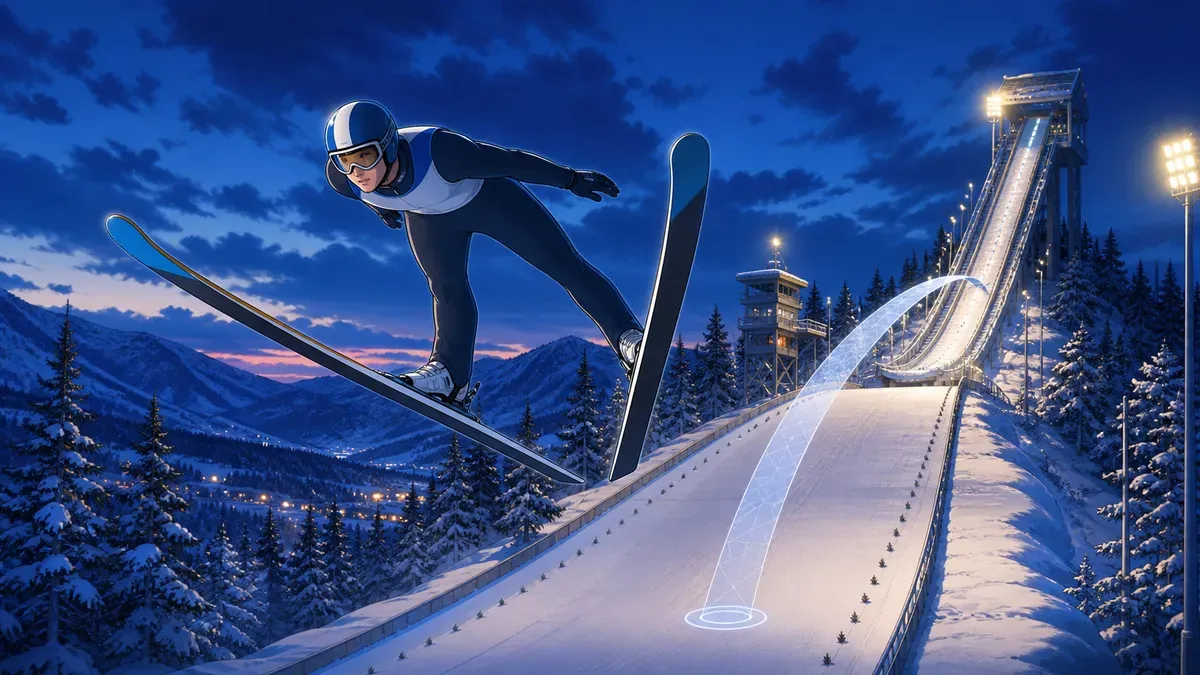
Ski jumping rules, technique, scoring, and beginner pathway
Learn ski jumping rules, K-point scoring, flight and telemark technique, hill anatomy, safety, and a coached beginner pathway from first drills.
Ski jumping is a judged distance sport in which an athlete descends a purpose-built inrun, extends from the takeoff table, creates aerodynamic lift in flight, and lands under control on a steep slope. The longest jump does not automatically win. Each attempt combines distance points, style points, and—when the system is in use—wind and starting-gate compensation.
The apparent simplicity hides a precise sequence. Inrun posture shapes speed. Takeoff timing sets the flight path. Ski and body angles determine how efficiently speed becomes lift. Landing preparation must then turn flight into a stable telemark position and controlled outrun. These skills are learned progressively on certified hills with qualified coaching; a recreational ski slope is not a substitute.
Quick answer
How does ski jumping work? A jumper starts from a gate, accelerates down two tracks, takes off from a sloped table, flies with the skis usually held in a V, and lands on the prepared hill. Distance is measured to the midpoint between the feet at landing. Reaching the hill’s K-point earns 60 distance points in standard ski jumping; each meter beyond or short of K adds or subtracts the hill’s meter value. Five judges score flight, landing, and outrun style, then the highest and lowest style marks are discarded. Wind and gate points may adjust the score for conditions and inrun length.
Key facts
- The K-point anchors the distance-points calculation for every homologated hill.
- Five judges evaluate flight, landing, and outrun quality while the middle three marks form the style score.
- Takeoff timing converts inrun speed into a stable early-flight trajectory.
- The V-style increases the ski-body system’s useful lift when angles remain controlled and symmetrical.
- A telemark landing demonstrates active impact absorption, balance, and control before the fall line.
Ski jumping hill anatomy
A ski jumping hill is engineered around a flight path and landing profile, not simply built as a steep ramp. The FIS International Competition Rules define its geometry, homologation, measuring systems, wind instruments, start controls, and prepared surfaces.
| Hill element | What it does | What to watch |
|---|---|---|
| Start gate | Sets the available inrun length | A higher gate usually permits more speed; the jury can change it for fairness and safety |
| Inrun | Guides the skis in parallel tracks toward the table | The athlete holds a compact, low-drag position without becoming rigid |
| Takeoff table | Provides the final surface for force production | Extension must be accurately timed while the table still slopes downward |
| Knoll | Curves away beneath the early flight | The athlete transitions quickly from takeoff into an aerodynamic position |
| K-point | Construction point and scoring reference | Standard jumping awards 60 distance points at K |
| Hill Size (HS) | Marks the designed end of the landing area | HS is normally farther than K and is not the same scoring reference |
| Landing slope | Matches the descending flight path | Its angle reduces the vertical component of landing impact compared with flat ground |
| Outrun | Lets the athlete stabilize, slow, and stop | Style remains judged until the athlete crosses the fall line |
Distances are measured along the landing slope in 1.6 ft (0.5 m) increments. The official mark is the point where the jumper’s feet contact the slope; if one foot lands ahead of the other, the measurement uses the midpoint between them.
The four phases of ski jumping technique
1. Inrun: create speed without wasting control
The jumper sits into a compact position with the hips back, torso low, arms close, and skis running cleanly in the tracks. The aim is not simply to be as small as possible. The posture must reduce drag while leaving the ankles, knees, and hips ready to extend at the table.
Small movements matter because they alter ski pressure and airflow before takeoff. A stable head and torso, balanced pressure through both feet, and a repeatable approach give the athlete a predictable platform. Fighting the tracks or standing too early costs speed and changes the timing problem at the table.
2. Takeoff: extend through a moving, sloped platform
Ski jumpers do not leap straight upward as they would in a gym test. They rapidly extend the ankles, knees, and hips while moving down a sloped table at high speed. The useful impulse has to be directed into the intended flight path without excessive forward rotation or a late loss of contact.
A field simulation of professional jumpers identified strong contributions from lower-limb extensors including the soleus, vastus lateralis, hamstrings, and gluteus maximus (Huang et al., 2023). Earlier wind-tunnel work showed that aerodynamic forces already influence the force-time problem during takeoff, reinforcing why timing and posture cannot be separated (Virmavirta et al., 2001).
For a spectator, the practical cue is the table edge: an efficient athlete appears to unfold decisively and then enter flight without a large, uncontrolled upward pop.
3. Flight: manage lift, drag, and symmetry
After leaving the table, the athlete brings the skis into a V while positioning the torso close to their plane. This increases the effective lifting surface, but more angle is not automatically better. Ski angle of attack, ski spread, body pitch, ankle control, yaw, and roll interact. A position that creates lift but excessive drag or instability can shorten the jump.
Research on Olympic competition found that the ski-to-body angle early in flight was strongly associated with jump length and that the stable flight position was largely established within about half a second (Virmavirta et al., 2005). Computational work also shows how lift and drag change rapidly during the initial posture transition and why expert control across the whole flight matters (Yamamoto et al., 2025).
The ski-attitude biomechanics study adds an important nuance: small changes in attack, yaw, and roll angles alter aerodynamic forces. The V-position is therefore a coordinated control task, not a shape to imitate during an unsupervised jump.
4. Landing and outrun: absorb force and prove control
Before touchdown, the athlete raises the torso, brings the skis toward parallel, and prepares the legs to absorb impact. In a telemark landing, one foot moves roughly a foot-length ahead of the other while both knees bend actively. The position should show balance over both skis rather than a lunge onto the front leg.
The official FIS style judging guidelines treat flight, landing, and outrun as one continuous performance. Landing without a telemark brings a 3-point deduction from each judge before any additional balance faults; a fall on or before the fall line brings the largest outrun deduction.
Landing is not cosmetic. Measurements from 22 athletes recorded peak normal ground-reaction forces ranging from 1.1 to 5.3 times body weight per foot, with greater flight time related to greater landing load (Bessone et al., 2019). The steep slope helps align the surface with the descending trajectory, but the athlete still needs strong, coordinated absorption.
How ski jumping scoring works
A competition result can look confusing because the scoreboard shows more than distance. Read it in four layers: distance points, style points, wind points, and gate points.
Distance points start at the K-point
In standard ski jumping, the K-point equals 60 distance points. The hill certificate also specifies how many points each meter is worth. A normal or large hill with a K-point from 328 to 440 ft (100 to 134 m) uses 1.8 points per meter. Smaller hills use larger meter values; ski flying has a separate 120-point K reference and 1.2 points per meter.
For a K120 hill, the basic calculation is:
distance points = 60 + (jump distance in metres - 120) × 1.8A 413.4 ft (126 m) jump therefore earns 70.8 distance points before style, wind, and gate adjustments: 60 + (6 × 1.8).
Style points reward the complete jump
Five judges may award up to 20 points each. The highest and lowest marks are removed, and the remaining three are added for a maximum of 60 style points. Judges deduct for visible faults in three phases:
- flight: instability, asymmetry, bent knees, uneven skis, or an ineffective aerodynamic position;
- landing: a poor transition, no telemark, excessive squat, crossed or edged skis, or balance corrections;
- outrun: unsteadiness, major deviation, hand or body contact, or a fall before the fall line.
This explains why a slightly shorter, controlled jump can beat a longer attempt with a poor landing.
Wind and gate compensation improve fairness
Headwind can add lift; tailwind usually removes it. A higher start gate can create more inrun speed than a lower gate. When the compensation system is used, measured wind and gate changes become point adjustments. Helpful conditions generally cost points, while adverse conditions generally add them.
Compensation is not a claim that every athlete experienced identical air. It is a standardized correction calculated from hill-specific factors. The jury can still pause, restart, shorten the inrun, or cancel a round when conditions are unsafe or unfair. If a coach voluntarily chooses a lower gate, gate compensation is awarded only when the athlete reaches at least 95% of HS under the current FIS rule.
Individual and team results
Many elite individual competitions use a qualification stage followed by two scored competition rounds, with the stronger first-round athletes advancing and both round scores added. Team formats add the scored jumps of several athletes across rounds. Exact entry limits, advancement rules, and event formats vary by series and championship, so a live broadcast should be read against that event’s current regulations.
For a contrasting judged-speed sport family, our bobsleigh, skeleton, and luge guide explains events decided by time rather than distance plus style. The alpine skiing disciplines guide shows how gate rhythm and the clock create a different downhill problem.
Equipment is part of the aerodynamic system
Ski jumping equipment is specialized and tightly controlled. It includes long jumping skis, bindings that leave the heel free, forward-flexing boots, a fitted aerodynamic suit, helmet, goggles, gloves, and a competition bib. Alpine skis, cross-country skis, and improvised ramps are not substitutes.
At elite level, ski length is linked to body measurements, while suit dimensions, construction, thickness, and air permeability are regulated. The current FIS competition-equipment specifications show why equipment control is more than appearance: skis and fabric change the aerodynamic surface, so non-compliance can create both performance and safety problems.
For beginners, equipment decisions belong to a recognized club. Coaches match the athlete, hill, binding setup, ski size, protective equipment, and progression. Buying used jumping skis without that system does not create a safe entry route.
Physical demands and off-hill preparation
Ski jumping rewards precision more than general fitness alone, yet several physical qualities support repeatable technique:
- rapid lower-body force for takeoff extension;
- isometric leg and trunk control during the inrun;
- ankle and hip control for ski-body angles in flight;
- eccentric strength for landing absorption;
- dynamic balance and spatial awareness through transition and outrun;
- aerobic capacity for repeated training attempts, recovery, and concentration;
- neck and trunk capacity for stable posture under aerodynamic load.
The goal of dry-land work is to prepare the athlete to learn skill, not to simulate a large-hill jump. A sensible base might include squat and split-squat patterns, hip hinges, calf work, trunk anti-rotation, controlled step-downs, low-level landing drills, and progressive jumps under coaching. Our eccentric training guide explains braking strength, while the balance training guide provides a general control foundation.
Two well-planned strength sessions may fit many schedules, but volume has to match technical training and recovery. Use the strength-training frequency guide to distribute work and the training-load guide to avoid increasing hill exposure, heavy lifting, and plyometric volume at the same time.
A coached beginner pathway
Ski jumping is not a self-taught activity. Access begins through a ski-jumping or Nordic-combined club with a qualified coach, an approved facility, and a progression sized to the athlete. FIS development programs explicitly place safe progression, individual development, suitable facilities, and athlete welfare at the center of their pathway (FIS, 2026).
| Stage | Main environment | Skill priority | Progress only when |
|---|---|---|---|
| 1. Movement base | Dry land and ordinary coached skiing | Balance, safe falling, parallel ski control, squat and landing patterns | The athlete follows instructions and controls speed consistently |
| 2. Hill introduction | Smallest club hill, often with plastic matting | Inrun position, straight glide, table awareness, stable outrun | Posture and direction stay repeatable at low consequence |
| 3. Small jumps | Progressive training hills | Timed extension, early-flight transition, parallel then modest V-position | The coach sees stable takeoff, flight, landing, and stopping |
| 4. Competition skills | Homologated hill appropriate to development | Telemark, wind awareness, start routine, scoring, equipment checks | Technical quality remains stable across changing conditions |
Age is not the only progression criterion. Ski skill, coordination, maturity, strength, confidence, medical context, facility rules, and coaching judgment all matter. A beginner may spend substantial time on landing and inrun drills before adding hill size. That is skill acquisition, not delay.
The biathlon beginner guide offers a useful Nordic contrast: biathlon combines cross-country endurance with shooting transitions, while ski jumping concentrates far more consequence into a few seconds of speed, takeoff, flight, and landing.
Safety, conditions, and stop rules
Wind is both a performance variable and a safety variable. Direction and speed can change across the table, middle flight, and landing zone, which is why homologated hills use multiple instruments and wind indicators. The jury—not the athlete—controls start permission, gate changes, holds, and cancellation.
A safe session also requires prepared tracks and landing surfaces, inspected equipment, a clear outrun, trained hill personnel, and communication between coach and officials. The first attempt after a long break or changing conditions deserves conservative judgment. Never use a public piste, backcountry feature, construction, or improvised ramp to reproduce ski jumping.
After a fall, stop for head impact, neck or back pain, confusion, amnesia, repeated vomiting, worsening headache, weakness, unusual drowsiness, severe joint pain, visible deformity, or inability to bear weight. Emergency symptoms need urgent medical assessment. Even without red flags, return to jumping should follow the club’s protocol and professional guidance rather than a same-day test of courage.
Use SuperAge after technique and safety are covered
Once coaching, equipment, and a safe facility are in place, SuperAge can help organize the training around the jump. Record hill sessions, dry-land strength, landing drills, travel, sleep, soreness, and perceived effort. Compare trends with your own baseline rather than treating one readiness number as permission to jump.
The useful question is practical: did a change in sleep, lifting load, illness, or travel coincide with worse coordination or slower recovery? That context can improve the conversation with a coach. It cannot measure wind at the hill, certify equipment, judge a telemark, diagnose concussion, or overrule a medical restriction.
Download SuperAge to connect training and recovery patterns while keeping technical decisions with your coach.
Frequently asked questions
Why do ski jumpers use V-shaped skis?
The V-position increases the effective aerodynamic lifting surface compared with older parallel-ski flight. The benefit depends on controlled ski spread, attack angle, body pitch, symmetry, and stability. It is not simply a matter of opening the skis as wide as possible.
What is the difference between the K-point and Hill Size?
The K-point is the hill’s construction and distance-scoring reference. Standard ski jumping awards 60 distance points there. Hill Size marks the designed end of the landing area and is usually farther down the slope. Broadcast graphics may show both because they answer different questions.
How are ski jumping distances measured?
Distance is measured from the takeoff edge along the landing slope to the point where the feet touch down. With a telemark landing, officials use the midpoint between the two feet. Measurements are recorded to the nearest 1.6 ft (0.5 m).
Why can a shorter ski jump win?
The result includes more than raw distance. A shorter jump can receive better style marks or more favorable wind and gate compensation. Across a multi-round event, consistency also matters because the round scores are added.
What do ski jumping judges score?
Judges assess the visible quality of flight, landing, and outrun. They look for an effective, symmetrical flight position; a controlled transition and telemark landing; and stable skiing to the fall line. Five marks are given, then the highest and lowest are dropped.
What is a telemark landing?
A telemark landing places one foot about a foot-length ahead of the other while both knees bend to absorb impact. The torso remains controlled and weight is balanced across both skis. Merely stepping one ski forward late does not meet the technical standard.
Can adults start ski jumping?
Some clubs offer adult introductions, but availability, hill access, insurance, and progression rules vary. An adult still needs qualified coaching, specialized equipment, sufficient skiing control, and a small-hill pathway. Fitness alone does not make a large hill appropriate.
Is ski jumping safe for beginners?
No high-consequence sport is risk-free. A recognized club reduces avoidable risk by using prepared facilities, small progressive hills, equipment checks, qualified coaching, weather control, and clear stop rules. Unsupervised or improvised jumping is not a safe beginner pathway.
Key takeaways
- Ski jumping joins inrun speed, timed takeoff, aerodynamic flight, and controlled landing in one judged sequence.
- The K-point anchors distance scoring; standard jumping awards 60 points at K and applies a hill-specific meter value.
- Five judges score flight, landing, and outrun, with the highest and lowest marks discarded.
- Wind and starting-gate compensation adjust points but do not replace the jury’s safety decisions.
- The V-position is a dynamic aerodynamic solution, while the telemark demonstrates landing control and impact absorption.
- Entry into the sport belongs in a recognized club on the smallest appropriate hill, never on an improvised ramp.
- Strength, balance, and recovery support technique, but they do not replace coaching, equipment control, or hill supervision.
References
- International Ski and Snowboard Federation. International Competition Rules: Ski Jumping, Book III. 2026.
- International Ski and Snowboard Federation. Style Judging Guidelines. 2024.
- International Ski and Snowboard Federation. Specifications for Competition Equipment. 2026–2027 edition.
- Yamamoto K, Nishino T, Bale R, et al. Numerical study of transient aerodynamic forces acting on a ski jumper considering dynamic posture change from takeoff to landing. Sports Biomechanics. 2025;24(3):763–777.
- Zhang L, Li X, Wang X, Chen L, Zhao T. Performance and biomechanics in the flight period of ski jumping: influence of ski attitude. Biology. 2022;11(5):671.
- Virmavirta M, Isolehto J, Komi P, Brüggemann G-P, Müller E, Schwameder H. Characteristics of the early flight phase in the Olympic ski jumping competition. Journal of Biomechanics. 2005;38(11):2157–2163.
- Virmavirta M, Kivekäs J, Komi PV. Take-off aerodynamics in ski jumping. Journal of Biomechanics. 2001;34(4):465–470.
- Huang X, Jiang L, Chen Q, et al. Musculoskeletal simulation of professional ski jumpers during take-off considering aerodynamic forces. Frontiers in Bioengineering and Biotechnology. 2023;11:1201738.
- Bessone V, Petrat J, Schwirtz A. Ground reaction forces and kinematics of ski jump landing using wearable sensors. Sensors. 2019;19(9):2011.
- Bessone V, Schwirtz A. Landing in ski jumping: a review about its biomechanics and the connected injuries. Journal of Science in Sport and Exercise. 2021;3:238–248.
- International Ski and Snowboard Federation. Inside FIS Development Camps: planning, passion, and paving the way for the future. 2026.
Related Articles
What is biathlon? Rules, race formats, shooting, and training
Learn how biathlon works, from skiing and shooting rules to race formats, penalties, physical demands, safety, and a practical beginner training plan.