What is biathlon? Rules, race formats, shooting, and training
Learn how biathlon works, from skiing and shooting rules to race formats, penalties, physical demands, safety, and a practical beginner training plan.
Biathlon combines fast cross-country skate skiing with five-shot rifle stages. Athletes repeatedly switch from whole-body endurance work to a precision task, then return to the course. A missed target adds either a penalty loop or time, depending on the event, so the fastest skier does not automatically win.
That contrast is the sport’s central problem. Ski too conservatively and you surrender time on the course. Arrive at the range with too much instability and misses can erase the gain. Good biathlon performance is therefore an exercise in skiing efficiency, accuracy, transitions, pacing, and judgment—not merely two unrelated sports placed next to each other.
Quick answer
What is biathlon and how does it work? Biathlon is a winter endurance sport in which athletes ski multiple loops and stop between them to shoot five targets from prone or standing positions. Sprint, pursuit, mass-start, and most relay misses usually require a 164 yd (150 m) penalty loop. In the classic individual race, each miss normally adds one minute. The winner is the athlete or team with the lowest time, or the first across the line in head-to-head formats.
Beginners should learn through a recognized club. Ski technique, range commands, legal requirements, and all firearm handling need qualified supervision. Many entry programs separate the skills or use laser and air-rifle formats before any progression to competition equipment.
Key facts
- Biathlon combines cross-country skate skiing with prone and standing shooting.
- Each range visit requires five targets to be closed under the rules of that event.
- A missed target creates a time cost through a penalty loop or an added minute.
- High exercise intensity can reduce standing-shot stability and increase the probability of a miss.
- Beginner development starts with skiing control, supervised range safety, and separate skill practice before race simulations.
How biathlon works
An athlete leaves the start, skis a marked loop, enters the range, completes a shooting stage, and returns to the course. This pattern repeats until the final ski loop. Individual starts make the race partly a contest against the clock; pursuit, mass start, and relay formats put competitors directly together.
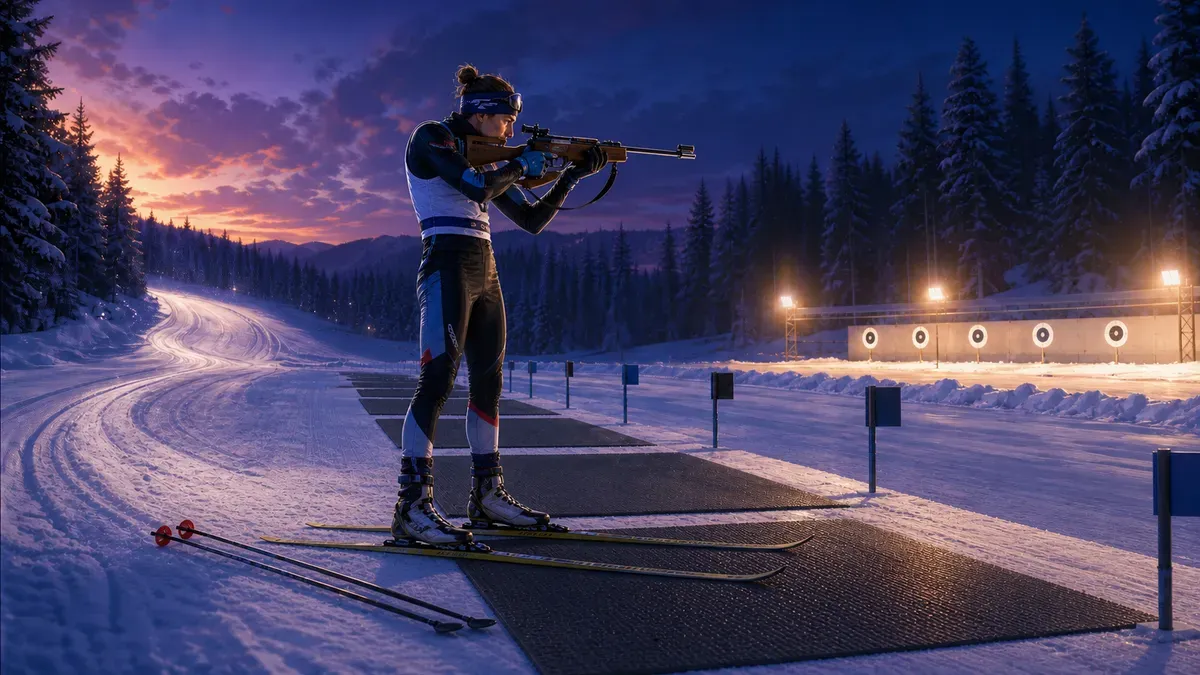
Modern international biathlon uses free-technique cross-country skiing, which at elite level normally means skating techniques. Athletes carry a small-bore rifle on the course, place their poles aside at the range, and shoot at five self-indicating targets approximately 55 yd (50 m) away. The current International Biathlon Union competition rules govern equipment, course design, range procedure, penalties, and event-specific details.
Our classic vs skate cross-country skiing guide explains how skating differs from parallel-track classic technique, why each style needs different trail space, and which basic movements a newcomer should learn first.
There are two shooting positions:
- Prone: the athlete lies facing the targets and has a smaller scoring area.
- Standing: the athlete supports the rifle without contact between the torso and the lane surface, making balance and rifle control more difficult.
Each normal stage contains five shots for five targets. Relays add three spare rounds, loaded individually, before an unclosed target produces a penalty loop. A hit changes the target display immediately, making the skiing-versus-shooting tradeoff visible to athletes and spectators.
Why the range changes the race
Course time is large enough that skiing fitness matters enormously, but accuracy carries disproportionate leverage. A World Cup analysis of individual races found that differences in course time and miss-related penalty time explained roughly equal portions of the performance gap between top-10 athletes and those ranked 21st–30th (Luchsinger et al., 2018). Shooting time itself explained much less of that gap.
That does not mean an athlete should shoot slowly without limit. It means that a few seconds saved by rushing can be a poor trade if they increase the chance of a one-minute penalty or another trip around the penalty loop.
Biathlon race formats compared
The stable differences among formats are the start method, number of range visits, shooting order, and consequence of a miss. Exact distances can differ by class and competition, so the table describes current senior international formats rather than every local variation.
| Format | Typical senior distance | Start and shooting | Miss consequence | How the winner is decided |
|---|---|---|---|---|
| Sprint | Men: 6.2 mi (10 km); women: 4.7 mi (7.5 km) | Interval start; prone, then standing | 164 yd (150 m) penalty loop per miss | Lowest total time |
| Pursuit | Men: 7.8 mi (12.5 km); women: 6.2 mi (10 km) | Start gaps come from a qualifying race; prone, prone, standing, standing | 164 yd (150 m) loop | First across the finish |
| Individual | Men: 12.4 mi (20 km); women: 9.3 mi (15 km) | Interval start; prone and standing alternate across four stages | One minute added per miss | Lowest total time |
| Mass start | Men: 9.3 mi (15 km); women: 7.8 mi (12.5 km) | Qualified field starts together; prone, prone, standing, standing | 164 yd (150 m) loop | First across the finish |
| Relay | Four athletes; leg distance varies by class | Each athlete shoots prone and standing; three spare rounds per stage | Loop for each target still open after spare rounds | First team across the finish |
| Mixed relay | Four athletes in current major format | Sprint-style legs with prone and standing stages; three spare rounds | Loop for each target still open after spare rounds | First team across the finish |
The IBU’s discipline pages provide the current overview for sprint, pursuit, individual, mass start, and relays. Always check the event’s current program: youth, junior, regional, para, and development competitions can use different distances or adapted equipment.
Sprint: speed with two decisive range visits
The sprint uses three ski loops and two shooting stages, prone followed by standing. Athletes start at intervals, so the visible leader on course is not necessarily leading on adjusted time. With only ten targets, one miss is costly, but the short format also rewards fast skiing and efficient range entry.
Pursuit: the previous result becomes the start list
The pursuit usually starts from the time gaps created by a qualifying sprint. If the sprint winner begins at 0:00 and another athlete finished 18 seconds back, that athlete starts 18 seconds later. Four stages and direct track position make the race easy to read: the first athlete across the line wins.
Individual: every miss costs a full minute
The individual is the longest classic format and alternates prone, standing, prone, standing. Instead of skiing a penalty loop after each miss, the result receives one added minute. That rule raises the value of accuracy and makes pacing across five loops a different problem from an all-out sprint.
Mass start and relays: traffic, tactics, and spare rounds
Mass-start athletes leave together, so drafting, lane traffic, and head-to-head decisions influence the race. Relay athletes complete one leg each. At every relay stage they have five standard rounds plus up to three spares to close five targets; only targets that remain open after those spares lead to penalty loops.
If you want a comparison with a winter sport where gates and line choice replace range stops, see our guide to alpine skiing disciplines.
Our ski jumping beginner guide shows a different Nordic problem: one short sequence of inrun, takeoff, flight, and landing earns distance and style points instead of a race time.
What biathlon demands physiologically
Biathlon skiing is intermittent whole-body endurance exercise. Climbs can push intensity high, descents change muscle loading and create partial recovery, and every range entry interrupts the locomotor rhythm. The athlete must generate speed with the legs, trunk, and upper body while carrying equipment, then rapidly organize breathing, posture, attention, and fine motor control.
A scientific review identifies aerobic capacity, lactate threshold, movement efficiency, skiing technique, shooting accuracy, shooting speed, postural balance, rifle stability, triggering behavior, and focused attention as interacting performance factors (Laaksonen et al., 2018). The evidence base is much smaller than it is for running or general cross-country skiing, so precise elite observations should not be turned into universal prescriptions for recreational athletes.
Aerobic capacity keeps the system usable
High aerobic fitness supports speed, recovery across changing terrain, and repeated returns to controlled movement. It does not guarantee accurate shooting, but poor conditioning makes every later skill harder to preserve. A beginner should build consistent easy endurance before stacking frequent high-intensity intervals.
Our VO2 max improvement guide explains how easy volume and hard intervals serve different purposes. The heart-rate zones by sport guide also explains why one set of zones does not transfer perfectly across running, cycling, skiing, and other modes.
Strength supports propulsion, posture, and control
Skate skiing uses repeated lateral push-off, single-leg support, trunk stabilization, and force through the poles. Strength training can improve the capacity behind those actions, but gym strength does not replace snow technique. Useful patterns include squats, split squats, step-ups, hip hinges, calf raises, rows, presses, anti-rotation work, and loaded carries.
The goal is not to exhaust every muscle. It is to build enough force and tissue tolerance that technique remains available. Two well-spaced full-body sessions are a practical starting point for many healthy adults; the correct dose depends on training age and total ski volume. See our strength-training frequency guide for the volume-versus-frequency distinction.
Why shooting changes after hard skiing
At the range, the athlete is not returning to a true resting state. Heart rate, breathing, muscle activation, arousal, and body sway are still changing. The technical challenge is to build a repeatable sequence inside that moving physiology.
In a 2025 study of 19 elite male biathletes, standing-shot miss likelihood was higher after race-like and near-maximal roller-ski efforts than at rest. Greater barrel velocity explained part, but not all, of the deterioration (Danielsen et al., 2025). An earlier simulation with national- and junior-team athletes similarly found that hold stability, aiming accuracy, triggering quality, and postural balance worsened after intense exercise (Ihalainen et al., 2018).
Those studies do not prove a single ideal arrival heart rate. They support three training principles:
- Learn shooting mechanics when fresh. Fatigue should not be used to hide inconsistent basics.
- Practice transitions progressively. Move from easy exercise before shooting to moderate and then competition-like efforts under coaching.
- Protect repeatability over theatrics. A short, practiced arrival routine is more useful than forcing an arbitrary breath count copied from an elite athlete.
Prone and standing should not be treated as identical. Classic research found that preceding exercise intensity had a clearer negative effect on standing accuracy and stability than on prone performance (Hoffman et al., 1992). Standing offers less external support, so balance and fine control become especially exposed when effort is high.
Shooting and range safety come first
This guide does not teach firearm handling. Biathlon shooting belongs at an authorized range under a qualified coach, with all national law, federation rules, club procedures, and range commands followed exactly. A newcomer should never improvise a target area, transport or handle equipment without the required authorization, or copy competition behavior outside a controlled session.
The safest entry pathway is often deliberately simple:
- attend an introductory session at a recognized biathlon or Nordic club;
- learn range commands and safe behavior before combining tasks;
- use laser, optical, or air-rifle systems when the program and local rules provide them;
- practice skiing and shooting separately until both are predictable;
- add low-intensity transitions only under direct supervision;
- progress to competition equipment only through the club’s legal and coaching pathway.
The IBU’s Biathlon 4 All development guide explicitly accommodates laser/optical, air, and small-bore formats while placing safety at the center of sessions. That is a useful model for access: preserve the ski-to-precision challenge without treating elite equipment as the first step.
A beginner pathway into biathlon
The best route depends on local facilities, snow access, age, and previous experience. The sequence matters more than the calendar.
Phase 1: control on cross-country skis
Learn balance, gliding, braking, turning, climbing, descending, and trail awareness before adding any range task. A beginner should be able to reduce speed and stop on command, hold a predictable line, and recover from small balance errors without grabbing another skier.
If snow is seasonal, hiking, cycling, running, and a ski ergometer can build general endurance. Roller skiing is highly specific but adds road, speed, and fall hazards; it requires instruction, a helmet and other appropriate protective equipment, a suitable closed or controlled area, and a clear understanding of local rules.
Phase 2: range behavior and precision while fresh
Learn only through the club’s supervised system. The early success metric is not speed. It is consistent compliance with commands, an organized setup, and a repeatable process. Laser or optical training can introduce the cognitive transition without firearm handling.
Phase 3: easy ski-to-range transitions
Combine a short easy loop with a supervised precision task. Keep the exercise intensity low enough that the athlete can follow every command and preserve technique. Increase the number of repetitions before increasing speed.
Phase 4: race-specific work
Only after both skills are stable should sessions include controlled threshold work, short high-intensity segments, timed range entry, or head-to-head simulations. The athlete still needs easy training; making every session race-like usually degrades quality and recovery.
A practical weekly training framework
This example suits a healthy adult who already has basic aerobic fitness and access to qualified instruction. It is not a personalized medical or competition plan.
| Day | Main session | Purpose |
|---|---|---|
| Monday | Rest or gentle mobility | Absorb the previous week |
| Tuesday | Easy endurance, 45–75 minutes | Aerobic base and technique at conversational effort |
| Wednesday | Full-body strength | Lower-body force, trunk control, and upper-body endurance |
| Thursday | Supervised range skills while fresh | Safety, consistency, and precision without heavy fatigue |
| Friday | Easy endurance or rest | Add volume only if recovery is good |
| Saturday | Club session: ski technique plus progressive transitions | Integrate skills at an intensity the coach can control |
| Sunday | Longer easy endurance, 60–120 minutes | Durability and low-intensity efficiency |
After several consistent weeks, one easy session can occasionally become intervals, such as four controlled three-minute efforts with generous recovery. Do not add hard intervals, extra strength volume, and longer skiing in the same week. The training-load curve guide explains why changing one major stressor at a time makes adaptation easier to interpret.
Shooting should not be used as a reward that encourages a fatigued beginner to rush safety steps. Stop the combination drill whenever commands, handling, balance, or judgment deteriorate.
Pacing, focus, and the transition routine
Pacing is an optimization problem. A hill may reward hard skiing, but the range that follows changes the value of that effort. The final loop has no later shooting stage, so it creates a different tradeoff from the approach to standing.
A practical transition routine has only a few coach-approved cues. It may cover approach intensity, lane entry, setup, a visual focus point, and the decision to reset after a poor shot. The cue words should be brief enough to survive fatigue. Detailed technique remains individual and belongs with the coach.
Pressure adds another layer. Athletes may interpret a miss as a command to hurry, even though rushing can compound the error. Mental-skills research in endurance sport supports rehearsed routines, realistic simulation, and attention to controllable actions. Our pre-race anxiety guide explains process goals and arousal management in a broader racing context.
Cold-weather safety and recovery
Biathlon adds environmental exposure to training stress. Wind, wet clothing, changing snow, darkness, and remote terrain can matter as much as the thermometer. Sweat can become a cooling problem during pauses, especially when a hard ski segment is followed by standing still.
The US Centers for Disease Control and Prevention notes that hypothermia can occur even above 40°F (4.4°C) when a person becomes chilled by rain, sweat, or cold water. Warning signs include shivering, exhaustion, confusion, fumbling hands, memory problems, slurred speech, and drowsiness (CDC, 2024). Confusion, loss of coordination, suspected hypothermia, frostbite, chest pain, fainting, or severe breathlessness are reasons to stop and seek appropriate medical help.
Before a winter session:
- check weather, wind, trail status, daylight, and the facility plan;
- wear adjustable layers that keep wind and moisture under control;
- protect hands, feet, ears, and face without compromising safe movement;
- carry dry layers and emergency supplies appropriate to the venue;
- tell someone the route and expected return when training outside a managed facility;
- fuel and hydrate for the session rather than assuming cold removes fluid needs;
- shorten or cancel training when conditions exceed the group’s equipment and experience.
Recovery is part of skill training. Sleep loss and accumulated fatigue can degrade attention before they produce an obvious fitness decline. Keep at least one low-load day after demanding combined sessions and avoid turning a missed target into unscheduled punishment volume.
Track adaptation with SuperAge
Once a safe training structure is in place, SuperAge can bring together Apple Health activity, sleep, resting heart rate, heart-rate variability, and cardio-fitness trends. The useful question is not whether one daily number predicts shooting. It is whether your training pattern is becoming more consistent and whether recovery markers return toward your own baseline after hard ski, strength, and transition sessions.
Use the app as a longitudinal notebook, not a range coach. It cannot assess firearm safety, diagnose cold injury, measure shot quality, or certify race readiness. A coach still decides technical progression, and a clinician should assess symptoms or medical risk.
If you want one private view of those recovery and fitness trends, download SuperAge on the App Store and compare hard training blocks with your own longer-term baseline.
Common beginner mistakes
Combining the skills too soon
A person can be a capable runner and still lack ski control; a competent target shooter can still lose repeatability after whole-body effort. Build each skill independently before expecting a clean transition.
Making every workout hard
Race intensity is specific, but it is not the default intensity for learning. Too much hard training reduces the number of technically useful repetitions and can make range behavior less reliable.
Copying elite routines literally
Elite pacing, shooting cadence, annual volume, and equipment reflect years of training. Use them to understand the sport, not as a beginner prescription. Progress should match current skill, recovery, and coaching access.
Treating one miss as a fitness diagnosis
Wind, visibility, setup, attention, balance, equipment, and random variation all influence a five-shot stage. Review patterns across sessions instead of inventing a physiological explanation for every target.
FAQ
Is biathlon cross-country skiing with shooting?
Yes, but the transition is what makes it a distinct sport. Athletes alternate free-technique cross-country ski loops with five-target prone or standing stages, and misses directly change the result.
How far away are biathlon targets?
Senior international biathlon targets are approximately 55 yd (50 m) from the firing line. Development, para, laser, optical, air-rifle, and local formats may use different equipment or distances.
What happens when a biathlete misses?
In sprint, pursuit, mass start, and most relays, a miss usually means a 164 yd (150 m) penalty loop. In the classic individual format, a miss normally adds one minute. Relay athletes may use up to three spare rounds before skiing a loop for a target that remains open.
What is the difference between prone and standing shooting?
Prone provides more support but uses a smaller target opening. Standing provides less external support and is generally more vulnerable to postural sway after hard skiing.
Do biathletes stop their heart rate before shooting?
No. Heart rate falls from skiing intensity during range entry, but the athlete shoots while the body is still recovering. There is no universal heart-rate number that guarantees accuracy.
Can a beginner try biathlon without owning a rifle?
Often, yes. Clubs may provide supervised introductory equipment or use laser, optical, and air-rifle formats. Availability and legal requirements differ, so contact a recognized local club rather than purchasing equipment first.
Can running or cycling prepare you for biathlon?
They can build aerobic fitness, but they do not teach ski balance, skating technique, range procedure, or precision after skiing. They are supporting tools, not complete substitutes.
Is biathlon safe for older beginners?
It can be approachable when the format, terrain, intensity, and equipment are adapted by qualified instructors. Anyone with symptoms, unstable medical conditions, or concerns about vigorous exercise in the cold should seek individualized medical advice before starting.
Key takeaways
- Biathlon rewards the best total race, not simply the fastest skiing or quickest shooting.
- Sprint, pursuit, individual, mass-start, and relay formats change the start, shooting sequence, and cost of a miss.
- Aerobic fitness, skiing efficiency, strength, balance, attention, and shooting repeatability interact.
- Hard skiing affects standing stability most clearly, so transitions must be trained progressively.
- The correct beginner route is a recognized club with qualified supervision and strict range procedures.
- Easy endurance, strength, separate skill work, and only occasional race-like sessions form a practical foundation.
References
- International Biathlon Union. Event and Competition Rules, November 2025
- International Biathlon Union. Biathlon discipline guides
- International Biathlon Union. Biathlon 4 All Events Guide, 2025
- Laaksonen MS, Finkenzeller T, Holmberg HC. The influence of physiobiomechanical parameters, technical aspects of shooting, and psychophysiological factors on biathlon performance. Journal of Sport and Health Science. 2018
- Danielsen J, et al. Effect of exercise intensity on biathlon standing shooting performance and rifle movement during outdoor roller skiing. Medicine and Science in Sports and Exercise. 2025
- Ihalainen S, et al. Technical determinants of biathlon standing shooting performance before and after race simulation. Scandinavian Journal of Medicine and Science in Sports. 2018
- Hoffman MD, et al. Biathlon shooting performance after exercise of different intensities. International Journal of Sports Medicine. 1992
- Luchsinger H, et al. The contribution from cross-country skiing and shooting variables on performance-level and sex differences in biathlon World Cup individual races. International Journal of Sports Physiology and Performance. 2018
- Centers for Disease Control and Prevention. Preventing hypothermia. 2024
This article is for education, not medical, legal, firearm, or coaching advice. Follow applicable law, range commands, federation rules, and qualified instruction. Seek medical care for concerning symptoms and individualized advice before vigorous cold-weather exercise when health risks are present.
Related Articles
Classic vs skate skiing: technique, terrain, and how to choose
Compare classic vs skate skiing technique, trail needs, fitness demands, equipment, and a safe beginner plan for choosing your first Nordic skiing style.