Classic vs skate skiing: technique, terrain, and how to choose
Compare classic vs skate skiing technique, trail needs, fitness demands, equipment, and a safe beginner plan for choosing your first Nordic skiing style.
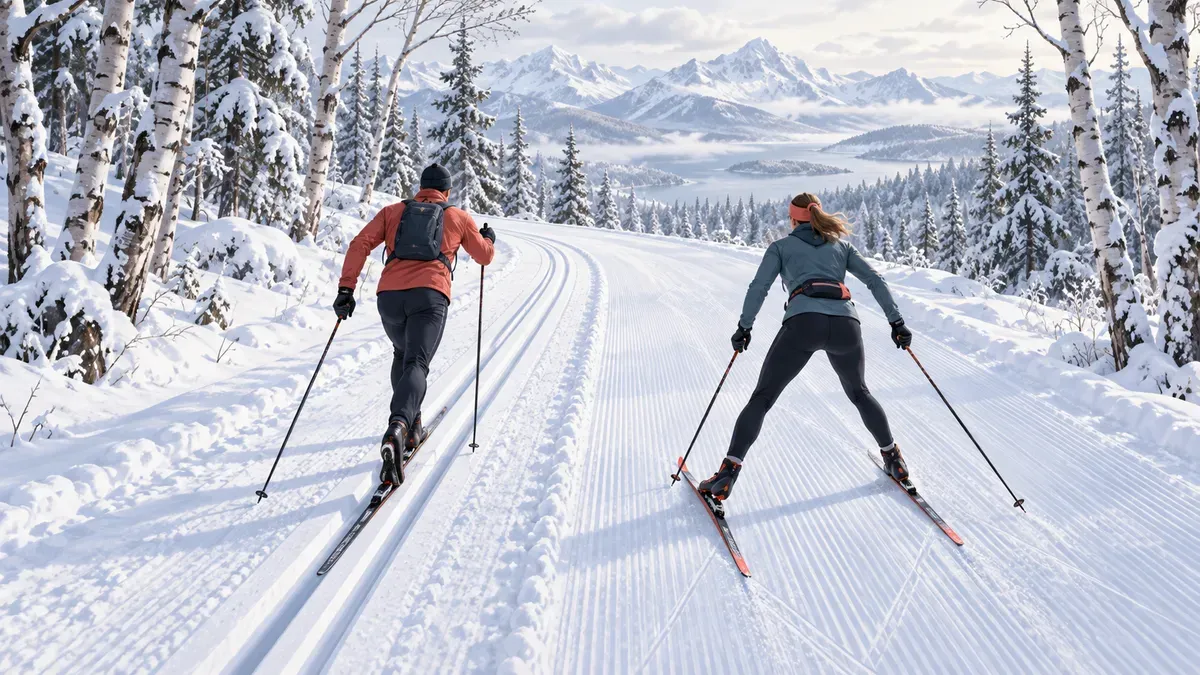
Classic and skate skiing use the same basic setting—groomed snow, long narrow skis, boots, and poles—but they solve forward motion differently. Classic skiing sends the skis mainly straight ahead, often inside parallel tracks, with grip under the foot supporting a kick-and-glide rhythm. Skate skiing pushes each ski diagonally outward on a wide, packed lane, more like repeated side-to-side skating.
Neither style is automatically better or universally easier. Classic usually offers the gentler first experience when a trail has reliable tracks and well-matched grip. Skate often feels faster once learned, but its balance, edge control, lateral push, and timing can make the first lessons more demanding. The best choice is the one that matches the trail, instruction, rental equipment, and movement you can practice consistently.
Quick answer
Choose classic skiing if you want a walking-like entry, access to narrow tracked trails, and a technique that can begin at low speed. Choose skate skiing if you enjoy dynamic lateral movement, have a wide groomed skating lane, and can invest in lessons for balance and timing.
Both are full-body endurance sports. Both require technique changes as terrain and speed change. Try each with correctly fitted rental equipment before buying: classic and skate skis, boots, and poles are designed for different jobs and should not be treated as one interchangeable kit.
Key facts
- Classic skiing creates propulsion through grip, weight transfer, and pole force while the skis travel mostly forward.
- Skate skiing creates propulsion by edging each ski and pushing diagonally away from the direction of travel.
- Terrain selects sub-technique because slope, speed, snow, and balance change the most efficient movement pattern.
- Skill quality improves economy by directing force forward and reducing unnecessary motion.
- A beginner progresses safely by learning balance, stopping, turning, and trail etiquette before adding speed or fatigue.
Classic vs skate skiing at a glance
| Feature | Classic skiing | Skate skiing |
|---|---|---|
| Main path of the skis | Mostly parallel and forward | Alternating V-shaped, diagonal push |
| Grooming | Parallel classic tracks; tracks may disappear on steep or technical sections | Wide, firm, packed skating lane |
| Basic propulsion | Grip zone or skin engages the snow, followed by glide; poles assist | Ski edge pushes laterally; poles coordinate with the skating cycle |
| Common beginner cue | Shift fully onto one gliding ski | Stand over the gliding ski before the next push |
| Low-speed access | Often easier to approximate with a walking shuffle | Balance and edge timing are harder when movement stalls |
| Space needed | Relatively narrow when tracks are present | Wider lane for the V-shaped movement |
| Typical learning challenge | Creating grip without stomping or slipping backward | Controlling the ski edge without collapsing inward or rushing side to side |
| Equipment | Classic skis, boots, and usually shorter poles; grip system matters | Skate skis, more supportive boots, and usually longer poles |
| Best first environment | Flat, well-set tracks with dependable grip | Flat, wide, freshly groomed lane with instruction |
Competition language can be confusing. The current FIS cross-country rules define classical technique as diagonal stride, double poling with or without a diagonal kick, herringbone without a gliding phase, and turning techniques. “Free technique” permits all cross-country techniques; in practice, racers normally skate when skating is faster. Recreational trail signs may simply say classic and skate.
How classic skiing works
Classic skiing is not one unchanging stride. It is a family of movements that functions like a gearbox.
Diagonal stride
Diagonal stride resembles an exaggerated walking or running pattern: one leg presses and extends while the opposite arm plants the pole. The skier briefly grips the snow under one ski, transfers body mass onto the other ski, and glides. On a gentle trail, the movement should feel long and quiet rather than like rapid shuffling.
The decisive step is commitment to one ski. If body mass stays between both feet, the grip ski may not load enough to hold and the glide ski cannot run freely. A beginner often tries to solve that problem by kicking harder. Better balance and timing usually matter more than more force.
Double poling
In double poling, both poles plant together while the skis continue to glide. The movement uses the trunk, shoulders, arms, hips, and legs as a coordinated system; it is not an isolated arm exercise. It suits flats, slight descents, and fast sections when grip from a leg kick is unnecessary.
Elite racing research illustrates why terrain changes the answer. In a treadmill study of highly trained skiers, double poling was favored at a faster 5% incline while diagonal stride produced a lower physiological response and better efficiency at a slower 12% incline (Dahl et al., 2017). Those exact thresholds are not beginner prescriptions. They show that a technique is efficient only in relation to speed, slope, snow, and the skier’s capacity.
Kick double pole and herringbone
Kick double pole adds one leg kick between coordinated double-pole actions. It bridges the gap between diagonal stride and pure double poling on rolling terrain.
When a hill becomes too steep to maintain grip and glide, the skis open into a herringbone. The skier steps upward on the inside edges without a gliding phase. A controlled herringbone is a useful gear, not evidence that the outing has failed.
If the diagonal arm-leg pattern feels foreign, Nordic walking technique can introduce contralateral rhythm on dry ground. Poles and surfaces differ, so walking practice supports coordination without replacing an on-snow lesson.
How skate skiing works
Skate skiing converts a lateral push into forward glide. The skis form a V, but the skier should not merely shove the feet apart. Pressure builds against an edged ski; the body moves forward and over the new gliding ski; the poles add force according to the chosen gear.
The common skate gears
Names vary by country and coaching system, which is why demonstrations matter more than labels. Three patterns explain most beginner decisions:
- Offset, often called V1: an asymmetrical pole action supports every second skate push. It is commonly used on climbs or when acceleration demands more force.
- One-skate, often called V2: a symmetrical double-pole action accompanies every skate push. It suits controlled speed on flatter or gently rising terrain when balance is stable.
- Two-skate, often called V2 alternate: a symmetrical pole action occurs every second skate push. It is useful at higher speeds and on easier terrain.
Research describes even more sub-techniques, including diagonal skate, skating without poles, turning, and downhill positions. The important principle is not memorizing a list: skilled skiers shift gears repeatedly as slope and speed change. A scientific review of cross-country energy systems emphasizes that terrain changes both metabolic demand and how much work the upper and lower body contribute (Gløersen et al., 2019).
Why beginners rush the side-to-side motion
Skate skiing becomes unstable when the next push begins before body mass reaches the gliding ski. The skier then makes short, wide steps, spends little time gliding, and uses the poles to rescue balance. Fatigue rises while speed does not.
Practice the sequence slowly on flat terrain: push, arrive over one ski, glide, then change sides. Brief no-pole drills can reveal balance, but use them only where speed is low and an instructor has confirmed the drill is appropriate. Removing poles on a descent or crowded trail adds risk without teaching the intended skill.
Terrain and grooming decide what is possible
Classic and skate skiing need different trail architecture. FIS rules reflect that distinction: classical courses normally use set tracks, while free-technique courses are packed wide enough for skiers to move side by side. Recreational venues use the same practical logic even when they are not competition courses.
Classic tracks guide the skis and reduce the steering demand. That support can make balance feel more predictable, but an icy track may be fast and difficult to exit. Some turns, descents, and steep climbs have no tracks, so every classic skier still needs a wedge stop, step turn, and basic out-of-track control.
Skate skiing needs a firm, sufficiently wide platform. Deep new snow, a narrow footpath, or a classic-only track is not a skating lane. Skating across set classic tracks damages the surface for other users. Check the venue’s grooming report, permitted technique, direction of travel, and pass requirements before leaving home.
Backcountry touring is a separate decision. Ungroomed snow, avalanche terrain, route finding, and remote rescue change the equipment and safety problem. This comparison concerns groomed Nordic skiing. If you want a slower winter-trail option, our snowshoeing beginner guide covers flotation, terrain choices, and cold-weather preparation.
Is classic or skate skiing a harder workout?
The honest answer is: the style you perform poorly may feel harder, while the style you perform efficiently may let you travel faster at the same perceived effort. Trail grade, snow speed, pole use, grip, technique, and session design can outweigh the label.
Cross-country skiing can recruit the legs, trunk, and upper body while repeatedly changing intensity across hills and descents. A systematic review found that performance-related biomechanics include useful cycle length, appropriate cycle rate, and movements that direct propulsion forward while limiting wasted motion (Zoppirolli et al., 2020). That is why a technically smoother easy session can be better training than a harder session built on slipping and instability.
Do not transfer running heart-rate zones mechanically. Skiing may engage more upper-body muscle, cold can affect perception and sensors, and technique changes alter the relationship between pace and heart rate. Use conversation, breathing, perceived effort, and terrain alongside the principles in our heart-rate zones by sport guide.
For general aerobic development, most beginner sessions should remain controlled enough to repeat good movements. Hard intervals are not a shortcut around balance. If improving aerobic capacity is a goal, the VO2 max guide explains how easy volume, threshold work, and high-intensity intervals serve different roles.
Equipment is style-specific
Start with a lesson and a rental package matched by the ski center. A complete fit includes body mass, height, ability, snow conditions, and local trail design—not just a generic size chart.
Classic equipment
Classic skis need both glide and grip. Waxless touring skis usually use a textured scale pattern or an integrated skin underfoot. Waxable race and performance skis use grip wax selected for the snow. The ski’s flex must let the grip zone engage when weighted yet lift enough to glide when weight transfers away.
Classic boots usually allow more ankle movement than skate boots. Classic poles are generally shorter because the movement and pole angles differ. An instructor or rental technician should set length and strap fit; competition limits are not a recreational fitting formula.
Skate equipment
Skate skis are typically shorter and torsionally suited to edge pressure, without a central grip zone. Skate boots provide more lateral ankle support. Longer poles support the timing and force demands of skating, but a pole that is too long can distort technique and shoulder position.
Bindings and boots must be compatible. Do not assume that two visually similar systems connect safely. Rental staff should inspect bindings, pole straps, ski condition, and fit before the session.
Can one setup do both?
“Combi” boots can be useful in some learning programs, but one ski cannot simultaneously behave like a correctly selected classic grip ski and a dedicated skate ski. Poles also differ. Renting separate setups reveals the real movement of each style and prevents an equipment mismatch from masquerading as a technique problem.
How to choose your first style
Use constraints, not identity. You do not need to decide what kind of skier you are forever.
Choose classic first when:
- your local venue reliably sets beginner tracks;
- rentals and beginner lessons are easier to access;
- you prefer a lower-speed introduction;
- narrow trail access matters;
- you enjoy rhythm, glide, and long steady outings.
Choose skate first when:
- your local venue maintains a wide skating lane;
- you can take a technique lesson early;
- ice-skating or inline-skating balance feels familiar;
- dynamic lateral movement appeals to you;
- you accept that the first sessions may involve short glides and frequent resets.
Choose the style your companion already skis only if they can stay patient and the trail suits a beginner. Following a faster skier onto difficult terrain is not instruction.
The biathlon guide explains a related but distinct sport: modern biathlon competition normally uses skate skiing, then adds supervised range procedures and shooting under fatigue. Learning skate does not by itself prepare someone for biathlon safety or competition.
A four-outing beginner progression
Repeat an outing until control survives mild fatigue. Thirty-five to 60 minutes is enough for many first sessions, including instruction and rests; cold, altitude, fitness, and skill may require less.
Outing 1: balance and control
- Learn how the bindings work and how to stand up after a fall.
- Move without poles on a flat practice area if the instructor recommends it.
- Shift onto one ski without rushing.
- Practice stopping, changing direction, and yielding before joining a loop.
Outing 2: build the basic propulsion cycle
- Classic: connect grip, weight transfer, and glide in diagonal stride.
- Skate: connect edge pressure, lateral push, and arrival over the gliding ski.
- Add poles only when they support rhythm rather than balance rescue.
- Finish while movement is still organized.
Outing 3: change gears with terrain
- Classic: alternate diagonal stride, double pole, kick double pole, and herringbone.
- Skate: practice an uphill gear and a flatter-terrain gear at controlled speed.
- Rehearse track entry and exit, passing, and a safe descent stance.
Outing 4: complete an easy loop
- Choose a short, familiar route with no technical surprise.
- Keep the effort conversational for most of the session.
- Pause before technique deteriorates, not after.
- End with one simple observation: which cue improved glide most?
Add distance before sustained intensity. Strength work can support posture, force, and tissue capacity, but it cannot replace snow time. Our strength-training frequency guide can help place one or two complementary sessions without turning every day into hard training.
Common mistakes and better corrections
| Mistake | What it causes | Better correction |
|---|---|---|
| Looking down at the ski tips | Collapsed posture and late terrain awareness | Look farther along the trail and keep the chest organized |
| Keeping weight between both skis | Weak grip in classic; unstable glide in skate | Arrive over one ski before starting the next cycle |
| Increasing cadence whenever grip fails | More slipping and less glide | Reset balance, ski selection, and grip before adding speed |
| Pulling only with the arms | Early upper-body fatigue | Coordinate poles with trunk, hips, and legs |
| Starting on a hill | Fear, braking, and poor repetition quality | Learn propulsion and stopping on flat terrain first |
| Copying an elite sub-technique | A movement chosen for another speed and capacity | Use the gear that matches your current terrain and control |
| Buying before trying | Expensive equipment that does not fit local trails | Take a lesson and rent each style first |
Technique should become quieter and more repeatable, not merely more forceful. Video can help when a coach records one controlled pass and gives one correction. Filming every section without a clear question often produces more data than learning.
Cold, falls, and trail safety
Groomed does not mean risk-free. Descents may be icy, tracks may cross roads, and another skier may be hidden beyond a rise. Learn the venue’s direction, difficulty symbols, passing convention, closing time, and emergency number. Do not stop in the middle of a descent or immediately beyond a blind corner.
Dress in layers that move sweat away from skin and protect against wind while allowing ventilation. Carry insulation for stops. The CDC notes that hypothermia can occur even above 40°F (4°C) when someone is wet and chilled; warning signs include shivering, exhaustion, confusion, fumbling hands, slurred speech, and drowsiness (CDC, 2026). Numb, pale, firm, or waxy skin can indicate frostbite. Leave the cold, seek appropriate help, and never rub frozen tissue.
Falls are part of learning, but repeated uncontrolled falls signal that the terrain, speed, or fatigue is beyond the session goal. A prospective study in competitive cross-country skiers found more lower-extremity than upper-extremity or trunk injuries, and more overuse than acute injuries across the year; previous injury was associated with new injury (Bolger et al., 2019). Recreational beginners are a different population, but the practical lesson is sound: progress load gradually and address a recurring problem instead of skiing through it.
Use SuperAge to compare sessions, not styles
Classic and skate sessions should not be judged by pace alone. Snow temperature, grooming, wind, elevation, grip, trail profile, and skill can change speed dramatically. A slower outing may be the better technical session.
Use SuperAge to review duration, heart-rate response, recovery, sleep, and how the session felt. Add a short note with technique, trail, snow, and one skill cue. Compare repeated outings on the same loop and in similar conditions before interpreting a trend.
The useful question is not “Which style burns more?” It is “Can I repeat this session with stable technique and recover for the next one?” Download SuperAge to keep training and recovery context together while leaving technique assessment to an instructor and trail decisions to current conditions.
Frequently asked questions
Is classic skiing easier than skate skiing for beginners?
Classic often offers an easier first hour because a beginner can shuffle at low speed and parallel tracks guide the skis. Correct diagonal stride still requires grip, full weight transfer, balance, and glide. Skate can feel harder initially because slow lateral movement is unstable, but prior skating experience may change the comparison.
Which is faster, classic or skate skiing?
Skate is generally faster on a wide, firm groomed lane for a proficient skier, which is why free-technique races normally use skating. Speed on any recreational outing still depends on snow, grooming, equipment, terrain, fitness, and skill. A skilled classic skier can easily outpace a novice skater.
Can I skate ski in classic tracks?
No. The lateral skating push crosses and damages the parallel grooves. Use the designated skating lane and follow local signs. Classic skiers may need to leave the tracks for turns, passing, herringbone climbs, or hazards, but should avoid obstructing faster traffic.
Can I use classic skis for skate skiing?
Not effectively or safely as a normal setup. Classic skis are designed around forward travel and a grip system; skate skis are designed for edge-driven lateral propulsion. Boots and pole lengths also differ. Rent a matched skate package.
Do I need wax for classic skiing?
Every ski base needs appropriate care, but not every classic ski needs daily kick-wax selection. Fish-scale and skin skis provide mechanical grip. Waxable classic skis use grip wax matched to conditions. All types rely on correct flex and preparation, so ask a qualified shop or rental technician.
Which style is better for cardiovascular fitness?
Both can provide demanding whole-body endurance training. Session intensity, duration, technique, terrain, and consistency matter more than the label. Beginners usually gain more by skiing smoothly at a controlled effort than by forcing a hard pace with unstable technique.
Does skate skiing hurt the knees more?
The techniques load the body differently, but available evidence does not justify declaring one universally more injurious. An older survey of marathon participants found no statistically significant difference in overall injury rate or injury location between classic and skate groups (Smith & Matheson, 1998). Individual history, fit, load progression, terrain, and technique remain important.
Can I learn both styles in one weekend?
You can sample both, but mastery takes repeated practice. If time is limited, spend the first lesson on one style so stopping, turning, balance, and trail behavior become reliable. Try the second style in a separate session with fresh attention and the correct equipment.
Key takeaways
- Classic travels mainly forward and uses grip plus glide; skate uses diagonal edge pushes on a wide packed lane.
- Both styles contain multiple gears, and terrain determines which movement is efficient.
- Classic often gives beginners a lower-speed entry, while skate commonly demands more balance and timing at first.
- Rent style-specific equipment and take a lesson before buying.
- Build control and technique before distance or intensity.
- Compare your own repeatable sessions, not headline claims about which style is “better.”
References
- International Ski and Snowboard Federation. International Competition Rules: Cross-Country, June 2026.
- Zoppirolli C, Hébert-Losier K, Holmberg HC, Pellegrini B. Biomechanical determinants of cross-country skiing performance: a systematic review. Journal of Sports Sciences. 2020.
- Gløersen Ø, et al. Energy system contribution during competitive cross-country skiing. European Journal of Applied Physiology. 2019.
- Dahl C, Sandbakk Ø, Danielsen J, Ettema G. Power fluctuations and diagonal versus double-poling preference. Frontiers in Physiology. 2017.
- Bolger CM, et al. Injury incidence in competitive cross-country skiers: a prospective cohort study. International Journal of Sports Physical Therapy. 2019.
- Smith M, Matheson GO. Comparison of injuries in classic and skating Nordic ski techniques. Clinical Journal of Sport Medicine. 1998.
- Centers for Disease Control and Prevention. Preventing frostbite and recognizing hypothermia. 2026.
Related Articles
Alpine skiing disciplines: slalom, giant slalom, super-G, and downhill
Learn how alpine skiing disciplines differ, from slalom to downhill, including race formats, physical demands, safety, and practical training priorities.