Nordic walking technique: poles, benefits, and a beginner plan
Learn Nordic walking technique, pole fit, common mistakes, evidence-based benefits, and a practical four-week beginner plan for safe progress.
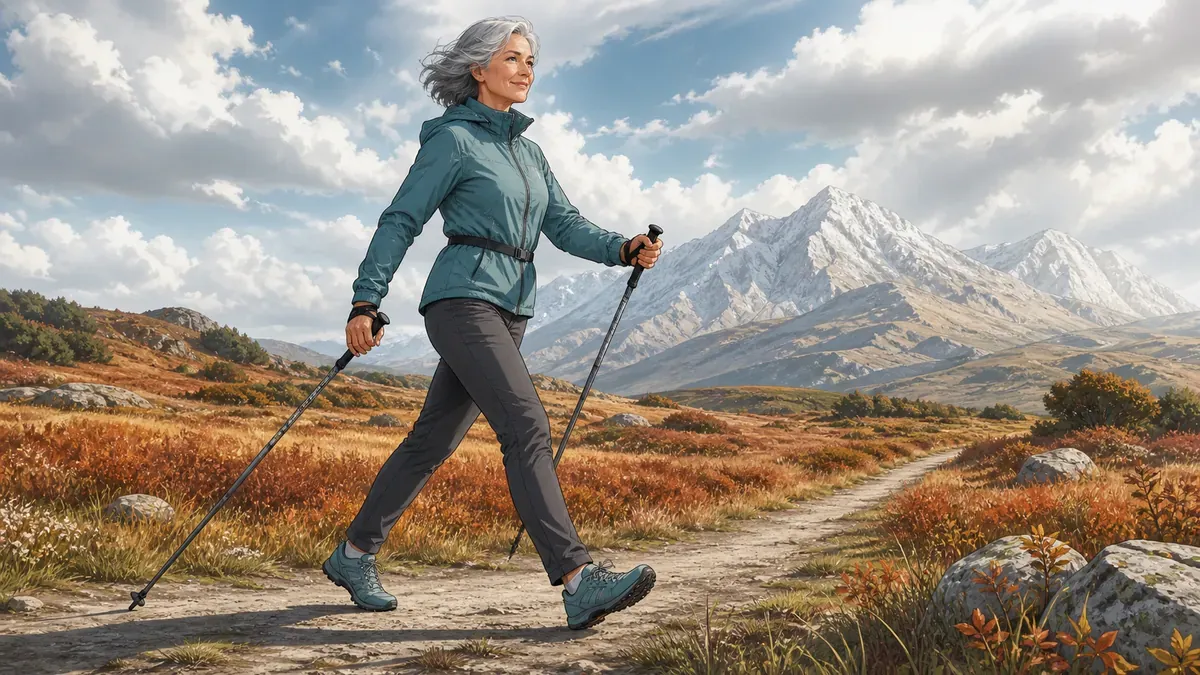
Nordic walking is not ordinary walking with two sticks added. It is a learned walking pattern in which each pole lands with the opposite foot, stays angled backward, and contributes to propulsion through the end of the stride. Done well, it turns a familiar aerobic activity into coordinated full-body exercise without turning the walk into a run.
The poles are tools, not engines. They should reinforce a tall gait, natural stride, and relaxed arm swing. If the shoulders rise, the hands stay clenched, or the poles stab the ground in front of you, more effort is not producing better technique. Begin slowly enough to learn the rhythm, then add time and pace.
Quick answer
Good Nordic walking technique uses a diagonal rhythm: the right pole moves with the left foot and the left pole with the right foot. Plant each pole near the opposite heel with its tip angled behind you, press backward through the strap, and let the hand open as the arm passes the hip. Start with 20–30 easy minutes on flat ground and progress duration before speed, hills, or stronger pole force.
What you will learn:
- How Nordic walking differs from normal walking, hiking with poles, and fitness walking
- How to fit poles without treating one formula as a universal rule
- A six-part technique sequence and simple self-checks
- What the research supports—and what it does not prove
- A four-week beginner plan with intensity and safety guidance
Key facts about Nordic walking
- Nordic walking coordinates each pole with the opposite foot.
- Backward pole pressure recruits upper-body muscles and can raise exercise demand.
- Pole fit creates room for a relaxed swing rather than one perfect elbow angle.
- Technique proficiency determines how much useful force reaches the ground.
- Gradual practice converts a complicated sequence into an automatic gait.
What is Nordic walking?
Nordic walking developed from dry-land training patterns used in cross-country skiing. In its recreational form, it is brisk walking with purpose-designed poles, a long but natural arm swing, and an active backward push. The movement remains walking: at least one foot stays on the ground and there is no flight phase.
If you want to take that diagonal coordination onto groomed snow, our classic vs skate cross-country skiing guide compares the classic kick-and-glide pattern with the lateral edge push used in skating.
The defining feature is not simply carrying poles. The poles alternate with the legs, contact the ground behind the body’s forward line, and remain loaded while the arm travels backward. This diagonal pattern helps the trunk, shoulders, arms, hands, hips, and legs share one continuous rhythm.
Nordic walking versus other pole-assisted walking
| Activity | Primary purpose | Pole action | Typical terrain | Main technique cue |
|---|---|---|---|---|
| Nordic walking | Full-body aerobic exercise | Active backward propulsion | Flat paths, parks, gentle trails | Opposite arm and leg move together |
| Hiking with poles | Stability and load management | Variable support and braking | Uneven, steep, or technical trails | Place poles where terrain demands |
| Fitness walking | Brisk aerobic exercise | No poles | Roads, tracks, paths | Quick natural steps and arm swing |
| Rehabilitation pole walking | Clinician-selected movement practice | Adapted to the condition | Controlled environment | Follow the prescribed pattern |
Our fitness walking technique guide explains the no-equipment alternative. Nordic walking has a narrower skill requirement: it is worth choosing when you enjoy pole technique and have enough open space to use it without endangering other path users.
Poles do not automatically reduce joint load, correct posture, or prevent falls. On steep descents, hiking-style pole placement may offer useful support, but that is a different task from the propulsive Nordic pattern. Match the technique to the terrain instead of forcing one movement everywhere.
Deep or soft snow creates another terrain-specific task: the beginner snowshoeing guide explains flotation, binding fit, winter stride, and how poles shift from propulsion toward balance.
How to choose and fit Nordic walking poles
Use lightweight poles with a grip-and-strap system that lets you push through the hand without squeezing continuously. A removable rubber tip can improve contact on firm pavement; a harder tip can suit soil or compact trail, provided local rules and surface conditions allow it. The point should grip rather than skate.
Fixed-length poles are simple and quiet. Adjustable poles are easier to share, transport, and fine-tune. Neither format guarantees better technique. The important questions are whether the lock stays secure, the strap fits your hand, and the pole allows a free backward swing.
Start with a range, then test the movement
A common starting estimate is roughly 67–70% of body height, rounded to an available pole size. That is a fitting prompt, not a medical or biomechanical law. Research comparing poles at 55%, 65%, and 75% of body height found relatively small kinematic differences in a small group of young men, while the longest setting raised oxygen use only at the fastest tested speed. The study does not establish one ideal length for every walker; read the pole-length study for its limits.
Use this practical fit check:
- Stand tall with the pole vertical and its tip beside your foot.
- Hold the grip lightly; the elbow should feel comfortably bent, often near—but not forced to—90 degrees.
- Swing the arm backward. The tip should stay behind you without making the shoulder hike.
- Walk for five minutes. Shorten the pole if you cannot clear the ground or the shoulder feels crowded; consider a small increase only if the motion feels cramped and control remains easy.
As a rough shop-floor reference, a person around 5 ft 6 in (168 cm) may begin near a 44–45 in (110–115 cm) pole, while someone around 6 ft (183 cm) may begin near 48–49 in (120–125 cm). Body proportions, mobility, speed, terrain, and the pole system all matter more than hitting a formula exactly.
Set the straps before chasing speed
The strap should support the heel of the hand when you press backward, yet release comfortably if the pole catches. Keep circulation and finger movement normal. Make sure left and right straps are on the correct hands if they are shaped differently.
Practice opening the hand behind the hip while the strap supports the load, then bringing the grip forward into the palm. This grasp-release rhythm reduces constant gripping. If the strap rubs, twists, or feels insecure, stop and adjust it before continuing.
Nordic walking technique in six steps
Learn on a flat, wide, low-traffic path. Leave hills, loose ground, and crowded sidewalks until the basic rhythm is automatic.
1. Walk normally while dragging the poles
Put the straps on, hold the grips very lightly, and let both pole tips trail behind you. Walk with your normal stride. Do not place the poles yet. This drill reveals the natural opposite-arm-and-leg rhythm: when the left foot advances, the right arm advances.
Spend two or three minutes here. If both arms move with the same-side legs, stop thinking about the poles and recover a normal relaxed walk.
2. Let the diagonal rhythm find the ground
Keep walking and allow each trailing tip to catch the ground as the opposite foot lands. The right pole accompanies the left foot; the left pole accompanies the right foot. Contact should be quiet and repeatable, not a downward jab.
Think hand forward, opposite heel forward. A friend filming ten seconds from the side can make the timing easier to see than trying to feel every limb at once.
3. Plant beside the body, not far ahead
The pole shaft should angle backward at contact. Depending on speed and proportions, the tip will usually land around the area between the opposite heel and the midfoot—not several feet ahead of the body. A forward, vertical plant tends to become braking or stabbing instead of propulsion.
Keep the wrist neutral and the hand near waist height. The shoulder stays low; the elbow is long but not locked. Let the contact happen as part of the swing rather than reaching for the ground.
4. Press backward through the strap
Once the tip grips, direct force backward rather than straight down. The pressure should move the body forward without creating a dramatic torso lean. Maintain a tall line from head through pelvis, with the ribs stacked over the hips.
Start with only enough force to feel the pole engage. A laboratory crossover trial in 15 young men found higher oxygen use, heart rate, ventilation, and upper-limb muscle activity during Nordic walking than ordinary treadmill walking at matched speeds and grades. Those acute results show that active poles can change the workload; they do not mean maximal force is better. See the energy-expenditure trial.
5. Finish the arm behind the hip
Allow the hand to travel behind the hip as the leg completes its push. Open the fingers so the strap—not a clenched fist—transmits the final pressure. The pole remains angled backward and then leaves the ground naturally.
The movement can be smaller during early practice. Range should grow from relaxed rhythm, not from forcing the shoulder into an uncomfortable end position.
6. Recover smoothly and repeat
Bring the arm forward from the shoulder while the elbow stays relaxed. The grip returns into the hand before the next plant. Avoid lifting the pole tip high or flicking it sideways, especially around other people.
Once the sequence is stable, raise walking pace slightly while preserving quiet contact. If coordination unravels, slow down, drag the poles for 30 seconds, and rebuild the pattern.
A five-point technique self-check
From the side, look for:
- opposite hand and foot moving forward together;
- pole tips contacting behind the forward hand;
- shafts angled backward rather than vertical;
- shoulders remaining low and hands relaxed;
- a natural walking stride without overreaching.
Experienced instructors produced greater pole force and exercise responses than recreational Nordic walkers in one small study, supporting a useful practical point: proficiency changes the stimulus. The study was not randomized and included only 17 people, so it cannot define a universal target force. It does show why learning the pattern matters more than simply owning poles. Review the pole-handling study.
How hard should Nordic walking feel?
Intensity comes from speed, terrain, duration, and how actively you use the poles. Do not assume the same pace will feel identical to normal walking.
Use three simple zones:
- Easy, 2–3/10: relaxed breathing and full conversation; best for drills and recovery
- Moderate, 5–6/10: deeper breathing but you can still speak in sentences
- Hard, 7–8/10: only short phrases; reserve for brief intervals after technique is stable
Most beginners should keep nearly all early sessions easy to moderate. If you use a wearable, compare heart rate with your own previous sessions rather than a different person’s values. Our heart-rate zones guide explains why activity type, heat, medication, and fitness alter the response.
A smooth moderate session can overlap with Zone 2 training, but the labels answer different questions. Nordic walking describes a movement; Zone 2 describes an intensity domain. The talk test and perceived effort remain useful when a sensor is unavailable or noisy.
The WHO physical activity guidelines recommend that adults accumulate 150–300 minutes of moderate aerobic activity per week, or 75–150 minutes vigorous, plus muscle-strengthening work on at least two days. Nordic walking can contribute to the aerobic total, but it does not replace progressive resistance training.
Nordic walking benefits: what the evidence actually says
Nordic walking is valuable first because it is physical activity people may enjoy and repeat. Research also identifies activity-specific differences, but many studies are small, use supervised programs, or include clinical populations. Separate immediate laboratory effects from long-term health outcomes.
It can raise demand at the same walking speed
Using the poles actively recruits more upper-body musculature. Controlled studies commonly report higher oxygen consumption and heart rate than ordinary walking at matched speed. In a natural-terrain crossover study with trained instructors, estimated energy cost was about 19.5% higher with poles. That figure describes a small, skilled sample on a particular course—not a calorie promise for every walker.
The broader biomechanical systematic review found changes in speed, stride length, muscle activation, range of motion, and ground reaction force across 42 studies, whose median methodological score was moderate. Technique, terrain, and participant experience produced substantial variation.
Training can improve fitness, but comparisons matter
A 2013 systematic review covering 16 randomized trials and 11 observational studies reported favorable effects on resting heart rate, blood pressure, exercise capacity, oxygen consumption, and quality of life in several populations. Yet programs, diagnoses, and controls varied, so the conclusion is not that Nordic walking cures disease or always beats ordinary walking. See the systematic review on PubMed.
A later meta-analysis of adults aged 60–92 found improvements in several fitness and quality-of-life outcomes compared with inactive controls. When Nordic walking was compared with ordinary walking, advantages were narrower and ordinary walking performed at least as well for some outcomes. This is the right frame: both are useful exercise; poles change the movement and may change the stimulus. Read the older-adult meta-analysis.
In a randomized trial of 33 sedentary older adults, eight weeks of both Nordic and ordinary walking improved walking economy and optimal speed. The Nordic group showed some arm-related adaptations, but the overall message was not that poles transformed every gait measure. The trial report reinforces the value of structured practice itself.
Cardiometabolic findings are promising, not guaranteed
A 2025 meta-analysis pooled 22 trials with 1,271 older adults and reported modest average changes in body composition, maximal oxygen uptake, blood pressure, and blood lipids. Those results combine different programs and populations; they do not predict an individual’s response or prove that Nordic walking is uniquely responsible compared with a well-matched exercise dose. Review the meta-analysis on PubMed.
Weight change still depends on energy intake, total activity, sleep, medication, health status, and time. Avoid claims that a fixed number of minutes or pole strokes burns a guaranteed amount of fat.
Pain and fatigue need individualized expectations
Some rehabilitation programs use Nordic walking for people with chronic conditions, but generic online technique is not a substitute for clinical assessment. A 2024 systematic review of 14 randomized studies found that several programs improved pain or fatigue, while many between-group comparisons were not statistically different. Methodological quality ranged from fair to good. See the pain and fatigue review.
If a health professional has prescribed walking for a specific condition, ask whether pole use, strap design, pace, and terrain fit that plan. More muscle involvement is not automatically better during a flare or after surgery.
A beginner Nordic walking session
This 30-minute template suits a generally healthy adult who can already walk comfortably for 20 minutes. Shorten it if needed.
| Phase | Time | Effort | Focus |
|---|---|---|---|
| Normal walking warm-up | 5 min | 2/10 | Posture, easy steps, relaxed arms |
| Pole-drag rhythm drill | 3 min | 2/10 | Opposite arm and leg |
| Easy Nordic walking | 5 min | 3/10 | Quiet diagonal plants |
| Normal walking reset | 2 min | 2/10 | Release shoulder and hand tension |
| Steady Nordic walking | 10 min | 4–5/10 | Backward pressure and full recovery |
| Cooldown | 5 min | 2/10 | Reduce pace gradually |
If the rhythm repeatedly breaks, use six rounds of two minutes with poles and one minute of normal walking. Skill improves through clean repetitions, not through dragging a faulty pattern for half an hour.
Choose a route with enough width to keep the pole tips away from pedestrians, dogs, bicycles, and traffic. A compact loop makes it easy to stop if the straps, tips, or locks need adjustment.
Four-week Nordic walking beginner plan
Progress one variable at a time. The plan assumes no pain during ordinary walking and no medical restriction on moderate exercise.
| Week | Sessions | Main prescription | Technique goal |
|---|---|---|---|
| 1 | 3 | 20–25 min easy, alternating 2 min poles / 1 min normal | Stable diagonal rhythm |
| 2 | 3 | 25–30 min easy-moderate, including 2 × 6 min continuous | Quiet plant and relaxed grip |
| 3 | 3 | 30–35 min, with 15–20 min continuous Nordic walking | Finish the push behind the hip |
| 4 | 3–4 | Two 30-min steady sessions, one 40-min easy session, optional skills walk | Hold form as pace or duration rises |
Keep at least one full day between the first sessions if shoulders, hands, or calves are adapting. After week four, extend one walk by about five minutes or add four to six one-minute brisk intervals. Do not add longer duration, steep hills, and forceful pole pressure in the same week.
Walking speed is one progress signal, not the only one. Track whether you can cover the same route with smoother rhythm, lower perceived effort, fewer grip corrections, and no next-day joint irritation. Our guide to walking speed as a functional marker explains why day-to-day pace also reflects terrain, weather, fatigue, and health.
Common Nordic walking mistakes
Moving the same-side arm and leg together
Signal: right pole and right foot advance at once.
Fix: drag both poles and recover normal walking arm swing. Add pole contact only after the diagonal rhythm returns.
Planting the poles vertically in front
Signal: the tip lands far ahead, the elbow bends sharply, or each contact feels like braking.
Fix: shorten the reach and allow the tip to land farther back with the shaft already angled behind you.
Squeezing the grips continuously
Signal: tired forearms, numb fingers, or tense shoulders.
Fix: adjust the straps, hold lightly on the forward swing, and open the hand after it passes the hip. Stop if numbness persists.
Reaching with an oversized stride
Signal: loud heel contact, knee discomfort, or the foot landing far in front of the torso.
Fix: return to your normal step length. Let speed come from rhythm and a slightly quicker cadence, not from forcing the front foot forward.
Pushing harder than technique allows
Signal: trunk twisting, shoulder hiking, crossed pole paths, or deteriorating timing.
Fix: reduce pole force. Build coordination first and demand second.
Treating poles as a guarantee of stability
Signal: choosing terrain that exceeds your balance or footwear because you have poles.
Fix: use predictable surfaces while learning. Nordic poles can slip, catch, or narrow your reaction options. On technical terrain, adopt an appropriate hiking-pole strategy or turn back.
Safety, surfaces, and who should get guidance
Inspect the poles before every session: locks secure, tips intact, straps correctly fitted, and shafts free of damage. Replace worn rubber tips before they lose grip. In low light, make your body and moving pole tips visible to others.
Wet leaves, ice, loose gravel, polished stone, and steep cambers change pole traction. Shorten the stride and reduce force when contact is uncertain. Do not use wrist straps where a trapped pole could pull the arm during a high-consequence fall, unless a qualified instructor has taught a safe terrain-specific method.
On grassy or wooded routes, include locally recommended tick prevention and a post-walk body check. If exposure is followed by fever or a changing rash, use our tick-bite warning-sign guide to organize the timeline and seek appropriate care.
Stop the session for chest pressure, fainting, sudden neurological symptoms, unusual severe shortness of breath, or pain that changes your gait. Seek urgent care when symptoms warrant it. New muscle fatigue is different from sharp wrist, elbow, shoulder, spine, hip, knee, or foot pain.
For knee clicking or grinding that comes with pain, swelling, stiffness, or lost function, the knee crepitus and pain guide explains when routine noise becomes a reason for assessment.
Ask a clinician or physical therapist before starting or intensifying Nordic walking if you have unstable cardiovascular disease, uncontrolled blood pressure, recent surgery, a recent fall, significant balance impairment, neuropathy affecting foot placement, inflammatory joint symptoms, or an upper-limb condition made worse by gripping or pushing. Our exercise and joint-health guide offers a broader framework for scaling movement without treating pain as a challenge to defeat.
One lesson with a qualified instructor can be valuable when coordination remains confusing, the poles repeatedly cross, or symptoms appear. The goal is not a certificate; it is direct feedback on a movement that is difficult to inspect from inside your own body.
Nordic walking and SuperAge
Nordic walking creates a useful experiment in your personal fitness data: you can compare sessions on the same route with and without poles, or watch technique become more economical across several weeks. Keep the comparison honest by noting route, duration, hills, temperature, and perceived effort.
Useful trends include:
- time spent walking each week;
- pace at a similar perceived effort;
- heart-rate response on a repeated route;
- recovery after a brisk interval or hill;
- consistency across four to eight weeks;
- shoulder, hand, and lower-limb comfort the next day.
SuperAge can help organize Apple Health activity and cardio-fitness trends, but a wearable cannot grade pole angle, strap use, or diagonal timing. Combine data with a simple technique video, perceived effort, and symptom notes. The best signal is not the highest calorie estimate; it is a repeatable session that supports the rest of your training.
Frequently asked questions
Is Nordic walking better than ordinary walking?
Not universally. Active pole use can raise oxygen demand and upper-body muscle activity at the same speed, while both forms can improve fitness when practiced consistently. Choose Nordic walking for its coordinated full-body pattern; choose ordinary walking for simplicity, crowded routes, or when gripping and pushing aggravate symptoms.
What is the correct Nordic walking pole length?
Begin around 67–70% of body height, then test the actual movement. A comfortable setting lets the pole trail and push behind you without shoulder hiking, wrist strain, or ground-clearance problems. There is no single research-proven percentage that fits every body, speed, and terrain.
Do Nordic walking poles go in front of or behind the body?
The hand swings forward, but the tip normally contacts near the opposite foot with the shaft angled backward. The force then travels backward as the hand passes the hip. Planting far ahead turns the pole into a brake rather than a propulsive tool.
Can Nordic walking help with weight loss?
It can increase activity and may cost more energy than ordinary walking at the same speed, but it does not guarantee weight loss. Long-term energy intake, total movement, sleep, medication, and health status all influence body weight.
Does Nordic walking build upper-body strength?
It activates upper-body muscles more than normal walking when the poles are used actively. That is endurance-oriented resistance, not a complete strength program. Keep progressive resistance exercise for muscles and bone in the weekly plan.
Can I use trekking poles for Nordic walking?
You can practice some alternating pole walking with many adjustable poles, but trekking grips and straps may not support the open-hand push used in classic Nordic technique. Do not force the release pattern if the strap is not designed to support it safely.
Is Nordic walking suitable after age 60?
Many studies include older adults, and the activity is scalable. Age alone is not the deciding factor; walking tolerance, balance, cardiovascular stability, upper-limb comfort, terrain, and instruction matter. Start easy and seek individualized guidance when health conditions affect exercise.
How often should a beginner Nordic walk?
Two or three sessions per week is a practical starting range. Short technique sessions can be added, but avoid increasing frequency, duration, hills, and pole pressure simultaneously. Consistency with good form matters more than daily practice.
Key takeaways
- Nordic walking uses a diagonal pattern, backward-angled poles, and an active push that finishes behind the hip.
- Pole length is a starting range to test, not a universal formula.
- Evidence supports higher acute exercise demand and useful training outcomes, but ordinary walking remains effective and comparisons vary.
- Beginners should learn rhythm on flat ground and increase duration before speed, hills, or force.
- Pain, numbness, unstable balance, or medical restrictions call for adaptation or professional guidance.
Make the next walk a technique session
Choose a short, familiar route and use the five-point self-check rather than chasing pace. If you track activity with Apple Health, download SuperAge to follow walking, cardio-fitness, and recovery patterns while your technique develops.
References
- World Health Organization. WHO guidelines on physical activity and sedentary behaviour. 2020.
- Lee HS, et al. Estimation of energy expenditure of Nordic walking: a crossover trial. BMC Sports Science, Medicine and Rehabilitation. 2021.
- Pellegrini B, et al. The impact of Nordic walking pole length on gait kinematic parameters. International Journal of Environmental Research and Public Health. 2023.
- Tschentscher M, Niederseer D, Niebauer J. Health benefits of Nordic walking: a systematic review. American Journal of Preventive Medicine. 2013.
- Bieler T, et al. Nordic walking influence on biomechanical parameters: a systematic review. European Journal of Physical and Rehabilitation Medicine. 2020.
- Takeshima N, et al. Proficiency in pole handling during Nordic walking influences exercise effectiveness in middle-aged and older adults. PLOS ONE. 2018.
- Bullo V, et al. Nordic walking can be incorporated in the exercise prescription to increase aerobic capacity, strength, and quality of life for elderly. Rejuvenation Research. 2018.
- Gomeñuka NA, et al. Nordic walking training in elderly, a randomized clinical trial. Part II: biomechanical and metabolic adaptations. Sports Medicine - Open. 2020.
- Liu J, Kim JH. The effects of Nordic walking on cardiovascular risk factors in older adults. Archives of Gerontology and Geriatrics. 2025.
- Sánchez-Lastra MA, et al. Nordic walking as a non-pharmacological intervention for chronic pain and fatigue. Healthcare. 2024.
- Pellegrini B, et al. Mechanical energy patterns in Nordic walking: comparisons with conventional walking. Gait & Posture. 2017.
- Schiffer T, et al. Mechanical and physiological effects of varying pole weights during Nordic walking compared to walking. European Journal of Applied Physiology. 2011.
Related Articles
Cardio without running: choose your activity and build a week
Build cardio without running with walking, cycling, water exercise, or indoor options. Learn effort cues, practical sessions, and a weekly plan you can adapt.