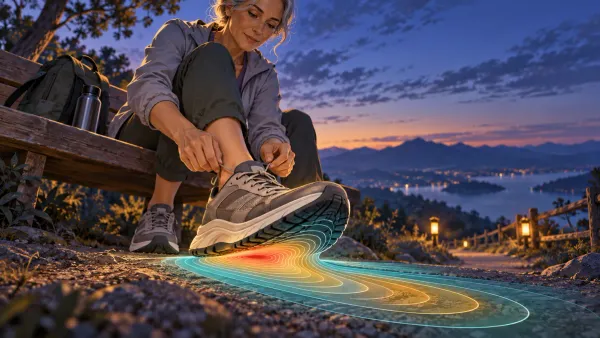
Fitness walking technique: turn a brisk walk into a workout
Learn fitness walking technique, pace, posture, and progression with a practical 4-week plan that turns brisk walking into structured exercise.
A casual walk and a fitness walk use the same basic movement, but they do not create the same training stimulus. Fitness walking—sometimes called power walking or sport walking—adds purposeful pace, coordinated arm movement, stable posture, and a planned duration. The result is a low-impact aerobic workout that can be progressed without turning into a run.
The technique should still look natural. You do not need an exaggerated hip motion, an unnaturally long stride, or a fixed speed. In fact, forcing those details can make the movement less efficient. The goal is to walk faster by organizing the movement you already have.
Quick answer
Fitness walking is brisk, continuous walking performed with an upright posture, quick natural steps, relaxed arm swing, and enough effort to raise breathing while preserving control. Begin with 20–30 minutes at a pace where you can talk but not sing, then increase duration before chasing more speed.
What you will learn:
- The difference between fitness walking, ordinary walking, Nordic walking, and race walking
- Five technique cues that improve speed without forcing your stride
- How to choose intensity using breathing and perceived effort
- A four-week beginner plan
- How to prevent common foot, shin, knee, and back problems
Key facts about fitness walking
- Fitness walking converts everyday gait into planned aerobic exercise.
- A quicker cadence raises walking speed without requiring an exaggerated stride.
- Natural arm swing supports balance and efficient forward movement.
- The talk test identifies moderate intensity without a wearable.
- Progressive duration builds tolerance before faster pace or hills add load.
What is fitness walking?
Fitness walking is continuous walking performed deliberately for exercise. It usually feels more athletic than commuting or strolling, but it keeps one foot in contact with the ground and does not require the formal technique of competitive race walking.
The term does not define one universal speed. The CDC classifies brisk walking as moderate-intensity activity and suggests the talk test: at moderate intensity you can talk, but not sing. It lists about 3 mph (4.8 km/h) as a common brisk-walking example, not a pass-fail threshold for every body.
A conditioned walker may need 4 mph (6.4 km/h), an incline, or a longer session to reach moderate effort. Someone rebuilding fitness may reach it below 3 mph. Temperature, hills, medication, age, gait mechanics, and fatigue all change the demand.
Fitness walking versus other walking styles
| Style | Main purpose | Typical intensity | Defining feature | Equipment |
|---|---|---|---|---|
| Casual walking | Transport, leisure, recovery | Light | Comfortable self-selected pace | None |
| Fitness walking | Aerobic exercise | Moderate to vigorous | Purposeful continuous pace and coordinated technique | None |
| Japanese interval walking | Aerobic intervals | Alternating easy and hard | Timed fast/easy blocks | Timer |
| Nordic walking | Full-body walking | Moderate to vigorous | Active pole planting and propulsion | Properly fitted poles |
| Race walking | Competition | Vigorous | Formal contact and straight-leg rules | None |
| Rucking | Loaded conditioning | Moderate to vigorous | Walking with external weight | Weighted pack |
Fitness walking is the simplest of the structured options: no poles, backpack, competition rules, or interval timer. Our Japanese interval walking guide is a better fit if alternating effort keeps you engaged; rucking adds an external-load stimulus when ordinary brisk walking is no longer challenging.
Fitness walking technique: five useful cues
Technique should help you sustain pace with less unnecessary tension. These cues are starting points, not rigid rules. Pain-free individual variation is normal.
1. Grow tall without becoming stiff
Keep your head balanced over your shoulders and look ahead rather than down at your feet. Let the rib cage sit over the pelvis. Avoid leaning backward from the waist or pushing the chest forward.
A small whole-body lean from the ankles may appear as speed rises, but you should not fold at the hips. Think tall and mobile, not military posture.
2. Use quicker steps before longer steps
The most common mistake is trying to walk faster by reaching the front foot far ahead. That creates a braking action each time the foot lands and can increase stress at the knee and hip.
Research comparing speed strategies found that people who increased cadence without lengthening their stride did not show the same rise in lower-limb joint moments as walkers who used longer steps. The study does not prescribe one perfect cadence, but it supports a practical cue: let speed come mainly from slightly quicker turnover rather than an exaggerated reach. See the biomechanics study on PubMed.
Your step can lengthen naturally behind you as you push the ground away. The front foot should land close to where your body is moving, with the knee soft rather than locked.
3. Let the foot roll naturally
Many walkers contact the ground toward the heel or rear foot and roll forward. Others land flatter, especially at higher speeds. Do not force a dramatic heel strike or actively point the toes upward.
Aim for:
- a quiet, controlled landing;
- smooth transfer toward the forefoot;
- a gentle push behind you;
- no slapping, scraping, or gripping with the toes.
If changing foot placement causes pain, return to your natural gait and focus on pace, duration, and comfort instead.
4. Swing the arms from the shoulders
Bend the elbows to a comfortable angle and allow the arms to move opposite the legs. Keep the hands relaxed. The swing should travel mostly forward and backward rather than crossing dramatically in front of the torso.
Arm swing is not decorative. Laboratory research found that removing it increased the metabolic cost of walking, while normal or slightly increased swing was more efficient than highly exaggerated motion. The useful lesson is modest: allow a natural, purposeful swing; do not pump as hard as possible. The relevant studies are indexed by PubMed and PubMed Central.
5. Keep the effort smooth
Your upper body should not bounce, twist aggressively, or tense with every step. Check the jaw, shoulders, and hands periodically. If form deteriorates, slow down for one or two minutes rather than fighting the pace.
Technique check: From the side, fitness walking should look like ordinary walking performed with more intent—not a completely different gait.
How fast should fitness walking be?
Speed is useful for tracking progress, but effort is better for prescribing a session.
Use the talk test
- Easy, 2–3/10: full conversation and easy nasal breathing
- Moderate, 5–6/10: you can talk but not sing
- Hard walking, 7–8/10: only short phrases; form remains controlled
Most fitness walks should sit in the moderate range. This is hard enough to count toward weekly aerobic activity but sustainable enough to repeat.
Use heart rate as supporting information
Heart-rate zones can help, but age formulas are estimates and wrist sensors can lag. Start with the talk test, then use heart rate to learn your pattern rather than forcing yourself into a number. Our guide to heart-rate zones by sport explains why the same heart rate can feel different during walking, cycling, and running.
If your session remains conversational and steady, it may overlap with Zone 2 training. The labels are not identical: fitness walking describes the activity and technique, while Zone 2 describes a physiological intensity.
A pace is not a health guarantee
Observational studies consistently associate faster self-selected walking pace with lower cardiovascular and all-cause mortality. A pooled analysis of 50,225 walkers found lower mortality among average and brisk walkers compared with slow walkers, particularly in adults over 50. Another cohort of 21,919 male physicians found lower mortality and cardiovascular-event rates at faster reported paces.
These findings do not prove that forcing an arbitrary pace causes the entire risk difference. Walking pace also reflects underlying health and fitness. Treat pace as both a trainable behavior and a functional signal—not a diagnosis or promise. Review the studies on PubMed and PubMed Central.
A fitness walking session from start to finish
1. Warm up for five minutes
Walk easily and let speed rise gradually. Make small ankle circles or calf raises before starting if they help you feel comfortable, but the walk itself is the primary warm-up.
2. Settle into purposeful pace
Use the five technique cues:
- tall, relaxed posture;
- quick natural steps;
- quiet foot contact;
- coordinated arm swing;
- smooth breathing and effort.
3. Hold the main pace
Beginners can start with 10–20 minutes at moderate effort. Experienced walkers may sustain 30–60 minutes. If the effort drifts too high, insert a one-minute easy section and resume.
4. Cool down for five minutes
Gradually reduce speed. Breathing should return toward normal. A cooldown is also a chance to notice whether discomfort appeared only under faster loading.
| Session type | Main set | Best for |
|---|---|---|
| Steady beginner | 15–20 min moderate | Building habit and technique |
| Steady aerobic | 30–45 min moderate | General fitness and weekly volume |
| Progression walk | 10 min easy + 15 min moderate + 5 min hard | Pace control |
| Hill fitness walk | 6 × 2 min uphill, easy return | Higher intensity without running |
| Long walk | 45–75 min easy-moderate | Endurance and time on feet |
Four-week beginner fitness walking plan
The plan assumes you can already walk comfortably for 20 minutes. If not, begin with shorter easy walks and add five minutes as tolerated.
| Week | Sessions | Main workout | Goal |
|---|---|---|---|
| 1 | 3 | 5 min easy + 15 min moderate + 5 min easy | Learn technique |
| 2 | 3 | 5 min easy + 20 min moderate + 5 min easy | Extend duration |
| 3 | 4 | Two 30-min steady walks, one easy walk, one 35-min walk | Build frequency |
| 4 | 4 | Two 30-min steady, one easy, one 40-min progression walk | Add controlled intensity |
Keep at least one session genuinely easy. If you also strength train or run, count the entire week rather than treating walking as free exercise.
The WHO recommends 150–300 minutes of moderate aerobic activity per week, or 75–150 minutes of vigorous activity, plus muscle-strengthening work on at least two days. Fitness walking can supply much of the aerobic target, but it does not replace resistance training.
Our broader guide to walking versus structured exercise explains why a complete plan combines walking, strength, and—when appropriate—some higher-intensity activity.
Fitness walking versus Nordic walking
Nordic walking uses purpose-designed poles and a learned diagonal planting pattern. The poles engage more upper-body musculature and may increase oxygen consumption at a given speed. A systematic review covering 16 randomized trials and 11 observational studies found benefits across several clinical populations, but study methods and participant conditions varied. See the review on PubMed.
For a pole-assisted option with a learned diagonal pattern, see Nordic walking technique: poles, benefits, and a beginner plan.
Choose fitness walking when:
- you want no equipment;
- you walk in crowded urban areas;
- simplicity and consistency are the priorities;
- your hands need to remain free.
Choose Nordic walking when:
- you enjoy learning pole technique;
- trails or open paths make pole use practical;
- additional upper-body involvement appeals to you;
- a clinician or instructor has recommended it for a specific program.
Poles do not automatically make walking safer or more effective. Incorrect pole length and poor planting technique can add shoulder or wrist irritation.
Common mistakes and how to correct them
Overstriding
Signal: loud heel contact, braking sensation, or pain at the front of the knee. Correction: shorten the step slightly and increase turnover without chasing speed.
Exaggerated arm pumping
Signal: raised shoulders, clenched hands, torso rotation, or neck tension. Correction: relax the hands and let the swing originate at the shoulders.
Making every session hard
Signal: pace falls across the week, soreness accumulates, or motivation drops. Correction: keep most sessions moderate and at least one easy.
Treating speed as technique
Signal: form becomes unstable simply to hit a number. Correction: slow down until posture, foot contact, and breathing regain control.
Progressing too many variables
Signal: you add hills, pace, duration, and frequency in the same week. Correction: change one variable at a time, usually duration first.
Shoes, surfaces, and safety
You do not need specialized fitness-walking shoes. Choose footwear that fits securely, bends comfortably at the forefoot, and feels stable on your route. Comfort is more useful than marketing categories. If a bunion makes ordinary shoes or push-off painful, review what bunion treatments can and cannot do before trying to walk through a worsening gait change.
Start on a flat, predictable surface. Hills increase cardiovascular and calf demand; uneven trails add balance and ankle demands. Introduce them after you can complete steady sessions without pain.
When soft snow requires flotation rather than ordinary footwear, switch to terrain-specific skills; our beginner snowshoeing guide covers binding fit, winter movement, pacing, and route safety.
If a dog joins those trail sessions, condition and equip the animal separately rather than assuming your walking fitness transfers to it. Our guide to hiking with a dog covers veterinary readiness, water, heat, paws, wildlife, and turnaround signs.
Use the exercise and joint-health guide if arthritis or recurring joint symptoms affect your choices. Stop and seek appropriate medical evaluation for chest pressure, fainting, unusual severe shortness of breath, sudden neurological symptoms, or pain that changes your gait. Ask a clinician before increasing intensity if you have unstable cardiovascular disease, uncontrolled blood pressure, recent surgery, or a condition that limits walking.
How to measure progress without obsessing over speed
Repeat a similar route every two to four weeks and compare:
- distance covered in 30 minutes;
- average pace at similar perceived effort;
- heart-rate response on the same terrain;
- breathing recovery after a hill;
- comfort in the final ten minutes;
- next-day foot, calf, and joint response.
A faster pace at the same effort is useful progress. So is walking longer without discomfort. Your walking speed can also act as a functional marker, but daily changes reflect weather, fatigue, terrain, and measurement noise.
Avoid turning every walk into a test. Training sessions build capacity; occasional repeatable checks reveal the trend.
For variety alongside your walks, the guide to cardio without running compares cycling, water exercise, and other modes using the same effort-based approach.
Fitness walking and SuperAge
After the technique and weekly plan are in place, longitudinal data can help you see whether the habit is working. SuperAge organizes compatible Apple Health activity, heart-rate, cardio-fitness, recovery, and consistency trends in one view.
Useful questions include:
- Is your walking pace improving at a similar heart rate?
- Are your weekly intensity minutes becoming more consistent?
- Does a harder hill session affect sleep or recovery?
- Are fitness walks complementing strength work rather than replacing it?
Wearable estimates are not laboratory tests, and one session should not drive a health conclusion. The value is the pattern across weeks and months. Learn how those signals contribute to SuperAge’s biological-age calculation.
Frequently asked questions
Is fitness walking the same as power walking?
The terms overlap and are often used interchangeably. Both describe purposeful, faster walking for exercise. Some coaching systems use more specific technique definitions, but no single speed or arm angle is required for a walk to provide aerobic benefit.
How fast should I walk for fitness?
Use relative effort first. Aim for a pace where you can talk but not sing, usually around 5–6 out of 10. About 3–4 mph (4.8–6.4 km/h) is a common range, but hills, fitness, age, and gait can move the appropriate speed lower or higher.
Is fitness walking better than running?
It is lower impact and often easier to recover from, while running provides a higher cardiovascular stimulus per minute. The better choice depends on your goals, joint tolerance, time, and preference. Both can belong in the same program.
Can fitness walking help with weight loss?
It raises energy expenditure and can support weight management, but no walking technique guarantees weight loss. Total activity, food intake, sleep, medication, and individual biology all matter.
Should I take longer strides to walk faster?
Usually not deliberately. Let stride length change naturally and use slightly quicker steps first. Reaching far ahead can increase braking and joint loading.
Can I fitness walk every day?
Many people can, provided intensity and duration vary and there is no accumulating pain or fatigue. Alternate purposeful sessions with easier walks, and preserve time for strength training and recovery.
Key takeaways
- Fitness walking turns brisk walking into structured aerobic training through pace, posture, arm coordination, and planned duration.
- Increase cadence before deliberately lengthening your stride.
- Allow a natural arm swing; exaggerated pumping is not more efficient.
- Use the talk test instead of treating one speed or heart-rate formula as universal.
- Build duration first, then add pace, hills, or another weekly session.
- Combine walking with strength training for a more complete healthy-aging program.
Take your next walk with purpose
On your next walk, change only three things: look ahead, quicken your steps slightly, and let your arms swing naturally. Hold a talk-but-not-sing effort for 15 minutes, then finish feeling that you could have done more.
If you use Apple Health, download SuperAge to follow walking, intensity, cardio-fitness, and recovery trends over time.
References
- World Health Organization. WHO guidelines on physical activity and sedentary behaviour. 2020.
- Centers for Disease Control and Prevention. Measuring physical activity intensity.
- Ardestani MM, et al. From normal to fast walking: impact of cadence and stride length on lower extremity joint moments. Gait & Posture. 2016.
- Ortega JD, Fehlman LA, Farley CT. Effects of aging and arm swing on the metabolic cost of stability in human walking. Journal of Biomechanics. 2008.
- de Graaf ML, et al. Influence of arm swing on cost of transport during walking. Biology Open. 2019.
- Stamatakis E, et al. Self-rated walking pace and all-cause, cardiovascular disease and cancer mortality. British Journal of Sports Medicine. 2018.
- Imran TF, et al. Walking pace is inversely associated with risk of death and cardiovascular disease. Atherosclerosis. 2019.
- Tschentscher M, et al. Health benefits of Nordic walking: a systematic review. American Journal of Preventive Medicine. 2013.
Related Articles

Japanese walking workout: the 3-3 interval method explained
Learn the Japanese walking workout: alternate 3 minutes fast and 3 minutes easy, progress safely, and understand what the research really shows.