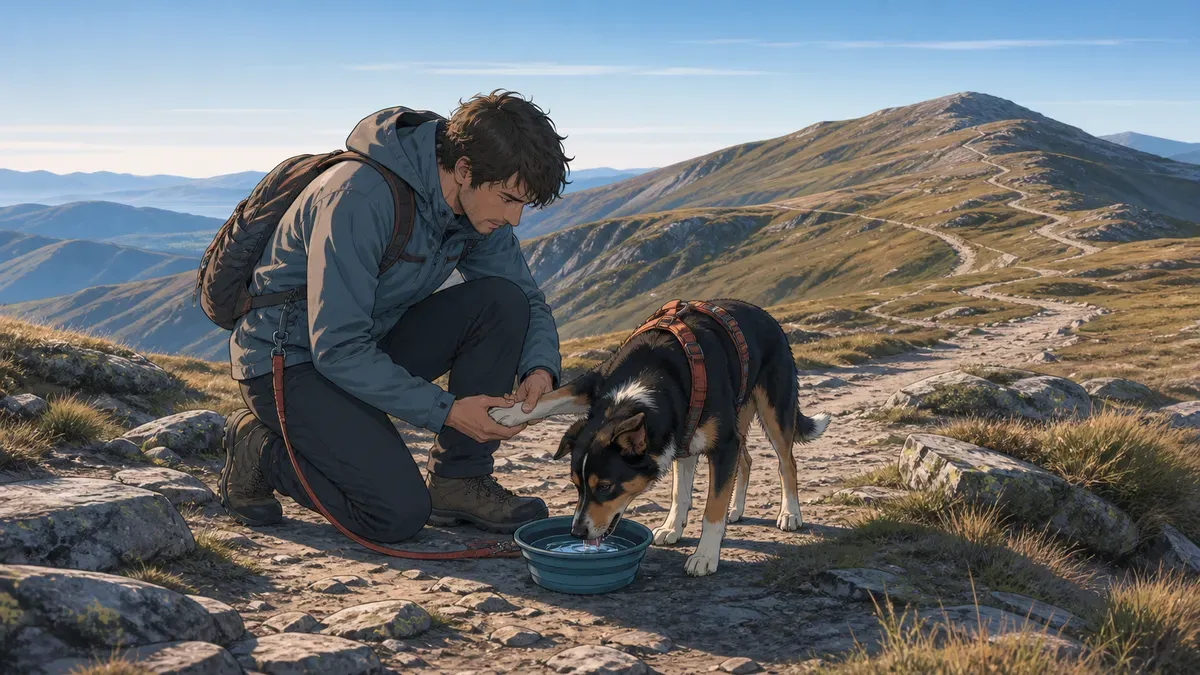
Hiking with a dog: conditioning, trail safety, and heat warning signs
Learn how to hike with a dog safely: fitness checks, conditioning, water, trail gear, heat warning signs, wildlife etiquette, and first-aid decisions.
Hiking with a dog can turn an ordinary walk into a shared endurance activity, but enthusiasm is not proof that a dog is ready for distance, elevation, heat, rough ground, or wildlife. The safest plan starts with the individual dog, then matches the route, weather, pace, water, equipment, and exit options to that dog’s current capacity.
For a healthy adult dog, begin with short, familiar outings and increase only one challenge at a time. Get veterinary guidance before a demanding hike if the dog is very young, older, flat-faced, overweight, recovering from illness or injury, or has heart, airway, joint, neurologic, or metabolic disease. On the trail, stop for abnormal panting, loss of coordination, repeated lagging, vomiting, paw injury, sudden lameness, collapse, or any behavior that is clearly unlike the dog’s normal effort.
Quick answer
To hike with a dog safely, confirm that dogs are permitted, choose a route below the team’s maximum ability, build walking fitness gradually, use a well-fitted leash system, carry clean water and a bowl, protect against local parasites, and know where emergency veterinary care is available. Keep the dog controlled around people, other dogs, livestock, and wildlife.
Watch the dog rather than a mileage target. Early trouble may look like a pace change, seeking shade, unusually wide or flattened tongue, persistent heavy panting, reluctance to continue, tender paws, stiffness, or poor responses to familiar cues. End the hike early when the dog stops moving normally; do not wait for collapse to validate the decision.
Key facts
- Progressive conditioning builds trail capacity: repeated, manageable walks prepare muscles, paws, balance, and behavior better than one abrupt long outing.
- Exertion can trigger canine heat illness: exercise was the recorded trigger in 74.2% of known-trigger heat-illness events in a large UK veterinary-record study.
- A leash controls multiple hazards: it limits wildlife encounters, falls, contaminated-water access, conflict with trail users, and separation from the owner.
- Clean carried water removes an avoidable exposure: natural water can contain pathogens, pollutants, or harmful algal toxins even when it looks inviting.
- Behavior is a field vital sign: a sudden change in gait, pace, coordination, attention, or willingness to move warrants a stop and reassessment.
This is a practical trail-planning guide, not a veterinary clearance. A clinician who knows the dog’s age, breed, body condition, medications, previous injuries, and local disease risks can identify constraints that a general checklist cannot.
Is your dog ready to hike?
A dog that walks comfortably around the neighborhood may not be ready for a steep, hot, rocky, or remote trail. Readiness has at least five parts: health, conditioning, paw tolerance, behavior, and the ability to recover normally after training.
Start with health rather than breed stereotypes
Breed can influence size, coat, airway anatomy, drive, and movement, but it does not tell you whether one dog is currently fit. Ask a veterinarian about a pre-hike assessment when the planned outing is substantially harder than normal or when any of these apply:
- the dog is a puppy whose skeleton is still developing;
- the dog is older or has recently become less active;
- the dog has a flat face or known breathing noise;
- there is excess body weight, exercise intolerance, or a previous heat event;
- there is arthritis, lameness, spinal disease, seizures, diabetes, heart disease, or lung disease;
- the dog recently had surgery, illness, or a medication change; or
- the destination adds altitude, extreme temperature, venomous animals, or long evacuation time.
Do not use a universal age to declare every puppy ready for distance. Growth and orthopedic risk vary with size and individual development. Favor free, self-paced movement and short explorations, and ask the dog’s veterinarian when repetitive long climbs, running, jumping, or load carrying are appropriate.
Working-dog guidance from the American Animal Hospital Association treats fitness assessment and individualized conditioning as part of preventive medical care, not as an afterthought once an injury occurs (AAHA). A family hiking companion is not a working dog, but the principle transfers: task demand should fit health and preparation.
Use ordinary walks as the baseline
Before choosing a route, observe several routine walks. Record time, surface, hills, weather, pace changes, water breaks, and recovery later that day and the next morning. The useful baseline is what the dog repeats comfortably, not the longest walk it has ever survived.
Signs that the baseline is not yet stable include lagging on later walks, soreness after rest, reluctance on stairs, excessive paw licking, altered posture, appetite change, or a new need for unusually long recovery. These signs are not a diagnosis, but they are reasons to reduce load and seek veterinary advice if they persist.
Owners need a baseline too. Our uphill walking guide explains why grade raises cardiovascular and muscular demand, while the guide to pacing and breathing on uphill hikes turns that demand into a practical field strategy. The rucking guide covers the additional cost of carrying a pack. A dog should not be asked to compensate for an owner’s poor pacing, balance, navigation, or load management.
Build hiking fitness without forcing a schedule
There is no scientifically validated distance formula that fits every dog. Terrain, temperature, body size, coat, age, health, speed, footing, excitement, and previous training all change the dose. Use a progression framework instead of a rigid mileage rule.
| Phase | Main exposure | Progress only when |
|---|---|---|
| Baseline | Familiar, easy walks on predictable surfaces | Gait, enthusiasm, appetite, paws, and next-day movement remain normal |
| Duration | Slightly longer time at the same easy intensity | The dog stays responsive and finishes with reserve |
| Terrain | Gentle hills, firm trail, small obstacles | Foot placement stays controlled and no soreness appears later |
| Environment | Mild novelty, then gradually warmer, cooler, or busier settings | The dog can settle, drink, and follow cues without escalating stress |
| Specificity | A route resembling the planned hike, with an easy exit | The full rehearsal and next-day recovery are uneventful |
Change one major variable at a time. Adding distance, elevation, rough footing, heat, altitude, and a backpack on the same day makes it impossible to know which load exceeded capacity. Include easy days between challenging sessions, and repeat a step when the response is uncertain.
Train the skills that prevent emergencies
Fitness alone is insufficient. Before a remote trail, practice:
- walking on a short leash without sustained pulling;
- stopping, waiting, turning around, and yielding on cue;
- ignoring food, feces, carcasses, plants, and wildlife;
- allowing paws, ears, coat, harness, and mouth to be inspected;
- drinking from the trail bowl used on the hike;
- settling quietly during breaks; and
- being lifted or supported if the dog’s size makes that realistic.
Recall remains useful, but it is not a substitute for a leash where rules, wildlife, livestock, cliffs, traffic, or other users create risk. A frightened, injured, predatory, or overheated dog may behave differently from its training history.
Treat a dog backpack as added load
A pack is optional, not evidence of preparedness. First condition the dog without it. Then introduce the empty, correctly fitted pack during short walks and check for rubbing, restricted shoulder movement, heat trapping, imbalance, or altered gait. Add load only with veterinary agreement and without using an internet percentage as a universal prescription.
Water weight changes as bottles empty, and loose contents can shift. Keep the two sides balanced, prevent hard objects from pressing into the ribs, and reassess fit after the first few minutes. Puppies, dogs with back or joint disease, and dogs struggling with heat should not carry a pack merely to reduce the owner’s load.
Choose a route the whole team can exit
Start with the rule page, not the summit photo. Pet access may differ by trail, season, habitat, protected area, transit system, campsite, and local wildlife conditions. Confirm current requirements from the land manager just before departure, including leash length, closures, waste disposal, water access, and whether dogs are prohibited entirely.
For an overnight route, add a separate human shelter decision before evaluating the dog’s setup: our mountain tent camping guide covers terrain traps, lightning exposure, sleep insulation, water treatment, and food-storage boundaries.
The US National Park Service summarizes responsible behavior as Bag waste, Always leash, Respect wildlife, and Know where you can go. These principles protect the dog, wild animals, habitat, and people who may be afraid of or allergic to dogs (NPS B.A.R.K. Ranger guidance). Local rules still control; the acronym is not universal permission.
Screen the route with a dog-specific lens
Evaluate:
- total time, elevation gain, steep descent, and turnaround points;
- shade, surface temperature, snow, ice, sharp rock, scree, bridges, ladders, or scrambles;
- reliable access to clean carried water rather than assumed stream water;
- livestock, nesting wildlife, hunting activity, snakes, porcupines, toxic plants, or bait;
- vehicle temperature at the trailhead and whether the return trip can be delayed;
- mobile coverage, coordinates, emergency access, and the nearest open veterinary clinic; and
- how the dog would be evacuated if it could no longer walk.
If the route is high, plan the human ascent conservatively with our altitude-sickness guide. Dogs can also become ill at altitude, but human acclimatization schedules and symptom scores should not be copied onto them. Ask a veterinarian about prior cardiopulmonary disease and be willing to descend for unusual respiratory distress, weakness, vomiting, confusion, or loss of coordination.
What to carry for hiking with a dog
Pack systems, not gadgets. Every item should answer a likely problem without creating a new one.
| System | Minimum useful items | Decision it supports |
|---|---|---|
| Control and identity | Well-fitted harness or collar, fixed-length leash, current ID, registration required locally | Prevent separation and identify the dog if control fails |
| Water and food | Clean water, dog-only bowl, extra reserve, familiar food for longer efforts | Avoid unsafe water and support normal energy needs |
| Weather and paws | Weather-appropriate insulation or cooling plan, towel, paw protection if trained and suitable | Reduce exposure to heat, cold, abrasive ground, ice, or salt |
| First aid | Gauze, non-stick dressing, cohesive wrap, saline, gloves, tweezers or tick tool, emergency contact details | Protect a wound and reach professional care; not replace it |
| Waste and environment | More waste bags than expected, sealed carry-out container where needed | Leave the trail clean without abandoning filled bags |
| Navigation and evacuation | Offline map, light, charged communication, dog-carrying plan | Turn around early and move an injured dog safely |
Use a fixed-length leash for precise control. Retractable leads can add speed before a sudden stop, wrap around people or animals, and make close passing difficult. Check that the harness does not cross the throat, restrict the shoulder, rub behind the elbows, or loosen enough for the dog to reverse out.
Boots can help on abrasive, icy, sharp, or very hot surfaces, but only if introduced before the hike. Poorly fitted boots can rub, twist, trap debris, or alter gait. They do not make a dangerously hot or technical route appropriate.
Water, heat, and the decision to stop
Dogs dissipate much of their exercise heat through panting, so air temperature alone does not define risk. Humidity, sun, radiant heat from the ground, wind, coat, airway anatomy, body condition, pace, excitement, and access to shade all matter.
A study of more than 900,000 dogs under UK primary veterinary care identified 1,259 heat-related illness events; among events with a known trigger, 74.2% were exertional. Walking was the most commonly recorded exercise within that group (Hall et al., 2020). The study is observational and UK-specific, but it corrects a dangerous mental model: canine heat illness is not limited to locked cars or extreme sport.
Use frequent observation, not a temperature shortcut
Begin in cool conditions while learning the dog’s response. Choose shade and easy exits, shorten the route when humidity or sun increases, and offer clean water during breaks. Do not force a fixed volume or let the dog gulp an uncontrolled amount after severe exertion. Individual need varies; if a medical condition changes fluid advice, follow the veterinarian’s plan.
Look for escalation:
- Stop and cool early: sustained heavy panting, shade seeking, slowing, reluctance, unusually broad or flattened tongue, reduced response to cues, or obvious distress.
- Treat as urgent: repeated vomiting, profuse drooling, stumbling, weakness, confusion, collapse, very hot skin, or loss of consciousness.
- Contact emergency veterinary care: move out of the heat, begin cooling with cool water and airflow, and arrange immediate transport. Do not wait for the dog to appear fully recovered.
The Merck Veterinary Manual lists rapid panting, distress, drooling, vomiting, uncoordinated movement, collapse, and unconsciousness among heatstroke signs and advises prompt cooling plus immediate veterinary care (Merck). In a randomized crossover study of 12 working dogs after exercise, partial water immersion cooled more effectively than passive recovery or alcohol applied to paw pads; the small, controlled sample does not turn one method into a universal wilderness protocol, but it supports using water rather than folk remedies (Parnes et al., 2023).
For the human half of the team, use thirst, conditions, duration, food, and sweat losses rather than forcing water. Our hydration guide explains why both underhydration and overdrinking can create problems.
Do not assume a stream is a safe bowl
Carry water for the dog. Natural sources can contain microbes, animal urine, agricultural runoff, salt, or cyanobacterial toxins. Water that is discolored, smelly, foamy, scummy, or covered by mats is an obvious no-go, but appearance alone cannot prove safety.
The US Environmental Protection Agency warns that pets can be exposed to harmful algal toxins by drinking, swimming, eating mats, or licking contaminated fur. If exposure is suspected, keep the dog from licking, rinse with clean water, and seek veterinary care immediately for drooling, weakness, breathing difficulty, vomiting, diarrhea, staggering, or seizures (EPA). CDC travel guidance likewise advises keeping pets out of stagnant, discolored, foul-smelling, foamy, or scummy water (CDC).
Wildlife, parasites, and trail etiquette
Keep the dog close before an encounter, not after it starts. Move off the trail where safe, place yourself between the dog and passing users, shorten the leash without choking, and ask before allowing greetings. Do not let a dog approach wildlife, livestock, nests, carcasses, feces, or unknown bait.
Wildlife risk is regional. Before travel, check the land manager and a local veterinarian for venomous species, large predators, toxic plants, parasite seasons, disease outbreaks, and required vaccines. Avoid universal claims such as “this vaccine is needed for every trail”; risk depends on geography, lifestyle, and the individual dog.
Make the post-hike check routine
After the hike:
- offer recovery in a cool, quiet place and observe breathing and gait;
- inspect between toes, pads, nails, ears, armpits, groin, collar area, and tail;
- remove burrs and debris without tearing skin;
- check the entire dog, owner, clothing, and equipment for ticks;
- note appetite, drinking, urination, stool, stiffness, and behavior through the next day; and
- contact a veterinarian for persistent pain, swelling, lethargy, appetite change, fever, neurologic signs, or an embedded foreign object.
CDC recommends daily tick checks for outdoor pets and highlights ears, eyelids, under the collar and front legs, between toes and back legs, and around the tail as common attachment areas. It also advises discussing veterinarian-approved prevention for the diseases present locally (CDC tick guidance). Owners should check themselves as well; our tick-bite warning-sign guide explains why fever and rash after exposure deserve medical attention beyond a narrow focus on Lyme disease.
Use SuperAge for the owner’s readiness, not the dog’s diagnosis
The person holding the leash makes pacing, route, weather, and turnaround decisions. Poor sleep, accumulated training load, illness, dehydration, or an elevated effort at an easy pace can shrink that decision margin. SuperAge can help the owner review personal sleep, resting heart rate, HRV, activity, and recovery trends before committing to a remote outing.
Use those trends as context, not clearance. They do not measure the dog’s temperature, hydration, pain, paw condition, breathing, or veterinary risk, and they do not override weather, trail rules, or either partner’s symptoms.
Download SuperAge to keep your own health and recovery signals in one private view, then make the hike conservative enough for the less-ready member of the team.
A trailhead decision card
Before leaving the car, answer each question:
- Is this exact trail open to dogs today, and what leash rule applies?
- Has the dog completed a similar but easier outing without next-day problems?
- Are temperature, humidity, sun, ground, altitude, and water supply acceptable?
- Do we have clean water, a bowl, waste bags, identification, first aid, navigation, and light?
- Is parasite prevention current for this location under veterinary guidance?
- Where is the nearest open emergency veterinary clinic?
- Can I evacuate this dog if it cannot walk?
- What observable sign will make us turn around before the planned endpoint?
If any answer depends on luck, choose a shorter route, a cooler time, a more accessible trail, or a walk close to home. Turning around is successful risk management, not a failed hike.
Frequently asked questions
How far can a dog hike in one day?
There is no safe universal distance. Use the dog’s repeatable baseline, health, age, body condition, terrain, weather, pace, paw response, and next-day recovery. A short steep route in heat may be harder than a longer shaded walk on firm ground. Build gradually and ask a veterinarian before a major increase.
How should I condition my dog for hiking?
Start with comfortable routine walks, then change one variable at a time: duration, gentle hills, surface complexity, environmental novelty, and finally a route-specific rehearsal. Progress only when gait, behavior, appetite, paws, and next-day movement remain normal. Train leash skills, stopping, settling, and body inspection alongside fitness.
How much water should I carry for my dog?
Carry enough clean water for the planned duration plus delay, but avoid one generic volume formula. Dog size, food, weather, pace, coat, medical conditions, and access to shade change demand. Offer water during breaks, observe drinking and behavior, and ask a veterinarian for an individualized plan when health conditions affect fluids.
Can my dog drink from a stream while hiking?
It is safer to provide carried clean water. Streams and lakes may contain microbes, animal urine, pollutants, salt, or harmful algal toxins. Never allow drinking or swimming in water that is discolored, foul-smelling, foamy, scummy, or covered with mats, and seek urgent veterinary advice after a suspected toxic-algae exposure.
What are early signs that my dog should stop hiking?
Stop for sustained heavy panting, shade seeking, unusual lagging, reluctance, a gait change, tender paws, reduced response to familiar cues, anxiety, or behavior that is clearly abnormal for that dog. Vomiting, drooling, loss of coordination, weakness, collapse, or altered consciousness requires urgent cooling and emergency veterinary care.
Should a dog wear boots or carry a backpack?
Both are optional and must be trained before the hike. Boots may protect from abrasion, ice, sharp ground, or heat but can rub or twist. A backpack adds load and may trap heat or alter gait. Introduce either on short walks, check fit frequently, and do not use equipment to make an unsuitable route acceptable.
Should I let my well-trained dog hike off leash?
Follow the local rule; many places require a leash, and some prohibit dogs. Even where off-leash access is lawful, wildlife, livestock, cliffs, contaminated water, other dogs, and frightened people remain. A leash is a practical risk control, not a judgment on obedience.
When should I call a veterinarian after a hike?
Seek urgent care for collapse, breathing difficulty, repeated vomiting, loss of coordination, seizures, severe weakness, major trauma, suspected toxin exposure, or uncontrolled bleeding. Contact a veterinarian promptly for persistent lameness, swollen or torn paws, embedded objects, unusual lethargy, appetite change, fever, or behavior that does not return to baseline.
Key takeaways
- Match the route to the individual dog rather than a breed reputation or mileage target.
- Build duration, terrain, environment, and load sequentially; repeat easy sessions until recovery is normal.
- Verify access rules, keep the dog controlled, carry clean water, and plan an evacuation before starting.
- Stop at the first meaningful change in pace, gait, panting, coordination, paws, or behavior.
- Cool and seek veterinary help immediately for suspected heatstroke or toxic-water exposure.
- Check the dog, owner, and gear for ticks and injuries after every outdoor outing.
References
- Hall EJ, Carter AJ, O’Neill DG. Dogs Don’t Die Just in Hot Cars: Exertional Heat-Related Illness Is a Greater Threat to UK Dogs. Animals. 2020.
- Parnes SC, Mallikarjun A, Ramos MT, Stone TA, Otto CM. A Randomized Cross-Over Study Comparing Cooling Methods for Exercise-Induced Hyperthermia in Working Dogs in Training. Animals. 2023.
- Merck Veterinary Manual. What to Do in a Dog or Cat Emergency.
- Centers for Disease Control and Prevention. Pet Travel Safety.
- Centers for Disease Control and Prevention. Preventing Ticks on Pets.
- US Environmental Protection Agency. How People and Animals Are Exposed to Harmful Algal Blooms and Their Toxins.
- US National Park Service. B.A.R.K. Ranger principles.
- American Animal Hospital Association. Working, Assistance, and Therapy Dog Guidelines: Medical Care Considerations.
Related Articles
Nordic walking technique: poles, benefits, and a beginner plan
Learn Nordic walking technique, pole fit, common mistakes, evidence-based benefits, and a practical four-week beginner plan for safe progress.