Functional training exercises: movements and beginner scaling
Learn functional training exercises, from squats and carries to swings and presses. Choose beginner variations, recognize form limits, and progress with control.
Quick answer
Functional training exercises combine familiar actions such as squatting, lifting, pushing, pulling, stepping, and carrying. Start with controlled versions you can repeat, then adjust resistance, range, support, or speed to match your ability. A chair squat, elevated deadlift, incline push-up, supported row, and light carry can teach the foundations before swings, jumps, or complex lifts enter the session.
The useful skill is recognizing the movement and choosing an appropriate version when it appears in a class or training plan. You do not need to perform every exercise, race a timer, or use a barbell to benefit. This guide is an exercise vocabulary and scaling guide for generally healthy adults; it is not a rehabilitation program.
Key facts
- Squats combine knee and hip movement to lower and raise the body.
- Hip hinges shift the hips backward to organize lifting and hip-driven movements.
- Scaling changes an exercise demand while preserving its intended training task.
- Ballistic exercises add acceleration and timing demands to basic strength patterns.
- Progressive resistance training improves strength and physical function across adulthood.
What makes an exercise functional?
“Functional” describes a relationship to a task, not a special category of equipment. Carrying a weight may help train carrying capacity; a machine can strengthen muscles needed for daily activity. An unstable surface or a complicated combination does not automatically make an exercise more useful.
Research uses several overlapping definitions. The HIFT definition paper describes high-intensity functional training as varied, multi-joint exercise performed at relatively high intensity. Ordinary functional strength practice can be much slower and easier. Learning a squat is different from repeating squats under severe fatigue.
The major muscle groups and movement patterns guide explains the anatomy behind the labels. Here, focus on recognizing what the exercise asks you to do and which demand you can change.
Decode the movements before choosing a variation
Use this table as a translation between exercise names and their main tasks. These examples are options, not a mandatory checklist or a ranking of effectiveness.
| Movement task | Common exercise | Manageable starting version | Demand to control |
|---|---|---|---|
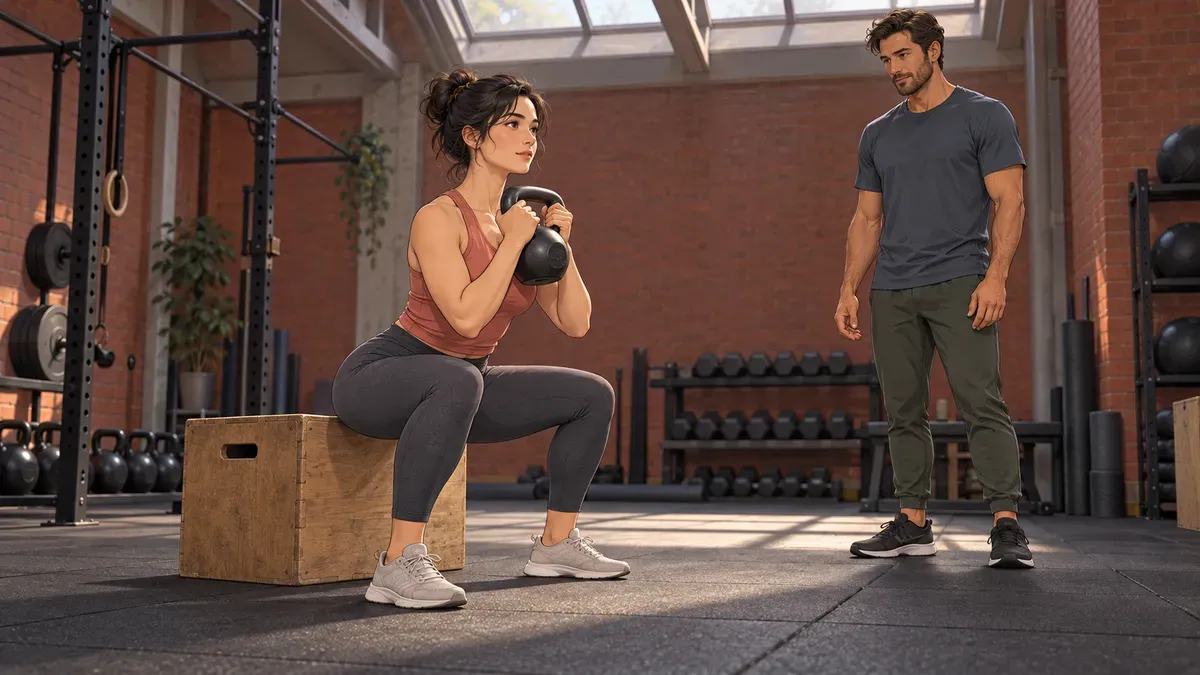
| Lower and stand | Goblet or front squat | Chair squat, then light goblet squat | Depth, balance, and external load |
| Lift through the hips | Deadlift or kettlebell swing | Unloaded hinge, then elevated deadlift | Starting height and trunk position |
| Push away | Push-up or overhead press | Incline push-up or light seated press | Support height and comfortable shoulder range |
| Pull toward you | Row or pull-up | Supported dumbbell row or cable row | Resistance and body support |
| Step and accept weight | Lunge or box step-up | Supported split squat or low step-up | Step height and single-leg control |
| Transport a load | Farmer carry or suitcase carry | Light two-handed carry | Grip, posture, and walking space |
| Accelerate or land | Swing, jump, or medicine-ball throw | Controlled hinge or step-up first | Speed, timing, and landing control |
| Transfer force | Clean, snatch, or squat-to-press | Practice the component movements separately | Coordination and load transitions |
The final two rows introduce additional skills. A person may be strong enough to lift a weight slowly without being ready to accelerate it or catch it overhead. Substitute the underlying pattern while learning the more technical movement with qualified instruction.
Learn the basic positions with mixed equipment
Squat: organize the load before adding depth
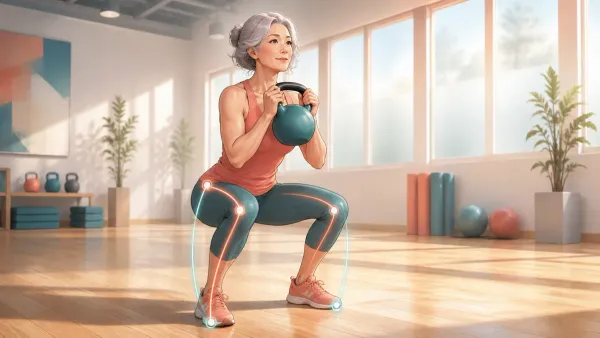
For a goblet squat, hold a manageable dumbbell or kettlebell close to the chest. Set the feet at a comfortable width, bend the hips and knees together, and lower while keeping the whole foot supported. Stand without letting the weight pull you forward. The ACE goblet squat resource illustrates the front-held loading position.
Choose depth according to control, comfort, and the task. A chair or box provides a repeatable target; it is not an invitation to drop onto the seat. If the elbows, wrists, or shoulders cannot hold a front-rack position comfortably, a goblet hold or another squat variation may be more suitable than forcing a barbell setup.
Hinge and deadlift: change the starting height
A hinge moves the hips backward with some knee bend. Practice reaching the hips toward a wall behind you while keeping the feet planted. For an elevated deadlift, place the weight on secure blocks so you can reach it without rounding or straining to find the handles.
Keep the load near the body, brace comfortably, and stand by extending the hips and knees. Return it under control. A Romanian deadlift begins standing and lowers through a controlled hinge; it does not require the weights to touch the floor. Starting higher is a useful adjustment when the floor position exceeds your current range.
Push and pull: make the support reliable
For an incline push-up, use a fixed bench or rail that cannot slide. Move the chest and pelvis together, then press away. Raising the hands reduces the demand. For a row, use a secure cable, band anchor, or bench-supported dumbbell setup and pull without swinging the trunk.
An overhead press adds a different shoulder position. Use a load and range you can control without leaning backward to finish the repetition. A comfortable horizontal press can remain the chosen pushing exercise while an overhead restriction is assessed. For a full bodyweight progression, use the calisthenics guide.
Step and carry: keep the environment predictable
Choose a low, stable platform for step-ups. Place the whole leading foot on it, stand with control, and lower deliberately. Use a rail if balance otherwise dominates the task. Increasing the box height changes both range and balance demands; it is not simply another way to add repetitions.
For a carry, pick up manageable weights, stand tall without stiffly holding your breath, and walk through a clear space. A short distance such as 30–50 feet (about 10–15 meters) is a practical learning example, not a required dose. Stop before grip failure changes posture. A suitcase carry places the load on one side and adds a different trunk-control demand.
Treat speed and combinations as separate skills
Kettlebell swing
A swing uses a rapid hip action to accelerate the bell; it is not a slow squat followed by an arm raise. Learn a controlled hinge and loaded deadlift first. Keep the initial swing practice short and supervised when possible, with room around you and a load you can manage.
The ACE swing coaching guide emphasizes hip-driven force and preparation through hinge practice. If you cannot distinguish the hinge from a squat, keep the deadlift variation rather than using fatigue to learn the difference.
Jumps and floor transitions
A box jump adds landing accuracy and a consequence for missing the target. A low step-up can train stepping strength without the flight phase, although it does not train the same explosive skill. Jump practice belongs in a clear area while fresh. Use the plyometric exercise progression guide for landing preparation.
A burpee combines several transitions. Elevate the hands, step back instead of jumping, or remove the push-up and jump to reduce separate demands. The burpee form guide shows these layers. Scaling the transition is often more useful than simply trying to move faster.
Cleans, snatches, and squat-to-press combinations
A clean brings a load to the shoulder; a snatch takes it overhead in one coordinated lift. These require specific instruction in timing, load path, and receiving positions. Reading a short description does not establish readiness to practice them under time pressure.
A squat-to-press links two simpler actions, but fatigue can make one component limit the other. Practice the squat and press separately first. In a mixed session, use an appropriate simpler movement agreed with the coach; preserving every named exercise is less important than matching the intended stimulus.
Scale the limiting demand, not just the weight
First identify why a repetition changes: load, range, balance, coordination, or accumulated fatigue. Then adjust the relevant demand. Reducing weight alone will not fix an unstable box or a confusing sequence.
| What you observe | First adjustment to consider | What the adjustment preserves |
|---|---|---|
| You fall onto the squat target | Raise the target or add support | Controlled lowering and standing |
| You cannot reach the deadlift handle comfortably | Elevate the weight securely | A repeatable hip-driven lift |
| Push-up posture changes before the arms tire | Raise the hands | Whole-body pressing alignment |
| Balance limits a lunge | Use hand support or a split stance | Loading the working leg |
| Swing timing becomes inconsistent | Return to controlled deadlifts | Hip loading without ballistic timing |
| A combination becomes rushed | Separate its components and rest | Practice of each movement |
| Repetitions deteriorate late in a set | End the set or reduce repetitions | Repeatable technique |
For example, a class lists overhead squats and fast pull-ups. A beginner might agree on goblet squats and supported rows. These are different exercises with different skill demands, but they can preserve a lower-body and pulling task without pretending to replicate the advanced movements exactly.
Keep the first practice sets comfortably submaximal. Finishing with roughly 2–3 good repetitions still possible is a practical learning cue, not a precise measurement of safety. For conditioning structure once the movements are familiar, see the metabolic conditioning guide.
Progress from practice to training
Start by selecting a few movements, checking the equipment, and doing easy practice repetitions before working sets. Repeat the same variations long enough to judge whether control is improving. Change one major demand at a time: more range, slightly more resistance, less assistance, or a more demanding skill.
The 2026 ACSM position stand synthesized 137 systematic reviews involving more than 30,000 participants. Resistance training improved strength, muscle size, and several measures of physical performance; exercise complexity and equipment type did not consistently determine outcomes. This supports using manageable tools. It does not establish that every exercise substitution produces identical adaptations.
Public-health guidance recommends muscle-strengthening activity for all major muscle groups at least 2 days per week, alongside aerobic activity (HHS guidelines). A movement-learning session alone may be too easy or incomplete to provide the whole weekly training stimulus. The complete exercise guide places strength practice within that wider plan.
Use SuperAge to add health context
Building strength supports the capacity to keep moving with age. If you use SuperAge to review health trends, consider them alongside a simple exercise log: variation, resistance, repetitions, and how you felt afterward. A health trend or estimated biological age cannot verify lifting technique, clear a painful shoulder, or decide that you are ready for a complex lift.
Progress can mean more comfortable stairs or a more controlled carry before it appears in any score. Keep those practical outcomes visible rather than treating every session as a test of your age.
Know when to stop or ask for help
Stop an exercise when sharp or increasing pain, loss of control, dizziness, or unusual breathlessness appears. Chest pain, fainting, or severe unexpected symptoms require urgent medical assessment. Severe muscle pain, swelling, weakness, or dark urine after an unusually hard session also warrants prompt medical attention.
If you have an injury, recent operation, cardiovascular condition, significant balance limitation, or a clinician-imposed restriction, seek an individualized starting plan. A qualified coach can help assess equipment setup and technique; a health professional should assess persistent pain or medical symptoms. Muscle effort and the inability to control a movement are different signals.
FAQ
What are the main functional training exercises?
Common examples include squats, deadlifts, rows, presses, lunges, step-ups, carries, and appropriately coached power movements. Choose exercises for the task and your current ability rather than trying to complete every example.
Is functional training always high intensity?
No. Slow technique practice and progressive strength sets can use the same movements. High intensity describes the effort of a session, not an essential property of a squat or carry.
Which exercises should a beginner learn first?
Begin with controllable squat, hinge, push, pull, and stepping or carrying variations. Stable support, an accessible range, and a manageable load matter more than the exercise name.
Can I replace a kettlebell swing with a deadlift?
A deadlift can preserve hip-dominant strength work while you learn the hinge. It does not reproduce the swing’s acceleration and timing demands, so agree on the substitution according to the session goal.
Do I need to learn cleans and snatches?
No. They are specific skills rather than prerequisites for general health. Use qualified instruction if you want to learn them, and build the relevant positions and strength first.
How do I know when to increase the weight?
Increase it when the planned repetitions remain consistent across sessions, the setup is reliable, and you can finish without forcing the movement. Add a small amount while keeping other demands stable; reduce it if control deteriorates.
Are machines less functional than free weights?
Not automatically. Machines can strengthen muscles needed for daily tasks and allow useful supported training. Free weights add other coordination demands, but the best choice depends on the goal and person.
Should a beginner use a timer?
A timer can organize rest, but it should not pressure you to rush unfamiliar movements. Learn the exercise first and end a set when technique deteriorates, even if time remains.
Key takeaways
- Recognize the task behind the exercise name before choosing a variation.
- Adjust range, support, load, complexity, and fatigue according to the limiting demand.
- Learn ballistic and combined lifts as additional skills, ideally with coaching.
- Keep controllable repetitions and repeatable practice ahead of speed or complexity.
Put the guide into practice
At your next session, choose one unfamiliar movement and ask which task it is meant to train. Agree on a manageable version, practice it while fresh, and record the variation you used. That gives the next session a clear starting point. Explore SuperAge if you want to review your wider health trends alongside that practice.
References
- Currier BS et al. (2026). Resistance training prescription for muscle function, hypertrophy, and physical performance in healthy adults: an overview of reviews. Medicine & Science in Sports & Exercise.
- US Department of Health and Human Services. Key points from the current Physical Activity Guidelines for Americans.
- Feito Y et al. (2018). High-intensity functional training: definition and research implications for improved fitness. Sports.
- American Council on Exercise. Goblet squat exercise library.
- American Council on Exercise (2025). The two-handed kettlebell swing.
Related Articles

Major muscle groups: build a balanced workout by movement pattern
Map the major muscle groups to movement patterns, choose exercises without gaps, and build a balanced workout that fits your schedule and goals safely.