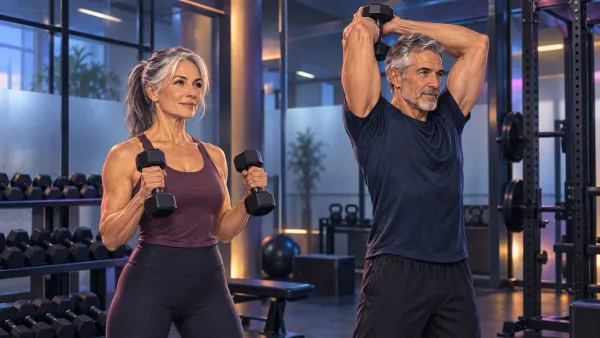
Goblet squat form: technique, muscles, and progressions
Learn goblet squat form, muscles worked, safe depth, common mistakes, and a four-step progression for stronger legs and more confident squatting.
Quick answer
The goblet squat is a squat performed while holding one compact weight vertically in front of your chest. It trains the quadriceps, gluteal muscles, adductors, calves, and trunk while the front-held load encourages you to keep your torso relatively upright.
For reliable goblet squat form, hold the weight close to your sternum, set your feet at a comfortable squat width, brace, and sit down between your hips while your knees follow the direction of your toes. Descend only as far as you can keep your whole foot supported and your trunk controlled. Stand by driving the floor away, not by shooting your hips up first.
Begin with bodyweight or a light 10–20 lb (5–10 kg) load for 2–3 sets of 6–10 repetitions. Add repetitions before weight, and stop a set when depth, balance, or speed changes noticeably. There is no universal stance, toe angle, or required depth for every body.
Key facts
- The goblet squat places one front-held load close to the chest.
- The quadriceps extend the knees while the gluteal and adductor muscles help extend the hips.
- An upright trunk shifts relatively more demand toward the knees and less toward the hips.
- A deeper squat increases range of motion but is useful only when the lifter controls that range.
- Progressive resistance builds strength through repeatable training, not through a perfect-looking single repetition.
The goblet squat is often taught as a beginner exercise, but it is not only for beginners. It can serve as a technique drill, a lower-body strength movement, a warm-up, or a higher-repetition accessory. Its main limitation is practical: as your legs become stronger, holding a single heavy object at chest height may become harder than the squat itself.
This guide is for general education, not injury rehabilitation. If squatting causes sharp or worsening pain, or if you have a recent operation, fracture, joint replacement, neurological symptoms, or clinician-imposed loading restriction, get individualized guidance before adding load.
What makes a goblet squat different?
In a bodyweight squat, your center of mass must remain over your base of support. Adding a weight in front changes that system. The load acts as a small counterbalance, which can make it easier for some people to sit deeper without falling backward. At the same time, the arms and upper back must keep the weight close.
That front-load position usually encourages a more upright torso than a back-loaded squat. A 2024 biomechanical review explains that a more upright trunk increases the external knee-flexion moment while reducing the hip-flexion moment; leaning farther forward does the opposite (Straub and Powers, 2024). Neither pattern is inherently superior. It means stance, trunk angle, depth, and load change where the exercise is most demanding.
The goblet squat is therefore useful when you want to:
- learn a balanced squat with immediate feedback;
- train the legs with modest equipment;
- practice a controlled range before moving to heavier variations;
- add lower-body volume without placing a bar on the shoulders;
- pair strength work with mobility you can actively control.
It is not a mandatory step toward barbell squatting. A person can use goblet squats indefinitely if the movement suits their goals and can be progressed safely.
Which muscles does the goblet squat work?
The goblet squat is a multi-joint exercise, so no single muscle works alone.
| Muscle group | Main role during the squat |
|---|---|
| Quadriceps | Extend the knees as you stand |
| Gluteus maximus | Extends the hips, especially from deeper positions |
| Adductors | Help control the femur and contribute to hip extension |
| Calves | Stabilize the ankle as the knees travel forward |
| Abdominal and spinal muscles | Maintain trunk position against the front-held load |
| Upper back and arms | Keep the weight close to the chest |
The core strength training guide adds direct anti-extension, lateral-stability, anti-rotation, and carrying progressions when trunk control is a separate goal.
A direct laboratory comparison of goblet and landmine squats in 32 adults found that the goblet variation produced greater quadriceps activity and vertical force under the tested conditions. The participants used a load equal to 30% of body mass, so the finding explains one specific comparison rather than proving that goblet squats always produce more muscle or strength (Collins et al., 2021).
Depth also changes muscular demand. In a small 10-week trial, full-squat training produced larger increases in gluteus maximus and adductor volume than half-squat training, while both groups increased knee-extensor volume. The study involved 17 young men performing back squats, not goblet squats, so use it as evidence that range affects adaptation—not as a command that every person must squat as deep as possible (Kubo et al., 2019).
For a broader explanation of how muscles share movement and stabilization roles, read our guide to agonist and antagonist muscles. If inner-thigh capacity is a specific goal, the adductor exercise progression separates direct adductor work from compound squatting.
How to do a goblet squat step by step
Use a dumbbell, kettlebell, or another compact load that you can hold securely. Clear the floor and wear footwear that does not slide.
1. Pick up the weight safely
Place the weight on a stable surface or between your feet. Hinge and bend the knees to reach it, hold it with both hands, and stand before repositioning it at your chest. Do not curl a weight that you cannot control.
Hold the load close to the sternum. With a dumbbell, support one end with both palms. With a kettlebell, hold the horns or the body. Your wrists should feel stable, not sharply bent backward.
2. Choose your stance
Start around shoulder width, then adjust. Turn the toes slightly outward if that helps the knees and hips move comfortably. Stance-width research shows that changing foot spacing alters joint positions and loading, but it does not identify one universally correct width (Sinclair et al., 2022).
Use a stance that lets you keep three points of contact under each foot: the heel, base of the big toe, and base of the little toe.
3. Brace and begin the descent
Inhale and create firm, not maximal, tension around your trunk. Bend the knees and hips together. Think “sit between the hips” rather than forcing the hips far backward as if every squat were a hinge.
Keep the weight close. If it drifts forward, the lever becomes longer and the upper body may become the limiting factor.
4. Let the knees follow the toes
The knees can travel forward and should generally follow the same direction as the toes. Do not force them perfectly vertical, and do not push them outward beyond the foot. The goal is a smooth path without a sudden inward collapse that you cannot control.
Forward knee travel is not automatically dangerous. Restricting it changes the distribution of demand between the knees, hips, and trunk. Choose the pattern that fits your mobility, symptoms, and goal rather than obeying a blanket “knees never over toes” rule.
5. Use your controllable depth
Descend until one of these changes first:
- the heels or inside edges of the feet lift;
- the pelvis tucks abruptly and the trunk loses control;
- the knees shift into an unstable path;
- pain appears or increases;
- the weight moves away from the chest.
That point is your current working depth. It may be above, at, or below thighs-parallel. Depth can improve as ankle motion, hip control, confidence, and strength improve.
6. Stand as one unit
Push through the whole foot and let the knees and hips straighten together. Keep the chest and hips rising at roughly the same rate. Exhale through the hardest part if that helps you avoid breath-holding.
Finish tall without leaning backward or squeezing the glutes so aggressively that the ribs flare. Reset your balance before the next repetition.
How deep should you squat?
Squat depth is a training variable, not a moral test. A deeper squat creates more knee and hip flexion and can increase demand through a longer range. A shallower squat may be appropriate when learning, managing symptoms, working around limited mobility, or using a heavier load.
The 2024 biomechanical review describes how depth, tibial angle, trunk position, stance, and foot rotation interact. As depth increases, compressive forces and muscular demand can increase, but load is not the same thing as injury. Tissues adapt to appropriately progressed load. The relevant question is whether the chosen depth is tolerable, repeatable, and matched to the person (Straub and Powers, 2024).
Use this progression:
- Squat to a box or bench that you can touch without dropping.
- Lower the target slightly once every repetition is stable.
- Remove the target and pause at the same depth.
- Add load only after the new range remains controlled.
If your ankles limit depth, try a slightly wider stance or a small temporary heel elevation during technique practice. Treat the elevation as a variation, not proof that your ankles are “bad.” If knee or hip pain changes substantially with depth, load, or stance, that response is useful information for a clinician or qualified coach.
Our joint-friendly exercise guide explains how to distinguish ordinary training stress from a pattern that needs modification.
Eight common goblet squat mistakes
| Mistake | What usually happens | Practical correction |
|---|---|---|
| Holding the weight away from the chest | Arms and back fatigue before the legs | Keep elbows down and load close |
| Copying another person’s stance | Hips or feet feel blocked | Adjust width and toe angle gradually |
| Rocking onto the toes | Balance and force become inconsistent | Keep heel and both forefoot points grounded |
| Forcing the knees outward | Knees move beyond the line of the feet | Track knees with toes instead |
| Dropping into the bottom | You lose muscular control | Use a 2–3 second descent |
| Chasing maximum depth | Pelvis, feet, or symptoms change | Stop at repeatable depth |
| Hips rising before the chest | The squat turns into a good-morning pattern | Reduce load and stand as one unit |
| Adding weight every workout | Technique and recovery deteriorate | Progress one variable at a time |
Filming one set from the front-quarter angle can help you see foot pressure, knee path, depth, and whether the weight drifts. Video is feedback, not a diagnosis. Anatomy differs, and a squat does not need to match a textbook silhouette to be effective.
How much weight should a beginner use?
Start lighter than you think you need. The first goal is to reproduce the same path for every repetition.
For many healthy beginners, bodyweight practice followed by 10–20 lb (5–10 kg) is a reasonable test range, but body size and training history vary too much for that to be a rule. Choose a load that lets you complete 6–10 repetitions with about 3 good repetitions still available.
Use a simple progression ladder:
| Level | Variation | Dose | Advance when |
|---|---|---|---|
| 1 | Bodyweight squat to box | 2 × 6–8 | You touch softly and stand without rocking |
| 2 | Counterbalance or unloaded free squat | 2–3 × 8 | Foot pressure and depth stay consistent |
| 3 | Light goblet squat | 3 × 6–8 | You keep 2–3 repetitions in reserve |
| 4 | Goblet squat with pause | 3 × 8–10 | The 1-second pause stays controlled |
| 5 | Heavier goblet squat | 3 × 6–10 | All sets retain the same depth and speed |
Increase only one variable at a time: two repetitions per set, one set, a slightly deeper range, a longer pause, or the smallest available weight increment. Repeat the new dose for at least two sessions before progressing again.
The updated 2026 American College of Sports Medicine position stand emphasizes that regular resistance training matters more than complicated programming for most healthy adults. It recommends training all major muscle groups at least twice weekly and tailoring load and volume to the goal (ACSM, 2026).
For the broader decision behind those numbers, our training frequency guide explains when once, twice, or more weekly exposures make sense at the same total volume.
How to program goblet squats
Place goblet squats early in a session when they are the main strength exercise. Use them later when they are an accessory and you are intentionally using lighter loads.
For learning technique
- 2–3 sessions per week
- 2–3 sets of 6–8 repetitions
- 2–3 minutes of rest
- stop with at least 3 controlled repetitions in reserve
For general strength
- 2 sessions per week
- 3–4 sets of 6–10 repetitions
- 2–3 minutes of rest
- add load when every set stays within the same depth and form boundary
For muscular endurance
- 1–2 sessions per week
- 2–3 sets of 10–15 repetitions
- 60–120 seconds of rest
- use a load that does not turn the final repetitions into fast, shallow bounces
The goblet squat should not be the whole program. Combine it with a hinge such as the progressively loaded pattern in our deadlift form guide, plus a push, pull, carry, calf exercise, and appropriately chosen balance or power work. Our strength versus cardio after 40 guide shows how resistance and aerobic training complement rather than replace each other.
The World Health Organization recommends muscle-strengthening activity involving major muscle groups on at least two days per week for adults, alongside aerobic activity (WHO guidelines). The goblet squat can contribute to that target, but one exercise cannot cover every major muscle group.
Why the movement matters with age
Squatting capacity supports tasks such as rising from a low seat, lifting from the floor, using stairs, gardening, and controlling a descent. The goblet squat is not a longevity test, and mastering it does not predict lifespan. It is simply one scalable way to train lower-body strength and movement confidence.
A 2025 network meta-analysis covering 151 randomized trials in adults aged 60 and older found that even low-volume resistance training improved physical function, lean mass, and muscle size, while moderate-to-higher volumes tended to produce larger lower-limb strength gains. The studies used many exercises and protocols, so the result supports progressive resistance training—not a special anti-aging effect of goblet squats (Radaelli et al., 2025).
If getting out of a chair is the outcome you care about, use a standardized 30-second chair stand test rather than treating goblet squat load as a clinical score. The test and the exercise answer different questions: one measures repeatable function; the other trains capacity.
Track the training context with SuperAge
A phone or wearable cannot judge goblet squat technique. It can help you see the context in which training happens: completed workouts, daily activity, sleep, resting heart rate, and longer-term recovery trends.
Record a few exercise details manually:
- load, sets, and repetitions;
- working depth or box height;
- estimated repetitions in reserve;
- discomfort during and the day after training;
- whether normal walking or stairs changed.
Then interpret health signals as trends, not commands. A single low recovery reading does not prove that you should skip squats, and a favorable score does not make painful lifting safe. SuperAge organizes Apple Health data so you can compare training consistency with the broader pattern while keeping technique and symptoms in human judgment.
Download SuperAge to follow activity and recovery trends while you build a repeatable strength routine.
When to choose another variation
The goblet squat is a poor fit when holding the load is the limiting factor, when the front position aggravates the wrists or shoulders, or when your legs need more load than you can safely bring to the chest.
| Need or limitation | Alternative | Why it may fit |
|---|---|---|
| New to squatting | Sit-to-stand or box squat | Provides a clear depth target |
| Balance needs support | Counter-supported squat | Lets the hands assist balance |
| Grip or wrist discomfort | Weighted vest or machine squat | Removes the front-held load |
| More unilateral strength | Bulgarian split squat or step-up | Trains one side at a time |
| Higher leg loading | Front squat, back squat, or machine | Allows progression beyond the goblet hold |
| Knee symptoms with deep flexion | Pain-free box squat range | Makes depth repeatable and adjustable |
| Hip symptoms in a wide stance | Narrower stance or split squat | Changes hip position and demand |
Equipment type is secondary to a tolerable movement that you can progress. The ACSM review found that machines, free weights, bands, and bodyweight approaches can all improve outcomes; complexity is optional for the average healthy adult.
When pain needs assessment
Muscular effort, warmth, and mild next-day soreness can be normal after a new squat dose. Sharp joint pain, instability, neurological symptoms, or worsening function are not progression targets.
Stop the set and seek appropriate assessment when you have:
- a sudden pop with swelling, bruising, or inability to bear weight;
- a knee that locks, repeatedly gives way, or rapidly swells;
- deep hip or groin pain that catches during each repetition;
- back pain with leg weakness, numbness, or bowel or bladder changes;
- chest pain, fainting, or unusual shortness of breath;
- pain that worsens across sessions despite reducing range and load.
For ordinary post-training soreness, avoid testing your maximum the next day. Repeat the movement when your normal walking and daily tasks are not meaningfully altered. Our guide to DOMS and recovery explains why soreness is not a score for workout quality.
If you are unsure how hard each set should feel, the guide to training to failure and repetitions in reserve shows why most goblet squat sets should stop before technique changes, with failure reserved for safer, more stable exercises.
Key takeaways
- Hold the weight close, keep the whole foot supported, and let the knees follow the toes.
- Use the deepest range you can control without forcing a universal standard.
- Start with 2–3 sets of 6–10 repetitions and several repetitions in reserve.
- Progress repetitions, range, pauses, sets, or weight one at a time.
- Treat pain and loss of function as feedback, not as proof that you need more grit.
- Use the goblet squat inside a balanced strength program rather than as a complete routine.
Frequently asked questions
Is the goblet squat good for beginners?
Yes. The front-held load can provide useful counterbalance and immediate feedback, while the weight can remain light. Beginners should first learn to control foot pressure, knee path, depth, and breathing rather than rushing to a heavier load.
Should my knees go over my toes in a goblet squat?
They may. Forward knee travel is a normal part of many squats and depends on limb proportions, stance, ankle motion, and depth. Keep the heels down and have the knees follow the toes; modify range if symptoms increase.
How low should I go?
Go as low as you can while maintaining whole-foot contact, a controlled trunk, stable knee tracking, and tolerable symptoms. Parallel is not mandatory, and deeper is not automatically better.
Is a dumbbell or kettlebell better?
Neither is universally better. Use the implement that is secure and comfortable for your hands and wrists. The training effect depends more on the squat range, load, effort, and progression than on the shape of the weight.
Why do I feel goblet squats in my arms?
The arms and upper back hold the weight in position. Keep it close to reduce the lever. If grip or arm fatigue consistently ends the set before the legs are challenged, use a lighter tempo variation or a different squat that does not require a goblet hold.
Can goblet squats replace back squats?
They can replace back squats when your goal is general lower-body strength and the goblet variation remains challenging enough. Advanced lifters may outgrow the amount they can comfortably hold at the chest and choose another variation for heavier loading.
How often should I do goblet squats?
Two sessions per week is a practical starting point for general strength. A third lighter technique session may fit if recovery and the rest of the program allow it. Avoid adding frequency, sets, and load simultaneously.
Are goblet squats safe for older adults?
They can be appropriate when range, balance, load, and support match the individual. Start with sit-to-stands or a box target if needed, and obtain professional guidance when falls risk, osteoporosis, joint replacement, neurological disease, or persistent pain changes the decision.
References
- American College of Sports Medicine. ACSM unveils landmark 2026 resistance training guidelines. 2026.
- Collins KS, et al. Differences in muscle activity and kinetics between the goblet squat and landmine squat in men and women. Journal of Strength and Conditioning Research. 2021.
- Straub RK, Powers CM. A biomechanical review of the squat exercise: implications for clinical practice. International Journal of Sports Physical Therapy. 2024.
- Sinclair J, et al. A multi-experiment investigation of the effects of stance width on the biomechanics of the barbell squat. Sports. 2022.
- Kubo K, et al. Effects of squat training with different depths on lower limb muscle volumes. European Journal of Applied Physiology. 2019.
- Radaelli R, et al. Effects of resistance training volume on physical function, lean body mass and lower-body muscle hypertrophy and strength in older adults. Sports Medicine. 2025.
- World Health Organization. WHO guidelines on physical activity and sedentary behaviour. 2020.
Last updated: August 8, 2026. This article is for general education and does not replace individualized medical, physiotherapy, or exercise-professional advice.
Related Articles

Daily yoga routine: poses, safety, and progression
Build a daily yoga routine with a safe 12-minute sequence, clear modifications, recovery rules, and a four-week plan for steady progress and mobility at home.