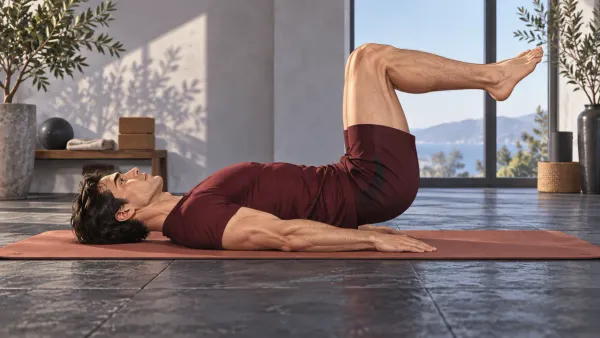
Core strength training: exercises, technique, and progression
Build core strength with safe exercise progressions, a two-day beginner plan, practical technique cues, and evidence-based guidance for durable results.
Quick answer
Core strength training develops the muscles around your trunk so they can create movement, resist unwanted movement, transfer force, and help you breathe under effort. A complete routine needs more than repeated sit-ups. It should include controlled flexion or anti-extension, lateral stability, rotation or anti-rotation, and extension or carrying.
For a practical start, train the core twice per week with a dead bug, bird dog, side plank, and suitcase carry. Perform 2 sets of each, stop with clean technique still available, and progress only one variable at a time: repetitions, hold time, range, lever length, or load. Core work can improve trunk strength, endurance, and balance, but it cannot remove belly fat from one area, guarantee a pain-free back, or replace full-body strength and aerobic training.
Key facts
- Core muscles coordinate pressure and force across the trunk.
- Exercise direction determines the trunk function being trained.
- Stable breathing preserves control as exercise demand increases.
- Progressive overload converts easy drills into continued adaptation.
- Full-body training supplies benefits that isolated core work cannot.
This guide is for generally healthy adults. It does not diagnose abdominal, pelvic-floor, hip, or back symptoms. If an exercise repeatedly causes pain, radiating symptoms, pressure or heaviness in the pelvis, or loss of bladder or bowel control, stop and seek individualized clinical guidance.
What does the core include?
The core is not one muscle and it is not limited to the visible rectus abdominis. It is a coordinated region linking the rib cage, spine, pelvis, and hips.
Important contributors include:
- the rectus abdominis, which helps flex the trunk and control rib position;
- the internal and external obliques, which contribute to rotation, side bending, and resisting both;
- the transverse abdominal region and deeper spinal muscles, which help control pressure and segmental motion;
- the spinal extensors and multifidus, which extend the trunk and resist flexion;
- the diaphragm and pelvic floor, which interact with breathing and pressure;
- the gluteal, hip, and shoulder-girdle muscles, which connect limb force to the trunk.
These muscles do not switch on as isolated buttons. They change their contribution according to posture, load, breathing, speed, fatigue, and the direction of force. The useful training question is therefore not “Which exercise activates the most abs?” It is “Which trunk task do I need to perform, and can I progressively load it with control?”
If your goal is broader alignment awareness rather than isolated trunk strength, use the postural exercises guide as a lower-load mobility and movement-control companion.
What core strength actually does
Core strength gives the arms and legs a controllable base. During a carry, the trunk limits side bending. During a push-up, it resists sagging into extension. During a throw, it transmits and redirects force. During a deadlift, it helps maintain a repeatable relationship between the rib cage and pelvis while the hips and knees produce force.
Research supports real but bounded benefits. A 2023 meta-analysis of 21 controlled studies reported improvements in outcomes including balance and jumping after core programs, while effects differed across tasks and studies (Rodríguez-Perea et al., 2023). A broader 2025 meta-analysis found clearer improvements in core endurance and balance than in many sport-specific outcomes, with high variation between programs (Yu et al., 2025). A 2026 analysis in team-sport athletes likewise reported small-to-moderate performance effects but rated the certainty low to very low (Liu et al., 2026).
That pattern matters: a stronger, more enduring trunk is a plausible training result; a faster sprint, harder throw, or injury-free season is not automatic. Sport skill, lower- and upper-body strength, power, conditioning, and practice remain decisive.
The same boundary applies to rotational sports: our golf swing mechanics and practice guide separates general trunk capacity from the feedback and repetition needed to improve a specific shot pattern.
Older adults can benefit too. In a randomized trial of 64 adults aged 60 and older, adding trunk strengthening and motor-control exercises to walking and balance training improved trunk muscle size, strength, and several functional tests over 12 weeks (Shahtahmassebi et al., 2019). The intervention was a program, not proof that one “best” core move drives healthy aging.
Place core work inside a complete week using the exercise guide for longevity, rather than treating it as a substitute for training the rest of the body.
When the goal shifts from force control to rapid force production, the plyometric exercise guide explains landing skill, drill choice, and jump-volume progression.
Train four trunk functions, not one muscle
A balanced core routine exposes the trunk to forces from several directions.
| Function | What the trunk does | Beginner example | Progression example |
|---|---|---|---|
| Anti-extension | Resists excessive arching as the limbs move | Heel-tap dead bug | Long-lever dead bug or body-saw plank |
| Lateral stability | Resists side bending | Short-lever side plank | Full side plank or suitcase carry |
| Anti-rotation and rotation | Resists or produces turning with control | Standing anti-rotation press | Split-stance press or controlled cable chop |
| Extension and posterior control | Resists flexion or extends the trunk | Bird dog | Loaded hinge or back-extension variation |
No single exercise covers every row equally. A front plank mostly challenges anti-extension; a side plank emphasizes lateral stability; a bird dog combines limb movement with trunk control; a unilateral carry introduces a changing real-world load.
When posterior control is the main goal, the lower back exercise guide builds from bird dogs and hip hinges to supported extensions and loaded strength without turning the routine into pain treatment.
Rotation is not forbidden. It is one human movement option. The Russian twist guide explains when controlled rotation fits and when an anti-rotation alternative may be easier to tolerate.
For a flexion-focused option, the sit-up technique and alternatives guide explains controlled torso lifting, hip-flexor involvement, and when a shorter curl-up may fit better.
For a complementary movement, the reverse crunch guide teaches a small pelvic curl while the upper trunk stays supported.
A readiness check before adding difficulty
Try these four checks before selecting a harder version:
- Breathe: take three quiet breaths without losing the exercise position.
- Control: complete five slow repetitions or a 15-second hold without shaking that changes your alignment.
- Range: move the arms or legs only as far as the trunk position remains deliberate.
- Symptoms: finish without sharp pain, radiating symptoms, dizziness, or increasing pelvic pressure.
Passing does not require a perfectly flat back or a permanently rigid abdomen. The spine has normal curves and movement. You are looking for a position you can control, breathe through, and reproduce—not one universal shape.
Brace by creating firm but sustainable tension around the trunk, as if preparing for a gentle push. Then keep breathing. The diaphragm contributes to both respiration and postural control, so breath and trunk tension must coexist rather than compete (Sannasi et al., 2023). During a demanding repetition, exhaling through the effort often makes pressure easier to manage. People with pelvic-floor symptoms need individualized advice rather than a blanket instruction to hold or force the breath.
For a low-load drill that contrasts selective hollowing with full bracing, use the stomach vacuum technique and safety guide.
Seven core exercises with clear progressions
Choose four to six movements that collectively cover the functions above. You do not need all seven in one session.
1. Dead bug for anti-extension control
Lie on your back with hips and knees bent, arms above the shoulders, and ribs comfortably stacked over the pelvis. Exhale, lower one heel toward the floor, and return before the lower back arches farther than you can control.
- Start: 2 sets of 5–8 heel taps per side.
- Regress: keep the toes on the floor and slide one heel away.
- Progress: lengthen the leg, move the opposite arm, or add a light pullover load.
- Stop the set: when the ribs flare, breathing locks, or the pelvis tips with every repetition.
Small laboratory studies show that dead-bug difficulty can be graded and that abdominal recruitment rises as the lever becomes harder, but surface electromyography does not prove long-term strength or clinical benefit (Souza et al., 2001; Kim et al., 2017). Use technique and progressive performance—not an activation ranking—to select the version.
2. Bird dog for cross-body control
Begin on hands and knees. Reach one leg back and the opposite arm forward without shifting the pelvis or rotating the rib cage. Pause, breathe out, and return under control.
- Start: 2 sets of 5–8 repetitions per side with a 2-second pause.
- Regress: move one limb at a time.
- Progress: lengthen the pause or draw a small controlled square with the hand and foot.
- Avoid: reaching so high that the lower back becomes the main movement.
3. Side plank for lateral stability
Lie on one side with the elbow below the shoulder. In the short-lever version, bend the knees and lift the hips from the knee and forearm. Keep the head, ribs, pelvis, and thighs aligned.
Use the dedicated side plank form and progression guide when you need a full setup checklist, shoulder-aware regressions, and a stepwise route from elevated support to harder variations.
- Start: 2 holds of 10–20 seconds per side.
- Regress: shorten the hold or keep the lower hip lightly supported.
- Progress: straighten the legs, raise the top arm, or add a controlled row.
- Avoid: letting the shoulder collapse toward the ear.
4. Front plank for anti-extension endurance
Set the elbows beneath the shoulders and use the knees or toes as the rear contact. Gently draw the ribs toward the pelvis, squeeze the glutes, and keep breathing behind the brace.
- Start: 2 holds of 10–30 seconds.
- Regress: plank from the knees or against a bench.
- Progress: use a longer lever, controlled shoulder taps, or a slow body-saw motion.
- End early: when the lower back sags, hips rise to escape the demand, or breath becomes a prolonged strain.
A one-minute plank is not automatically better than a challenging 20-second version. Once a hold becomes easy, change leverage or load rather than collecting endurance with deteriorating form.
When you can maintain the support while moving one leg, the mountain climber exercise guide adds an alternating knee drive, joint-aware regressions, and conditioning options without treating speed as the first progression.
5. Standing anti-rotation press
Stand side-on to a resistance band or cable anchored around chest height. Hold the handle at the sternum, step away to create light tension, and press the hands forward without allowing the trunk to turn.
- Start: 2 sets of 6–10 slow presses per side.
- Regress: stand closer to the anchor or use a wider stance.
- Progress: narrow or split the stance, increase resistance slightly, or pause with the arms extended.
- Avoid: twisting away from the anchor to create the appearance of more range.
6. Suitcase carry for moving lateral stability
Hold one weight at your side and walk while remaining tall. The load should challenge you without pulling the shoulder down or making you lean away.
- Start: 2 carries of 30–60 ft (10–20 m) per side.
- Regress: use a lighter load or shorter distance.
- Progress: add a small amount of weight, distance, or slower marching steps.
- Avoid: rushing, gripping through pain, or turning the carry into a side bend.
Carries train the trunk as part of a whole-body task. Pair them with a squat or hinge such as the goblet squat rather than assuming isolated mat work transfers automatically.
7. Controlled hip hinge for posterior trunk strength
Stand facing away from a wall, push the hips back until they touch it, and return to standing. Keep the weight balanced over the whole foot and the trunk organized as the pelvis moves.
- Start: 2 sets of 8 wall hinges.
- Regress: stand closer to the wall.
- Progress: move farther away, hold a light weight close to the body, then learn a deadlift variation.
- Avoid: reaching for the floor by rounding farther instead of moving through the hips.
A two-day beginner core plan
Use this plan after the main lifts or as a short standalone session. Rest 30–75 seconds between sets. Finish each set while you could still complete roughly two clean repetitions or several more seconds with the same position.
| Day A | Dose | Day B | Dose |
|---|---|---|---|
| Dead bug | 2 × 6 per side | Bird dog | 2 × 6 per side |
| Short-lever side plank | 2 × 15–20 sec per side | Front plank | 2 × 15–25 sec |
| Suitcase carry | 2 × 30–60 ft (10–20 m) per side | Anti-rotation press | 2 × 8 per side |
Leave at least one day between sessions at first. Core muscles also work during squats, hinges, presses, rows, carries, running, and sport, so direct training volume should reflect the rest of your week.
The 2026 American College of Sports Medicine position stand concludes that progressive resistance training improves strength and physical function and that consistency matters more than unnecessary complexity for most healthy adults (Currier et al., 2026). Public-health guidance also recommends strengthening all major muscle groups on at least two days per week; core-only sessions do not satisfy that whole-body recommendation (WHO, 2020).
If you place a core movement inside a timed circuit, keep the version simple enough to control while breathing hard. The metabolic conditioning workout guide shows how to choose work-rest ratios without turning technique loss into the goal.
How to progress for six weeks
Progress only after every set stays repeatable for two sessions. Change one variable at a time.
| Weeks | Main goal | Progression rule |
|---|---|---|
| 1–2 | Learn positions and breathing | Use the easiest version that stays symptom-free |
| 3–4 | Build volume | Add 1–2 repetitions or 5 seconds per set |
| 5 | Increase leverage or range | Choose one harder version and return to the lower dose |
| 6 | Consolidate | Repeat the harder version with cleaner control or a small load increase |
Useful overload options include:
- a longer arm or leg lever;
- a slightly larger controlled range;
- more repetitions or hold time;
- a slower lowering phase or deliberate pause;
- a narrower base of support;
- a small increase in external load;
- an extra set when the existing dose recovers well.
Do not increase all of them together. If progress stalls, audit technique, exercise difficulty, frequency, and recovery before adding more work. The workout plateau guide provides a structured way to separate insufficient stimulus from accumulated fatigue.
Common core-training mistakes
| Mistake | Why it limits training | Better choice |
|---|---|---|
| Training only trunk flexion | Leaves lateral, rotational, and posterior tasks underexposed | Cover several force directions |
| Chasing the longest plank | Builds tolerance for one easy version | Increase leverage or load with shorter clean sets |
| Pulling the abdomen inward all day | Confuses an exercise cue with normal breathing and movement | Brace only as much as the task requires |
| Holding the breath through every repetition | Makes pressure and fatigue harder to manage | Exhale through effort and reset as needed |
| Using unstable tools before basic control | Adds balance noise without guaranteed extra benefit | Earn a stable version, then add instability for a reason |
| Progressing through pain | Turns a training choice into a symptom test | Change range, load, or exercise and seek help if symptoms persist |
| Expecting spot fat loss | Misreads local muscle fatigue as local fat use | Use nutrition and whole-body activity for body-composition goals |
Soreness is not a score for exercise quality. New drills can make the abdominal wall sore, but pain with coughing, a visible bulge, deep pelvic pressure, or symptoms that worsen rather than settle deserve more attention. The DOMS recovery guide explains how ordinary post-exercise soreness typically behaves.
Core training, back pain, and safety
Core exercise can be part of care for some people with low back pain, but “weak core” is not a complete diagnosis and one program does not fit every cause. The 2021 physical-therapy clinical practice guideline includes trunk strengthening, endurance, specific activation, movement control, aerobic exercise, and general exercise among options for chronic low back pain, selected according to the presentation (George et al., 2021). The World Health Organization’s 2023 guideline similarly supports structured exercise as one component of person-centered care for chronic primary low back pain (WHO, 2023).
That is not evidence that everyone with pain should plank harder. Pain can change movement, confidence, sleep, and activity. A clinician may begin with graded exposure, walking, general strength, specific motor-control work, or another approach depending on symptoms and preferences.
Stop the session and obtain appropriate assessment if you develop:
- pain that is sharp, electric, or radiates into an arm or leg;
- new numbness, weakness, or loss of coordination;
- chest pain, faintness, or unusual shortness of breath;
- a new abdominal bulge with pain or vomiting;
- pelvic heaviness, leaking, or pain that repeatedly worsens under load;
- back pain with fever, significant trauma, new bladder or bowel changes, or numbness around the groin.
Pregnancy, the postpartum period, recent abdominal or spinal surgery, osteoporosis with exercise restrictions, a known hernia, and persistent pelvic-floor symptoms call for individualized progression.
For a conventional short upper-trunk curl, see our crunch form and neck-comfort guide.
Track capacity, not a six-pack
Useful core metrics are functional and repeatable: the exercise version, repetitions or seconds, load, breathing quality, symptoms during the set, and response over the next day. A longer lever with stable breathing is progress even when appearance does not change.
Core strength is one small part of long-term health. Track it beside the behaviors with broader evidence: weekly aerobic activity, full-body resistance training, sleep, and recovery. SuperAge can help you view those trends together, but it cannot diagnose pain or confirm that a specific exercise is safe for you.
When you want the wider pattern rather than one workout number, download SuperAge and review whether your training is becoming more consistent, capable, and recoverable.
Key takeaways
- The core includes abdominal, spinal, breathing, pelvic, hip, and shoulder-connected muscles working as a system.
- Train anti-extension, lateral stability, rotation or anti-rotation, and posterior control instead of relying on one abdominal exercise.
- Dead bugs, bird dogs, side planks, carries, anti-rotation presses, and hinges can form a complete beginner routine.
- Start with two sessions per week, 2 sets per exercise, and finish before technique or breathing breaks down.
- Progress one variable at a time after two consistently controlled sessions.
- Core training can improve trunk capacity and balance, but transfer to sport and injury prevention is not guaranteed.
- Core work does not spot-reduce abdominal fat and does not replace full-body strength or aerobic training.
- Persistent pain, neurological symptoms, pelvic-floor symptoms, or post-surgical concerns require individualized guidance.
FAQ
What are the best exercises for core strength?
The best selection covers several trunk functions. A dead bug, bird dog, side plank, suitcase carry, and standing anti-rotation press provide a practical mix of anti-extension, posterior control, lateral stability, and anti-rotation.
How often should I train my core?
Two direct sessions per week are enough for many beginners. Add frequency only when you recover well and the extra work has a clear purpose, remembering that full-body lifts and sport also load the trunk.
How long should a core workout last?
A focused beginner session can take 10–20 minutes. Exercise quality, progressive difficulty, and repeatable weekly practice matter more than making the session long.
Are planks better than sit-ups?
Neither is universally better. Planks mainly train the trunk to resist extension, while sit-up variations produce trunk and hip flexion. Choose according to the function you need, symptoms, and the movement you can progressively control.
Can core exercises reduce belly fat?
Core exercises strengthen and fatigue local muscles but cannot choose where body fat is lost. Changes in body fat depend mainly on sustained energy balance, nutrition, whole-body activity, sleep, and individual biology.
If visible definition is your goal, our guide to visible abs and body composition separates that appearance question from the core-strength plan above.
Should I tighten my core all day?
No. Normal movement and breathing require changing levels of tension. Brace firmly for a demanding task, then relax when the task ends rather than holding the abdomen rigid throughout the day.
Is shaking during a plank bad?
Mild shaking near the end of a challenging set can reflect fatigue. End or regress the set when shaking changes your position, stops normal breathing, or appears with pain, dizziness, or other concerning symptoms.
Can I train my core if I have back pain?
Possibly, but exercise choice should match the type, duration, and irritability of your symptoms. Begin with tolerable movement and seek a qualified clinician for persistent, worsening, radiating, traumatic, or neurologically associated pain.
References
- Currier BS, et al. American College of Sports Medicine position stand: resistance training prescription for muscle function, hypertrophy, and physical performance in healthy adults. Medicine & Science in Sports & Exercise. 2026. PubMed
- World Health Organization. WHO guidelines on physical activity and sedentary behaviour. 2020. WHO
- Rodríguez-Perea Á, et al. Core training and performance: a systematic review with meta-analysis. Biology of Sport. 2023. PubMed
- Yu T, et al. The impact of core training on overall athletic performance in different sports: a comprehensive meta-analysis. BMC Sports Science, Medicine and Rehabilitation. 2025. PubMed
- Liu Y, et al. Effects of core training on physical performance in team-sport athletes: a systematic review and meta-analysis. BMC Sports Science, Medicine and Rehabilitation. 2026. PubMed
- Shahtahmassebi B, et al. Trunk exercise training improves muscle size, strength, and function in older adults: a randomized controlled trial. Scandinavian Journal of Medicine & Science in Sports. 2019. PubMed
- Sannasi R, et al. Diaphragm and core stabilization exercises in low back pain: a narrative review. Journal of Bodywork and Movement Therapies. 2023. PubMed
- Souza GM, Baker LL, Powers CM. Electromyographic activity of selected trunk muscles during dynamic spine stabilization exercises. Archives of Physical Medicine and Rehabilitation. 2001. PubMed
- Kim CR, et al. Electromyographic changes in trunk muscles during graded lumbar stabilization exercises. PM&R. 2017. PubMed
- George SZ, et al. Interventions for the management of acute and chronic low back pain: revision 2021. Journal of Orthopaedic & Sports Physical Therapy. 2021. PubMed
- World Health Organization. WHO guideline for non-surgical management of chronic primary low back pain in adults in primary and community care settings. 2023. WHO
- Talasz H, et al. Breathing, straining and the pelvic floor: a basic concept. Healthcare. 2022. PubMed
Related Articles
How to do crunches: form, neck comfort, and progression
Learn how to do crunches with a controlled short curl, adjust when your neck takes over, and progress a small routine. Find a starting point that fits you.