Reverse crunch: form, muscles, and controlled progression
Learn reverse crunch form, distinguish a pelvic curl from a leg lift, and choose manageable sets, regressions, and progressions. Build control before adding reps.
Quick answer
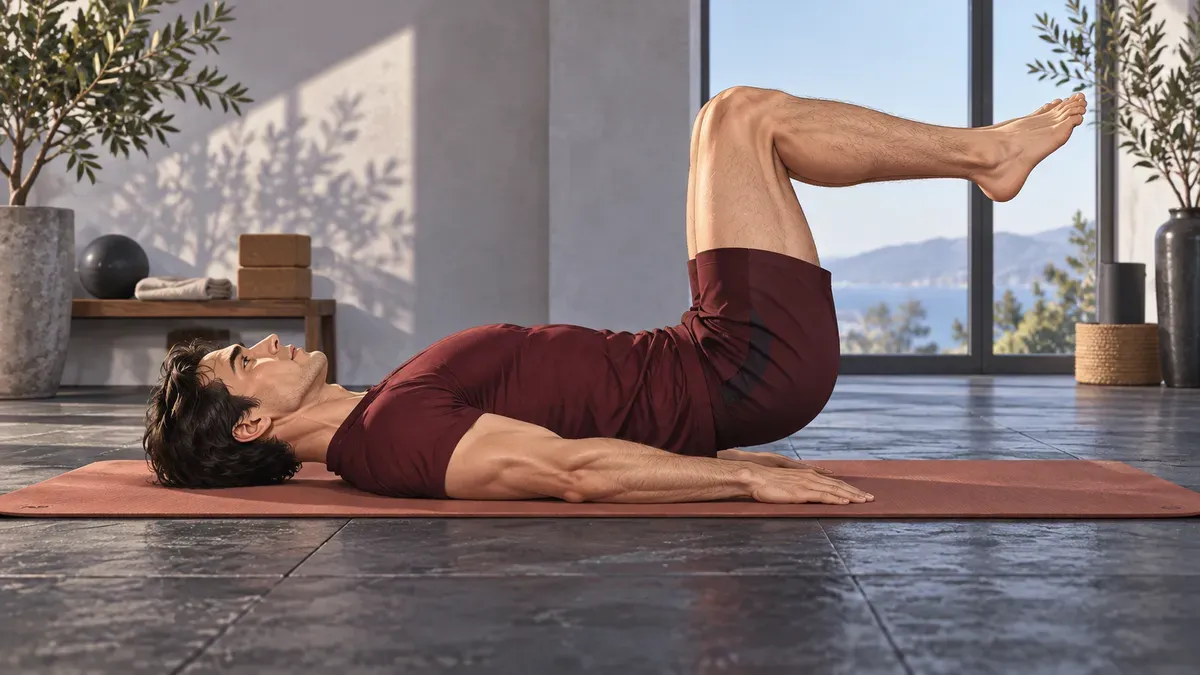
To perform a reverse crunch, lie on your back, bend your knees, and bring your thighs above your hips. Exhale and gently curl your pelvis toward your ribs so your tailbone lifts a little from the mat. Keep your head and shoulders supported, then lower the pelvis slowly. The useful movement is a controlled pelvic curl, not a fast swing of the legs toward your face.
Begin with a small range you can repeat comfortably. If lifting the pelvis requires momentum, practice a feet-supported pelvic tilt or choose a different core task. A reverse crunch can train abdominal movement and control, but it is optional: it does not isolate a separate lower-ab muscle, guarantee a healthy back, or selectively remove belly fat.
Key facts
- Reverse crunches move the pelvis toward the rib cage.
- Abdominal muscles contribute to pelvic curling and controlled lowering.
- Hip flexors help position and support the raised legs.
- Bent knees reduce the lever length compared with straight legs.
- Small, repeatable movements expose momentum before volume increases.
Recognize the movement before counting repetitions
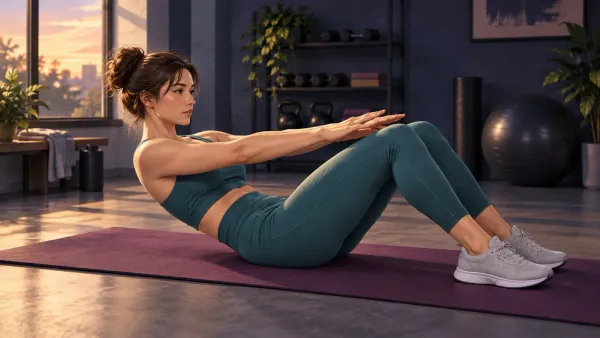
A conventional crunch brings the upper trunk toward the pelvis. A reverse crunch keeps the upper trunk supported while the pelvis curls toward the rib cage. A leg raise mainly changes the angle at the hips; it may include abdominal stabilization, but lifting the legs alone is not the same task as curling the pelvis.
The difference is easiest to feel with bent knees. Set the thighs approximately above the hips and notice whether your pelvis rolls slightly away from the floor. Your knees may travel as a result, but their distance from your face is not the target. If the legs move widely while the pelvis stays still, you are practicing a different exercise.
This distinction also prevents contradictory instructions. A reverse crunch involves a small amount of spinal flexion as the pelvis rolls. Trying to keep every part of the lower back immobile while lifting the tailbone defeats that movement. Instead, keep the range deliberate and comfortable, without forcing a large roll onto the upper back.
The ACE reverse crunch demonstration describes controlled rolling of the pelvis and a return with the thighs above the hips. Use the core strength training guide for the broader program; this page focuses on learning one pelvic-curling exercise.
What the abdominal muscles contribute
The rectus abdominis links the front of the pelvis with the rib cage and contributes to trunk flexion. The obliques also contribute to abdominal control. Hip flexors help hold the thighs in position, while other trunk muscles participate according to the variation and effort. Feeling work at the front of the hips does not prove that your abdominal muscles are inactive.
“Lower abs” is a convenient location description, not the name of an independent muscle that this exercise switches on alone. Regional muscle activity can differ, however. In a laboratory study of 25 healthy participants, the reverse curl produced more electrical activity in the lower rectus region than the other tested exercises, while upper-region activity was similar across several tasks (Willett et al., 2001).
That finding supports a nuanced explanation: movement can change regional recruitment, but it does not establish selective muscle growth, superiority over every core exercise, or long-term injury prevention. Surface electromyography measures electrical activity during a task. It is not a direct measurement of future strength, muscle size, or the safety of a particular person’s spine.
Build a clean repetition in four stages
Use a stable, comfortable mat on a nonslip floor. Warm up with easy movement and leave enough space around your head and feet. Start without ankle weights, a decline bench, or someone pushing your legs.
Find a supported starting position
Lie on your back with your head and shoulders resting comfortably. Place your arms beside you or slightly out to the sides, palms down. Bend the knees and bring the thighs approximately above the hips, with the knees bent near a right angle. Your arms can provide balance without turning the repetition into a forceful push against the floor.
Breathe normally here. If simply holding the legs up is already strenuous or uncomfortable, return the feet to the mat. Practice the easier pelvic-tilt option below before adding the raised-leg position.
Begin the curl at the pelvis
Exhale gently, create abdominal tension, and tip the front of the pelvis toward the ribs. Let the tailbone and pelvis lift slightly. Keep the knee bend approximately unchanged so the movement does not turn into a kick.
Use the smallest lift that clearly changes pelvic position. There is no required height or need to reach the knees toward the forehead. Keep pressure away from the neck and stop before rolling onto the shoulders. Think of shortening the distance between pelvis and ribs rather than throwing the legs backward.
Pause without bracing your breath
Briefly check that you can stop the movement. A pause makes it easier to notice whether momentum carried you upward. You should still be able to release a little air; a hard breath hold is unnecessary for learning this bodyweight task.
If your face, neck, or arms strain while the pelvis barely moves, reduce the range or reset with the feet supported. The purpose is a manageable abdominal movement, not the largest possible lift.
Unroll and reset deliberately
Lower the pelvis gradually, returning the thighs to approximately above the hips. Take about 2–3 seconds to lower as a practice cue, not a scientifically required tempo. Inhale comfortably as you reset.
Do not extend the legs toward the floor to make every repetition look bigger. That adds a longer-lever hip movement and can make trunk control harder. Finish the set when the lowering becomes a drop or the next curl needs a swing.
Troubleshoot the signal you actually notice
Change one feature and see whether control improves. A burning sensation is not the only sign of useful work, and an exercise does not have to cause next-day soreness to count.
| What you notice | What it may indicate | First adjustment |
|---|---|---|
| Knees swing toward the face | Momentum is replacing a deliberate curl | Start with thighs above hips and use a smaller lift |
| Pelvis drops abruptly | The descent exceeds your current control | End the set earlier or reduce the range |
| Lower back arches as legs move away | The added leg-lowering task is too demanding | Reset above the hips instead of reaching toward the floor |
| Neck or shoulders strain | You are pressing or rolling too far | Keep the head supported and shorten the curl |
| Hip pinching, pelvic pressure, or pain | The current variation may not suit you | Stop and use an alternative; seek advice if symptoms recur |
A side-view video can help distinguish pelvic motion from leg swing. It cannot diagnose pain or certify that a movement is safe. Compare the first and last repetition: if range, breathing, or descent change substantially, the set has reached its useful limit for technique practice.
Choose a regression before forcing the full version
For a feet-supported pelvic tilt, lie with the knees bent and feet on the floor. Gently tip the pelvis so the low-back curve decreases, then release. Keep the effort small and breathe throughout. This lets you rehearse pelvic motion without holding the legs in the air; it is not an equivalent strength stimulus or a treatment for posture.
Next, try the raised-leg starting position for a few comfortable breaths without curling. When that position is manageable, add a very small lift and return. These are separate learning steps, so there is no need to achieve all of them in one session.
If you prefer a core task that keeps the trunk steadier, use a short-lever dead bug or the front plank progression. For upper-trunk curling, the sit-up and crunch comparison explains a different movement. Choose according to comfort and purpose, rather than ranking every exercise by difficulty.
A small practice plan with a clear progression rule
For a generally healthy adult who finds the movement comfortable, try the following original learning template. These numbers are practical starting examples, not a clinical prescription or a proven optimal reverse-crunch dose.
| Stage | Suggested practice | Condition for moving on |
|---|---|---|
| Learn the position | Feet-supported pelvic tilts, then a comfortable raised-leg hold | You can breathe and change pelvic position without strain |
| Learn the curl | 1–2 sets of 5–8 small curls, twice weekly | First and last repetitions have similar control |
| Build repeatability | Add one repetition per set after two comfortable sessions | You retain a slow descent and about two clean reps in reserve |
| Add challenge | Increase toward 8–12 reps, then change one variable | The extra challenge preserves comfort and technique |
Rest roughly 60–90 seconds between sets and allow at least a day between the initial sessions. Place the exercise after your main strength work or in a short separate practice block. If you already do several abdominal exercises, substitute it for one of them instead of automatically adding more volume.
For example, six smooth repetitions followed by two swung repetitions are a reason to keep the next set at six. Once two sets of eight remain comfortable across two sessions, try nine or add a brief pause. A slower descent, less hand support, or a slightly longer leg lever can increase demand; choose just one and return to fewer repetitions if necessary.
The 2026 ACSM resistance-training guidance emphasizes regular training of all major muscle groups, individualized programs, and useful results from bodyweight exercise. Training to failure is not consistently necessary for the average healthy adult. It does not prescribe a specific reverse-crunch routine. Our strength training methods guide helps place this small drill within a complete program.
Know when a different exercise is the better choice
Stop for sharp or increasing pain, radiating symptoms, dizziness, or pelvic pressure or leakage. Persistent or recurring symptoms deserve individualized assessment. Recent abdominal or spinal surgery, a hernia, pregnancy, postpartum recovery, or an existing back or hip problem may change which exercise is appropriate.
People with osteoporosis or a spinal-fracture history should ask their clinician or physiotherapist about repeated spinal-flexion exercises. The Royal Osteoporosis Society explains that flexion exercises such as sit-ups and Pilates curls may need adaptation. A reverse crunch also includes flexion, so a general online technique guide cannot clear it for your individual circumstances.
Comfortable movement in a healthy adult is not automatically damaging because the spine moves. Equally, calling an exercise “bodyweight” does not make every variation appropriate for everyone. Keep the choice flexible and avoid using a harder bench variation to solve a problem with the basic movement.
Separate abdominal capacity from abdominal appearance
Practicing reverse crunches can improve your ability to perform that movement. Progress might mean a more deliberate curl, easier breathing, or more controlled repetitions. It does not independently demonstrate fat loss or measure overall fitness.
In a randomized trial of 24 sedentary adults, six weeks of abdominal exercise improved muscular endurance without significant changes in the measured abdominal fat or body-composition outcomes (Vispute et al., 2011). This small study does not describe every possible exercise program, but it does not support promising local belly-fat loss from abdominal drills. The visible abs guide treats training and body composition as related but separate questions.
For a conventional short upper-trunk curl, see our crunch form and neck-comfort guide.
Put repeatable training in context with SuperAge
Keep simple training notes: variation, controlled repetitions, and how you feel afterward. Review those notes alongside the broader activity, sleep, and recovery trends you follow in SuperAge. A single abdominal exercise or one good session cannot establish a change in biological age; consistent habits provide more useful context.
To review those wider habits, explore SuperAge. Use movement quality and appropriate professional advice for technique decisions. An app cannot diagnose symptoms or determine whether a reverse crunch is suitable for rehabilitation.
Key takeaways
- Curl the pelvis toward the ribs instead of throwing the legs backward.
- Keep the upper trunk supported and use a range you can lower slowly.
- Regional abdominal activity is possible; isolated lower-ab growth is not established by an EMG study.
- Start with a small practice dose and progress one feature at a time.
- Change the exercise when symptoms or health history call for another approach.
- Judge progress by repeatable control, not promises of local fat loss.
FAQ
What is the difference between a reverse crunch and a leg raise?
A reverse crunch includes curling the pelvis toward the ribs. A leg raise mainly moves the thighs at the hips. Both can involve abdominal effort, but they ask you to control different movements.
Does a reverse crunch work the lower abs?
It works abdominal muscles, and regional electrical activity can differ from other exercises. “Lower abs” does not describe a separate muscle, and short-term activation does not prove selective long-term growth.
How high should my hips lift?
Only as high as you can curl and return deliberately while keeping the head and shoulders supported. Begin with a small lift; bringing the knees to the face is unnecessary.
How many reverse crunches should a beginner do?
One or two sets of 5–8 controlled repetitions twice weekly are a reasonable learning example if the movement is comfortable. Use a pelvic tilt or another core exercise if you cannot control that version.
Should my feet touch the floor between repetitions?
You can reset them between attempts while learning. For a continuous set, return the thighs above the hips rather than lowering the legs toward the floor and adding a different challenge.
Why do I feel the front of my hips?
Hip flexors help support the raised legs. Effort there does not prove poor abdominal recruitment. Pinching or pain is a reason to stop, change the task, and seek advice if it persists.
Are reverse crunches safe for back pain or osteoporosis?
Suitability depends on your symptoms and health history. Get individualized guidance for ongoing back pain, osteoporosis, spinal fractures, or recovery from surgery; this exercise is not a universal rehabilitation choice.
Can reverse crunches remove belly fat?
They train movement and muscular capacity, but they do not reliably choose where fat is lost. Use a broader approach to activity, nutrition, and health rather than expecting local fat loss from one drill.
References
- American Council on Exercise. Reverse ab crunch: exercise technique. ACE exercise library.
- Willett GM, et al. Relative activity of abdominal muscles during commonly prescribed strengthening exercises. Journal of Strength and Conditioning Research. 2001. PubMed.
- American College of Sports Medicine. Updated resistance-training guidelines for healthy adults. 2026. ACSM.
- Royal Osteoporosis Society. How to exercise safely for bones. Reviewed June 2026. Royal Osteoporosis Society.
- Vispute SS, et al. The effect of abdominal exercise on abdominal fat. Journal of Strength and Conditioning Research. 2011. PubMed.
Related Articles
Side plank form: muscles, benefits, and progressions
Learn proper side plank form, muscles worked, realistic benefits, common mistakes, regressions, progressions, and a practical shoulder-aware training plan.