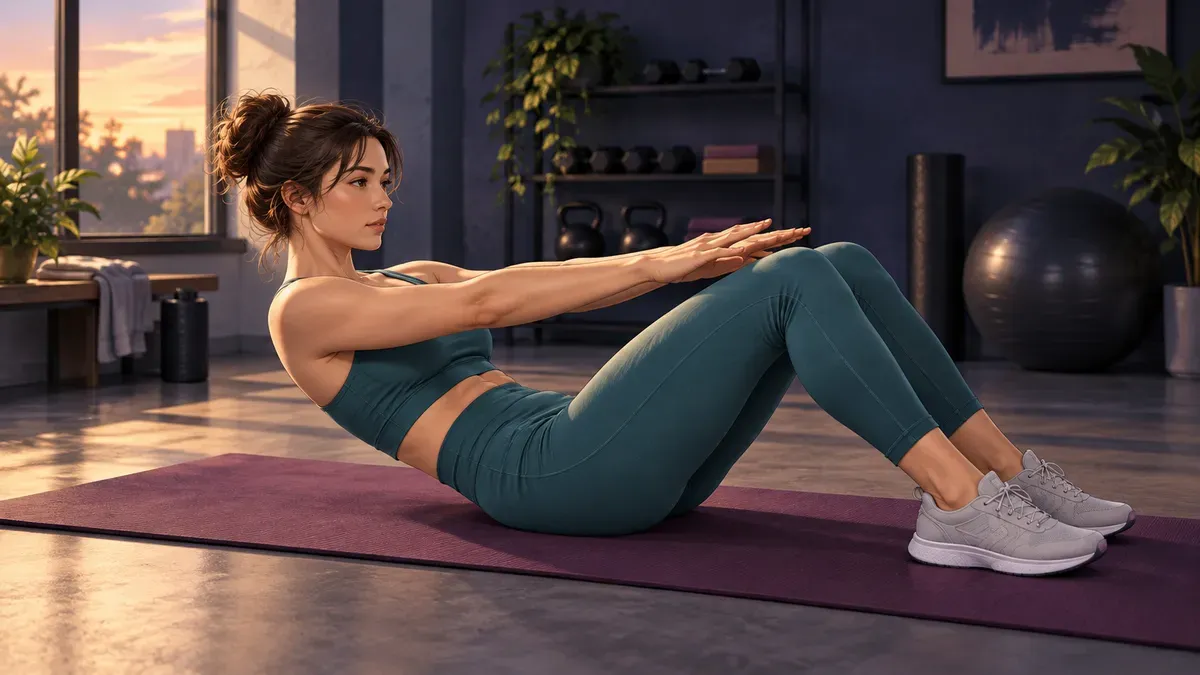
How to do a sit-up: technique, muscles, and alternatives
Learn how to do a sit-up with control, understand the difference from a crunch, and choose useful alternatives. Build a repeatable core routine with confidence.
Quick answer
To do a sit-up, lie on your back with your knees bent and feet on the floor, reach your arms forward or cross them over your chest, and lift your torso toward your thighs without jerking your head. Exhale during the rise and lower yourself with control. Use only a comfortable range; if you need momentum, cannot control the descent, or develop symptoms, choose a shorter curl-up or another core exercise.
A sit-up trains abdominal muscles and hip flexors. It is an optional exercise, not a required test of fitness, a treatment for back pain, or a way to selectively remove belly fat. Start with a few controlled repetitions rather than a timed maximum. This guide helps generally healthy adults learn the movement and decide whether it fits their goals.
Key facts
- Sit-ups combine trunk flexion with hip flexion.
- Abdominal muscles contribute to lifting and controlling the torso.
- Hip flexors contribute more as the torso moves toward sitting.
- Crunches use a shorter movement than full sit-ups.
- Controlled repetitions make exercise difficulty easier to judge.
What a sit-up asks your body to do
The beginning of a sit-up resembles a crunch: the head and shoulders lift as the rib cage moves toward the pelvis. Continuing toward an upright torso adds substantial movement at the hips. Abdominal muscles remain involved, but the exercise is not an isolated contraction of the visible six-pack.
The rectus abdominis helps flex the trunk, the obliques contribute to trunk control, and hip flexors help move the torso relative to the thighs. How much each contributes depends on the variation, range, foot support, speed, and individual proportions. Feeling effort at the front of the hips does not mean the abdominal muscles have switched off.
A small laboratory study of six men found abdominal activity during both trunk-flexion and hip-flexion exercises, with greater hip-flexor involvement when the movement required hip flexion. Supporting the legs also changed the demands (Andersson et al., 1997). Another laboratory investigation distinguished shorter curl-ups from sit-ups through their muscle-activation patterns (Konrad et al., 2001). These observations explain movement mechanics; an electrical signal does not prove which exercise produces the most muscle growth or prevents injury.
Our core strength training guide covers the wider program. Here, the narrower question is how to perform and dose one flexion exercise.
Learn the sit-up in five steps
Use a firm, comfortable mat on a nonslip floor. Clear enough room that neither your head nor your feet can hit furniture. Warm up with a few minutes of easy movement before trying a demanding set.
1. Set your starting position
Lie on your back. Bend your knees to a comfortable angle and place your feet about hip-width apart. Reach your arms toward your knees to make the first attempts easier. Crossing the arms over the chest increases the challenge without adding equipment.
Keep your neck comfortable and avoid pressing your chin hard into your chest. Do not clasp your hands behind your head to pull yourself up. Your normal spinal curves do not have to be forced into one rigid position.
2. Begin with a small curl
Create gentle abdominal tension, breathe out, and lift the head and shoulders together. Think of bringing the ribs toward the pelvis rather than throwing the arms. If you can only lift the shoulder blades smoothly, use that shorter movement as your exercise for now.
The Mayo Clinic crunch demonstration offers a useful shorter-range option and emphasizes deliberate movement without pulling on the neck.
3. Continue only while you control the movement
For a full sit-up, continue lifting the torso toward the thighs. Stop before you need a sudden arm swing, a bounce, or an uncomfortable final fold. Reaching an arbitrary upright angle is less important than controlling the range you choose.
If your feet lift, do not immediately ask someone to hold them down so you can force more repetitions. Foot anchoring changes the task and can increase hip-flexor contribution. A shorter curl-up, a different arm position, or another exercise may be the better starting point. Anchored sit-ups can serve specific training or test purposes, but they are not the default beginner solution.
4. Lower with the same attention
Return gradually until your torso rests on the mat. Aim for about 2–3 seconds on the way down as a learning cue, not a mandatory physiological formula. Breathe in as you return and reset between repetitions when needed.
If the final part becomes a drop, the current range or number of repetitions is too demanding. Shorten the movement or finish the set. The descent is part of the repetition, not a pause before the next one.
5. End before the technique changes
Finish while you could still perform roughly two clean repetitions. Notice whether the last repetition looks like the first: similar range, smooth lowering, and a comfortable neck. A small set you can repeat is more useful for learning than a high score built from compensations.
Sit-up, crunch, or plank? Match the task
These exercises challenge different functions, so there is no universal winner.
| Exercise | Main movement or demand | Useful reason to choose it | Limitation to consider |
|---|---|---|---|
| Sit-up | Trunk flexion followed by hip flexion | Practice controlled torso lifting or prepare for a required movement test | Larger range and hip involvement may be uncomfortable or difficult to control |
| Crunch or curl-up | Shorter trunk flexion | Train a manageable flexion movement without rising to sitting | Still involves spinal movement and may not suit every clinical situation |
| Front plank | Resist extension while supporting the body | Practice maintaining trunk position under steady load | Shoulder or wrist support can become the limiting factor |
| Dead bug | Control the trunk while moving the limbs | Practice coordination with adjustable limb leverage | Difficulty depends on maintaining control, not reaching the floor at any cost |
If you want to practice curling the pelvis while keeping the head and shoulders supported, the reverse crunch technique guide explains that different flexion task and its regressions.
The front plank technique guide explains the face-down stability task. If your goal involves turning, the Russian twist guide covers a different movement choice. Neither replaces the skill of a sit-up when a specific test requires one, and a test-specific exercise is not automatically the best choice for general health.
Common problems and practical adjustments
Treat a problem as information about the current task, not a reason to push harder.
| What you notice | First adjustment | When to change the exercise |
|---|---|---|
| Pulling at the neck | Reach forward, shorten the range, and let the head move with the upper torso | Symptoms recur despite a smaller, controlled movement |
| Feet lifting or arms swinging | Reduce the range and number of repetitions | You cannot rise without momentum |
| Dropping onto the mat | Slow the lowering phase and end the set earlier | You cannot control even a short descent |
| Front-of-hip discomfort | Try less range and an unanchored shorter curl-up | Pinching or pain continues |
| Breath holding and straining | Reduce effort and exhale during the rise | Dizziness, pelvic pressure, or other symptoms appear |
A video from the side can help you notice momentum or an uncontrolled landing, but it cannot diagnose pain. There is no need to make the abdomen look perfectly flat or eliminate every visible spinal movement. Judge the exercise by control, comfort, and progress toward your goal.
A small starting dose and a progression rule
If the movement is comfortable, try 1–2 sets of 5–8 repetitions twice weekly, with at least a day between sessions at first. Rest about 60–90 seconds between sets. This is an original learning template, not a clinical prescription or a research-proven optimal sit-up dose.
Use a shorter curl-up if a full sit-up is currently too difficult. After two sessions with repeatable technique and comfortable recovery, add one repetition per set. When the top of your range feels easy, choose one small progression: a slightly longer range, arms crossed rather than reaching, a slower descent, or another set. Avoid changing all of these together.
For example, if you complete two sets of six clean repetitions on both training days, try seven next time. If the seventh becomes an arm swing, stay at six or choose a simpler version. The useful result is better repeatable performance, not permission to force the target number.
Place direct abdominal work after the main movements of a full-body session or in a short separate block. The 2026 ACSM guidance supports bodyweight and home-based resistance exercise, regular participation, and programs matched to individual goals. It does not require training to failure for the average healthy adult. Use our strength training methods guide to build the rest of the session; sit-ups alone leave major muscle groups untrained.
When to choose individualized advice instead
Stop a set for sharp or increasing pain, radiating symptoms, dizziness, or pelvic pressure or leakage. Recurring symptoms call for assessment rather than repeated experimentation with harder variations. Pregnancy, postpartum recovery, recent abdominal or spinal surgery, and an existing back or hip condition can change the appropriate starting exercise; follow advice suited to your situation.
Osteoporosis and spinal fractures deserve particular care. The Royal Osteoporosis Society notes that exercises involving forward spinal curvature, including sit-ups, may need adaptation. Seek advice from your clinician or physiotherapist before using repeated or loaded trunk flexion when you have osteoporosis or a fracture history. Staying active remains valuable; changing the exercise does not mean abandoning training.
For a healthy adult without symptoms, spinal movement during a sit-up is not by itself a diagnosis of injury. Equally, absence of pain during one set does not guarantee that any volume or load is appropriate. Progress gradually and keep the exercise optional.
What sit-ups can and cannot change
Repeated, progressively challenging sit-ups can build capacity for the movement. A higher repetition count may reflect better endurance, skill, or tolerance; it does not independently measure your entire core or your health.
Do not use abdominal exercise as a promise of local fat loss. In a randomized trial of 24 sedentary adults, six weeks of abdominal training improved endurance without significant changes in the measured abdominal fat or body-composition outcomes (Vispute et al., 2011). That small trial is not a complete model of every training program, but it does not support selling sit-ups as a way to burn belly fat. The visible abs guide addresses appearance and body composition separately.
For long-term capability, combine movement skills with whole-body strength, aerobic activity, and recovery. Choosing an exercise you can sustain matters more than treating one abdominal drill as essential.
For a conventional short upper-trunk curl, see our crunch form and neck-comfort guide.
Keep useful training notes with SuperAge
Record the variation, controlled repetitions, and how you feel later that day and the next morning. Keep those notes alongside the activity, sleep, and recovery trends you review in SuperAge. A steadier routine can support long-term health habits, but an app cannot assess sit-up technique, diagnose pain, or choose a safe rehabilitation progression.
If you want context for those wider habits, explore SuperAge. Use your own movement quality and appropriate clinical advice to make exercise decisions.
Key takeaways
- Learn a smooth rise and controlled descent before increasing repetitions.
- Expect both abdominal and hip-flexor involvement in a full sit-up.
- Choose a crunch, plank, or dead bug according to the function and comfort you need.
- Progress one variable at a time and leave clean repetitions in reserve.
- Treat recurring symptoms and osteoporosis-related precautions individually.
- Keep sit-ups within a balanced program; they cannot target belly fat or measure overall health.
FAQ
How many sit-ups should a beginner do?
Start with a small amount you can control, such as 1–2 sets of 5–8 repetitions twice weekly. Use a shorter curl-up if necessary. This is a practical learning example, not a universal target.
Are sit-ups better than crunches?
They do different tasks. A sit-up includes more hip flexion and a larger torso movement; a crunch is shorter. Choose the version that matches your goal and remains comfortable and controllable.
Why do I feel sit-ups in my hips?
Hip flexors contribute as the torso approaches sitting, especially when the feet are supported. Effort is not automatically a problem, but pinching or pain is a reason to adjust or change the exercise.
Should someone hold my feet?
Not automatically. Anchoring changes the movement demands and may be relevant to a specific test. For general beginner training, try a shorter range or another exercise before using anchoring to force repetitions.
Can sit-ups burn belly fat?
They train muscles but cannot reliably select the location of fat loss. Body-composition changes involve the broader pattern of activity, eating, and individual physiology.
Are sit-ups bad for every back?
No single answer applies to everyone. Symptoms, health history, loading, and tolerance matter. People with osteoporosis, spinal fractures, or ongoing back problems should obtain individualized exercise guidance.
Do I need to do sit-ups every day?
No. Two short sessions per week are a reasonable learning start within a broader program. Add frequency only for a clear purpose and when recovery remains comfortable.
What if I cannot do one full sit-up?
Use a short curl-up, an easier dead bug, or another controllable core task. Full sit-up ability is not a requirement for starting strength training or a complete measure of fitness.
References
- Andersson EA, et al. Abdominal and hip flexor muscle activation during various training exercises. European Journal of Applied Physiology and Occupational Physiology. 1997. PubMed.
- Konrad P, et al. Neuromuscular evaluation of trunk-training exercises. Journal of Athletic Training. 2001. Full text.
- Mayo Clinic. Abdominal crunch: demonstration and technique. Updated 2025. Mayo Clinic.
- American College of Sports Medicine. Updated resistance-training guidance for healthy adults. 2026. ACSM.
- Royal Osteoporosis Society. How to exercise safely for bones. Reviewed 2026. Royal Osteoporosis Society.
- Vispute SS, et al. The effect of abdominal exercise on abdominal fat. Journal of Strength and Conditioning Research. 2011. PubMed.
Related Articles

How to do crunches: form, neck comfort, and progression
Learn how to do crunches with a controlled short curl, adjust when your neck takes over, and progress a small routine. Find a starting point that fits you.