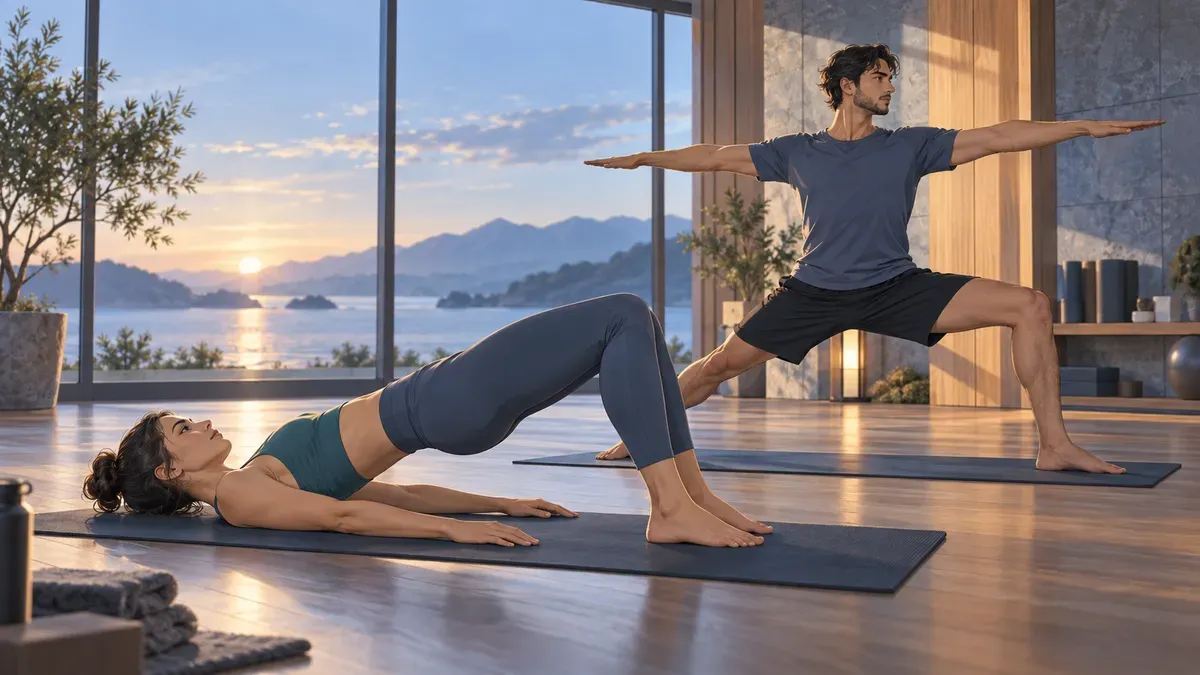
Piloga workout: how to combine Pilates and yoga safely
A Piloga workout combines Pilates control with yoga mobility and breathing. Learn a safe 30-minute routine, progressions, benefits, and limits at home.
Piloga is a hybrid workout that combines the controlled trunk and hip work associated with Pilates with yoga-inspired postures, mobility, breathing, and relaxation. It is also called Yogalates in some studios. The name describes a format, not one universally standardized exercise system: two classes may use very different movements, doses, and teaching styles.
That distinction matters. Research supports several benefits of yoga and Pilates as separate practices, but there is not yet a comparable body of trials proving that a branded Piloga blend is uniquely better than either component. A sensible Piloga workout therefore borrows useful methods without borrowing inflated promises.
This guide gives you a balanced 30-minute beginner session, explains how to scale it, and shows where it fits in a complete week of exercise. If you are still deciding which component better matches your goals, start with our evidence-based yoga versus Pilates comparison. If you prefer a yoga-only habit, the 12-minute daily yoga routine offers supported poses, recovery rules, and a four-week progression.
Quick answer
A beginner Piloga workout should move from easy breathing and joint mobility into controlled core and hip exercises, then standing yoga-inspired poses, balance, and a short relaxation. Start with 20-30 minutes at an effort of about 4-6 out of 10, keep every repetition pain-free, and use a wall or chair for standing work. Piloga can train mobility, body awareness, core endurance, and balance, but it does not replace the aerobic and progressive strength work recommended for a complete fitness program.
Key facts
- Piloga combines Pilates-style control with yoga-inspired mobility, postures, breathing, and relaxation.
- A safe sequence builds from stable floor exercises to standing patterns and balance challenges.
- Current research supports the component practices more clearly than the named hybrid format.
- A complete exercise week includes aerobic, muscle-strengthening, and balance work beyond one mind-body session.
- Sharp pain, chest pressure, severe breathlessness, faintness, or new neurological symptoms require stopping the session and seeking appropriate care.
What Piloga is, and what it is not
Pilates and yoga overlap, but they are not interchangeable. Pilates usually emphasizes precise repetitions, trunk control, alignment, and coordinated breathing. Yoga spans many traditions, but modern movement classes commonly use sustained or flowing postures, mobility, balance, attention, and breath practice.
Piloga alternates or blends those tools inside one session. A class might use a Pilates bridge, side-lying leg work, and dead-bug pattern before moving into a low lunge, Warrior II, supported tree pose, and relaxation. The useful idea is not that the methods somehow multiply each other. It is that one session can practice several physical qualities with a coherent progression.
There is no single official Piloga protocol
The label does not guarantee a fixed exercise order, instructor credential, intensity, or therapeutic effect. Treat claims about “detoxification,” instant posture correction, spot reduction, or a special calorie-burning synergy with caution. The evidence base evaluates yoga and Pilates in many different forms, often against inactive control groups, and outcomes vary with the population and program.
This also prevents a common mistake: assuming a calm session is automatically easy. A long plank, deep end-range pose, unsupported balance, or repeated spinal loading can be demanding even when the room is quiet. Technique, dose, and your starting capacity matter more than the label.
Evidence-based benefits and honest limits
The best way to evaluate Piloga is to examine the components and then avoid claiming more than their evidence allows.
Mobility and movement control
Yoga-style postures can expose the hips, ankles, shoulders, and thoracic spine to varied ranges of motion. Pilates-style exercises add active control within those ranges. That combination can help you distinguish passive flexibility from usable mobility and control.
The practical outcome is not a permanently “lengthened” muscle or perfectly aligned body. It is greater confidence moving through positions you can control. Progress should show up as smoother transitions, steadier breathing, and a slightly larger pain-free range—not as forcing yourself deeper into a pose.
Core and hip endurance
Pilates commonly trains the abdomen, back, hips, and shoulder girdle through low-load, controlled repetitions. An umbrella review of 27 systematic reviews found possible benefits across outcomes including pain, balance, and sleep, but most included reviews were low or critically low quality. That means the method can be useful without being uniquely superior to other well-designed exercise (Pilates umbrella review).
For chronic low back pain, a 2024 systematic review found that Pilates reduced pain compared with no exercise and showed a similar favorable direction versus nonspecific exercise (Pilates and low back pain review). This does not turn a generic Piloga class into rehabilitation. Persistent, radiating, or worsening pain needs an individual assessment, and a clinician may choose a more specific progression.
Balance and body awareness
Slow transitions, narrowed stances, and single-leg poses give the nervous system repeated information about joint position and postural control. A 2024 review of 39 Pilates studies in older adults found improvements in several static and dynamic balance measures, although it did not establish a reduction in the number of falls or fear of falling (Pilates balance review). A separate review found low-certainty evidence that yoga improves balance in healthy adults, while effects on bone density and falls remained unclear (yoga balance review).
So balance practice belongs in Piloga, but a few elegant poses are not a complete fall-prevention program. Adults with instability should use support and add progressively challenging gait, strength, and reactive-balance work. Our balance training guide after 50 explains that wider plan.
Stress and downshifting
Breathing, attention, and a deliberate reduction in pace can make the session feel mentally restorative. A 2024 meta-analysis found low-certainty evidence that yoga reduced perceived stress in stressed adults compared with passive controls, with substantial variation among programs (yoga and stress review). “Low certainty” does not mean no benefit; it means the average estimate may change with better studies and should not be promised to every person.
Treat relaxation as a skill rather than a biological hack. A quieter mind after class is valuable, but it does not prove that a specific hormone, vagal pathway, or biological-age marker changed.
What Piloga does not cover by itself
The World Health Organization physical activity guidelines recommend that adults combine aerobic activity with muscle-strengthening work; older adults should also emphasize varied balance and functional training. U.S. guidance similarly describes multicomponent activity as a mix of aerobic, strengthening, and balance work (Physical Activity Guidelines for Americans).
A gentle Piloga session may contribute to strength and balance, but it may not raise your heart rate enough for meaningful aerobic training or load the major muscle groups enough for continued strength gains. Keep walking, cycling, swimming, or other cardio in your week, and use progressive resistance when that is safe for you.
A safe 30-minute beginner Piloga workout
You need a non-slip mat, a stable chair or clear wall, and enough space to lie down with your arms extended. Move slowly enough that you can breathe without straining. The routine should feel controlled rather than maximal.
| Block | Time | Main goal |
|---|---|---|
| Arrival and mobility | 5 minutes | Breathing, spine and shoulder movement |
| Floor control | 10 minutes | Trunk, hips and coordinated breathing |
| Standing flow | 10 minutes | Legs, mobility, transitions and balance |
| Downshift | 5 minutes | Gentle range and relaxation |
Block 1: breathing and mobility, 5 minutes
1. Supine 360-degree breathing — 5 breaths
Lie on your back with knees bent and feet on the floor. Place your hands around the lower ribs. Inhale comfortably into the front, sides, and back of the rib cage. Exhale without aggressively pulling the abdomen inward. Keep the throat, jaw, and shoulders relaxed.
2. Pelvic clock — 6 slow repetitions each direction
Imagine the pelvis resting on a clock face. Gently tip it toward 12, 3, 6, and 9 o’clock, then blend the points into a small circle. The movement should be subtle and pain-free. This is exploration, not a forceful lower-back stretch.
3. Cat-cow to neutral — 6 repetitions
Move to hands and knees. Alternate a comfortable rounded spine with a gentle extension, then pause halfway in neutral. Spread pressure through both hands. If kneeling bothers your knees, place a folded towel under them or perform the motion seated with hands on thighs.
4. Thread-the-needle rotation — 4 repetitions per side
From hands and knees, slide one arm beneath the other and rotate gently through the upper back. Return and reach toward the ceiling. Keep the hips mostly centered; stop before shoulder or spinal pain.
Block 2: Pilates-style floor control, 10 minutes
Complete two rounds. Use a slow exhale during the effort and inhale during the easier phase.
1. Heel slide — 6 repetitions per side
Lie on your back with knees bent. Slide one heel away until the leg is nearly straight, keeping the pelvis quiet, then return. Shorten the slide if the lower back arches or grips.
2. Bridge — 8 repetitions
Press through the feet and lift the pelvis until the hips are comfortably extended. Pause for one breath, then lower with control. Do not chase height by flaring the ribs or compressing the lower back. If bridges cause pain, replace them with a gentle glute squeeze.
3. Dead-bug toe tap — 5 repetitions per side
Bring one leg at a time to tabletop, if you can maintain a comfortable trunk position. Lower one foot to tap the floor and return. Keep the movement small. Use alternating heel slides instead if tabletop creates strain or breath-holding.
4. Side-lying clam — 8 repetitions per side
Lie on one side with hips and knees bent. Keep the feet together while lifting the top knee without rolling the pelvis backward. The range may be only a few inches (several centimeters). You should feel the side of the hip more than the front of the thigh.
5. Bird dog reach — 5 repetitions per side
From hands and knees, slide one foot back while reaching the opposite arm forward. Progress to lifting the limbs only if the trunk remains steady. Imagine getting longer rather than higher.
For a more systematic path beyond this session, use the core strength progression guide rather than adding random advanced variations.
Block 3: yoga-inspired standing flow, 10 minutes
Stand beside a wall or behind a chair. Complete the sequence twice, moving within a range where you can control each transition.
1. Mountain stance with arm sweep — 3 breaths
Stand with feet about hip-width apart. Inhale as the arms rise comfortably; exhale as they lower. Keep the ribs stacked over the pelvis and avoid shrugging.
2. Chair-pose hinge — 6 repetitions
Send the hips back as if reaching for a chair while the knees bend. Rise by pressing the floor away. Use the actual chair as a depth target or hand support. This should resemble a controlled squat, not a contest for the lowest position.
3. Supported low lunge — 3 breaths per side
Step one foot back and keep the rear heel lifted. Hold the chair or wall. Bend the front knee slightly while keeping it roughly aligned with the foot. Shorten the stance if balance or hip comfort deteriorates.
4. Warrior II to side reach — 4 repetitions per side
Turn to a wide stance, point the front foot outward, and bend the front knee within a comfortable range. Open the arms, then glide the torso a small distance toward the front leg and return. Keep the movement long and controlled instead of collapsing into the side.
5. Supported tree pose — 20-30 seconds per side
Hold support with one hand. Place the free foot at the ankle or lower calf, never directly on the knee joint. Keep the toes on the floor as a kickstand if needed. Progress by lightening your hand contact before moving the foot higher.
6. Standing roll-down alternative — 3 repetitions
Rather than hanging in a deep forward fold, soften the knees and hinge from the hips with hands sliding down the thighs. Pause when the hamstrings first resist, then return with a long spine. People with osteoporosis, acute back pain, dizziness, or clinician-directed spinal precautions should avoid loaded or deep spinal flexion and use an upright modification.
Block 4: downshift, 5 minutes
1. Supine figure-four stretch — 30 seconds per side
Cross one ankle over the opposite thigh and draw the legs toward you only until the outer hip feels a mild stretch. Keep the head down and the pelvis heavy.
2. Gentle side-to-side knee drops — 5 per side
With both feet on the floor, let the knees travel together through a small comfortable arc. Reduce the range if the lower back feels pinched.
3. Quiet breathing — 6-10 breaths
Rest on your back, side, or seated against a wall. Let the exhale be easy and slightly longer than the inhale, without breath holds. Notice contact with the floor and allow effort to decrease.
How to progress without turning control into strain
Repeat the session two or three times per week for two weeks before making it harder. Consistency is a better first progression than complexity; this exercise-consistency guide can help you build the habit.
Change only one variable at a time:
- Range: move a little farther while keeping the same alignment and breath.
- Repetitions: add two repetitions to one or two exercises.
- Tempo: take three seconds to lower in bridges, squats, and side-lying work.
- Support: reduce hand pressure during balance instead of removing support abruptly.
- Leverage: lengthen an arm or leg only after the shorter version is steady.
- Load: add external resistance only when you can preserve control and the exercise suits your goals.
Avoid progressing by stacking every challenge at once—for example, closing your eyes, standing on a cushion, and reaching overhead during a single-leg pose. That creates risk faster than it creates useful practice.
A simple four-week plan
| Week | Sessions | Focus |
|---|---|---|
| 1 | 2 | Learn the sequence; use support freely |
| 2 | 2-3 | Smoother transitions and steady breathing |
| 3 | 3 | Add two repetitions to selected strength movements |
| 4 | 3 | Reduce support slightly or slow the lowering phase |
After four weeks, reassess. If the routine no longer challenges you, make selected movements harder or join a well-taught class. Do not keep extending the session indefinitely; reserve time and recovery for aerobic and progressive strength work.
Safety, modifications, and stop signs
A systematic review of randomized trials found yoga had a safety profile broadly comparable with usual care and other exercise, while also emphasizing incomplete adverse-event reporting (yoga safety review). A Cochrane review of yoga for chronic nonspecific low back pain found mostly small functional benefits versus no exercise but more minor adverse events, mainly increased back pain (Cochrane yoga review). “Low impact” never means “no risk.”
Modify the session when needed
- Knee sensitivity: pad kneeling positions, shorten lunges, and use a chair for squats.
- Wrist sensitivity: use fists, forearms, an elevated surface, or seated versions rather than forcing wrist extension.
- Low bone density or osteoporosis: seek individualized guidance; avoid forceful, loaded, or repeated end-range spinal flexion and twisting when advised.
- Balance problems: keep support within reach and avoid eyes-closed standing work.
- Glaucoma or eye-pressure precautions: ask your clinician about inversions and prolonged head-down positions.
- Pregnancy: use pregnancy-specific modifications. The American College of Obstetricians and Gynecologists supports modified yoga and Pilates in uncomplicated pregnancy while advising against hot classes and prolonged flat-on-back positions later in pregnancy (ACOG exercise guidance).
- Persistent pain or neurological symptoms: use a clinician-led plan rather than a generic online routine. Our wall Pilates safety guide gives a broader modification framework.
Stop immediately for chest pain or pressure, extreme or unusual shortness of breath, fainting, severe dizziness, sudden weakness, loss of coordination, or a new neurological symptom. U.S. National Institutes of Health guidance specifically advises stopping and seeking help for chest or upper-body pressure, extreme breathlessness, or dizziness (NIDDK activity safety).
Muscle effort, warmth, and mild stretching sensation can be normal. Sharp, electric, escalating, or joint-centered pain is not a cue to “breathe through it.” Reduce the range or stop and choose a different movement.
Where Piloga fits in a complete week
Piloga works best as one component of a varied plan. The CDC’s current guidance for older adults emphasizes aerobic, muscle-strengthening, and balance activities rather than relying on a single format.
Here is one practical template for a generally healthy adult:
| Day | Session |
|---|---|
| Monday | Full-body progressive strength |
| Tuesday | Piloga, 30 minutes + easy walk |
| Wednesday | Moderate aerobic activity |
| Thursday | Full-body progressive strength |
| Friday | Piloga, 30 minutes |
| Saturday | Longer aerobic activity or recreational sport |
| Sunday | Rest or easy mobility |
Adjust frequency and intensity for your health, training history, and recovery. The important pattern is coverage: Piloga supplies useful movement practice, but other sessions develop aerobic capacity and progressively load muscles and bones.
Track the response, not the marketing
You do not need a special Piloga score. Track outcomes that reflect whether the routine is helping:
- session completion and weekly consistency;
- pain or discomfort during the following 24 hours;
- controlled range in the squat, lunge, and rotation patterns;
- balance time with the same support conditions;
- perceived effort and breathing control;
- broader activity, resting heart rate, sleep, and recovery trends.
SuperAge can place Apple Health and Apple Watch trends—such as activity, resting heart rate, sleep, and heart-rate variability—inside a longer-term health picture. Those signals can support reflection, but they do not prove that one workout caused a same-day change. Look for repeatable trends over weeks and interpret them alongside how you move and feel.
If your goal is healthy aging, use the routine as practice for capabilities that matter: getting to and from the floor, controlling your trunk, moving through usable ranges, and recovering balance. The bigger picture remains regular movement, adequate strength, aerobic fitness, sleep, nutrition, and appropriate clinical care—not a proprietary blend or a single wearable number.
Frequently asked questions
Is Piloga the same as Yogalates?
The terms are commonly used for similar yoga-and-Pilates hybrid classes, but neither label guarantees a standardized sequence. Check the actual movements, intensity, instructor approach, and modifications rather than assuming every class follows the same method.
Is Piloga good for beginners?
It can be, provided the class or routine offers stable starting positions, gradual transitions, and clear modifications. A beginner should be able to use a chair, shorten ranges, rest, and skip any movement that causes pain or dizziness.
Can Piloga build strength?
Piloga can improve local muscular endurance and control, especially around the trunk and hips. Continued maximal-strength and muscle gains usually require progressive resistance that becomes more challenging over time. Treat Piloga as complementary unless the session is deliberately programmed and loaded for strength.
Does Piloga count as cardio?
A fast, continuous class may reach moderate intensity for some people, but many sessions remain too gentle or intermittent to supply much aerobic training. Use the talk test and your actual effort, then keep dedicated brisk walking, cycling, swimming, or another aerobic activity in your week.
Is Piloga better than yoga or Pilates alone?
There is no strong evidence that the named hybrid is inherently superior. It may be more convenient or enjoyable if you want mobility, controlled strength, balance, and relaxation in one session. The best choice is the format you can perform safely and consistently while still covering the rest of your fitness needs.
Can Piloga help back pain?
Exercise can help many cases of chronic nonspecific low back pain, and Pilates and yoga each have relevant evidence. A generic hybrid routine is not a diagnosis or treatment plan. Seek assessment for severe, worsening, traumatic, radiating, or neurologically accompanied pain, and use individualized modifications.
How often should I do a Piloga workout?
Two or three sessions per week is a reasonable starting frequency. Leave enough recovery for your other training, and progress only when the same routine feels controlled and does not worsen symptoms during the next day.
Do I need special equipment?
No. A non-slip mat and stable wall or chair are enough for this beginner routine. Blocks, cushions, or straps can make some positions more accessible, but they are optional and should not create unstable surfaces for standing balance.
Key takeaways
- Piloga is a flexible yoga-and-Pilates blend, not one standardized or uniquely proven protocol.
- Sequence the session from stable breathing and floor control toward standing mobility and balance.
- Progress one variable at a time: range, repetitions, tempo, support, leverage, or load.
- Keep the effort pain-free and use modifications for joints, balance, pregnancy, bone health, and medical conditions.
- Combine Piloga with aerobic activity and progressive strengthening for a complete weekly plan.
- Judge the routine by repeatable function, consistency, and symptom response—not by exaggerated claims.
Try the routine consistently
Complete the 30-minute session twice this week with the same modifications. Record which movements felt controlled, where you needed support, and how you felt the next day. Repeat for two weeks before changing the difficulty, then progress only one element at a time.
References
- World Health Organization. WHO guidelines on physical activity and sedentary behaviour. 2020.
- U.S. Department of Health and Human Services. Physical Activity Guidelines for Americans, 2nd edition. 2018.
- Centers for Disease Control and Prevention. What counts as physical activity for older adults. Updated 2025.
- Schleinzer A, et al. Effects of yoga on stress in stressed adults: a systematic review and meta-analysis. Frontiers in Psychiatry. 2024.
- Bajaj P, et al. Effect of yoga on balance, falls, and bone metabolism: a systematic review of randomized controlled trials. Osteoporosis International. 2025.
- de Campos Júnior JF, et al. Effects of Pilates exercises on postural balance and reduced risk of falls in older adults. Complementary Therapies in Clinical Practice. 2024.
- Patti A, et al. Effectiveness of Pilates exercise on low back pain: a systematic review with meta-analysis. Disability and Rehabilitation. 2024.
- Shao X, et al. Pilates and multiple health outcomes: an umbrella review. 2023.
- Cramer H, et al. The safety of yoga: a systematic review and meta-analysis of randomized controlled trials. American Journal of Epidemiology. 2015.
- Wieland LS, et al. Yoga for chronic non-specific low back pain. Cochrane Database of Systematic Reviews. 2022.
- National Institute of Diabetes and Digestive and Kidney Diseases. Staying active at any size.
- American College of Obstetricians and Gynecologists. Exercise during pregnancy.
Related Articles

Walking steadiness: What your score means and how to improve it
Learn what walking steadiness measures, what OK, Low, and Very Low scores mean, and 7 evidence-based exercises to improve balance and reduce fall risk.