Wall Pilates contraindications: safety, risks, and modifications
Learn when wall Pilates may be unsafe, which symptoms mean stop, and how to modify common moves safely for back pain, osteoporosis, pregnancy, and balance.
Quick answer
Wall Pilates is not automatically unsafe because you are older, have stiff joints, or are new to exercise. For many people, the wall can make Pilates-style movements easier to control. But a wall is not a medical safety device, and some popular routines include deep knee bends, repeated spinal flexion, long periods on the floor, or awkward transitions that do not suit every body.
The practical answer is to separate a true reason to stop from a reason to modify. Do not start a session if you have new chest pain, unexplained breathlessness, fainting, a new irregular heartbeat, a suspected fracture, or rapidly worsening neurological symptoms. A stable health condition usually calls for an individualized version rather than a blanket ban. Recent surgery, pregnancy complications, vertebral fractures, severe balance problems, and active joint or back symptoms deserve guidance from a clinician or physiotherapist who knows your history.
This guide is educational and cannot diagnose an injury or clear you for exercise.
Key facts
- Wall Pilates uses wall contact to change leverage, balance demand, and body position.
- New cardiopulmonary or neurological symptoms require medical assessment before exercise.
- Osteoporosis with vertebral fracture risk changes spinal-flexion technique, not the value of movement itself.
- Uncomplicated pregnancy permits physical activity but requires symptom-led and position-specific modifications.
- A safe progression increases one variable at a time: range, repetitions, leverage, or balance challenge.
What wall Pilates is — and what the evidence actually covers
“Wall Pilates” is a broad online label, not one standardized program. It usually combines mat Pilates principles with exercises performed against or near a wall: wall squats, wall push-ups, standing leg work, bridges with the feet on the wall, roll-downs, and supine leg patterns.
The wall can provide useful tactile feedback and an external reference for alignment. It can also reduce wrist load in a wall push-up or offer light support during standing work. Yet putting the feet on a wall may increase the effort of a bridge, a deeper wall squat can increase knee demand, and getting down to the floor may be the hardest part of the workout for someone with impaired balance.
Research generally studies mat or equipment-based Pilates, not the short social-media routines marketed as wall Pilates. Reviews suggest Pilates may improve chronic nonspecific low-back pain, physical function, and some balance measures, but it is not clearly superior to every other appropriate form of exercise. A 2025 umbrella review found mostly small short-term benefits from exercise therapies for low-back pain and noted that adverse-event reporting was incomplete; reported events were usually temporary soreness or increased pain. A 2024 review in older adults found improvements in static and dynamic balance, but not convincing evidence that Pilates reduces the number of falls. That makes wall Pilates one possible training tool—not a cure, a rehabilitation plan, or a complete fall-prevention program.
If you want the wider comparison of movement systems, see yoga versus Pilates. For a broader weekly framework, balance training after 50 explains why strength, balance, and regular practice matter more than a fashionable format.
For a combined format that starts with stable floor work before adding supported standing poses, use the beginner Piloga workout and keep the same symptom-led modifications described here.
Who should not start wall Pilates today?
Most “contraindication” lists online are too broad. A diagnosis alone rarely tells you whether every Pilates movement is safe. Current symptoms, stability, recent treatment, fracture risk, and the exact exercise matter more.
Stop and seek urgent medical help for red flags
Do not use a workout to test symptoms that may signal a medical emergency. Stop before or during exercise and seek urgent help for:
- chest pressure, tightness, or pain, especially with sweating, nausea, breathlessness, or pain spreading to the arm, back, neck, or jaw;
- fainting, near-fainting, severe dizziness, confusion, or a new loss of coordination;
- sudden or unexplained severe shortness of breath;
- a new fast or irregular heartbeat accompanied by weakness, chest discomfort, dizziness, or breathlessness;
- sudden one-sided weakness, facial droop, speech difficulty, or another possible stroke symptom;
- new back pain with numbness around the genitals or anus, loss of bladder or bowel control, or weakness or numbness in both legs;
- a suspected fracture, inability to bear weight, major swelling after trauma, or a visibly deformed joint.
The American Heart Association advises stopping activity for warning signs such as angina, light-headedness, unusual breathlessness, or a fast or uneven heartbeat. The NHS back-pain guidance treats bilateral leg symptoms, saddle numbness, and bladder or bowel changes as emergency signs. Your local emergency number and care pathway may differ, but the principle does not: investigate the warning sign rather than trying another variation.
Pause and get individualized clearance
Contact the relevant clinician or physiotherapist before starting or resuming if you have:
- recent surgery, a recent fracture, a new disc or joint injury, or movement restrictions from a surgeon;
- unstable heart, lung, metabolic, or neurological disease;
- recurrent dizziness, unexplained falls, new palpitations, or breathlessness before exertion;
- known osteoporosis plus vertebral fractures, multiple low-trauma fractures, marked spinal curvature, or pain with spinal loading;
- a complicated pregnancy or an obstetric reason to limit activity;
- pain, swelling, weakness, or altered sensation that is getting worse rather than settling;
- a clinician-prescribed rehabilitation plan that conflicts with the generic routine you found online.
Clearance should answer a specific question: which movements, ranges, positions, and effort levels suit you now? A vague “be careful” is less useful than a plan you can apply.
Contraindication, precaution, or normal training response?
| Situation | What it means for wall Pilates | Safer next step |
|---|---|---|
| New chest pain, fainting, severe breathlessness, or acute neurological signs | Stop; this is not a modification problem | Seek urgent medical assessment |
| Recent operation or fracture | Restrictions depend on tissue healing and procedure | Follow the surgeon or rehabilitation team’s timeline |
| Stable chronic condition | Often a precaution, not a universal ban | Ask which positions, loads, and intensity are appropriate |
| Osteoporosis without a vertebral fracture | Exercise remains valuable, but technique and fall risk matter | Use controlled resistance and balance work; learn a hip hinge |
| Vertebral fracture or high fracture risk | Deep, repeated, loaded spinal flexion may be unsuitable | Favor neutral-spine and extension-focused options with specialist input |
| Uncomplicated pregnancy | Activity is generally encouraged | Modify prolonged supine work, balance challenges, heat, and intensity |
| Local muscle fatigue or mild next-day soreness | Common after a new stimulus | Reduce volume, recover, and progress gradually |
| Sharp, escalating, radiating, or joint-centered pain | Not a target sensation | Stop that movement and assess the cause |
The central idea is dose matching. An exercise can be appropriate in one range and provocative in another. A shallow supported squat may be comfortable while a long wall sit is not; a wall push-up may be tolerable while a floor plank is not.
Condition-specific wall Pilates modifications
Osteoporosis or previous vertebral fracture
Exercise is recommended for bone health, strength, balance, and function; osteoporosis is not a reason to become inactive. The safety issue is how the spine is loaded. The 2022 UK consensus recommends resistance, impact when appropriate, balance work, and spinal extensor exercise while avoiding postures with a high degree of spinal flexion. The Royal Osteoporosis Society specifically notes that repeated Pilates roll-downs and curl-ups can require adaptation.
Practical changes include:
- replace a wall roll-down or abdominal curl with a hip hinge, wall push-up, standing march, or neutral-spine brace;
- avoid combining end-range rounding with twisting or added load;
- keep transitions deliberate and use a sturdy chair if getting to the floor is uncertain;
- prioritize progressive leg strength, upper-back endurance, and balance instead of assuming gentle movement alone will improve bone density.
Pilates research in people at increased fracture risk is limited, and its effect on fractures and bone mineral density remains uncertain. Read the larger context in our guide to osteoporosis, bone aging, and DEXA.
Back pain, sciatica, or spinal conditions
Pilates can be a reasonable option for chronic nonspecific low-back pain. It is not a self-diagnosis tool for a new or changing problem. A Delphi survey of Pilates-trained physiotherapists found consensus on some precautions and possible benefits, but much less agreement on contraindications—another reason to avoid one-size-fits-all lists.
Start with positions that let you control the spine and breathe normally. Reduce the range of a bridge or squat, keep the pelvis quiet, and stop if symptoms spread farther down a leg, numbness or weakness appears, or pain escalates with each repetition. A routine designed for chronic, stable discomfort does not apply to a suspected fracture, unstable spondylolisthesis, infection, or neurological emergency.
For a progressive strength framework that separates normal effort from warning signs, use our lower-back exercise guide.
Knee, hip, shoulder, or wrist pain
Wall support changes load; it does not erase it. Deep wall squats and long isometric holds can aggravate an irritable knee. Feet-high bridges may demand more from the hamstrings and hips. Wall push-ups reduce load compared with floor push-ups, but a high hand position or excessive range may still bother a shoulder or wrist.
Use these substitutions:
| Popular move | Common problem | More adjustable option |
|---|---|---|
| Deep wall squat or long wall sit | Knee pain or excessive thigh fatigue | Shallow sit-to-stand with a chair behind you |
| Feet-on-wall bridge | Hamstring cramp, back discomfort, difficult setup | Feet-on-floor bridge with a shorter lift |
| Wall push-up | Wrist or shoulder pain | Higher hands, smaller range, or forearms on the wall |
| Standing wall leg lift | Pelvic hiking or loss of balance | Smaller range with both hands supported |
| Roll-down | Spinal flexion intolerance or fracture concern | Hip hinge with a long spine |
| Floor bicycle or double-leg lowering | Abdominal pressure, back arching, breath-holding | Supine heel slide or standing march |
A useful modification preserves the intended pattern without forcing the painful range. If every version provokes the same joint pain, the answer is not endless modification; it is assessment.
Pregnancy and the postpartum period
For an uncomplicated pregnancy, physical activity is generally safe and desirable. The American College of Obstetricians and Gynecologists recommends clinical evaluation, gradual progression for previously inactive people, hydration, and position-specific adjustments. It advises avoiding long periods flat on the back and stopping for warning signs such as vaginal bleeding, fluid leakage, painful contractions, dizziness, chest pain, breathlessness before exertion, or calf pain and swelling.
Wall Pilates can be adapted with standing, side-lying, seated, or inclined exercises. Reduce unstable single-leg work as balance changes, leave space for the abdomen, and do not use breath-holding or forceful abdominal bracing to chase a visual “core” goal. Postpartum return depends on delivery, healing, pelvic-floor symptoms, abdominal-wall function, sleep, and medical complications—not a universal six-week countdown.
Our trimester-by-trimester exercise guide gives the full warning-sign pathway.
High blood pressure or cardiovascular disease
Stable, controlled hypertension does not automatically exclude Pilates. A 2024 meta-analysis found modest blood-pressure reductions in studied Pilates programs, but those results do not make a generic wall routine a treatment or prove safety for unstable disease.
Avoid prolonged breath-holding and straining. Exhale through the effort, keep the intensity conversational, warm up, and cool down. If you have diagnosed cardiovascular disease, follow the intensity and symptom limits supplied by your care or cardiac-rehabilitation team. Stop for chest discomfort, faintness, unusual breathlessness, or a fast or irregular rhythm.
The rating of perceived exertion guide can help you regulate effort without treating a wearable number as medical clearance.
Balance problems, dizziness, or difficulty getting down to the floor
A hand brushing the wall is not the same as a secure support. Do standing work next to a stable counter or rail, remove rugs and pets from the area, wear footwear that grips if appropriate, and place a sturdy chair nearby. Practice the floor transfer separately or keep the entire session standing.
Pilates may improve measured balance in older adults, but the 2024 meta-analysis did not show a clear reduction in actual falls. A complete plan still needs progressive leg strength, functional balance, vision and medication review when relevant, and real-world walking practice. Our postural exercise guide offers additional low-load options without pretending posture alone explains pain or falls.
How to judge pain during a session
Normal effort can include warmth, muscle fatigue, and mild stretching. Concerning symptoms have a different quality or trajectory.
Use this three-part check:
- During: Can you breathe, speak, and keep control? Stop for sharp pain, dizziness, chest symptoms, breathlessness that prevents comfortable speech, new numbness, or sudden weakness.
- Immediately after: Do symptoms settle when the movement stops? Persistent or escalating symptoms need assessment, not another set.
- The next day: Are you back near baseline, or has function clearly worsened? If walking, sleeping, using stairs, or ordinary tasks are worse, reduce the dose and reconsider the movement.
Pain intensity is only one clue. Location, spreading symptoms, swelling, instability, timing, and loss of function can be more important than a number from zero to ten.
A cautious 10-minute starting routine
This sample is for adults without the red flags or restrictions described above. Use a clear wall, non-slip floor, and stable chair. Work at an easy-to-moderate effort that lets you speak in full sentences.
- Supported march — 60 seconds: fingertips on the wall or chair, small alternating knee lifts.
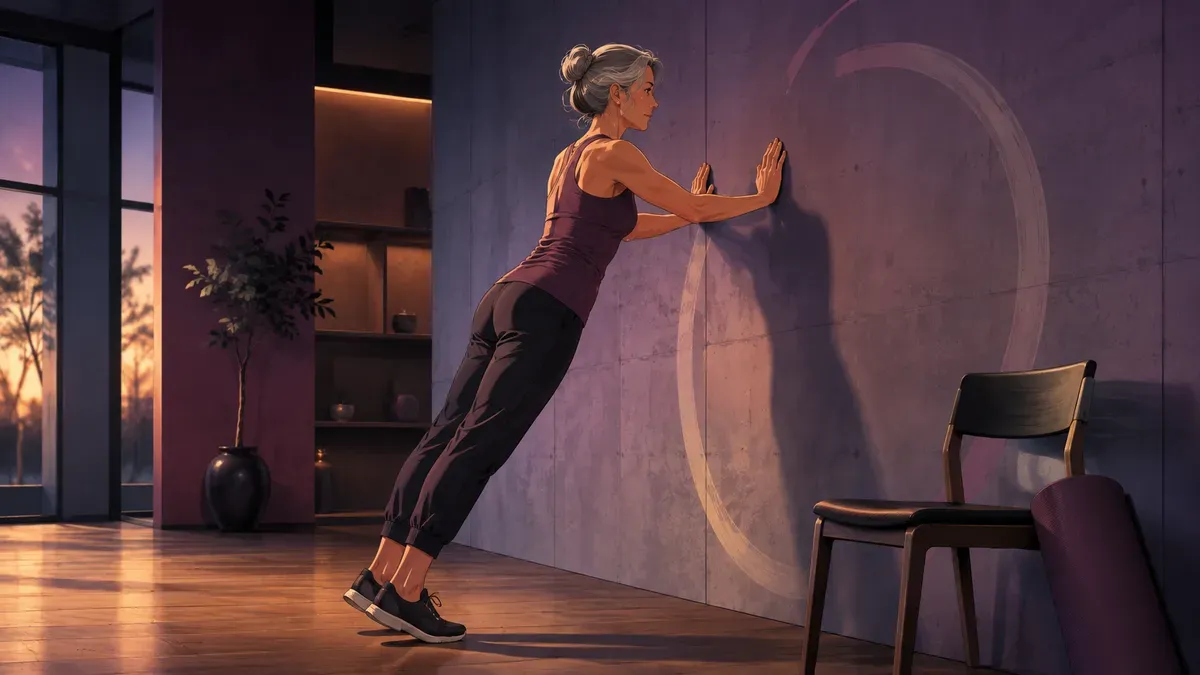
- Wall push-up — 6 to 10 repetitions: hands below shoulder height, body moving as one controlled line.
- Shallow wall squat — 6 to 8 repetitions: hips move back only as far as knees and balance tolerate.
- Standing hip extension — 6 to 8 per side: hold support, move the leg without arching the back.
- Wall-supported calf raise — 8 to 12 repetitions: rise and lower slowly without rolling the ankles.
- Hip hinge to wall — 6 to 8 repetitions: send the hips back while keeping a long spine.
- Easy walk and breathing reset — 2 minutes: let heart rate and breathing return gradually.
Repeat the routine two or three times per week before making it harder. Increase only one feature at a time: add two repetitions, a slightly larger range, a slower lowering phase, or less hand support. Do not increase all four at once. U.S. physical-activity guidance recommends that inactive adults “start low and go slow,” while the WHO guidelines emphasize regular aerobic, strengthening, and—in older adults—multicomponent balance activity. Wall Pilates can contribute to those goals, but one short routine does not cover the whole week.
Make the wall setup genuinely safer
Before the first repetition:
- check that the wall is dry, clean, and free of unstable mirrors, frames, heaters, or sharp edges;
- test whether socks, shoes, the mat, and the wall create too much or too little friction;
- keep enough clear floor space for a missed step;
- use a stable chair or counter rather than a movable stool;
- position the screen at eye level so you are not twisting to copy the instructor;
- choose a camera angle that lets you pause and inspect the movement instead of racing the video;
- keep a phone accessible if you exercise alone and have a relevant medical history.
The wall is feedback, not a spotter. If a movement would be unsafe without catching your full body weight on the wall, choose a simpler exercise.
Where SuperAge fits
The most useful signal is not whether you completed a viral challenge. It is whether your capacity improves without a worsening symptom pattern.
SuperAge can help you view movement, resting heart rate, sleep, and recovery trends in one place. Use those trends to support sensible decisions: repeat a tolerable dose, allow recovery when fatigue accumulates, and build a balanced routine over time. A favorable wearable trend cannot clear chest pain, neurological symptoms, a fracture, or a complicated pregnancy. Symptoms and professional advice override the dashboard.
For healthy aging, combine Pilates-style control with walking or other aerobic work, progressive strength for all major muscle groups, and specific balance practice. That broader mix aligns better with public-health guidance than relying on a single branded routine.
Frequently asked questions
Who should avoid wall Pilates?
People with urgent warning signs should avoid exercise and seek medical assessment. Those with recent surgery or fracture, unstable medical conditions, pregnancy complications, vertebral fractures, recurrent dizziness, or worsening neurological symptoms need individualized clearance. Many stable conditions require modifications rather than permanent avoidance.
Is wall Pilates safe for seniors?
It can be, provided the exercises match current strength, balance, bone health, and floor-transfer ability. The wall may offer feedback, but it is not always stable support. Older adults often benefit from a sturdy chair, shallow ranges, standing alternatives, gradual progression, and a program that also trains leg strength and real-world balance.
Is wall Pilates safe with osteoporosis?
Movement and resistance exercise are generally encouraged with osteoporosis. If you have a vertebral fracture or high fracture risk, repeated deep spinal rounding—such as forceful roll-downs or curl-ups—may need to be replaced with hip-hinge, neutral-spine, and extension-focused work. Ask a physiotherapist for personalized spine-sparing technique.
Can I do wall Pilates with lower-back pain?
Pilates may help some people with chronic nonspecific low-back pain, but the correct program depends on the cause and symptom behavior. Stop and seek prompt assessment for new weakness, numbness in both legs, saddle numbness, bladder or bowel changes, trauma, fever, or rapidly worsening pain.
Is wall Pilates safe during pregnancy?
In an uncomplicated pregnancy, activity is usually encouraged, with adjustments for balance, heat, intensity, and prolonged supine positions. Stop and contact your obstetric care team for bleeding, fluid leakage, painful contractions, chest pain, dizziness, breathlessness before exertion, or calf pain and swelling. Complicated pregnancies need individualized advice.
Why do my knees hurt during wall squats?
A deep knee angle, long hold, fatigue, foot position, or current joint irritability may exceed your tolerance. Shorten the range, use a controlled chair sit-to-stand, and reduce duration. Stop if pain is sharp, swelling develops, the knee gives way, or symptoms worsen from set to set.
How often should a beginner do wall Pilates?
Two or three short sessions per week is a reasonable starting pattern for many healthy beginners. Leave enough recovery to return near baseline, keep the first sessions easy, and increase one variable at a time. Your full week should still include aerobic activity and strength work that progressively challenges all major muscle groups.
Key takeaways
- Wall Pilates is a flexible exercise label, not a standardized clinical protocol.
- New chest, breathing, fainting, neurological, fracture, or severe pain symptoms are reasons to stop and seek care—not to search for a gentler video.
- Osteoporosis, pregnancy, chronic pain, and stable cardiovascular conditions often call for specific modifications rather than blanket inactivity.
- The wall changes leverage and feedback but does not remove knee load, spinal load, balance demands, or the challenge of floor transfers.
- Start with controlled standing movements, conversational effort, and one progression variable at a time.
- Judge success by improved function and stable symptoms, not by completing a fixed challenge.
Build a routine your body can repeat
Choose the version that leaves you capable of normal activity afterward and the next day. A modest routine performed consistently is more useful than a dramatic session you cannot recover from. If your health history makes the choice unclear, take the exact exercise list to a physiotherapist or clinician and ask what to keep, modify, or replace.
References
- World Health Organization. WHO guidelines on physical activity and sedentary behaviour. 2020.
- U.S. Department of Health and Human Services. Physical Activity Guidelines for Americans, 2nd edition. 2018.
- Owen PJ, et al. Benefits and harms of exercise therapy and physical activity for low back pain: an umbrella review. British Journal of Sports Medicine. 2025.
- Wells C, et al. Indications, benefits, and risks of Pilates exercise for people with chronic low back pain. Physical Therapy. 2014.
- Campos Junior JF, et al. Effects of Pilates exercises on postural balance and reduced risk of falls in older adults. Complementary Therapies in Clinical Practice. 2024.
- Giangregorio LM, et al. Too Fit To Fracture: exercise recommendations for individuals with osteoporosis or osteoporotic vertebral fracture. Osteoporosis International. 2014.
- Brooke-Wavell K, et al. Strong, steady and straight: UK consensus statement on physical activity and exercise for osteoporosis. British Journal of Sports Medicine. 2022.
- Fernandez-Rodriguez R, et al. The effects of Pilates on health-related outcomes in individuals with increased risk of fracture. Clinical Rehabilitation. 2022.
- American College of Obstetricians and Gynecologists. Physical activity and exercise during pregnancy and the postpartum period. 2020.
- Gonzalez-Devesa D, et al. The efficacy of Pilates method in patients with hypertension. Journal of Human Hypertension. 2024.
- American Heart Association. Develop a physical activity plan for you. Reviewed 2024.
- NHS. Back pain. Reviewed 2026.
Related Articles
Ski fitness exercises: a progressive preseason routine
Build ski fitness with a progressive strength, balance, and cardio routine. Learn exercise doses, recovery checks, and how to prepare before the first snow day.