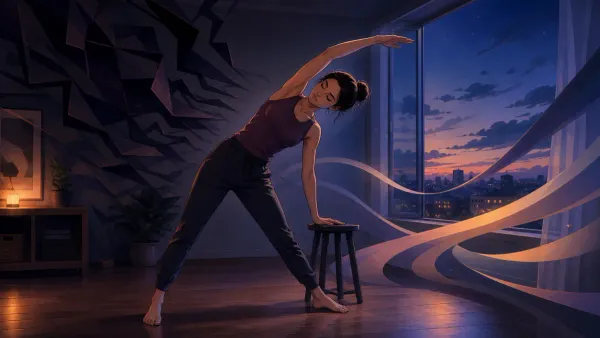
Postural exercises: benefits, limits, and a practical routine
Postural exercises build strength, mobility, and movement awareness. Learn what evidence supports, what posture cannot explain, and a safe 15-minute routine.
Quick answer
Postural exercises are controlled movements that develop mobility, strength, endurance, balance, breathing coordination, and awareness of how you organize your body. They can improve a specific alignment problem in some people and make everyday positions or movements feel easier. They do not permanently lock the body into one “correct” posture, and a slouched photo cannot diagnose the cause of pain.
A useful program trains options rather than perfection. It helps you move comfortably between upright, relaxed, reaching, bending, carrying, and resting positions. Begin with the 15-minute routine below two or three times per week, change position regularly during sedentary work, and progress only when the movements remain controlled and tolerable.
Key facts
- Postural exercise develops movement options.
- Strength training can change some spinal alignment measures.
- Static posture alone does not establish the cause of pain.
- Active breaks reduce uninterrupted exposure to one position.
- Consistent practice improves capacity more reliably than forced correction.
This guide is for general education and exercise, not diagnosis or individualized rehabilitation. Persistent pain, a known spinal condition, recent surgery, pregnancy-related symptoms, significant osteoporosis, or neurological symptoms deserve advice from an appropriately qualified clinician before you copy a generic routine.
What are postural exercises?
“Postural exercise” is an umbrella term rather than one standardized method. A class may include gentle mobility, stretching, trunk and shoulder endurance, balance, breathing, and slow task practice. A rehabilitation program may use some of the same movements but select and dose them for a diagnosed problem.
The common aim is not simply to look straighter. It is to improve the relationship between several capacities:
- Mobility: can the joints access the range needed for the task?
- Strength and endurance: can muscles support and repeatedly control that range?
- Motor control: can the nervous system coordinate the movement at the required speed and load?
- Balance: can you keep or recover stability as the base of support changes?
- Breathing: can you create useful trunk tension without holding your breath unnecessarily?
- Awareness: can you notice discomfort, fatigue, and unnecessary effort early enough to adjust?
That is why a complete postural session looks broader than a list of stretches. Our guide to flexibility versus mobility explains the distinction: range of motion is useful, but usable control inside that range matters too.
Can exercise “fix” bad posture?
Exercise can change measurable alignment in selected groups, but “fixing bad posture” promises more than the evidence can support.
A 2024 systematic review of 23 controlled studies found that chronic strengthening improved several spinal and lumbopelvic posture measures overall, with clearer effects in the cervical and thoracic regions. Stretching by itself did not produce a significant posture change. The studies varied, however, and an alignment change is not automatically a pain or function improvement (Warneke et al., 2024). A separate review of 22 studies also concluded that targeted strengthening and stretching may improve specific postural deviations, while emphasizing that the exercise, dose, and body region must match the problem (Okazaki et al., 2024).
Pain is more complicated. An umbrella review covering 41 systematic reviews found no consensus that particular spinal postures, sitting, standing, bending, twisting, or other physical exposures independently cause low back pain. Associations appeared in parts of the literature, but causality was inconsistent, especially in prospective research (Swain et al., 2020). Research on head and neck posture likewise finds that some measurements correlate with pain or disability, while other commonly used angles do not clearly differ between people with and without neck pain (Mahmoud et al., 2023).
The practical conclusion is balanced:
- A specific posture can become uncomfortable when you hold it too long or lack capacity for it.
- A visible alignment difference may be relevant for one person and harmless for another.
- Changing alignment may be a useful goal when it improves comfort, confidence, or function.
- Pain should not be reduced to one photograph, one tight muscle, or one supposedly lazy habit.
Think “expand capacity and vary position,” not “freeze the body into perfect symmetry.”
What benefits are realistic?
The outcome depends on who is training, what they practice, and what problem they are trying to solve.
| Goal | What the evidence supports | Important limit |
|---|---|---|
| Change a measured alignment | Targeted strengthening can improve some cervical, thoracic, shoulder, and hyperkyphosis measures | A changed angle does not guarantee less pain |
| Reduce chronic low back pain | Structured exercise can improve pain and function compared with minimal or no exercise | Effects vary, and no universal routine is best for everyone |
| Improve movement confidence | Repeated controlled practice can make bending, reaching, balancing, and carrying more tolerable | Confidence grows through progressive exposure, not constant bracing |
| Tolerate desk work better | Active breaks and postural shifts can reduce uninterrupted exposure and may help recurring discomfort | A perfect chair setup cannot replace movement, sleep, and total activity |
| Support healthy aging | Strength, mobility, and balance help preserve daily function | A short posture routine does not replace aerobic or full-body strength training |
Chronic back pain and function
Exercise is a legitimate part of care for chronic primary low back pain. The World Health Organization says a structured exercise therapy or program may be offered within holistic, person-centered care (WHO guideline, 2023). A Cochrane review of 249 trials found that exercise probably reduces pain compared with no treatment, usual care, or placebo, although the average pain improvement was small and study programs differed substantially (Hayden et al., 2021).
Motor-control, resistance, aerobic, mind-body, Pilates, and other programs can all help some people. Network analyses rank certain methods differently, but adherence and individual suitability matter more than declaring one brand of movement universally corrective. If back symptoms are your main concern, use exercise as graded capacity building rather than a test of whether your spine can stay perfectly still.
Neck, shoulders, and upper-back alignment
Targeted exercise may improve forward-head, rounded-shoulder, or thoracic alignment measures, especially when it combines strengthening with mobility rather than stretching alone. The certainty and clinical meaning remain variable. A more upright measurement is useful only if it accompanies a result you value—less fatigue, easier overhead reach, better control, or greater tolerance for work and recreation.
Older adults with hyperkyphosis
In a randomized trial of 99 adults aged 60 and older with hyperkyphosis, a six-month spine-strengthening and posture-training program reduced measured kyphosis compared with the control group. It did not significantly change every physical-function or quality-of-life outcome (Katzman et al., 2017). That is a good example of why a specific alignment program may work for a defined condition without proving that every older adult needs postural correction.
For a broader functional picture, combine posture work with balance training after 50 and periodic at-home mobility screening.
Postural exercise, Pilates, stretching, and strength training
These methods overlap, but their organizing goals differ.
| Method | Primary emphasis | Typical tools | What it may miss alone |
|---|---|---|---|
| Postural exercise | Alignment awareness, movement control, local mobility and endurance | Floor, wall, chair, light resistance | Higher-load strength and aerobic fitness |
| Pilates | Coordinated trunk control, breathing, precision, whole-body sequences | Mat or specialized apparatus | Progressive heavy loading and aerobic volume |
| Stretching | Increasing or maintaining range of motion | Body weight, strap, support | Strength and control in the new range |
| Strength training | Producing and resisting force with progressive overload | Body weight, bands, weights, machines | Task-specific awareness if technique is ignored |
You do not have to choose only one. Postural work can be the low-load skill portion of a larger program, Pilates can provide structured mind-body practice, and progressive resistance can build the capacity that makes daily posture less demanding. See yoga versus Pilates for a practical comparison and our core strength progression guide for loadable trunk work. If a wall-based routine is your starting point, the wall Pilates safety guide separates urgent stop signs from conditions that usually call for a modification.
If you prefer one session that combines controlled trunk work with yoga-inspired mobility, the 30-minute Piloga routine provides a gradual floor-to-standing sequence without treating posture as a rigid ideal.
If your goal is specifically lumbar-extensor capacity, the lower back exercise guide provides a separate progression from bird dog and hip hinge practice to supported extension and external load.
A 15-minute beginner postural routine
This routine is a general starting point, not a treatment protocol. Move slowly enough to notice control, but do not chase a rigid pose. Use a wall or stable chair for support. One round takes about 15 minutes.
1. Supine breathing and pressure scan — 90 seconds
Lie on your back with knees bent and feet on the floor. Let the back of your head, rib cage, pelvis, and feet feel supported without pressing them flat. Breathe in quietly through the nose, then exhale slowly while the ribs settle. Complete five to eight breaths.
- Purpose: notice unnecessary tension and coordinate breathing with gentle trunk support.
- Avoid: forcing the lower back flat, lifting the chest, or taking breaths so large that you become dizzy.
For a more specific breath-led abdominal-control drill, the stomach vacuum technique guide explains hollowing, bracing, and safety limits.
2. Cat-camel spinal motion — 6 to 8 cycles
Begin on hands and knees. Slowly round the spine within a comfortable range, then reverse toward a gentle arch. Let the head follow the trunk rather than throwing the neck backward.
- Purpose: explore spinal movement rather than holding one ideal curve.
- Regress: place the hands on a table and perform a smaller standing version.
- Stop: if the motion produces sharp, radiating, or rapidly increasing symptoms.
3. Wall slide with reach — 6 to 10 repetitions
Stand with your back near a wall and feet about 6–10 in (15–25 cm) forward. Keep the ribs comfortable rather than pinned down. Slide the forearms upward only as far as the shoulders move without shrugging or pain, then reach slightly away from the wall before returning.
- Purpose: combine thoracic position, shoulder-blade motion, and overhead control.
- Regress: perform one arm at a time or shorten the range.
- Progress: add a light resistance band around the wrists only after the unresisted version is easy.
4. Bird dog — 5 to 8 repetitions per side
From hands and knees, slide one leg back and reach the opposite arm forward. Pause for one breath, return, and alternate sides. The goal is not to keep the trunk motionless at all costs; it is to limit wobble enough that the limb movement remains deliberate.
- Purpose: integrate cross-body coordination and trunk endurance.
- Regress: move only one arm or one leg.
- Progress: lengthen the pause before adding load.
5. Sit-to-stand with overhead finish — 8 to 12 repetitions
Sit near the front of a stable chair. Place the feet where you can stand without momentum, lean the whole trunk slightly forward, and rise. At the top, reach the arms upward only as far as comfortable. Sit back with control.
- Purpose: connect leg strength, trunk control, and upright reach to a daily task.
- Regress: use a higher seat or light hand support.
- Progress: slow the lowering phase to three seconds or hold a light weight close to the chest.
6. Supported tandem balance — 20 to 30 seconds per side
Stand beside a wall or sturdy chair. Place one foot slightly in front of the other, narrow the gap only as balance allows, and look forward. Keep a fingertip close to support. Switch the leading foot.
- Purpose: train postural control as an active balance task.
- Regress: widen the feet.
- Progress: use less hand support or turn the head slowly while keeping the eyes open.
Finish with a two-minute easy walk. Notice whether you feel more comfortable and ready to move—not whether every body part appears perfectly aligned.
How often and how should you progress?
Start with one round two or three days per week. On other days, use one or two movements as a brief reset, but avoid turning them into a constant posture-monitoring ritual. Strength and skill change through repeated exposure plus recovery.
Progress one variable at a time:
- Add two repetitions or five seconds.
- Increase range only while the motion stays comfortable.
- Reduce external support.
- Use a longer lever or a small resistance.
- Integrate the skill into a harder task such as carrying, rowing, squatting, or reaching.
Record one functional outcome every two to four weeks: time you can work before discomfort, ease of looking over a shoulder, confidence carrying groceries, repeated chair stands, or balance duration. A mirror angle can be secondary; it should not be the only definition of success.
Desk posture: change the exposure, not just the chair
Long periods in one position can become uncomfortable even when the position looks textbook-perfect. Adjust the workstation so the screen, keyboard, and chair do not force sustained strain, then build variation into the day.
- Alternate supported sitting, relaxed sitting, standing, and walking.
- Take a brief active break or change position before discomfort becomes intense.
- Keep frequently used objects within an easy reach, but reach farther on purpose when it is safe.
- Pair a routine cue—finishing a call, refilling water, or sending a document—with 30–120 seconds of movement.
- Use sedentary-time guidance to manage the whole day rather than treating one exercise as an antidote to eight motionless hours.
A cluster-randomized trial in high-risk office workers found that active-break and postural-shift interventions shortened recovery and reduced recurrence of neck and low back pain over 12 months compared with a placebo seat pad (Waongenngarm et al., 2021). One trial does not define the perfect break schedule, but it supports a practical principle: vary the load instead of policing one frozen position.
Posture, activity, and healthy aging
Postural capacity matters because it supports tasks that keep life active: looking around while walking, recovering balance, reaching a shelf, carrying a bag, getting up from a chair, and breathing under load. Those abilities are more meaningful than appearing symmetrical in a still image.
Postural exercise is only one slice of a complete week. Adults should also accumulate aerobic activity and train the major muscle groups. The WHO recommends 150–300 minutes of moderate aerobic activity or 75–150 minutes of vigorous activity per week, plus muscle-strengthening work on at least two days (WHO physical activity guideline). Use the complete exercise and longevity guide to place mobility, balance, strength, and conditioning in one sustainable plan.
Use SuperAge to follow function, not a posture score
No wearable can diagnose “good posture” from general health data, and a biological-age estimate should not reward you for sitting rigidly. What matters is whether a movement practice fits a repeatable pattern of activity, sleep, recovery, and functional progress.
If you train with Apple Health or Apple Watch, use SuperAge to review longer-term activity and recovery trends around your exercise routine. Pair those trends with a simple functional note such as less stiffness after work or steadier balance. The app does not diagnose a spinal condition, identify the cause of pain, or replace a physiotherapy assessment.
Download SuperAge on the App Store when you want to view posture-friendly movement as part of your broader healthy-aging routine rather than as a cosmetic correction project.
When to get professional help
Ask a physiotherapist, physician, or other appropriately qualified professional for an assessment when pain persists, repeatedly limits sleep or normal activity, follows a significant injury, or worsens despite reducing the exercise dose. A clinician can distinguish general exercise needs from a condition requiring specific management.
Stop the routine and seek urgent medical care for new bladder or bowel control changes, numbness around the groin or saddle area, new or progressive weakness, loss of coordination, symptoms in both legs, chest pain, fainting, or severe unexplained shortness of breath. The NHS lists bilateral leg symptoms and bladder or bowel changes among emergency warning signs associated with back pain (NHS back pain guidance).
Frequently asked questions
What is the best postural exercise?
There is no single best exercise. Choose the movement that matches the limiting capacity: mobility for a restricted range, strength or endurance for a demanding position, balance for stability, and task practice for coordination. A professional assessment is useful when symptoms or a diagnosed condition shape that choice.
How long does it take for postural exercises to work?
You may feel a short-term change in comfort or awareness after one session, but lasting strength, endurance, skill, or alignment changes usually require consistent practice over weeks. Judge progress by function and tolerance as well as appearance.
Can postural exercises cure back pain?
They can be one helpful form of structured exercise for some people with non-specific back pain, but they are not a universal cure. Back pain can reflect biological, psychological, social, workload, sleep, and health factors. New, severe, or persistent symptoms need appropriate assessment.
Is there one correct sitting posture?
No single sitting posture is comfortable or necessary for every person and every moment. Use a reasonably supportive setup, then vary position and take movement breaks. If one position consistently reproduces symptoms, modify it and seek guidance if the problem persists.
Are postural exercises the same as Pilates?
No. They overlap in breathing, trunk control, precision, and awareness, but Pilates is a defined movement method with structured sequences and, sometimes, specialized apparatus. Postural exercise is a broader label that may include mobility, balance, and rehabilitation-style drills.
Should postural exercises hurt?
They may create mild muscular effort or a tolerable stretch, but sharp pain, radiating symptoms, increasing numbness, weakness, dizziness, or loss of control is a reason to stop. Reduce range or difficulty rather than forcing the target position.
Can older adults do postural exercises?
Yes, with an appropriate starting level and stable support. Older adults may especially value the combination of spinal strength, mobility, chair-rise practice, and balance. Known osteoporosis, previous fractures, marked hyperkyphosis, falls, or neurological symptoms call for individualized guidance.
Do posture braces replace exercise?
No. A brace may have a specific clinical role, but it does not build strength, balance, movement skill, or general fitness. Do not use a commercial posture device as a substitute for diagnosis or a progressive exercise plan.
Key takeaways
- Postural exercise is a blend of mobility, strength, endurance, balance, breathing, and motor control.
- Exercise can change some alignment measures, especially when it is targeted, but alignment alone does not determine pain.
- A good program creates more comfortable movement options instead of enforcing one rigid “perfect” posture.
- Practice the 15-minute routine two or three times per week and vary sedentary positions during the day.
- Track functional changes, then integrate posture work with aerobic, balance, and progressive strength training.
- Seek individualized or urgent care when symptoms are persistent, progressive, neurological, or otherwise concerning.
References
- Swain CTV, et al. No consensus on causality of spine postures or physical exposure and low back pain: a systematic review of systematic reviews. Journal of Biomechanics. 2020.
- Warneke K, Lohmann LH, Wilke J. Effects of stretching or strengthening exercise on spinal and lumbopelvic posture. Sports Medicine - Open. 2024.
- Okazaki VHA, et al. The effect of exercise on postural alignment: a systematic review. Journal of Bodywork and Movement Therapies. 2024.
- Mahmoud NF, et al. Is neck pain related to sagittal head and neck posture?. Indian Journal of Orthopaedics. 2023.
- Hayden JA, et al. Exercise therapy for chronic low back pain. Cochrane Database of Systematic Reviews. 2021.
- World Health Organization. Guideline for non-surgical management of chronic primary low back pain. 2023.
- Katzman WB, et al. Targeted spine strengthening exercise and posture training to reduce hyperkyphosis. Osteoporosis International. 2017.
- Waongenngarm P, et al. Active break and postural shift interventions in office workers. Musculoskeletal Science and Practice. 2021.
- World Health Organization. Guidelines on physical activity and sedentary behaviour. 2020.
- NHS. Back pain: symptoms, self-care, and emergency advice. Reviewed 2026.
Related Articles
Piloga workout: how to combine Pilates and yoga safely
A Piloga workout combines Pilates control with yoga mobility and breathing. Learn a safe 30-minute routine, progressions, benefits, and limits at home.