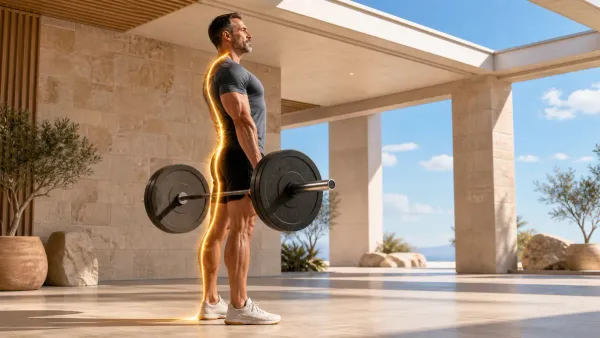
Lower back exercises: strength, technique, and progression
Learn lower back exercises with clear technique, safe progressions, a two-day strength plan, and evidence-based limits for stronger lumbar muscles.
Quick answer
Lower back exercises train the lumbar extensors and the wider trunk to create or resist movement while the hips and limbs produce force. A practical beginner sequence is bird dog, wall hip hinge, glute bridge, and a supported back extension. Perform two controlled sets of each once or twice per week, stop before position or breathing breaks down, and progress only one variable at a time.
The goal is not to keep the spine rigid all day or to chase a burning sensation. It is to build repeatable capacity through an appropriate range. Lower back strength can improve with training, but no single exercise guarantees perfect posture, prevents every injury, or treats every cause of back pain.
Key facts
- Lumbar extensors resist trunk flexion and produce controlled spinal extension.
- Hip hinges distribute load through the hips while the trunk maintains a repeatable shape.
- Progressive resistance develops strength when exercise difficulty increases gradually.
- Pain changes exercise selection and requires a different decision process from healthy training.
- Whole-body training provides benefits that isolated lower back work cannot replace.
This guide is for generally healthy adults learning strength exercises. It is not a diagnosis or a rehabilitation plan for current back pain, radiating symptoms, recent trauma, surgery, osteoporosis-related restrictions, or neurological problems.
What muscles do lower back exercises train?
The lower back is a region, not one muscle. The erector spinae run along the spine and help extend the trunk or prevent it from folding under load. The deeper multifidus muscles contribute to segment-by-segment control. Smaller spinal muscles, the quadratus lumborum, abdominal wall, diaphragm, pelvic floor, glutes, and hip muscles all change their contribution according to posture, breathing, load, and movement direction.
That shared work explains why a deadlift is not simply a “lower back exercise.” The hips and knees create much of the movement, while the trunk usually works hard to transmit force and limit unwanted change. A back-extension exercise places more direct demand on the spinal extensors. A bird dog uses a much lighter load but challenges the trunk to stay controlled while opposite limbs move.
The most useful program therefore combines three jobs:
| Training job | What happens | Beginner example | Later option |
|---|---|---|---|
| Resist flexion | The trunk holds its shape against gravity or load | Bird dog | Loaded hip hinge |
| Produce extension | The trunk rises through a controlled range | Supported prone lift | 45-degree back extension |
| Transfer force | Hips and limbs move while the trunk stays organized | Glute bridge | Deadlift or loaded carry |
For a broader routine covering anti-extension, lateral stability, rotation, and posterior control, use the core strength training guide as the primary companion to this more specific lumbar program.
What lower back strengthening can and cannot do
Strength training follows a specific principle: the capacity that adapts most is the capacity you repeatedly challenge. Practicing controlled trunk extension can improve trunk-extension strength. Practicing hinges can improve your ability to organize the trunk while the hips move. These are useful outcomes, but they do not automatically transfer to every sport, lift, work task, or pain condition.
In a randomized trial of 64 adults aged 60 and older, a 12-week program that added trunk strengthening and motor-control work to walking and balance training increased lumbar multifidus size, trunk strength, and several functional-test outcomes compared with walking and balance alone (Shahtahmassebi et al., 2019). Because the intervention included several exercises, it does not identify one best lower back movement.
A small study in healthy adults found that six weeks of isolated lumbar-extension training increased strength with both heavier and lighter loads. The lighter-load group performed more repetitions, trained longer, and reported more discomfort, while strength changes did not differ clearly between groups (Fisher et al., 2018). That finding supports flexibility in loading; it is not a reason for beginners to train to failure.
Recent evidence also illustrates how whole-body lifts can train the trunk. In a 2026 randomized trial of 32 older women, a supervised hexagonal-bar deadlift program performed twice weekly for 24 weeks improved trunk-extensor torque and several functional measures compared with a control group, with no reported adverse events (Tsai et al., 2026). The sample was small and closely supervised, so the result does not make that lift necessary or appropriate for everyone.
What should you not promise from lower back exercises?
- They cannot spot-reduce fat around the waist.
- They do not permanently “correct” one ideal posture.
- More muscle activation in a laboratory does not prove better long-term results.
- Strong extensors do not make poor fatigue management, rushed technique, or excessive loading irrelevant.
- A healthy-adult strength plan is not interchangeable with treatment for persistent pain.
First learn the difference between hip and spine motion
The spine can flex and extend; those movements are not automatically harmful. The training question is whether the range, speed, load, and fatigue match your current capacity and the purpose of the exercise.
In a hip hinge, most visible motion comes from the hips. Stand tall, soften the knees, move the hips backward, and let the torso incline as one coordinated unit. The lower back does not need to be perfectly flat, but its shape should remain deliberate and repeatable. If the pelvis stops moving and you keep reaching by rounding farther, the exercise has changed.
In a back extension, controlled spinal movement may be part of the task. The aim is not to throw the chest upward or force the body beyond a comfortable straight line. Move slowly enough to know where the motion occurs, keep the hips supported, and finish each repetition before momentum or pinching replaces muscular effort.
The postural exercises guide can help if you first need lower-load awareness of rib-cage, pelvis, hip, and shoulder movement. Posture practice and strength training overlap, but neither requires holding one position all day.
A readiness check before adding load
Use these checks with the easiest version of an exercise:
- Symptoms: you can begin without sharp, radiating, or escalating pain.
- Breathing: you can take three steady breaths without losing the position.
- Control: you can complete five slow repetitions without a sudden shift or bounce.
- Range: you can stop at the planned point instead of falling into the end position.
- Recovery: ordinary muscular fatigue settles as expected and does not change your walking or daily movement the next day.
Passing this checklist does not guarantee that a harder version is safe. It shows that the current version is controlled enough to practice. When uncertain, reduce range, external load, lever length, or set duration before adding another exercise.
Seven lower back exercises with clear progressions
You do not need all seven in one session. Choose two or three that match your equipment and training history, then pair them with full-body pushing, pulling, squatting, carrying, and aerobic work.
1. Bird dog for low-load trunk control
Begin on hands and knees. Reach one leg behind you and the opposite arm forward while keeping the pelvis and rib cage from rotating. Pause for one or two seconds, breathe out, and return slowly.
- Start: 2 sets of 5–8 repetitions per side.
- Regress: move only one limb or slide the foot along the floor.
- Progress: lengthen the pause or draw a small square with the hand and foot.
- Stop the set: when reaching higher makes the lower back sag or rotate.
The bird dog is a coordination exercise before it is a maximal-strength exercise. Its value is repeatable cross-body control, not how far the hand and foot travel.
2. Wall hip hinge for movement skill
Stand about 6–10 inches (15–25 cm) in front of a wall with your back to it. Keep the whole foot on the floor, soften the knees, and push the hips backward until they touch the wall. Return by driving the floor away and bringing the hips forward.
- Start: 2 sets of 8 slow repetitions.
- Regress: stand closer to the wall.
- Progress: step slightly farther away or hold a light weight against the chest.
- Avoid: turning the movement into a squat or reaching the wall by rounding farther.
This drill teaches the pattern used in loaded hinges. It should feel simple before weight is added.
If your routine also includes wall squats, push-ups, bridges, or roll-downs, use the wall Pilates contraindications and modifications guide to distinguish a manageable exercise adjustment from a symptom that needs assessment.
3. Glute bridge for posterior-chain coordination
Lie on your back with knees bent and feet planted. Exhale gently, press through the feet, and lift the pelvis until the hips are extended without forcing the ribs upward. Pause, then lower under control.
- Start: 2 sets of 8–12 repetitions.
- Regress: use a smaller range.
- Progress: add a longer pause, marching steps, or a small external load.
- Adjust: move the feet until the hamstrings and glutes can share the work without cramping.
The glutes create most of the hip extension. The trunk supports force transfer, which makes the bridge a useful entry exercise rather than an isolated lumbar lift.
For direct posterior-thigh work across both hip extension and knee flexion, use the hamstring exercise progression.
4. Supported prone trunk lift for gentle extension
Lie face down with the forehead supported on a folded towel and arms beside the body. Gently lengthen through the crown of the head and lift the upper chest a small distance without throwing the chin upward. Pause briefly and lower slowly.
- Start: 2 sets of 5–8 repetitions with a small range.
- Regress: create tension without visibly lifting the chest.
- Progress: lengthen the pause or move the hands toward the temples.
- Avoid: chasing height, holding the breath, or continuing through a pinching sensation.
This option is not mandatory. Skip it if lying prone is uncomfortable, and use a bird dog or supported machine variation instead.
5. Romanian deadlift for loaded hip-hinge strength
Hold light dumbbells close to the thighs. Soften the knees, move the hips backward, and lower only as far as the weights remain close and the trunk position stays controlled. Stand by pressing through the feet and extending the hips.
- Start: 2 sets of 6–10 repetitions with a load that leaves several clean repetitions available.
- Regress: return to the wall hinge or shorten the range.
- Progress: add a small amount of load after two repeatable sessions.
- Avoid: lowering to a predetermined depth when hamstring range or trunk control ends earlier.
If lifting from the floor is your goal, the deadlift form guide explains setup, bracing, bar path, and progression in more detail.
6. Supported back extension for direct extensor work
On a 45-degree bench, place the pad below the front of the pelvis so the hips can move. Begin in a straight, comfortable position, hinge down under control, then return until the torso and legs form one line. Some programs use more spinal movement; beginners can first learn the hip-dominant version.
- Start: 2 sets of 6–10 bodyweight repetitions.
- Regress: shorten the range or use a machine with a stable setup.
- Progress: add repetitions, then hold a light weight close to the chest.
- Avoid: rising beyond a comfortable straight line or bouncing from the bottom.
Equipment varies. Adjust the pad and foot support before the set rather than improvising while loaded.
7. Suitcase carry for upright force transfer
Hold one dumbbell or kettlebell at your side and walk slowly without leaning toward or away from the weight. Keep breathing and let the opposite arm swing naturally if space permits.
- Start: 2 carries of 30–60 feet (10–20 m) per side.
- Regress: use less weight or a shorter distance.
- Progress: add a small amount of weight or controlled marching steps.
- Avoid: rushing, shrugging continuously, or treating grip failure as a trunk-training target.
Carries train the lower back as part of a whole-body system. They complement direct extension instead of duplicating it.
A two-day beginner lower back plan
Train on nonconsecutive days. Warm up with several minutes of comfortable walking or cycling and one easy practice set of each movement. Rest about 45–90 seconds between sets, longer when breathing or grip needs it.
| Day A | Dose | Day B | Dose |
|---|---|---|---|
| Bird dog | 2 × 6 per side | Wall hip hinge | 2 × 8 |
| Glute bridge | 2 × 10 | Supported prone lift or back extension | 2 × 6–8 |
| Romanian deadlift | 2 × 8 | Suitcase carry | 2 × 30–60 ft (10–20 m) per side |
If you already deadlift, squat, row, and carry during full-body training, you may need only one direct lower back movement. The 2026 American College of Sports Medicine position stand synthesized 137 systematic reviews and emphasizes that resistance-training consistency matters more than unnecessary complexity for most healthy adults. Load and volume should match the goal, while bodyweight, bands, machines, and free weights can all be effective (ACSM, 2026).
This plan does not replace the wider recommendation to train all major muscle groups. The World Health Organization recommends muscle-strengthening activity involving major muscle groups on at least two days per week for adults, alongside aerobic activity (WHO, 2020). The exercise and longevity guide shows how to combine both rather than building a week around one body region.
How to progress for six weeks
Progress after two sessions in which every repetition stays controlled and recovery is ordinary.
| Weeks | Main goal | Progression rule |
|---|---|---|
| 1–2 | Learn position, range, and breathing | Use the easiest version and leave 3–4 repetitions available |
| 3–4 | Build repeatable volume | Add 1–2 repetitions per set within the listed range |
| 5 | Increase one difficulty variable | Add a small load, longer lever, or slightly larger range |
| 6 | Consolidate | Repeat the new version without adding another variable |
Keep a simple log of exercise, version, sets, repetitions, load, range, symptoms, and next-day response. Add load only when it preserves the skill you are trying to strengthen. A heavier movement with less control is a different exercise, not automatic progress.
You do not need to train to momentary failure. Stop most beginner sets while two or three clean repetitions remain. Failure makes fatigue visible, but it is not required for every strength outcome and can make technical practice less repeatable.
If the program leaves the lower back unusually fatigued before sport or a major lift, reduce direct volume or move it later in the week. The strength-training frequency guide can help distribute work without increasing every variable at once.
Common mistakes
Treating the lower back as an isolated machine
The hips, abdomen, breathing muscles, and legs change the demand on the lumbar region. Train the pattern as well as the local muscles.
Confusing a large range with a useful range
More motion is not automatically more stimulus. Use the range you can control today and expand it for a reason.
Adding load before the hinge is repeatable
If every repetition follows a different path, more weight amplifies noise. Return to the wall hinge and make the setup predictable.
Training extension but ignoring flexion resistance
Back extensions can be useful, but hinges, carries, and bird dogs teach the extensors to resist changing shape while other joints move.
Chasing soreness
Novel exercises often create soreness, but soreness does not measure strength gain or session quality. Use the DOMS recovery guide to distinguish expected post-exercise tenderness from symptoms that deserve a different response.
Using exercise to self-test unexplained pain
Repeatedly loading a painful movement to see whether it “loosens up” is not a diagnosis. Change the exercise and seek appropriate assessment when symptoms persist, worsen, radiate, or follow trauma.
Lower back exercise and pain require different rules
Exercise can be part of care for chronic primary low back pain, but pain is influenced by physical, psychological, social, sleep, work, and health factors. The WHO guideline recommends person-centered, coordinated care and includes structured exercise among several possible interventions rather than naming one universal best exercise (WHO, 2023).
A 2025 meta-analysis of eight randomized trials found that isolated lumbar-extension training reduced pain compared with true control in adults with chronic nonspecific low back pain, but effects on disability and isometric strength were not statistically clear, and the certainty of evidence was rated very low (Trybulski et al., 2025). That uncertainty is exactly why a general strength article should not prescribe a pain-treatment dose.
Stop training and obtain prompt medical assessment for new leg weakness, spreading numbness, loss of coordination, numbness around the groin, new bladder or bowel changes, severe pain after significant trauma, back pain with fever, or unexplained systemic illness. Seek urgent care for chest pressure, fainting, severe unusual breathlessness, or sudden neurological symptoms.
Pregnancy, recent abdominal or spinal surgery, a known fracture, osteoporosis with exercise restrictions, cancer treatment, persistent pelvic-floor symptoms, or pain that repeatedly changes your gait calls for individualized guidance before progressing load.
Track strength without turning one metric into a diagnosis
Useful progress markers are concrete: the exercise version, controlled range, load, repetitions, breathing quality, and how normally you move the next day. A smoother set at the same load is progress. So is choosing a smaller range when fatigue would otherwise change technique.
SuperAge can place strength sessions beside Apple Health activity, sleep, resting heart rate, HRV, and longer-term fitness trends. Use those signals to notice patterns in training consistency and recovery, not to certify spinal health or diagnose pain.
Download SuperAge to review training and recovery trends in one private timeline while keeping exercise selection grounded in technique, symptoms, and professional guidance when needed.
Key takeaways
- Lower back exercises train lumbar extensors within a coordinated trunk, hip, and breathing system.
- Combine low-load control, a hip hinge, direct extension, and whole-body force transfer instead of relying on one movement.
- Begin with two controlled sets once or twice weekly and leave several clean repetitions available.
- Progress repetitions, load, range, or leverage one at a time after two repeatable sessions.
- Lower back strength can improve, but it does not guarantee injury prevention, ideal posture, or pain relief.
- Current or unexplained pain requires a different decision process from healthy-adult strength training.
- Direct lumbar work complements rather than replaces full-body resistance and aerobic exercise.
FAQ
What are the best lower back exercises for beginners?
Bird dogs, wall hip hinges, glute bridges, and a small-range supported back extension form a practical sequence. They teach control before adding significant external load. The best starting version is the one you can repeat while breathing normally and without sharp or radiating symptoms.
How often should I train my lower back?
Once or twice per week is enough for many beginners because squats, hinges, rows, carries, running, and daily lifting also load the trunk. Start with nonconsecutive days and adjust direct volume according to the rest of your program and recovery.
Should lower back exercises feel painful?
No. Muscular effort and fatigue are expected; sharp, electric, radiating, escalating, or gait-changing pain is not a target. Stop or modify the exercise, and seek assessment for persistent pain or neurological symptoms.
Are back extensions bad for the spine?
Back extensions are not universally bad or required. Their suitability depends on setup, range, load, speed, fatigue, symptoms, and training history. Begin with a controlled range, avoid bouncing beyond a comfortable straight line, and choose another movement if the exercise repeatedly provokes symptoms.
Do deadlifts strengthen the lower back?
Yes, the spinal extensors work to control the trunk during a deadlift, while the hips and knees produce much of the movement. Deadlifts are a whole-body hinge rather than an isolated lumbar exercise, so technique and load progression matter more than labeling them a back lift.
Is a bird dog enough to build lower back strength?
It is a useful low-load control exercise, especially early in a progression, but it may eventually be too light for continued maximal-strength gains. Progress its leverage or pause, then add an appropriate hinge, carry, or supported extension when control and goals justify it.
Can lower back exercises fix posture?
They can increase muscular capacity, but they do not lock the body into one ideal posture. Comfortable posture varies by person and task. Movement options, work setup, full-body strength, activity breaks, sleep, and symptom context all matter.
Can I do these exercises if I have chronic low back pain?
Exercise may be part of care, but this healthy-adult routine is not an individualized treatment plan. Chronic pain deserves exercise choices and doses matched to symptoms, preferences, health history, and goals, often with guidance from a qualified clinician.
References
- Currier BS, et al. American College of Sports Medicine position stand: resistance training prescription for muscle function, hypertrophy, and physical performance in healthy adults. Medicine & Science in Sports & Exercise. 2026. ACSM summary
- World Health Organization. WHO guidelines on physical activity and sedentary behaviour. 2020. WHO guideline
- Shahtahmassebi B, et al. Trunk exercise training improves muscle size, strength, and function in older adults: a randomized controlled trial. Scandinavian Journal of Medicine & Science in Sports. 2019. PubMed
- Fisher J, et al. Heavier- and lighter-load isolated lumbar extension resistance training produce similar strength increases, but different perceptual responses, in healthy males and females. PeerJ. 2018. PubMed
- Tsai SC, et al. Effects of free-weight resistance training based on hexagonal barbell deadlift in older women: a 24-week randomized controlled trial. Archives of Gerontology and Geriatrics. 2026. PubMed
- World Health Organization. WHO guideline for non-surgical management of chronic primary low back pain in adults in primary and community care settings. 2023. WHO guideline
- Trybulski R, et al. Impact of isolated lumbar extension strength training on reducing nonspecific low back pain, disability, and improving function: a systematic review and meta-analysis. Scientific Reports. 2025. PubMed
- George SZ, et al. Interventions for the management of acute and chronic low back pain: revision 2021. Journal of Orthopaedic & Sports Physical Therapy. 2021. PubMed
Related Articles

Core strength training: exercises, technique, and progression
Build core strength with safe exercise progressions, a two-day beginner plan, practical technique cues, and evidence-based guidance for durable results.