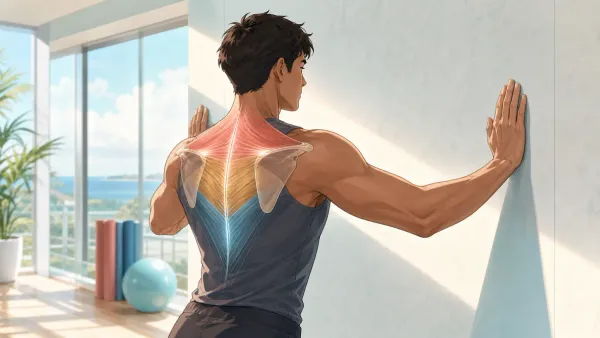
DOMS explained: muscle soreness, recovery, and when to train again
Learn what causes DOMS, how long muscle soreness lasts, which recovery methods help, and when pain means you should rest, modify training, or seek care.
Delayed-onset muscle soreness, or DOMS, is the tenderness and stiffness that develops after an unfamiliar or unusually demanding workout. It normally appears later rather than during the session, is often most noticeable one to three days afterward, and then improves.
DOMS can make stairs, sitting down, or lifting your arms feel surprisingly difficult. That does not automatically mean you are injured, but it also does not mean you should ignore every symptom and repeat the same workout at full load.
Quick answer
DOMS usually begins 12–24 hours after unfamiliar exercise and is often worst 24–72 hours later. Mild, symmetrical soreness that improves as you warm up can usually be managed with lighter movement and modified training. Sharp or focal pain, major swelling, worsening weakness, dark urine, or symptoms that do not improve need a different response.
There is no instant cure. Gentle activity, massage or foam rolling, and heat or cold may reduce how sore you feel, but the effects are usually modest and do not guarantee that strength and range of motion have fully recovered. The best prevention is gradual exposure to new exercises, volume, speed, and especially eccentric loading.
If soreness appeared after your first sessions back, use the 10-minute exercise restart plan to reduce the next dose and progress only after normal function returns.
Key facts
- Delayed-onset muscle soreness follows unfamiliar loading, especially active muscle lengthening.
- DOMS peaks after exercise because the repair and pain response develops over hours, not during the set.
- Lactate does not cause next-day muscle soreness.
- Repeated exposure reduces soreness through the repeated-bout effect.
- Pain relief does not prove that muscle function has fully recovered.
- Severe pain, dark urine, or unusual weakness requires urgent medical assessment.
What DOMS is—and what it is not
The American College of Sports Medicine describes DOMS as soreness caused by unaccustomed loading. The discomfort is different from the burning or fatigue you may feel during a hard interval or set because it emerges after the activity has ended.
A sudden, hard calf contraction that wakes you from sleep is also a different pattern. Use the night leg cramps guide for immediate relief, prevention, and vascular warning signs rather than labeling that brief spasm as DOMS.
Typical DOMS has a recognizable pattern:
- It affects muscles that did unfamiliar work.
- It feels diffuse across part or all of a muscle rather than pinpointed in one tiny spot.
- It is tender when the muscle is pressed, stretched, or contracted.
- It may temporarily reduce strength or comfortable range of motion.
- It gradually improves across several days.
DOMS is one symptom within the broader response called exercise-induced muscle damage. Scientists measure that response with soreness ratings, strength, range of motion, swelling, blood markers, and imaging. Those measurements do not always move together. A low soreness score does not guarantee normal force production, and a high blood creatine kinase value does not tell you exactly how much pain a person feels.
DOMS is not lactic acid trapped in the muscle
Lactate rises during demanding exercise and then clears relatively quickly. DOMS develops much later. The delayed pain reflects a cascade involving mechanical stress, changes within muscle and connective tissue, inflammation, swelling, sensitized nerve endings, and tissue remodeling.
Calling DOMS “lactic acid buildup” leads to weak recovery advice. You do not need to flush a substance that has been sitting in your muscles since yesterday. You need to manage a temporary response to unfamiliar load while watching for signs that the problem is not ordinary soreness.
If pain began suddenly during a twist, sprint, lift, or impact, use the PEACE and LOVE soft tissue injury guide to check warning signs and plan response-guided loading instead of treating the problem as DOMS.
Why eccentric exercise causes more soreness
An eccentric contraction occurs when an active muscle lengthens under tension. Examples include lowering a dumbbell, descending stairs, running downhill, landing from a jump, and braking your body as you sit into a squat.
Eccentric actions can produce high force at a relatively low energy cost. They are valuable for strength, tendons, deceleration, and daily function, but an unfamiliar dose often creates more soreness than familiar concentric work. Our guide to eccentric training after 40 explains how to introduce the lowering phase without turning every session into a recovery test.
A 2026 review of eccentric exercise and muscle damage emphasizes that soreness, blood markers, imaging, and force loss represent different parts of the response. Eccentric exercise is not inherently harmful. The problem is a large, novel dose that exceeds what the tissue is prepared to handle.
The repeated-bout effect protects you
When you repeat a similar exercise after recovering, the second bout usually causes less soreness and a smaller loss of function. This repeated-bout effect can persist for weeks. Neural coordination, connective-tissue remodeling, muscle architecture, and cellular adaptations may all contribute.
A 2023 systematic review and meta-analysis found that pre-conditioning bouts reduced later soreness, strength loss, range-of-motion loss, and creatine kinase responses. That does not justify deliberately causing extreme soreness. It supports the opposite strategy: use a tolerable first dose so the body can adapt before volume or intensity rises.
If landing is the unfamiliar eccentric load, use the plyometric exercise guide to progress from held landings to hops without raising jump volume abruptly.
The DOMS timeline
| Time after exercise | What ordinary DOMS may feel like | Best question to ask |
|---|---|---|
| During the workout | Fatigue, heat, or effort; delayed soreness has not started | Is any pain sharp, sudden, or changing technique? |
| 6–12 hours | Mild stiffness may begin | Was the session new or much harder than usual? |
| 12–24 hours | Tenderness becomes clearer | Is the discomfort diffuse and limited to the trained muscles? |
| 24–72 hours | Soreness may peak; strength and range can be temporarily lower | Is function improving, stable, or worsening? |
| 3–5 days | Most ordinary cases trend down | Can normal movement return without compensation? |
| Beyond 5–7 days | Persistent symptoms are less typical | Could this be an injury, illness, or excessive training load? |
The clock is a guide, not a diagnosis. Training status, exercise type, dose, sleep, age, medications, illness, and individual pain sensitivity all influence the course. A symptom does not become safe merely because it appeared the day after exercise.
DOMS vs injury: a practical comparison
| Feature | More consistent with DOMS | More concerning for injury or illness |
|---|---|---|
| Onset | Gradual, hours after exercise | Sudden during a repetition, impact, sprint, or change of direction |
| Location | Broad area of a worked muscle, often on both sides after symmetrical training | One focal point, joint, tendon, bone, or one-sided area |
| Sensation | Dull ache, stiffness, tenderness with movement or pressure | Sharp, tearing, catching, unstable, burning, or electric pain |
| Movement | Stiff at first but may ease with a gentle warm-up | Worsens with movement or changes gait and technique |
| Appearance | Mild fullness or no visible change | Major swelling, bruising, deformity, redness, or unusual warmth |
| Trend | Peaks, then gradually improves | Persists, worsens, or repeatedly returns with the same action |
| Whole-body signs | None beyond normal fatigue | Fever, faintness, nausea, dark urine, marked weakness, or confusion |
Pain during exercise deserves attention in the moment. Stop the set when it is sharp, changes your movement, or appears around a joint or tendon. Do not wait until the next morning and relabel it DOMS.
Rhabdomyolysis is not extreme DOMS
Exertional rhabdomyolysis is a potentially dangerous breakdown of muscle that can injure the kidneys. The CDC lists severe muscle pain, tea- or cola-colored urine, and unusual weakness or exercise intolerance as key warning signs. Symptoms can appear hours or days after the triggering effort, and a blood test is needed to assess creatine kinase.
Seek urgent medical care for dark urine, severe or rapidly increasing pain or swelling, pronounced weakness, reduced urine output, fainting, confusion, or systemic illness after exercise. Do not try to diagnose rhabdomyolysis with a wearable, a urine dipstick, or a soreness scale.
Can you train with DOMS?
Use function, not soreness alone, to make the decision. Check walking or normal daily movement, comfortable range of motion, bodyweight versions of the planned exercise, and whether your technique stays normal.
| Readiness level | What you notice | Training decision |
|---|---|---|
| Green: mild | 1–3/10 diffuse soreness, normal daily movement, full useful range, no weakness or swelling | Train normally or reduce load slightly; extend the warm-up and reassess |
| Yellow: moderate | 4–6/10 soreness, stiffness, small strength or range loss, movement improves but is not normal | Train another body area, use easy aerobic work, or cut load, volume, and eccentric emphasis |
| Red: severe or atypical | 7–10/10 pain, focal pain, altered gait, major range or strength loss, swelling, bruising, dark urine, or worsening symptoms | Stop the planned session; seek clinical assessment when red flags are present |
If a warm-up improves the sensation but your squat depth, running stride, landing control, or lifting technique remains altered, the muscle is not ready for the original session. Choosing a lighter session is not lost progress. It protects the quality of the next several sessions.
The broader guide to recovery between workouts can help when sleep, fatigue, resting heart rate, and motivation—not soreness alone—also suggest incomplete recovery.
What actually helps DOMS recovery?
No method erases the underlying adaptation overnight. Separate three goals:
- Reduce discomfort
- Restore movement and performance
- Avoid interfering with the training adaptation you wanted
An intervention can help the first goal without fully achieving the other two.
1. Gentle movement can reduce stiffness
An easy walk, relaxed cycling, or a low-load mobility sequence often makes sore muscles feel better temporarily. Keep the effort truly easy. Active recovery becomes another workout when breathing, muscle tension, or duration climbs.
Use movement as a test and comfort tool, not as punishment. If light activity increases pain, changes your gait, or leaves symptoms worse later that day, stop and choose rest or clinical advice.
2. Massage and foam rolling may reduce soreness
Massage has one of the more consistent signals among physical recovery methods, although study quality and protocols vary. A broad meta-analysis of post-exercise recovery techniques found massage effective for perceived soreness and fatigue.
A 2024 systematic review of foam rolling found small-to-moderate reductions in muscle soreness, with clearer effects after 24 hours than immediately after exercise. A practical dose is brief and tolerable rather than aggressive. Rolling should not create bruising, numbness, or sharp pain.
3. Stretching does not meaningfully prevent DOMS
Stretch if you value flexibility or the movement feels good, but do not present it as a soreness cure. A 2021 systematic review and meta-analysis found no meaningful advantage of post-exercise stretching over passive recovery for soreness, strength, or range of motion.
Our evidence review on stretching and injury prevention separates flexibility training from claims about preventing injury or next-day pain.
4. Heat or cold can change symptoms, with trade-offs
Heat may make stiffness feel more comfortable. Cold-water immersion can reduce subjective soreness in some settings, especially when rapid turnaround matters. A 2025 umbrella review found that many physical therapies show possible pain benefits, but most underlying reviews had low or critically low methodological quality. Treat a recovery tool as optional symptom management, not a biological reset.
Repeated cold-water immersion immediately after resistance training may also work against part of the desired adaptation. A meta-analysis of resistance-training studies found a small attenuation of strength gains, driven mainly by studies that cooled the trained limbs. Save routine post-lifting cold immersion for situations where short-term recovery matters more than maximizing adaptation.
If you are comparing recovery modalities, our sauna vs cold plunge guide explains when comfort, performance, and long-term adaptation point in different directions.
5. Sleep, food, and hydration support recovery but do not guarantee less pain
Eat enough total energy, include protein-rich foods across the day, replace carbohydrate after demanding endurance or high-volume sessions, and drink according to thirst and environmental losses. Those basics support repair and the next training session.
Protein is not a direct DOMS treatment. A 2023 systematic review and meta-analysis found that peri-exercise protein helped preserve some measures of muscle function after damaging resistance exercise but did not reduce soreness. Our protein timing guide explains how daily intake and meal distribution matter more than chasing a soreness supplement.
Avoid using alcohol as a recovery method. Be cautious with pain medication: it can mask symptoms, and non-steroidal anti-inflammatory drugs carry gastrointestinal, kidney, and cardiovascular risks. Ask a clinician or pharmacist when medication is necessary, especially if you have medical conditions or take other drugs.
How to prevent excessive DOMS
Start new exercises below your maximum capacity
The first session in a new program is an exposure, not an exam. Begin with fewer sets, a lighter load, a shorter downhill route, or fewer fast decelerations than you believe you could survive. Leave room to judge the 48-hour response.
Progress one stressor at a time
Load, repetitions, sets, range of motion, eccentric tempo, speed, hills, and weekly frequency can all increase muscle stress. Raising several together makes the cause of a bad response hard to identify.
A simple progression:
- Keep the exercise and range stable.
- Add a small amount of volume.
- Let soreness and performance return to baseline.
- Increase load or range next—not everything at once.
Maintain consistency
Long gaps turn familiar loading into novel loading again. Consistent, recoverable practice uses the repeated-bout effect in your favor. When travel, illness, or injury interrupts training, reduce the first week back rather than resuming your previous peak volume.
Do not chase soreness as proof of growth
DOMS proves that a stimulus was unfamiliar or sufficiently disruptive to create a pain response. It does not prove the workout was optimal. A review of muscle damage and hypertrophy concluded that significant damage is not required for muscle growth and does not mediate or enhance long-term hypertrophy.
Progress is better judged with repeatable performance, technique, training volume, strength, endurance, and how well you can sustain the program.
The guide to training to failure and repetitions in reserve explains how to create a hard set without making maximal fatigue—or next-day soreness—the goal of every exercise.
Track the response, not just the pain
Once you understand the soreness itself, the useful longevity question is whether the workout fits your total recovery capacity. A hard session can create normal local DOMS while poor sleep, rising resting heart rate, falling HRV, and persistent fatigue show that your overall load is too high.
SuperAge helps you review training, sleep, cardiovascular trends, and health data in one place. Use that context to answer a practical question: Is this one sore muscle adapting, or is my whole recovery pattern deteriorating?
Do not turn a wearable score into a diagnosis. A normal score does not overrule focal pain, weakness, swelling, or dark urine. When multiple recovery signals remain abnormal, the recovery-debt guide offers a structured way to reduce load before performance falls.
Download SuperAge to review activity, sleep, HRV, resting heart rate, and longer-term health trends in one place.
Three real-world decisions
New strength workout, sore thighs
Your thighs feel diffusely tender 36 hours after squats. Walking is normal, bodyweight squats loosen the stiffness, and there is no swelling. Choose an upper-body session, easy cardio, or a reduced lower-body session. Avoid another high-volume squat workout simply because the pain improved during warm-up.
Downhill run, altered stride
Your quadriceps are sore two days after a long descent and you shorten each step on stairs. Even if the pain is ordinary DOMS, altered mechanics make fast running or technical trails a poor choice. Walk or cycle easily until normal stride and control return.
One-sided calf pain during the run
Pain started suddenly during acceleration and remains focal the next day. That pattern is not typical DOMS. Stop running and have the calf assessed if pain, swelling, weakness, or walking difficulty persists.
Frequently asked questions
How long does DOMS last?
DOMS usually starts 12–24 hours after unfamiliar exercise, is most noticeable 24–72 hours later, and improves within three to five days. Symptoms lasting beyond a week, worsening pain, or persistent loss of function deserve assessment.
Is DOMS a sign of a good workout?
No. DOMS shows that the load was unfamiliar or disruptive, not that the session was optimal. Effective training can increase strength, muscle, and fitness with little soreness once the body adapts.
Should I rest until all soreness disappears?
Not always. Mild soreness with normal movement and technique can coexist with easy or modified training. Moderate soreness with reduced strength or range calls for a lighter plan. Severe or atypical symptoms require rest and sometimes medical care.
Does stretching get rid of DOMS?
No meaningful effect has been shown. Stretching can support flexibility, but systematic reviews find that it performs similarly to passive rest for post-exercise soreness and strength recovery.
Does foam rolling help DOMS?
It may modestly reduce perceived soreness, particularly 24–72 hours after exercise. Use tolerable pressure and remember that feeling better does not prove that force production has fully recovered.
Can DOMS happen after walking?
Yes. Long walks, steep descents, stairs, and unfamiliar terrain can create substantial eccentric loading, especially in the quadriceps and calves. Distance and elevation should increase gradually.
When should muscle soreness worry me?
Seek urgent care for dark urine, severe swelling or pain, unusual weakness, reduced urine output, fainting, confusion, or systemic illness. Focal pain, bruising, joint instability, or symptoms that worsen rather than improve also need evaluation.
Key takeaways
- DOMS is delayed: it usually begins after the workout and peaks within one to three days.
- Lactate is not the cause: next-day soreness reflects a delayed response to unfamiliar loading.
- Function guides training: assess range, strength, gait, and technique rather than relying on pain alone.
- Recovery tools mostly manage symptoms: massage, foam rolling, heat, cold, and easy movement may help, but none instantly restores the muscle.
- Stretching is not a DOMS cure: use it for flexibility, not as guaranteed soreness prevention.
- Gradual exposure works best: consistency and conservative first doses harness the repeated-bout effect.
- Red flags change the plan: dark urine, severe swelling, major weakness, or atypical pain require medical assessment.
References
- American College of Sports Medicine. Delayed onset muscle soreness. ACSM Resource Library.
- Nosaka K. Eccentric exercise and muscle damage: an introductory guide. Sports Medicine. 2026.
- Boyd L, Deakin G, Devantier-Thomas B, et al. The effects of pre-conditioning on exercise-induced muscle damage. Sports Medicine. 2023.
- Wiecha S, et al. Physical therapies for delayed-onset muscle soreness: an umbrella and mapping systematic review. Sports Medicine. 2025.
- Zhou J, Jia D, Mao J, Xu Y. Preventive effect of foam rolling on muscle soreness after exercise. Journal of Bodywork and Movement Therapies. 2024.
- Afonso J, Clemente FM, Nakamura FY, et al. The effectiveness of post-exercise stretching in short-term and delayed recovery. Frontiers in Physiology. 2021.
- Dupuy O, Douzi W, Theurot D, Bosquet L, Dugué B. An evidence-based approach for choosing post-exercise recovery techniques. Frontiers in Physiology. 2018.
- Piñero A, et al. Effects of post-exercise cold-water immersion on resistance training-induced gains in muscular strength. European Journal of Sport Science. 2022.
- Pearson AG, Hind K, Macnaughton LS. The impact of dietary protein supplementation on recovery from resistance exercise-induced muscle damage. European Journal of Clinical Nutrition. 2023.
- Damas F, Libardi CA, Ugrinowitsch C. The development of skeletal muscle hypertrophy through resistance training. European Journal of Applied Physiology. 2018.
- CDC/NIOSH. Signs and symptoms of rhabdomyolysis. Updated January 14, 2025.
Related Articles
Deadlift form: muscles worked, benefits, and safe progression
Learn deadlift form step by step, muscles worked, safe progressions, common mistakes, variations, and programming for strong, confident lifting at any age.