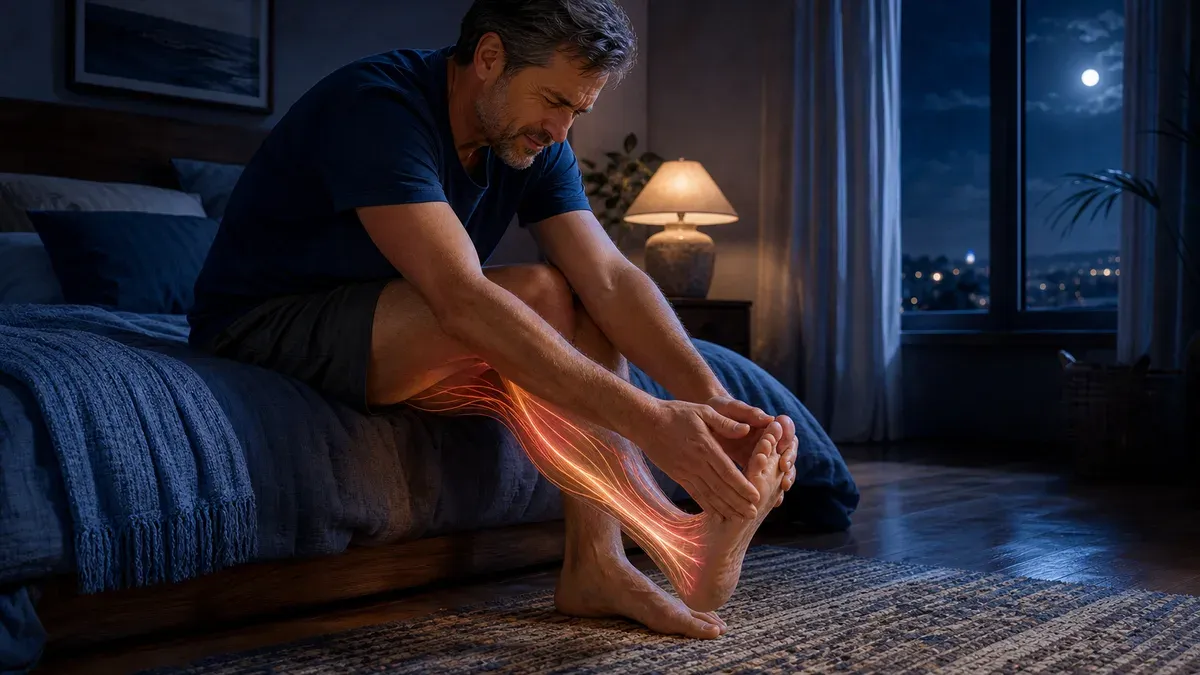
Night leg cramps: causes, fast relief, and warning signs
Night leg cramps are usually harmless, but patterns matter. Learn fast relief, prevention, medication clues, warning signs, and when to seek medical care.
Quick answer
A night leg cramp is a sudden, painful, involuntary tightening, usually in the calf. To release it, gently straighten the knee and pull the toes toward the shin; stand and put weight through the leg only if you can do so safely. Most episodes end within minutes. Recurrent cramps are often idiopathic, meaning no single disease or deficiency explains them. A regular calf-stretching trial may help, while magnesium is unlikely to provide meaningful prevention for most older adults. Seek prompt care when pain comes with one-sided swelling, warmth, skin-color change, weakness, numbness, a cold foot, or breathlessness.
Key facts
- A night leg cramp contracts a muscle involuntarily. The calf becomes painful and often feels visibly or palpably hard.
- Gentle lengthening releases the shortened calf. Bringing the toes toward the shin opposes the cramped position.
- A symptom pattern guides the next step. Timing, swelling, weakness, exercise triggers, medicines, and circulation signs matter more than guessing a nutrient.
- Nightly stretching may reduce recurrent cramps. Small trials support a low-risk experiment, but the evidence is not strong enough to promise prevention.
- Quinine creates disproportionate risk. Regulators warn against using it for routine prevention or treatment of night leg cramps.
Waking with a calf locked in pain can feel alarming. The muscle may remain tender the next morning, and fear of another episode can make it harder to return to sleep. Yet the most useful response is neither panic nor an automatic supplement: first confirm that the event behaves like a cramp, then look for the pattern around it.
This guide separates immediate relief from prevention and triage. It does not diagnose a clot, circulation problem, nerve disorder, or medication effect.
Medical note: New severe leg pain, one-sided swelling, a cold or discolored foot, weakness, chest pain, or shortness of breath needs urgent assessment. Pregnancy, kidney disease, liver disease, dialysis, vascular disease, and prescription medicines change what is safe; discuss recurrent cramps with a clinician rather than self-treating with supplements or someone else’s medicine.
What a night leg cramp feels like
Typical nocturnal leg cramps have four features: sudden onset, intense pain, involuntary tightening, and a hard muscle you can usually feel. They commonly affect the calf, but the foot or thigh can cramp too. The contraction may last seconds to several minutes, followed by residual soreness.
That pattern differs from a vague ache, tingling, an urge to move, or pain that reliably begins after walking a fixed distance. The distinction matters because those symptoms point toward different causes and different tests.
The NHS leg-cramp guidance notes that most cramps are short-lived and harmless. Repetition changes the calculation: cramps that repeatedly disrupt sleep, last longer than about 10 minutes, or occur with numbness or swelling deserve medical review.
How to release a calf cramp safely
When the calf suddenly tightens:
- Pause and orient yourself. Sit at the edge of the bed if standing immediately would risk a fall.
- Straighten the knee gently. Keep the heel supported.
- Pull the toes toward the shin. Use your hands, a towel, or a strap if needed. Hold steady rather than bouncing.
- Stand only if safe. Placing the foot flat and gradually shifting weight onto it can deepen the stretch.
- Massage after the peak eases. Slow pressure or gentle walking may help the muscle relax.
Do not force the ankle through sharp pain or keep stretching if the foot becomes cold, numb, pale, blue, or weak. Pain relievers act too slowly to stop the contraction itself, although a clinician or pharmacist may advise one for lingering soreness when it is otherwise safe for you.
If you are older, pregnant, unsteady, or prone to falls, keep the floor clear and a stable support within reach. The safest stretch is one you can perform without turning a brief cramp into a fall injury.
Why night leg cramps happen
Many recurrent night cramps are idiopathic: the history fits a true cramp, but no single underlying cause is found. The mechanism is not settled. Muscle fatigue and altered nerve control are plausible explanations, especially because cramps become more common with age and often follow a change in activity.
Several contexts can raise suspicion without proving causation:
- a sudden increase in walking, running, hills, court sport, or lower-body training;
- prolonged standing, awkward sleep position, or reduced ankle mobility;
- pregnancy, especially later pregnancy;
- dehydration after heat, illness, alcohol, or prolonged exercise;
- medicines or dose changes;
- peripheral vascular disease, neuropathy, spinal disease, kidney disease, liver disease, or dialysis.
Do not reduce the whole list to “low electrolytes.” The American Academy of Family Physicians’ clinical review of nocturnal leg cramps found that history and examination usually matter more than routine electrolyte testing in an otherwise typical presentation. Dehydration can still contribute in the right context, but a cramp by itself does not prove magnesium, potassium, or sodium deficiency.
Our hydration and healthy-aging guide can help you review fluid intake without treating forced water consumption as a cure. If exercise load changed recently, distinguish a brief contraction from delayed-onset muscle soreness, which usually develops hours later and lasts much longer.
Medicines deserve a review, not an abrupt stop
Bring every prescription, over-the-counter medicine, and supplement to a pharmacist or clinician. Diuretics, some cholesterol-lowering medicines, hormonal therapies, and other drugs can enter the differential, but association does not prove that a specific prescription caused your cramps.
Do not stop a statin, blood-pressure medicine, diuretic, or hormone on your own. The safer move is to document when the cramps began, when the dose changed, and whether weakness, dark urine, swelling, or other symptoms appeared. That timeline helps a clinician decide whether the medicine, the underlying condition, or something else is more likely.
Cramp or something else?
| Pattern | What it feels like | Useful next step |
|---|---|---|
| Night leg cramp | Sudden painful tightening; hard calf or foot; seconds to minutes | Gentle stretch, then track recurrence |
| Restless legs syndrome | Urge to move with crawling or uncomfortable sensations; movement brings relief; no hard knot | Discuss sleep and neurologic pattern if persistent |
| Peripheral artery disease | Calf ache or cramp predictably triggered by walking and relieved by rest | Ask about vascular assessment; see the PAD walking guide |
| Neuropathy | Burning, electric pain, numbness, or reduced sensation | Review diabetes, vitamin status, medicines, and nerve symptoms clinically |
| DOMS or strain | Tenderness after unfamiliar exercise; lasts hours to days; may hurt with use | Reduce load and assess for injury rather than treating it as a brief cramp |
| Deep-vein thrombosis | Persistent one-sided calf pain with swelling, warmth, or color change | Seek urgent medical assessment |
| Acute limb ischemia | Sudden severe pain with a pale or cold foot, numbness, weak movement, or absent pulse | Emergency care now |
Pain that begins with walking and stops with rest is not the same pattern as a calf that knots during sleep. Likewise, an uncomfortable need to move the legs is different from a visible, painful contraction. Naming the pattern prevents a sleep problem, vascular warning, or neuropathy from being mislabeled as “just cramps.”
Chronic heaviness or tenderness in both legs, easy bruising, and disproportionate limb tissue form a different pattern again. Our lipedema symptoms and diagnosis guide explains why distribution, clinical examination, and exclusion of vascular or lymphatic causes matter more than appearance alone.
A two-week prevention experiment
If the episodes are typical, brief, and free of warning signs, use a structured experiment instead of changing five things at once.
1. Stretch the calf before bed
Face a wall with both hands supported. Step the affected leg back, keep its heel down and knee straight, and lean forward until the upper calf feels a gentle stretch. Do not bounce or chase pain. Repeat with the back knee slightly bent to reach the deeper calf muscles.
A randomized trial in 80 adults over 55 found that nightly calf and hamstring stretching for six weeks reduced cramp frequency and pain compared with no specific stretching. A later Cochrane review of non-drug therapies rated the evidence low certainty, so treat stretching as a reasonable trial, not a guaranteed cure.
2. Make training load less abrupt
If cramps appeared after new hills, sprints, long walks, standing shifts, or strength work, reduce the spike rather than abandoning movement. Rebuild volume gradually and include ankle range-of-motion and calf-strength work when pain-free. The broader muscle recovery guide explains why a sudden unfamiliar dose creates different symptoms from ordinary training fatigue.
3. Replace fluid losses proportionately
Drink according to thirst, climate, illness, exercise duration, and clinical advice. After heavy sweating, ordinary meals usually replace electrolytes. People with heart failure, kidney disease, or prescribed fluid limits should not increase water or sodium without guidance.
4. Review the medication timeline
Record new medicines, dose changes, and the timing of each cramp. Ask a pharmacist whether the pattern fits a known adverse effect or interaction. Never use this article as a reason to stop an essential prescription.
5. Track the pattern, not just the pain
For two weeks, record:
- which leg and muscle cramped;
- start time and approximate duration;
- activity, heat, illness, and alcohol that day;
- medicines and recent dose changes;
- swelling, numbness, weakness, color change, or walking-triggered pain;
- whether stretching before bed was completed.
A simple log can reveal an activity spike, repeated one-sided symptoms, or a medication timeline that memory misses. It also gives a clinician something more useful than “it happens a lot.”
Supplements and medicines: what the evidence says
Magnesium is not an automatic answer
A 2020 Cochrane review of magnesium for muscle cramps concluded that supplementation is unlikely to provide a clinically meaningful reduction in cramp frequency or severity for older adults with idiopathic cramps. Evidence in pregnancy was conflicting, and the review found no qualifying randomized trials for ordinary exercise-associated cramps.
Magnesium can also cause diarrhea and interact with medicines. A documented deficiency or another clinical indication is different from taking it solely because a calf cramped. Read the magnesium guide for the broader nutrient context, but use testing and professional advice rather than symptoms alone.
Potassium and salt can be harmful when guessed
Potassium supplements are not a routine treatment for night cramps and can be dangerous with kidney disease or medicines that raise potassium. Extra salt can worsen blood pressure, fluid retention, or heart failure. Replace a demonstrated problem; do not create a second one by treating a guess.
Quinine is not a routine cramp remedy
The US Food and Drug Administration warns that quinine is not considered safe and effective for preventing or treating night leg cramps. It can cause severe blood disorders, kidney injury, allergic reactions, and dangerous heart-rhythm problems. Tonic water is not a controlled treatment plan either.
Recent trials of vitamin K2 and compression stockings are interesting but do not establish a universal self-treatment. Vitamin K can interfere with vitamin-K-antagonist anticoagulants, while compression can be inappropriate when arterial circulation is impaired. Discuss persistent symptoms with a clinician before experimenting.
When to seek medical care
Arrange a routine appointment when cramps repeatedly disturb sleep, are increasing, last longer than about 10 minutes, or accompany numbness. Ask for a review sooner if you also have progressive weakness, balance change, back pain with leg symptoms, new medication exposure, pregnancy concerns, kidney or liver disease, or pain that consistently appears with walking.
Seek urgent assessment for persistent pain plus swelling, warmth, or skin-color change in one leg. The NHS deep-vein thrombosis guide emphasizes that a DVT usually affects one leg and needs prompt medical help.
Seek emergency care now for any of the following:
- leg pain or swelling with chest pain, coughing blood, faintness, or shortness of breath;
- a suddenly cold, pale, blue, or numb foot;
- new inability to move the foot or leg normally;
- severe pain after an injury, especially with deformity or rapidly increasing swelling;
- dark urine with marked muscle pain or weakness after extreme exertion or a medication change.
These are not “wait and stretch” patterns. A cramp ends; a vascular blockage, clot, major muscle injury, or neurologic deficit can worsen while you wait.
Connect cramps to the wider health pattern
A single night cramp is rarely a longevity signal. Recurrent sleep disruption, reduced activity, medication changes, vascular symptoms, and declining strength are the patterns worth connecting.
SuperAge can help you keep sleep, activity, heart-rate trends, medicines, symptoms, and health records in one timeline. It cannot diagnose why a calf cramped or rule out a clot. Its useful role is to make the follow-up clearer: Did cramps begin after training volume rose? Is sleep repeatedly fragmented? Did walking tolerance change? Was a medicine added that week?
Protecting sleep still matters even when the cause is mechanical. Use the sleep and longevity guide to rebuild a stable routine after symptoms are addressed, and the sleep-debt guide to avoid trying to “repay” repeated disruption with one long weekend.
Ready to make the pattern easier to explain? Download SuperAge and organize your health and wearable trends without treating the app as a diagnostic tool.
FAQ
What should I do during a night leg cramp?
Gently straighten the knee and pull the toes toward the shin. Stand and place weight through the leg only if it is safe, then massage or walk gently after the contraction eases. Stop and seek care if the foot becomes cold, pale, numb, or weak.
Are night leg cramps caused by dehydration?
Sometimes dehydration contributes, particularly after heat, illness, heavy sweating, or alcohol. But many recurrent nighttime cramps are idiopathic, and the symptom alone does not prove dehydration or an electrolyte deficiency.
Does magnesium stop calf cramps at night?
Probably not for most older adults with idiopathic cramps. A Cochrane review found no clinically meaningful preventive benefit. Pregnancy and documented deficiency require individual medical advice rather than routine self-treatment.
Why do leg cramps become more common with age?
The exact mechanism is uncertain. Age-related changes in nerve control, muscle and tendon flexibility, activity, circulation, health conditions, and medication exposure may all contribute. A new pattern still deserves review rather than being dismissed as normal aging.
Can a blood clot feel like a calf cramp?
A DVT can cause calf pain, but it is more concerning when pain persists and one leg is swollen, warm, or discolored. Seek urgent assessment for that pattern, especially after surgery, immobility, long travel, pregnancy, estrogen exposure, cancer, or a prior clot.
Should I ask for blood tests?
Typical brief cramps do not automatically require a broad electrolyte panel. A clinician may order targeted tests when the history suggests kidney, liver, thyroid, nerve, vascular, medication, or nutritional problems. Testing should answer a specific question.
Can stretching before bed prevent cramps?
It may help. One small randomized trial found fewer and less painful cramps after six weeks of nightly calf and hamstring stretching, but systematic reviewers rate the evidence as low certainty. Try gentle, consistent stretching and track whether your own frequency changes.
Key takeaways
- Release a typical calf cramp by gently straightening the knee and pulling the toes toward the shin.
- Use timing, muscle tightening, triggers, and accompanying symptoms to distinguish a cramp from restless legs, soreness, neuropathy, or vascular pain.
- Try a consistent bedtime calf stretch and reduce abrupt training-load changes.
- Do not assume that cramps prove dehydration, magnesium deficiency, or low potassium.
- Avoid quinine for routine night-cramp treatment because serious harms outweigh its modest benefit.
- Review medicines with a pharmacist or clinician instead of stopping them yourself.
- Treat one-sided swelling, a cold or discolored foot, weakness, chest pain, or breathlessness as urgent warning signs.
References
- NHS. Leg cramps. Reviewed 2023.
- Allen RE, Kirby KA. Nocturnal leg cramps. American Family Physician. 2012.
- Hallegraeff JM, van der Schans CP, de Ruiter R, de Greef MHG. Stretching before sleep reduces the frequency and severity of nocturnal leg cramps in older adults. Journal of Physiotherapy. 2012.
- Blyton F, Chuter V, Walter KEL, Burns J. Non-drug therapies for the secondary prevention of lower limb muscle cramps. Cochrane Database of Systematic Reviews. 2021.
- Garrison SR, Korownyk CS, Kolber MR, et al. Magnesium for skeletal muscle cramps. Cochrane Database of Systematic Reviews. 2020.
- US Food and Drug Administration. Serious risks associated with quinine for nocturnal leg cramps. 2012.
- NHS. Deep vein thrombosis. Reviewed 2026.
- Tan J, Zhu R, Zhou J, et al. Vitamin K2 in managing nocturnal leg cramps: a randomized clinical trial. JAMA Internal Medicine. 2024.
- Tolonen H, et al. Secondary prevention of leg cramps using compression stockings or magnesium supplements. Randomized clinical trial. 2026.
Related Articles
Magnesium glycinate vs citrate vs threonate: Which form should you take?
Compare magnesium glycinate, citrate, and threonate side by side. Learn which form is best for sleep, digestion, brain health, and how each one affects aging.