Lipedema symptoms: diagnosis, look-alikes, and care
Lipedema symptoms include painful, disproportionate limb tissue and easy bruising. Learn how diagnosis works, what mimics it, and which treatments help.
Quick answer
Lipedema is a chronic disorder in which painful or uncomfortable subcutaneous fatty tissue develops disproportionately in the legs and sometimes the arms. The pattern is usually bilateral and symmetrical, often spares the feet and hands, and may come with heaviness, tenderness, nodular tissue, and easy bruising. Appearance alone cannot confirm it. Diagnosis is clinical: a qualified clinician reviews the history, examines the tissue and circulation, and rules out conditions such as obesity, lymphedema, chronic venous disease, and a blood clot. Compression, individualized exercise, weight and metabolic care, skin care, and psychological support can reduce symptom burden; surgery is a specialist decision because evidence and access differ by country.
Key facts
- Lipedema enlarges limb subcutaneous tissue disproportionately. The torso may remain relatively smaller while both legs, and sometimes both arms, enlarge.
- Lipedema commonly causes pain or physical sensitivity. Tenderness, heaviness, pressure sensitivity, and easy bruising distinguish the symptom pattern from shape alone.
- A clinician diagnoses lipedema clinically. No approved blood test, gene test, scan, or home measurement confirms it by itself.
- Conservative care targets symptoms and function. Properly fitted compression, tailored movement, skin care, and management of coexisting conditions may improve comfort and mobility.
- Sudden one-sided swelling is not a typical wait-and-see pattern. New unilateral pain, warmth, color change, chest pain, or breathlessness needs urgent assessment.
Lipedema is often reduced online to a photo comparison: large legs, a smaller waist, and an ankle “cuff.” That shortcut can miss people whose bodies do not match a textbook image, while encouraging others to self-diagnose ordinary fat distribution or fluid swelling. The more useful question is whether distribution, symptoms, history, and examination form one coherent clinical pattern.
The 2026 Lipedema World Alliance consensus describes a chronic disease that predominantly affects women and typically combines symmetrical limb enlargement with pain or discomfort. It also emphasizes a major limitation: many recommendations still rest on expert consensus and small or heterogeneous studies. This guide therefore separates widely recognized clinical signals from claims the evidence cannot yet support.
Medical note: This article cannot diagnose lipedema or explain unexplained bruising and swelling. Seek urgent care for sudden one-sided leg swelling or pain, a red or hot limb, fever, chest pain, fainting, or shortness of breath. Ask a clinician promptly about bruising with bleeding elsewhere, black stools, severe fatigue, or a new medicine or supplement.
What lipedema is—and is not
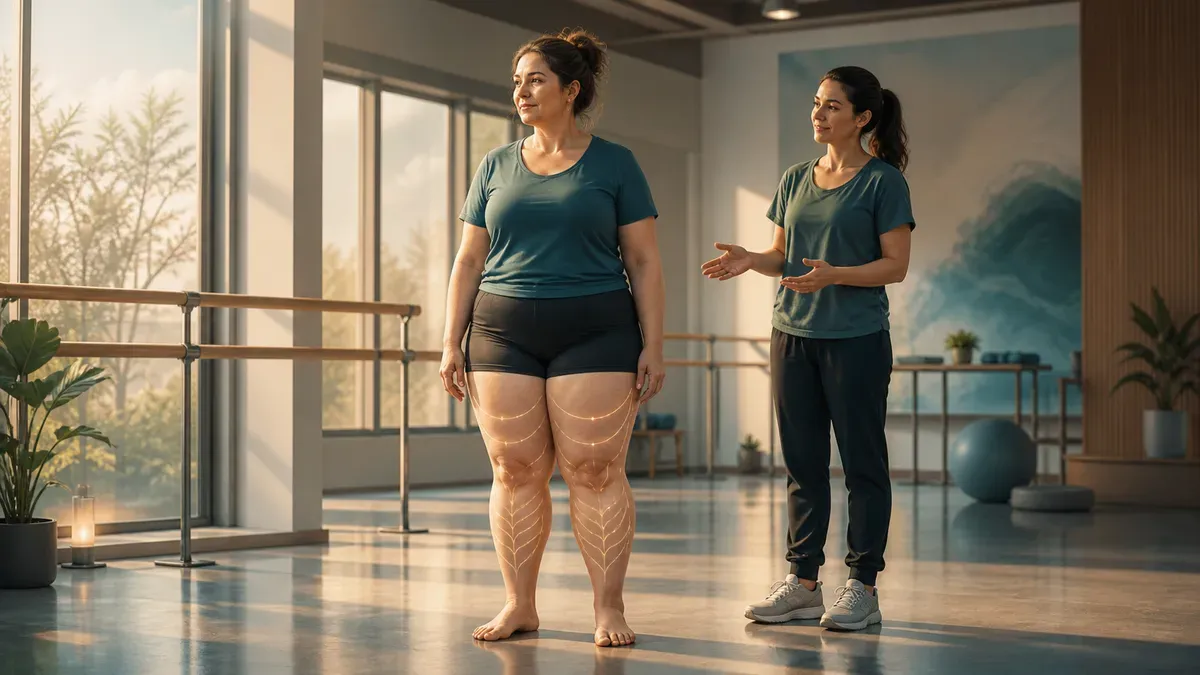
Lipedema affects subcutaneous adipose tissue, the fat and connective tissue beneath the skin. The characteristic phenotype is disproportionate enlargement of the extremities relative to the torso, most often across the hips, buttocks, thighs, and lower legs. Arms can also be involved. The feet and hands are usually spared, creating a visible transition near the ankles or wrists, although comorbid swelling can blur that boundary.
It is not simply cellulite. Cellulite describes a common dimpled skin texture and usually does not cause a symmetrical syndrome of painful, heavy limbs. Lipedema is also not synonymous with obesity. A person can have lipedema at any body size, and someone can have both lipedema and obesity. Treating obesity can improve cardiometabolic health, load on painful joints, and mobility, but a change on the scale does not decide whether lipedema is present.
The name can be confusing because obvious pitting edema is usually absent in uncomplicated lipedema. Researchers are still investigating whether and how extracellular fluid and lymphatic changes contribute. It is safer to describe what a clinician can observe than to present one unsettled mechanism as fact.
For broader evidence-based health explainers, use the SuperAge health library as a starting point rather than relying on diagnostic image galleries.
The symptom pattern clinicians look for
No single feature proves lipedema. Suspicion becomes more reasonable when several of these features occur together:
- disproportionate enlargement of both legs, often from the hips to the ankles;
- a similar bilateral pattern in the arms in some people;
- feet and hands that are relatively spared;
- aching, heaviness, tenderness, or pain with light pressure;
- easy bruising in the affected tissue without remembered trauma;
- soft, nodular, or increasingly fibrotic tissue on examination;
- symptoms that began or changed around puberty, pregnancy, or menopause;
- reduced walking tolerance, joint stress, or difficulty with daily movement;
- a family history with a similar pattern.
The NHS overview of lipoedema gives a practical public-facing summary: it usually affects both sides, can involve the legs and arms, commonly spares the feet and hands, and may cause pain, tenderness, heaviness, and easy bruising. These features are clues, not a checklist that can replace an examination.
Hormonal transitions are frequently associated with onset or worsening, but association is not proof of a single hormonal cause. The international consensus explicitly states that the relevant mechanisms remain uncertain. Men can develop lipedema, but reported cases are rare and often warrant careful evaluation for hormonal or other contributing conditions.
Easy bruising still deserves context
Bruising within affected areas is commonly reported in lipedema, yet bruising is not specific to it. Anticoagulants, antiplatelet medicines, corticosteroids, liver disease, low platelets, bleeding disorders, nutritional problems, trauma, and normal age-related skin changes can also contribute.
Document when bruises appeared, whether they follow pressure or injury, and whether you also have nosebleeds, gum bleeding, heavy menstrual bleeding, blood in urine or stool, or pinpoint red-purple spots. Do not stop a prescribed blood thinner because you suspect lipedema; ask the prescriber to review the complete pattern.
Lipedema versus common look-alikes
The diagnostic task is not “Does this leg look like lipedema?” It is “Which condition or combination best explains the distribution, tissue, pain, fluid, skin changes, and timeline?”
| Pattern | Features that may point toward it | Why clinical assessment matters |
|---|---|---|
| Lipedema | Usually bilateral disproportionate limb tissue, pain or tenderness, heaviness, easy bruising, relative sparing of feet or hands | No single confirmatory test; comorbid obesity, venous disease, or lymphedema can change the presentation |
| General obesity | Fat distribution includes the torso more proportionately; painful pressure sensitivity and easy bruising are not defining features | Obesity and lipedema can coexist, so BMI alone cannot rule either condition in or out |
| Lymphedema | Fluid-rich swelling may involve the foot or hand and can become pitting or fibrotic; often asymmetric | Primary or secondary lymphedema may coexist with lipedema and changes compression and skin-care needs |
| Chronic venous disease | Ankle swelling, varicose veins, aching after standing, skin discoloration, or ulcers | Venous examination and duplex ultrasound may identify reflux or obstruction that needs its own treatment |
| Deep-vein thrombosis | New persistent pain and swelling, usually on one side, sometimes with warmth or color change | A clot cannot be excluded by appearance or a home test; urgent clinical assessment and imaging may be needed |
| Peripheral artery disease | Exertional calf pain relieved by rest, cold feet, slow-healing wounds, or weak pulses | Compression may be unsafe until arterial circulation is assessed |
| Cellulitis | Rapidly increasing redness, heat, pain, and swelling, sometimes fever or flu-like symptoms | Infection can worsen quickly and may require antibiotics |
Pain that reliably begins with walking and stops with rest fits an arterial pattern more than lipedema; our peripheral artery disease guide explains that distinction. A brief muscle that hardens during sleep is different again; see the night leg cramps guide for that pattern.
Red flags that should not be attributed to lipedema
The updated NHS deep-vein thrombosis guidance lists throbbing pain and swelling in one leg as common DVT symptoms. If leg pain or swelling comes with chest pain or breathlessness, emergency evaluation is needed because a clot may have travelled to the lungs.
Seek urgent medical help for:
- sudden or rapidly increasing one-sided swelling;
- a red, hot, markedly painful limb or fever;
- chest pain, shortness of breath, fainting, or coughing blood;
- a suddenly cold, pale, numb, or weak foot;
- new severe swelling during pregnancy or soon after birth;
- bruising plus uncontrolled bleeding, black stools, vomiting blood, or neurological symptoms.
Lipedema can coexist with urgent illness. A previous diagnosis should never be used to dismiss a new asymmetrical or systemic change.
How lipedema is diagnosed
Diagnosis starts with history and physical examination. The international consensus reports that no imaging, serological, genetic, or measurement tool is officially approved to verify the diagnosis. A 2024 systematic review of diagnostic imaging and a 2025 systematic review of physical assessment tools found promising methods, but variation in protocols and limited evidence prevent any scan or device from functioning as a universal standalone test.
A thorough appointment may include:
- Timeline. When did the body-shape difference, pain, heaviness, or bruising begin? Did it change with puberty, pregnancy, menopause, weight change, surgery, or immobility?
- Distribution. Are both legs affected? Are the feet spared? Are arms involved? Is there a sharp ankle or wrist transition?
- Tissue and skin. The clinician assesses tenderness, nodules, fibrosis, pitting, skin integrity, bruising, infection, and the ability to pinch skin at a toe or finger.
- Circulation and function. Pulses, varicose veins, swelling behavior, joint alignment, gait, strength, balance, and mobility help identify comorbid disease.
- Differential diagnosis. Medicines, obesity, venous disease, lymphedema, endocrine problems, organ disease, and bleeding causes are considered according to the presentation.
- Targeted tests. Blood tests or imaging may investigate an alternative or coexisting condition; they do not “prove” lipedema by themselves.
Bring a concise record rather than a folder of filtered photos: symptom onset, family pattern, medicines and supplements, pregnancy or hormonal history, daily variation, previous clots or surgery, and what pain or swelling prevents you from doing. Measurements taken consistently over time can support monitoring, but an isolated BMI or thigh circumference is not diagnostic.
Stages do not equal symptom severity
Traditional stages describe visible and palpable tissue changes. They do not reliably measure pain, disability, mental burden, vascular health, or response to care. Someone with subtle surface changes may have substantial tenderness; someone with marked enlargement may report less pain. Ask for a functional assessment, not only a stage label.
Conservative care: what each component can do
Conservative treatment does not remove abnormal subcutaneous tissue. Its realistic goals are to reduce pain or heaviness, support movement, protect skin, address fluid when present, improve fitness, and manage coexisting conditions.
The 2024 German S2k guideline summary and the international consensus support individualized multimodal care. Evidence is still developing, so response should be measured with symptoms and function rather than promises of a cure.
Compression fitted to the person
Compression garments or bandaging can reduce pain and subjective heaviness for some people, particularly during activity. Fit, textile stiffness, pressure, limb shape, dexterity, heat tolerance, skin condition, venous status, and arterial circulation all matter. A trained clinician or therapist should select and adjust the system; more pressure is not automatically better.
Do not start strong compression on a limb with suspected arterial disease, an untreated acute clot, severe infection, or unexplained sudden swelling. If a garment causes numbness, color change, coldness, sharp pain, or skin injury, remove it and seek advice.
A small 2024 controlled study of exercise with and without compression suggests that combining the two may improve selected outcomes, but a single modest study cannot define the best garment or dose for everyone.
Tailored, progressive movement
Exercise supports cardiovascular health, muscle capacity, joint function, balance, and weight management even when it does not selectively remove lipedema tissue. Start from current tolerance. Walking, cycling, resistance training, and water-based activity can all be scaled; buoyancy may make movement more comfortable when joints are painful.
A 2025 systematic review of exercise training concluded that exercise appears promising, with potentially greater effects when combined with ongoing compression, but the evidence base remains small. Use symptoms the next day to guide progression. Our fitness walking guide offers a gradual framework, while the mobility screen after 50 can help identify functional limits without treating a home test as diagnosis.
Skin care and fluid management
Moisturize dry skin, treat small wounds promptly, and check areas where garments rub. Manual lymphatic drainage may help selected people, especially when fluid or coexisting lymphedema is present, but the 2026 consensus found no evidence for using it alone as a universal lipedema treatment. Complete decongestive therapy may combine compression, movement, skin care, manual techniques, and self-management; not every component is necessary for every person.
Nutrition, weight, and metabolic health without blame
Lipedema is not caused by a lack of discipline. At the same time, coexisting obesity, insulin resistance, hypertension, or sleep problems deserve evidence-based care because they affect long-term health, mobility, inflammation, and surgical risk. Focus on a sustainable dietary pattern, adequate protein and fiber, and gradual change rather than a branded “lipedema detox.”
Lipedema-specific diet trials are limited. No ketogenic, anti-inflammatory, or supplement protocol has been proven to cure the disease. The healthy-weight guide explains why waist, function, health markers, and trend matter alongside weight; the perimenopause weight guide adds context when symptoms change around menopause.
Mental health and social support
Pain, delayed diagnosis, body stigma, clothing difficulties, and reduced mobility can affect mood and participation. Psychological support does not imply that symptoms are imaginary. It can help with coping, body image, depression, anxiety, and the practical burden of chronic care while physical symptoms are assessed and treated.
Medicines, supplements, and surgery
There is no medication proven to treat lipedema itself. Medicines should address diagnosed comorbidities or specific symptoms, not an unverified mechanism. Be wary of sellers claiming that a supplement “drains lipedema,” balances the responsible hormone, repairs lymphatics, or dissolves diseased fat. The international consensus found no evidence for an effective pharmacological intervention and only limited evidence for supplements.
Liposuction intended for lipedema is different from ordinary cosmetic contouring: the aim is symptom and functional improvement while protecting lymphatic structures. Observational studies report improvements in pain, bruising, mobility, limb size, and quality of life for selected patients, but uncontrolled before-and-after studies are vulnerable to bias.
Guidelines do not fully agree. The 2026 international consensus says lymph vessel-sparing reduction surgery may be considered when it is likely to improve symptoms, while acknowledging the lack of completed randomized comparisons and robust long-term safety data. UK NICE guidance, reviewed in 2025, recommends liposuction only in research because efficacy evidence is inadequate and safety concerns include fluid imbalance, fat embolism, DVT, and local-anesthetic toxicity. A Canadian health technology review likewise judged the evidence low quality.
If considering surgery, seek a multidisciplinary assessment from clinicians experienced in lipedema, vascular and lymphatic evaluation, conservative care, and the specific procedure. Ask about diagnostic certainty, alternatives, expected symptom—not cosmetic—outcomes, number of operations, anesthesia, blood-clot prevention, lymphatic risk, complications, compression and rehabilitation, costs, and long-term follow-up.
A practical four-week tracking plan
Tracking cannot confirm lipedema, but it can turn a vague story into useful clinical information.
| What to track | Simple method | What it may clarify |
|---|---|---|
| Pain and tenderness | 0–10 at the same times each day | Baseline burden and response to compression or activity |
| Heaviness or swelling sensation | Morning and evening note | Daily pattern, standing effect, and asymmetry |
| Bruising | Date, location, approximate size, known trauma | Frequency and whether bruising occurs outside affected tissue |
| Function | Comfortable walking time, stairs, sit-to-stand | Whether care improves daily capacity |
| Garment use | Type, hours, comfort, skin response | Tolerance without assuming more wear is always better |
| Context | Menstrual or hormonal change, travel, heat, illness, medicine changes | Potential modifiers to discuss with a clinician |
Use consistent conditions and avoid daily circumference checking if it increases distress. Seek care rather than extending the experiment when red flags appear.
Use SuperAge to follow function, not diagnose tissue
Lipedema is a clinical diagnosis; Apple Health data and a wellness app cannot identify it. SuperAge can still help place function inside the bigger picture by showing available trends in walking, activity, sleep, heart rate, and other health metrics against your own baseline.
Use those trends to prepare better questions: Did walking volume fall as pain rose? Is sleep worsening on high-symptom days? Is a gradual movement plan improving consistency? Do not use a weight, step, or biological-age change to prove that lipedema improved or progressed.
Download SuperAge to keep health and mobility trends organized while diagnosis and treatment decisions remain with qualified clinicians.
Questions to bring to an appointment
- Which features support lipedema, and which expected features are absent?
- What alternative or coexisting conditions need to be ruled out?
- Do I need vascular, lymphatic, endocrine, or bleeding evaluation?
- What are the goals of compression or therapy in my case?
- Which outcomes should we track—pain, function, swelling, skin, or quality of life?
- Which warning signs should change the plan urgently?
- If surgery is discussed, what evidence, qualifications, risks, and follow-up apply locally?
FAQ
What are the first signs of lipedema?
Early clues can include disproportionate enlargement of both legs, relative sparing of the feet, tenderness or pain with pressure, heaviness, and easy bruising. None is diagnostic alone, and presentation varies.
Can a blood test or scan confirm lipedema?
No standalone blood test, genetic test, scan, or body measurement is officially approved to confirm it. Tests may help evaluate other causes or comorbid conditions.
Is lipedema the same as obesity?
No. Lipedema has a characteristic regional, symptomatic tissue pattern, while obesity describes excess body fat and related health risk. They can occur together, and both deserve care without stigma.
Does lipedema always spare the feet?
The feet and hands are usually spared in uncomplicated lipedema, but advanced disease or coexisting lymphedema and venous disease can alter the pattern. Foot sparing is a clue, not an absolute rule.
Does lipedema always get worse?
No. The course varies, and the 2026 consensus notes that lipedema may not consistently progress. Weight gain, hormonal transitions, comorbid disease, and reduced mobility may worsen symptoms for some people.
Can diet or exercise cure lipedema?
No diet or exercise program has been shown to cure lipedema. Sustainable nutrition and tailored movement can improve overall health, fitness, function, weight management, and sometimes symptom burden.
Does compression remove lipedema fat?
No. Compression may reduce pain, heaviness, or associated fluid and support movement, but it does not remove abnormal adipose tissue. Fit and medical suitability matter.
Is liposuction proven to work for lipedema?
Observational studies report benefits for selected patients, but high-quality comparative and long-term safety evidence remains limited. Guidelines differ, so surgery requires specialist, locally appropriate assessment and shared decision-making.
When is leg swelling an emergency?
Seek urgent assessment for sudden one-sided pain or swelling, a hot or red limb, fever, a cold or numb foot, chest pain, fainting, or shortness of breath.
Key takeaways
- Lipedema is a chronic, usually bilateral disorder of painful or uncomfortable subcutaneous limb tissue—not a synonym for cellulite or obesity.
- Distribution, tenderness, heaviness, easy bruising, history, and exclusion of look-alikes matter more than one photo or measurement.
- No approved standalone test confirms lipedema; diagnosis is clinical.
- Conservative care can improve symptoms and function but should be individualized and measured honestly.
- Medicines and supplements do not have proven lipedema-specific efficacy.
- Surgical evidence is evolving, and recommendations differ between expert consensus and health technology authorities.
- Sudden asymmetrical swelling, infection signs, chest pain, or breathlessness require urgent care.
References
- Kruppa P, et al. Lipedema World Alliance Delphi consensus-based position paper. Nature Communications. 2026.
- NHS. Lipoedema. Reviewed 2023.
- Reich-Schupke S, et al. S2k guideline lipedema. Journal der Deutschen Dermatologischen Gesellschaft. 2024.
- Cellina M, et al. Diagnostic imaging in lipedema: a systematic review. Skin Research and Technology. 2024.
- McGowan A, et al. Assessment tools to quantify the physical aspects of lipedema: a systematic review. Lymphatic Research and Biology. 2025.
- Lanzi S, et al. Exercise training in women with lipedema: a systematic review. Vasa. 2025.
- Paling I, et al. Compression therapy combined with exercise versus exercise alone. Journal of Clinical Medicine. 2024.
- Herbst KL, et al. Standard of care for lipedema in the United States. Phlebology. 2021.
- NICE. Liposuction for chronic lipoedema: recommendations. Published 2022; reviewed 2025.
- Canadian Agency for Drugs and Technologies in Health. Liposuction for lipedema: 2022 update. 2022.
- NHS. Deep-vein thrombosis. Reviewed 2026.
This article is for general education and does not replace diagnosis or treatment by a qualified clinician. Health systems use different referral pathways and procedural policies; follow local guidance.
Related Articles
Knee crepitus and pain: when to suspect osteoarthritis
Knee crepitus is often harmless, but pain, swelling, stiffness, or locking changes the picture. Learn osteoarthritis signs and when to seek care.