Arm exercises: build stronger biceps and triceps
Learn the best arm exercises for biceps and triceps, use joint-friendly form, and progress a practical workout for strength, muscle, and daily function.
The best arm exercises are the ones that train elbow flexion and extension through a controlled range, fit your joints and equipment, and can be progressed without turning every set into a form test. For most people, that means combining a pulling movement and a curl for the biceps side with a pressing movement and an extension for the triceps side.
You do not need a separate “arm day,” a dozen curl variations, or maximal weights. Pull-ups, rows, presses, and push-ups already train the arms. Direct curls and triceps extensions can then add focused work where the larger movements leave a gap.
Quick answer
For a simple arm workout, choose one curl, one triceps extension, one pull, and one press. Perform 2–3 sets of 8–15 controlled repetitions per exercise, once or twice each week, while counting hard pulling and pressing sets from the rest of your program. Finish most sets with about 1–3 good repetitions still possible.
A practical session could pair a dumbbell curl with an overhead triceps extension, then a supported row with an incline close-grip push-up. Add repetitions within the target range before increasing the load. If the elbow, wrist, or shoulder develops sharp pain, numbness, sudden weakness, or swelling, stop treating the problem as ordinary workout discomfort and seek an appropriate assessment.
Key facts
- The biceps and other elbow flexors bend the elbow and help control the lowering phase of curls and pulls.
- The triceps straightens the elbow during extensions, presses, push-ups, and many reaching tasks.
- Compound pulls and presses provide substantial indirect arm work before isolation exercises are added.
- Progressive resistance develops strength and muscle when effort, volume, range, or load increases gradually.
- Exercise variety changes joint position and regional loading, but consistency matters more than collecting variations.
This guide is general exercise education, not a diagnosis or rehabilitation plan. Get individualized advice before loading a recent fracture, tendon tear, dislocation, operation, or unexplained loss of grip or arm strength. Seek prompt care after a traumatic “pop” with bruising or deformity, or when arm pain comes with chest pressure, breathlessness, sweating, or pain spreading into the jaw or back.
What arm exercises actually train
“Arms” is a useful gym label, not one muscle group. Elbow movement depends on several muscles crossing the elbow, while the shoulder, forearm, wrist, and hand stabilize the load.
Biceps, brachialis, and brachioradialis
The biceps brachii has long and short heads. Both help flex the elbow and supinate the forearm—turning the palm upward. Because the biceps also crosses the shoulder, changing upper-arm position changes its length and leverage, but no curl switches one head completely on or off.
The brachialis lies beneath the biceps and is a strong elbow flexor regardless of whether the palm faces up, in, or down. The brachioradialis contributes strongly when the forearm is neutral, as in a hammer curl. Rows and pull-ups recruit these elbow flexors alongside the back, shoulders, forearms, and grip.
Triceps and elbow extension
The triceps brachii has long, lateral, and medial heads that join into a common tendon at the elbow. All three extend the elbow. The long head also crosses the shoulder, so an overhead arm position lengthens it more than a position with the arm beside the body.
Presses and push-ups load the triceps together with the chest and shoulders. Cable, band, dumbbell, or machine extensions make elbow extension the main task. Both categories can be useful: compound exercises move more total load, while isolation exercises let you add local arm work without another demanding chest or shoulder session.
The agonist and antagonist muscle guide explains why the biceps and triceps reverse roles as movement direction changes—and why they may co-contract for control rather than behaving like simple on-off switches.
How to choose the best arm exercises
An exercise is useful when it meets four tests:
- It matches the goal. A curl improves curl-specific strength; a pull-up builds an integrated pulling skill; neither is universally superior.
- It gives the target muscles meaningful resistance. Momentum, grip failure, or trunk movement should not consistently end the set before the arm muscles work.
- It fits the joints. A straight bar, neutral handle, dumbbell, cable, band, or machine can all work. Choose the setup that allows a stable wrist and tolerable elbow and shoulder position.
- It is measurable. You should be able to compare repetitions, load, range, tempo, or assistance from week to week.
The 2026 American College of Sports Medicine position stand synthesized 137 systematic reviews and emphasized that progressive resistance training improves strength, muscle size, power, and physical function across adulthood. For the average healthy adult, consistency and sufficient effort matter more than a particular equipment type or complicated method (ACSM).
A large network meta-analysis likewise found that many combinations of load, sets, and frequency produced strength and hypertrophy compared with no training. Higher loads ranked well for maximal strength, while multiple sets ranked well for muscle growth (Currier et al., 2023). This supports a flexible menu rather than one mandatory “best” curl or extension.
Eight effective arm exercises
Use the list as a menu. A complete workout does not require all eight.
1. Supinated dumbbell curl
Stand or sit with a dumbbell in each hand, palms facing forward. Keep the upper arms quiet, bend the elbows, and lift until the forearms approach the upper arms without forcing the shoulders forward. Lower to a comfortable long-arm position under control.
Use 2–4 sets of 8–15 repetitions. Alternating arms can make trunk control easier; curling both together is faster. Let the forearm rotate naturally if a fixed palm-up position irritates the wrist.
Common mistake: leaning backward and driving the elbows forward to finish every repetition. A small amount of body movement is not automatically dangerous, but repeated momentum makes the dose difficult to compare. Reduce the load when the curl becomes a whole-body lift.
2. Hammer curl
Hold the dumbbells with the palms facing each other. Bend the elbows while keeping the wrists neutral, then lower until the elbows are comfortably extended. The neutral grip trains the elbow flexors while giving the brachioradialis a prominent role.
Use 2–3 sets of 8–15 repetitions. A rope cable or resistance band can reproduce the same neutral-hand idea. Hammer curls are an option, not an obligatory “width” exercise; arm appearance reflects anatomy, total muscle growth, body composition, and time.
Common mistake: allowing the wrist to collapse backward. Keep the hand and forearm aligned and choose a handle thickness you can grip without pain.
3. Supported or preacher curl
Rest the upper arms against a stable angled pad or brace the working arm against the inner thigh. Begin from a controlled lower position, curl without lifting the shoulder away from the support, and stop before the forearm simply rests at the top.
Support reduces the opportunity to swing and makes progress easy to track. It also places the elbow and shoulder in a fixed position that may not suit everyone. Do not force the final few degrees of elbow extension under a load you cannot control.
A randomized trial in young women found regional differences after eight weeks of preacher versus incline curls: preacher curls produced more distal elbow-flexor growth, while incline curls produced more proximal growth, and strength improved most in the version trained (Kassiano et al., 2025). That does not establish a universal winner. It shows that exercise selection can shape specific adaptations and that tested strength is task-specific.
4. Row, pulldown, or assisted pull-up
Choose a horizontal or vertical pull that lets the back and elbow flexors share the work. For a row, support the chest or stabilize the trunk, pull the upper arm back, and return until the shoulder blade and elbow move through a controlled range. For a pulldown or assisted pull-up, pull the upper arm toward the side of the rib cage without turning the repetition into a swing.
Use 2–4 sets of 6–12 repetitions. A palm-up grip can increase the elbow-flexion demand for some people, but neutral and palm-down grips still train the arms. Grip choice should not override shoulder, elbow, or wrist comfort.
The pull-up form and progression guide shows how to adjust assistance, range, and body control when a full bodyweight repetition is not yet available.
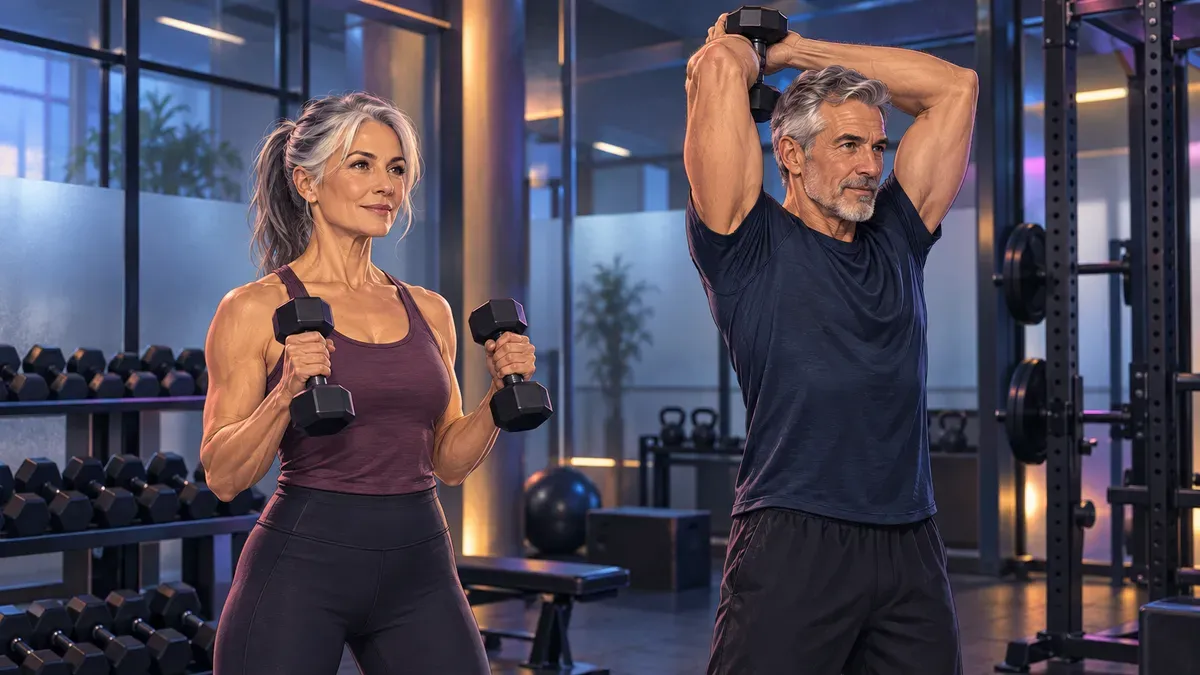
5. Overhead triceps extension
Hold one dumbbell with both hands, one dumbbell in each hand, or a rope attached to a low cable. Bring the upper arms overhead within a comfortable shoulder range. Bend the elbows so the forearms move behind the head, then extend the elbows without arching the lower back.
Use 2–4 sets of 8–15 repetitions. An incline bench can support the torso, and a cable or band can make the resistance easier to control. If the overhead position pinches the shoulder or makes the elbows ache, use a different extension rather than forcing the angle.
In a small 12-week within-person study, overhead cable extensions produced more triceps growth than extensions performed with the arm beside the body, especially in the long head (Maeo et al., 2023). The study supports overhead work as a useful option; it does not make it mandatory or prove that every overhead tool and technique has the same effect.
6. Cable, band, or machine triceps press-down
Set the upper arms near the sides, begin with the elbows bent, and extend the elbows until the arms are long without aggressively jamming the joint. Return under control while keeping the shoulders from rolling forward.
Use 2–4 sets of 8–20 repetitions. A rope allows the hands to find a comfortable path; a straight or angled bar may feel more stable. Bands are lightest near the top and become harder as they stretch, while cables maintain a more consistent line of pull.
Common mistake: turning the movement into a standing pullover by moving the upper arms and torso. Some shoulder motion can be intentional, but if the goal is to compare triceps-extension performance, keep the setup repeatable.
7. Close-grip incline push-up
Place the hands on a wall, rail, bench, or stable box slightly narrower than shoulder width. Keep the body organized, lower the chest toward the support with the elbows following a comfortable path, then press away. Choose a surface high enough that every repetition remains controlled.
Use 2–4 sets of 6–15 repetitions. Lowering the surface increases the percentage of body weight supported by the arms. A floor version is not inherently better if it shortens range, changes trunk position, or aggravates the wrists.
Do not force the elbows against the ribs. A modest angle between the upper arms and torso usually allows the shoulders and wrists to find a natural path. Push-up handles or dumbbells placed securely on the floor can provide a neutral wrist position.
8. Close-grip dumbbell or machine press
Lie on a bench or sit in a chest-press machine with a grip that keeps the wrists stacked over the forearms. Lower through a comfortable range, then press while allowing the elbows to extend fully without a violent lockout.
Use 2–4 sets of 6–12 repetitions. A narrower grip usually increases the elbow-extension demand, but an extremely narrow grip can make the wrist or shoulder position worse. “Close” means somewhat narrower than your usual press, not hands touching.
This exercise also trains the chest and front shoulder. If your program already contains substantial pressing, count those sets before adding several triceps isolation exercises. The shoulder exercise guide can help you distinguish arm work from the broader pressing, raising, rotation, and shoulder-blade tasks a balanced shoulder plan needs.
Arm exercise form: the principles that matter
Good form is not a frozen pose. It is a controlled solution you can repeat while the intended muscles remain the main limiter.
- Set the wrist before the repetition. Keep the hand broadly aligned with the forearm unless a deliberate wrist exercise is part of the plan.
- Use a range you own. Reach a comfortably lengthened position without bouncing or letting the load pull the joint farther than you can control.
- Move at the elbow on isolation work. Some shoulder movement is normal, but large changes should not appear only when fatigue arrives.
- Control the return. A roughly 1–3 second lowering phase makes the repetition easier to monitor; artificially slow tempos are optional.
- Keep breathing. Exhale through the hard phase or breathe continuously. Avoid prolonged breath-holding if you are not trained for it or have a reason to limit pressure spikes.
- Stop when the task changes. End the set when range collapses, pain rises, or another body part supplies most of the motion.
Full range is a useful default when it is controlled and comfortable, but “full” is individual and exercise-specific. A systematic review found that full range and partial work at longer muscle lengths generally outperformed short-length partials for several muscles, including elbow flexors, while the evidence was not identical across every muscle and region (Kassiano et al., 2023). Use that evidence to favor useful range—not to force a painful joint angle.
How many sets and repetitions should you do?
Start with the smallest dose that creates progress and leaves the next session productive. Direct arm volume sits on top of the indirect work from pulling and pressing.
| Goal | Repetition emphasis | Direct arm starting dose | Effort guide | Main progression |
|---|---|---|---|---|
| General strength and function | 6–12 | 2–4 weekly sets each for curls and extensions | Finish with 2–3 reps in reserve | Add reps, then a small load |
| Muscle growth | 8–20 | 4–8 weekly sets each, adjusted for compound work | Usually 1–3 reps in reserve | Add recoverable weekly sets only if needed |
| Muscular endurance | 12–25+ | 2–6 weekly sets each | Stop before form or joint comfort degrades | Add reps or time before load |
| Skill or return to training | 8–15 easy reps | 2–4 weekly sets each | 3–5 reps in reserve | Expand range and consistency first |
These are starting ranges, not biological laws. A set of rows does not equal a full set of curls for every person, but it is not zero biceps work either. Likewise, presses contribute to triceps workload. If your arms are progressing and joints feel good, more direct sets are not automatically better.
Current public-health guidance recommends muscle-strengthening activity for all major muscle groups on at least two days per week, alongside aerobic activity (U.S. Physical Activity Guidelines). That is a whole-body target, not a prescription for two dedicated arm days.
Training frequency is mainly a way to distribute quality volume. A meta-analysis found no meaningful hypertrophy advantage for higher versus lower frequency when weekly volume was equated (Schoenfeld et al., 2019). One or two weekly exposures can both work; two shorter exposures often make arm volume easier to recover from and fit around compound training.
A practical two-day arm workout
This template fits inside two full-body or upper-body sessions. Warm up with 5 minutes of easy whole-body movement, then perform one light rehearsal set for the first pull, press, curl, and extension.
Day A: horizontal pull and press
| Exercise | Sets × reps | Rest | Notes |
|---|---|---|---|
| Chest-supported row | 3 × 6–12 | 90–150 sec | Pull with the upper arm; keep the trunk supported |
| Close-grip incline push-up or press | 3 × 6–12 | 90–150 sec | Select a wrist- and shoulder-friendly setup |
| Supinated dumbbell curl | 2 × 8–15 | 60–120 sec | Lower to a controlled long-arm position |
| Overhead triceps extension | 2 × 8–15 | 60–120 sec | Use a comfortable overhead range |
Day B: vertical pull and direct work
| Exercise | Sets × reps | Rest | Notes |
|---|---|---|---|
| Pulldown or assisted pull-up | 3 × 6–12 | 90–150 sec | Avoid swinging to finish the set |
| Dumbbell or machine press | 3 × 6–12 | 90–150 sec | Use a grip slightly narrower than usual |
| Hammer or supported curl | 2 × 10–15 | 60–120 sec | Keep the wrist aligned |
| Press-down | 2 × 10–20 | 60–120 sec | Extend the elbow without forcing lockout |
Leave at least one day between these sessions. If chest, back, or shoulder work elsewhere in the week already includes similar pulls and presses, remove the duplicated compound movements and keep only the direct work you need.
You can alternate curls and extensions as paired sets to save time. The muscles oppose each other at the elbow, so local fatigue overlaps less than it would in two consecutive curl variations. Keep transitions calm and extend the rest if repetitions or technique fall sharply.
How to progress without irritating the elbows
Use double progression:
- Choose a load you can perform near the bottom of the target range with 2–3 repetitions still possible.
- Keep that load until every set reaches the top of the range with the same controlled technique.
- Increase by the smallest practical amount—often 1–5 lb (0.5–2 kg) per dumbbell or one cable increment.
- Return to the lower half of the repetition range and build again.
Increase only one main variable at a time. Adding load, sets, frequency, range, and intensity together makes it impossible to know which change caused progress or irritation.
Training to momentary failure is not required for arm growth. A systematic review and meta-analysis found no clear hypertrophy advantage for taking every set to failure compared with stopping earlier, especially when training volume was considered (Refalo et al., 2023). The training-to-failure guide explains how to use effort as a dose rather than a test of character.
When progress stalls, first check sleep, nutrition, adherence, total pressing and pulling volume, and whether range or technique changed. Then choose one adjustment: add a repetition, add a small load, add one weekly set, or replace an exercise that no longer fits. The strength-training methods guide places those changes inside a complete program rather than treating arm work as an isolated challenge.
Arm training after 40, 60, and beyond
Age does not remove the ability to gain strength. A meta-analysis of randomized trials in adults aged 75 and older found meaningful strength improvements from resistance training (Straight et al., 2020). What often changes is the cost of poor load management: connective tissue may tolerate abrupt spikes less well, recovery may be slower, and medical or joint history may narrow the useful exercise menu.
Practical adjustments include:
- Begin with two direct sets per movement rather than copying an advanced high-volume routine.
- Use neutral-grip dumbbells, cables, bands, or machines when straight bars irritate the wrists or elbows.
- Spread volume over two days instead of concentrating all curls and extensions in one session.
- Progress by one variable at a time and hold the dose steady for several weeks before judging it.
- Keep whole-body pulling, pressing, carrying, leg training, balance, and aerobic work in the week.
Arm circumference is not the same as useful capacity. Pulling a door, lifting luggage, rising from the floor, carrying groceries, and controlling a fall depend on the grip, shoulders, trunk, legs, and coordination as well as the biceps and triceps. Use the major muscle groups guide to keep direct arm work inside a balanced movement plan.
Use SuperAge to connect arm progress with recovery
An arm workout is easy to log, but one good session says little about adaptation. SuperAge can help you view training beside sleep, resting heart rate, HRV trends, activity, and longer-term health patterns so you can ask better questions: Did performance improve at the same load? Did soreness settle before the next session? Did a volume increase coincide with worse recovery or fewer completed workouts?
Use those signals as context, not as medical clearance and not as a command to change the program every morning. Keep the plan stable long enough to see a pattern, then adjust one variable. The guide to recovery between workouts explains how local soreness, performance, sleep, and motivation can inform the next session without turning a single metric into a verdict.
Download SuperAge to review arm-training progress beside activity, sleep, resting heart rate, HRV, and longer-term health trends while keeping exercise decisions grounded in technique and recovery.
Common arm-workout mistakes
Counting only direct sets
Rows, pull-ups, push-ups, and presses load the arms. Ignoring that work can turn a modest-looking plan into an aggressive weekly dose. Count compound training first, then add curls or extensions for a specific reason.
Changing exercises every week
Novelty creates soreness and makes performance hard to compare. Keep a small core menu for 4–8 weeks unless pain, access, boredom, or a goal change gives you a reason to switch.
Chasing soreness or a pump
A temporary pump reflects fluid shifts and blood flow; soreness reflects an imperfect mix of novelty, loading, and individual response. Neither proves that a workout produced more muscle growth. Track repetitions, load, range, comfort, and consistency instead.
Forcing identical technique on every body
Limb lengths, shoulder mobility, elbow carrying angle, wrist comfort, equipment, and training history differ. Preserve the exercise’s purpose and control while allowing grip width and joint path to fit the person.
Treating elbow pain as weak willpower
Pain that worsens during the set, lingers and escalates across sessions, changes grip strength, or affects daily tasks deserves a load change and possibly clinical assessment. Swapping a handle while keeping the same excessive volume is not always enough.
Frequently asked questions
What are the best arm exercises for beginners?
A dumbbell or band curl, a band or cable triceps extension, a supported row, and an incline push-up cover elbow flexion, elbow extension, pulling, and pressing. Start with two sets of 8–15 repetitions and choose versions that let you control the full useful range.
Can push-ups build the triceps?
Yes. Push-ups train the triceps with the chest, front shoulder, serratus anterior, and trunk. A somewhat narrower hand position often increases elbow-extension demand, but direct triceps work may still be useful when arm growth or extension strength is a priority.
Do rows and pull-ups replace biceps curls?
They can provide enough elbow-flexor work for general fitness, especially in a small program. Curls are useful when you want more local volume, curl-specific strength, a different forearm position, or arm growth without adding more back fatigue.
How many arm exercises should I do per workout?
One curl and one triceps extension are enough for many beginners when the workout already includes a pull and a press. Add another variation only when it has a clear purpose and recovery remains good.
Should I train biceps and triceps on the same day?
You can, but you do not have to. Pairing them can save time because the local actions oppose each other. Separate days work equally well when weekly volume, effort, progression, and recovery are appropriate.
Is it better to use heavy weights or high repetitions?
Both can build muscle when sets are sufficiently challenging and technique remains stable. Heavier loads are more specific to maximal strength; moderate and higher repetition ranges often make direct arm work easier on the joints and simpler to control.
Should every set go to failure?
No. Most sets can stop with 1–3 good repetitions in reserve. Occasional near-failure work may help you calibrate effort, but repeated failure can add fatigue and technique breakdown without a guaranteed growth advantage.
How long does it take to build stronger arms?
You may notice better coordination or more repetitions within a few weeks, while visible size changes usually require months of consistent training, adequate food and protein, sleep, and progressive loading. Genetics, starting point, age, total program, and measurement method all affect the timeline.
Key takeaways
- Build arm training around elbow flexion, elbow extension, one pull, and one press.
- Count compound pulling and pressing before adding direct arm volume.
- Use controlled range, stable wrists, and exercise variations that fit your joints.
- Start with a small recoverable dose and progress repetitions before load.
- Train hard enough to stimulate adaptation, but do not make failure mandatory.
- Keep arm work inside a whole-body plan that includes aerobic fitness, legs, trunk, balance, and recovery.
For that wider framework, start with the complete exercise guide for longevity, then use this arm plan as one focused component rather than the entire program.
References
- American College of Sports Medicine. Resistance training prescription for muscle function, hypertrophy, and physical performance in healthy adults. 2026.
- Currier BS, et al. Resistance training prescription for muscle strength and hypertrophy in healthy adults. British Journal of Sports Medicine. 2023.
- Kassiano W, et al. Which ROMs lead to Rome? A systematic review of range of motion and muscle hypertrophy. Journal of Strength and Conditioning Research. 2023.
- Kassiano W, et al. Distinct muscle growth and strength adaptations after preacher and incline biceps curls. International Journal of Sports Medicine. 2025.
- Maeo S, et al. Triceps hypertrophy after overhead versus neutral-arm elbow extension. European Journal of Sport Science. 2023.
- Refalo MC, et al. Proximity to failure and skeletal-muscle hypertrophy. Sports Medicine. 2023.
- Schoenfeld BJ, et al. Weekly training frequency and muscle hypertrophy. Journal of Sports Sciences. 2019.
- Straight CR, et al. Resistance training, muscle size, and strength in very elderly adults. Sports Medicine. 2020.
- U.S. Department of Health and Human Services. Current Physical Activity Guidelines for Americans.
Related Articles

How to build muscle after 40: training, food, and recovery
Learn how to build muscle after 40 with progressive strength training, enough protein and energy, smart recovery, and a practical 12-week plan that works.