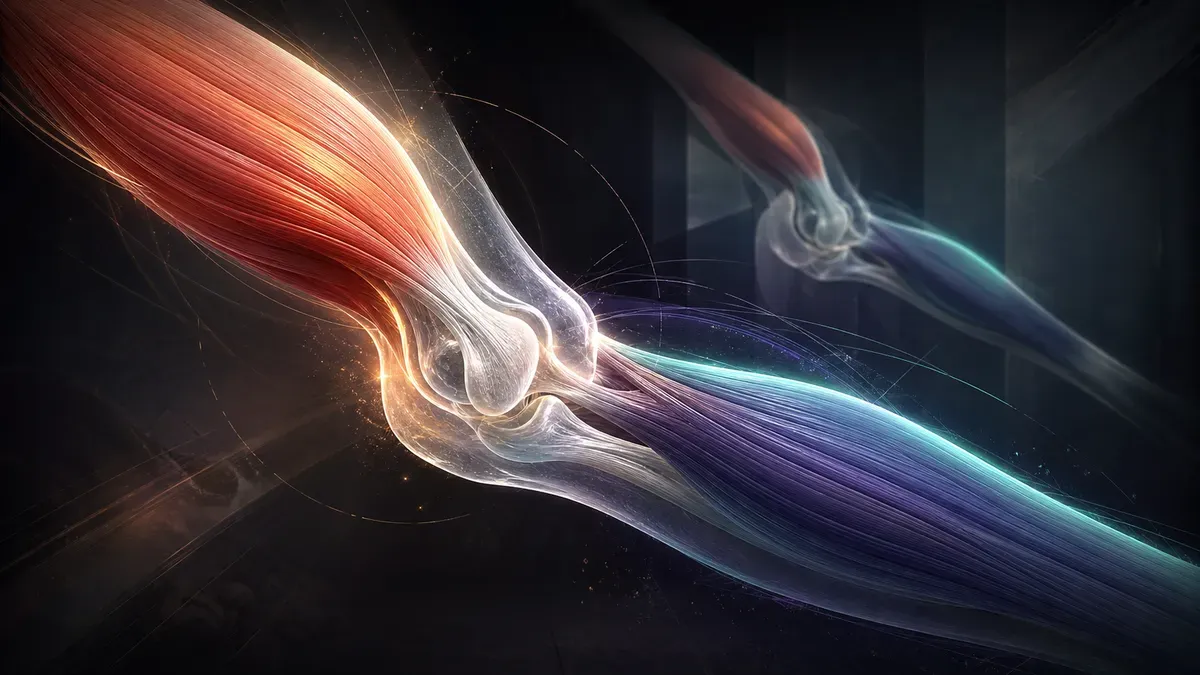
Agonist and antagonist muscles: how opposing pairs control movement
Learn how agonist and antagonist muscles control movement, when they co-contract, and how to pair exercises for balanced, time-efficient strength training.
Agonist and antagonist muscles are not permanent rival teams. They are task-specific roles: the agonist produces the main joint action, while the antagonist can lengthen, brake, or contract alongside it to control the same movement. The roles can reverse when the direction changes.
That distinction is useful in the gym, but it is even more useful in daily life. Every controlled reach, step, squat, and stair descent depends on the nervous system coordinating muscles that create motion with muscles that restrain it.
Quick answer
In an elbow curl, the elbow flexors led by the biceps and brachialis act as agonists while the triceps opposes elbow flexion. When you press the weight back down by actively extending the elbow, the triceps becomes the agonist and the elbow flexors become antagonists. During real movement, both sides may be active at once to improve control or joint stiffness.
For training, you do not need to make every opposing muscle pair perfectly equal. A better goal is to train all major movement patterns with recoverable volume, appropriate technique, and exercise choices that fit your body and goals.
Key facts
- Agonist muscles generate the joint action required by a task.
- Antagonist muscles oppose, brake, or refine that joint action.
- Reciprocal inhibition reduces opposing activation when efficient movement requires it.
- Muscle co-contraction increases joint stiffness and movement control when stability matters.
- Agonist-antagonist paired sets shorten workouts without clearly sacrificing long-term strength or muscle growth.
Agonist and antagonist describe jobs, not fixed anatomy
A muscle can perform several actions because its line of pull may cross more than one joint or change with joint position. That is why a list that labels one muscle as “the agonist” and another as “the antagonist” is incomplete unless it also names the movement, direction, and phase.
Consider the biceps brachii. It helps flex the elbow, so it can be an agonist during the lifting phase of a curl. It also helps supinate the forearm, turning the palm upward. During controlled elbow extension, the same muscle may work eccentrically to brake the movement rather than simply switching off.
Four role terms make movement easier to analyze:
| Role | What it does | Practical question |
|---|---|---|
| Agonist or prime mover | Produces most of the required joint torque | Which muscle action moves the load in the intended direction? |
| Antagonist | Produces torque in the opposite direction | Which muscle could reverse or brake this joint action? |
| Synergist | Assists the action or prevents an unwanted secondary action | Which muscles help the prime mover do its job cleanly? |
| Fixator or stabilizer | Holds one body segment steady so another can move | What must remain controlled while the movement occurs? |
These are functional descriptions, not a ranking of which muscles matter. A stabilizer working isometrically may be essential even though it creates little visible motion.
Common agonist-antagonist examples
The table below simplifies each movement to its main joint action. Compound exercises involve several joints, so different pairs work simultaneously.
| Joint action | Typical agonist group | Typical antagonist group | Exercise example |
|---|---|---|---|
| Elbow flexion | Biceps brachii, brachialis, brachioradialis | Triceps brachii | Curl |
| Elbow extension | Triceps brachii | Elbow flexors | Push-down or pressing lockout |
| Knee extension | Quadriceps | Hamstrings | Leg extension or rising from a chair |
| Knee flexion | Hamstrings | Quadriceps | Leg curl |
| Ankle plantar flexion | Gastrocnemius and soleus | Tibialis anterior and other dorsiflexors | Calf raise |
| Ankle dorsiflexion | Tibialis anterior and other dorsiflexors | Plantar flexors | Toe raise |
| Shoulder horizontal adduction | Pectoralis major and anterior deltoid | Posterior shoulder and horizontal abductors | Bench press |
| Shoulder horizontal abduction | Posterior deltoid and scapular retractors | Pectoralis major and anterior shoulder | Row |
For a practical look at how elevation, retraction, and upward rotation share the work, use the trapezius exercise guide to compare shrugs, rows, carries, Y raises, and wall slides.
A squat shows why simple pair charts have limits. The quadriceps extend the knee, the gluteal muscles extend the hip, the calf muscles help control the ankle, and the trunk muscles resist collapse. The hamstrings can assist hip extension while also opposing knee extension. One muscle group can therefore be a synergist at one joint and an antagonist at another during the same repetition.
Hip adduction shows the same fluid roles: the adductors can draw the thigh toward the midline, stabilize the pelvis, or control the leg as it moves outward. Our adductor exercise guide turns those functions into six progressive strength variations.
How the nervous system coordinates opposing muscles
Muscles pull; they do not push. The nervous system must continuously blend activation across opposing groups to start movement, set speed, absorb force, and stop the limb at the intended position.
Reciprocal inhibition supports efficient motion
When a muscle spindle detects stretch, sensory input can excite motor neurons serving the stretched muscle and, through an inhibitory interneuron, reduce activity in the opposing group. This spinal arrangement is called reciprocal innervation. The classic reflex circuit is described in the NCBI Neuroscience textbook.
The everyday version is not a binary on-off switch. Reciprocal inhibition can reduce unnecessary resistance, but antagonist activity rarely disappears completely in demanding movement. Speed, external load, uncertainty, pain, skill, and the need for precision all change the pattern.
Co-contraction trades efficiency for control
Co-contraction means the agonist and antagonist are active at the same time. Because their torques partly oppose each other, the net movement may be smaller than the muscular effort suggests. That can cost energy, but it can also increase apparent joint stiffness and help the body resist an unexpected disturbance.
A major review of muscle coactivation emphasizes that its effect depends on the task and the mechanical system. More co-contraction is not automatically good or bad. Bracing before a heavy lift, landing from a jump, learning a new skill, and walking on an unstable surface all demand different blends of mobility and stiffness.
Eccentric control is not the same as antagonism
An eccentric contraction occurs when an active muscle lengthens under tension. An antagonist is defined by the direction of its joint torque relative to the task. Those concepts overlap sometimes, but they are not interchangeable.
During the lowering phase of a curl, the elbow flexors can remain the main load-controlling muscles while lengthening eccentrically. The triceps does not automatically become the prime mover just because the forearm travels downward. If controlled deceleration is a priority, our guide to eccentric training after 40 explains how to progress the lowering phase safely.
Does balanced training require equal work for opposing muscles?
No scientific rule says every push must be matched by exactly one pull or that opposing muscle groups must produce identical strength. Anatomy, sport demands, injury history, exercise selection, and daily posture all influence an appropriate program.
The useful idea behind “balance” is broader:
- Train the major actions your body needs rather than repeating only your favorite lifts.
- Preserve enough pulling, posterior-chain, calf, dorsiflexor, trunk, and single-leg work to support the activities you perform.
- Progress volume only while technique, pain response, and recovery remain acceptable.
- Change the exercise when joint irritation persists instead of assuming one weak antagonist is the sole cause.
The 2026 American College of Sports Medicine position stand distilled 137 systematic reviews and more than 30,000 participants. Its central message is that consistency and goal-specific volume matter more for most healthy adults than complicated techniques. ACSM recommends training all major muscle groups at least twice weekly, with load and volume adjusted to strength, muscle growth, power, or physical-function goals. See the ACSM summary of the updated resistance-training guidance.
For the broader anatomy-to-session map, our guide to major muscle groups and movement patterns helps you check knee-dominant, hip-dominant, pushing, pulling, carrying, and trunk work without forcing equal set counts.
If you are building a complete routine rather than fixing one movement, use our exercise guide for longevity as the weekly framework and our comparison of strength training and cardio after 40 to balance training modes.
How to pair opposing exercises
An agonist-antagonist paired set alternates exercises whose main actions oppose each other. A horizontal press followed by a row is the clearest example. The chest and front shoulder work hard during the press while the upper-back muscles receive relative local recovery; the emphasis reverses during the row.
This setup can compress a workout, but it is not magic. A 2025 systematic review and meta-analysis of 19 studies found that supersets shortened sessions and produced chronic strength and hypertrophy outcomes similar to traditional sets. They also increased perceived exertion and metabolic demand. In subgroup analysis, agonist-antagonist pairings maintained training volume better than pairings that repeatedly stressed the same muscle group.
Use paired sets when time is the limiting factor and technique remains stable. Use traditional sets with longer rest when maximal force, power, a technically demanding lift, or symptom monitoring is the priority.
Practical pairings
| Pair | Exercise A | Exercise B | Main training logic |
|---|---|---|---|
| Horizontal push-pull | Dumbbell press or push-up | Cable, machine, or dumbbell row | Alternates chest-dominant pressing with upper-back pulling |
| Vertical push-pull | Overhead press | Pull-down or assisted pull-up | Alternates shoulder elevation with shoulder-girdle pulling |
| Elbow flexion-extension | Curl | Cable or band triceps extension | Simple single-joint pairing with low setup cost |
| Knee flexion-extension | Leg curl | Leg extension | Direct local pairing; useful when machines are appropriate |
| Ankle pair | Calf raise | Toe raise | Trains plantar flexors and dorsiflexors through distinct actions |
For a complete progression from those elbow pairings to a two-day routine, the arm exercise guide explains how to count compound pulling and pressing before adding curls and extensions.
If the assisted pull-up is the vertical-pull half of your pair, use this pull-up form and progression guide to choose assistance, range, and stopping points without turning the set into a swing.
Lower-body compound pairings require more caution. A squat and a Romanian deadlift are not a clean antagonist pair; both heavily tax the hips, trunk, and grip. Pairing them with minimal rest may turn a strength session into a conditioning test.
A time-efficient starting template
For a healthy adult already familiar with the movements:
- Perform exercise A for 6-12 controlled repetitions.
- Transition to exercise B without rushing and perform 6-12 repetitions.
- Rest 60-120 seconds after the pair.
- Repeat for 2-3 rounds.
- Stop the set when the next repetition would require a clear technique change.
Choose loads that leave roughly two or three technically sound repetitions in reserve at first. Longer rest is appropriate for heavier work. Advanced methods are optional; the best pairing is one you can perform consistently without sacrificing execution.
Agonist-antagonist coordination across adulthood
Strength loss with age is not explained by muscle size alone. Neural drive, motor-unit behavior, balance confidence, and the coordination between opposing muscles also influence force and movement quality. A systematic review in older adults found that strength training improved voluntary activation in some lower-limb muscle groups, while results for changes in antagonist coactivation were inconsistent.
That uncertainty matters. Trying to eliminate all co-contraction would be a mistake because some opposing activity can stabilize a joint. Assuming that more stiffness is always protective would also be a mistake because excessive co-contraction can make movement costly and slow.
A small 2026 randomized study of healthy older adults reported that eight weeks of conventional strength training improved elbow-flexion force and the relative coordination between biceps and triceps. The finding is promising, but the sample was small and does not justify prescribing a universal “co-contraction score.” Read the study abstract and limitations.
For healthy aging, focus on observable capacity: controlled repetitions, progressive strength, confidence through range, and the ability to produce force without unnecessary tension. Balance training after 50 and joint-friendly exercise after 40 add the stability and load-management pieces that a muscle-pair chart cannot capture.
Use SuperAge to track the outcomes that matter
Knowing which muscles oppose each other helps you design a session. It does not tell you whether the whole program is improving your health.
SuperAge helps connect training to broader trends such as activity, recovery, cardiovascular fitness, and biological-age inputs. Use those trends alongside performance markers such as repetitions, load, range of motion, and daily function. A single workout or one sore muscle should not determine the conclusion.
Want a broader view of how your routine is changing over time? Download SuperAge and review training, recovery, and health signals together.
Common mistakes to avoid
Treating the labels as permanent
Name the joint action and phase before naming the agonist. The same muscle can change roles as direction, load, or body position changes.
Assuming soreness proves an imbalance
Delayed-onset soreness usually reflects unfamiliar loading or volume. It does not diagnose a strength ratio, movement disorder, or injury.
Forcing a one-to-one push-pull ratio
A simple ratio ignores exercise difficulty, range, weekly sets, sport practice, and multi-joint overlap. Track the actual work and the response to it.
Pairing every heavy lift
Supersets raise session density. If breathing or systemic fatigue degrades a technical compound lift, separate the exercises and rest longer.
Ignoring stabilizers and movement quality
Prime movers do not work alone. Trunk, shoulder-blade, hip, foot, and grip control can determine whether force reaches the intended joint safely.
For a practical example, our Russian twist form guide shows how the obliques rotate while the rest of the trunk controls position.
Using “muscle balance” as a diagnosis
Persistent pain, weakness, numbness, swelling, loss of motion, or repeated joint instability deserves individualized assessment. A clinician or physiotherapist can examine the relevant joint, nervous system, training load, and technique instead of guessing from an opposing-pair chart.
Frequently asked questions
What is the difference between an agonist and an antagonist muscle?
The agonist creates the main joint action required by the task. The antagonist can create the opposite action and may lengthen, brake, or co-contract to refine control.
Do antagonist muscles relax completely?
Not necessarily. Reciprocal inhibition can reduce antagonist activity, but co-contraction is common when a movement requires stiffness, precision, speed control, or protection from disturbance.
Are biceps and triceps always antagonists?
They create opposing torques at the elbow, but their exact roles depend on the task. The biceps can lead elbow flexion, the triceps can lead elbow extension, and both may contribute to control.
Are antagonist supersets better for muscle growth?
Current evidence suggests they can produce strength and hypertrophy outcomes similar to traditional sets while saving time. They are not clearly superior, and the higher effort may require more recovery.
Can weak antagonist muscles cause pain?
Strength and coordination can influence movement, but pain rarely has one universal cause. Symptoms may also involve training dose, technique, tissue irritation, previous injury, sleep, stress, or a medical condition.
How often should I train opposing muscle groups?
For general fitness, train all major muscle groups at least twice per week and adjust volume to your goal and recovery. The World Health Organization also recommends muscle-strengthening work for major muscle groups on two or more days weekly.
Key takeaways
- Agonist and antagonist are roles defined by a specific movement, not permanent muscle labels.
- Opposing muscles can alternate to create motion or co-contract to improve control and joint stiffness.
- Eccentric contraction and antagonist action describe different aspects of movement.
- Balanced training means covering major movement patterns with appropriate volume, not forcing perfect symmetry.
- Agonist-antagonist paired sets can save time, but maximal or highly technical work may benefit from traditional rest.
- Persistent pain or loss of function needs assessment, not a self-diagnosed muscle imbalance.
References
- American College of Sports Medicine. Resistance training prescription for muscle function, hypertrophy, and physical performance in healthy adults: 2026 guidance summary. 2026.
- Krzysztofik M, et al. Superset versus traditional resistance training prescriptions: a systematic review and meta-analysis. Sports Medicine. 2025.
- Robbins DW, et al. Agonist-antagonist paired set resistance training: a brief review. Journal of Strength and Conditioning Research. 2010.
- Latash ML. Muscle coactivation: definitions, mechanisms, and functions. Journal of Neurophysiology. 2018.
- Purves D, et al. The spinal cord circuitry underlying muscle stretch reflexes. Neuroscience. NCBI Bookshelf.
- Arnold P, Bautmans I. The influence of strength training on muscle activation in elderly persons: a systematic review and meta-analysis. Experimental Gerontology. 2014.
- Yao WX, et al. Motor imagery and resistance training improve strength in older adults through distinct effects on agonist-antagonist coordination. Frontiers in Psychology. 2026.
- World Health Organization. Physical activity recommendations.
Related Articles
Deadlift form: muscles worked, benefits, and safe progression
Learn deadlift form step by step, muscles worked, safe progressions, common mistakes, variations, and programming for strong, confident lifting at any age.