Russian twist exercise: proper form, safety, and progressions
Learn Russian twist exercise form, muscles worked, back-safe progressions, common mistakes, and alternatives for building controlled rotational core strength.
Quick answer
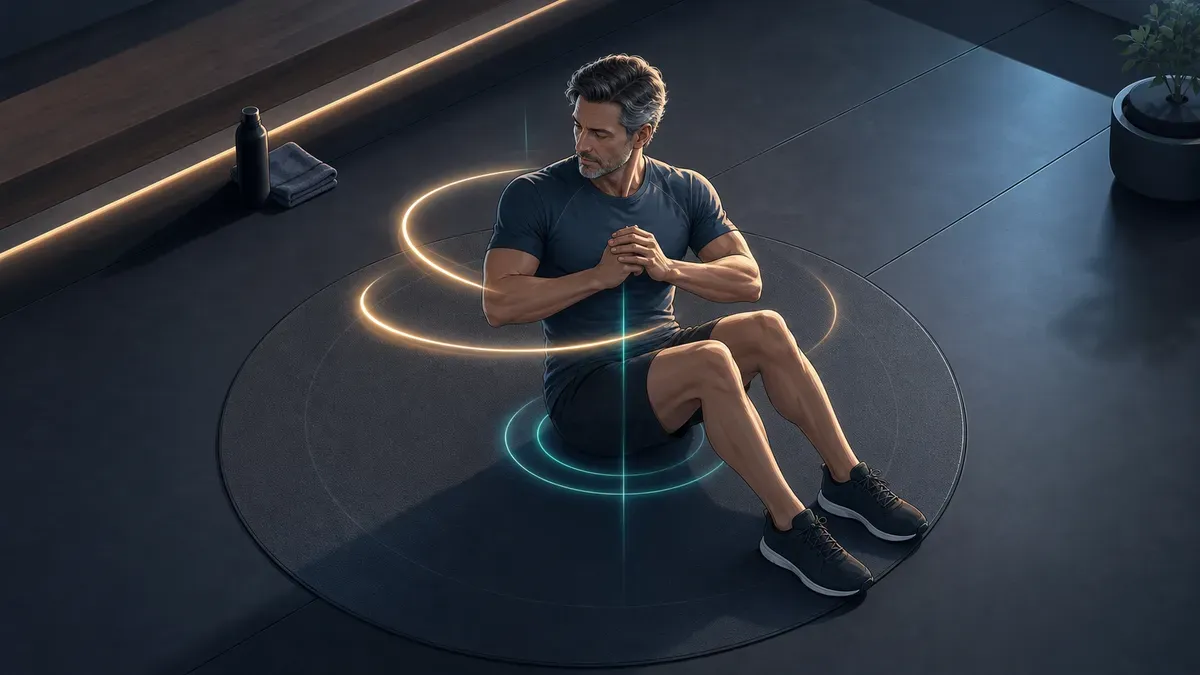
The Russian twist is a seated core exercise in which you hold a controlled backward lean and rotate your rib cage from side to side. It trains the internal and external obliques, rectus abdominis, deeper trunk stabilizers, and hip flexors, but it is neither essential nor automatically harmful.
Start with your heels on the floor, spine comfortably long, hands together, and no added weight. Brace as if preparing for a gentle push, rotate through a range you can control without rounding farther, and stop the set when your pelvis rocks, your shoulders race ahead of your trunk, or you feel back pain. People with current back pain, radiating symptoms, osteoporosis-related restrictions, a recent abdominal or spinal procedure, or pregnancy-related concerns should obtain individualized guidance rather than self-prescribing loaded twists.
Key facts
- The Russian twist combines an isometric seated lean with controlled trunk rotation.
- The oblique muscles produce rotation while the remaining trunk muscles resist unwanted motion.
- A heel-supported setup reduces the balance and hip-flexor demand of the exercise.
- A smaller controlled range protects technique better than touching the floor at any cost.
- Anti-rotation exercises provide a practical alternative when repeated spinal rotation is uncomfortable.
The useful question is not whether the Russian twist is universally “good” or “bad.” Exercise risk depends on the person, current symptoms, range, load, speed, fatigue, and training history. The same movement can be a manageable endurance drill for one person and a poor choice for another.
This guide treats the Russian twist as one optional tool inside a complete strength program. To train anti-extension, lateral stability, carries, and progression alongside rotation, use our complete core strength training guide. It does not diagnose back pain or replace assessment by a qualified clinician.
What the Russian twist actually trains
During a rightward rotation, the left external oblique and right internal oblique help turn the trunk, while muscles on both sides co-contract to control the movement. The rectus abdominis helps maintain the backward lean, the transverse abdominal region contributes to pressure and trunk control, and the spinal extensors resist collapse. Hip flexors also work because the torso and legs form a lever around the pelvis.
Laboratory research supports that trunk rotation is a coordinated task rather than an isolated “side abs” movement. In a small three-dimensional motion and electromyography study, internal oblique and transverse abdominal activity increased during early ipsilateral lumbar rotation, while external oblique activity increased during contralateral rotation (Takahashi et al., 2016). Another study found that rotation speed changes torque and the co-activation pattern of agonist and antagonist trunk muscles (Kumar et al., 2014).
Those findings explain the exercise; they do not prove that Russian twists prevent injury, reduce abdominal fat, or outperform other core exercises. Surface EMG records electrical activity, not long-term strength, pain, athletic performance, or lifespan. Direct trials of the Russian twist itself are scarce, so claims should remain modest.
If you want a broader explanation of how muscles exchange movement and stabilizing roles, see our guide to agonist and antagonist muscles.
Is the Russian twist bad for your back?
Not inherently, but the usual setup can concentrate several demands at once: a seated backward lean, abdominal fatigue, spinal rotation, and sometimes an external load held far from the body. Poorly controlled repetitions add momentum and may combine increasing spinal flexion with end-range rotation.
A laboratory study of adolescent rowers found that lower-lumbar axial rotation was smaller in end-range flexion and extension than in a neutral posture (Burnett et al., 2008). That result does not establish an injury threshold for Russian twists, but it supports a practical cue: do not force rotation after losing a comfortable trunk position.
The opposite extreme is also misleading. Avoiding every spinal movement is not a universal treatment. The 2021 low-back-pain clinical practice guideline recommends exercise options that can include trunk strengthening, endurance, specific activation, movement control, and—in suitable chronic cases—trunk mobility (George et al., 2021). Exercise selection should match symptoms and goals rather than a social-media rule.
Use this decision:
- Pain-free and controlled: a modest Russian twist variation may be reasonable.
- Technique fails before the core tires: regress the lever, range, or duration.
- Local discomfort appears repeatedly: choose a pain-free alternative and review your setup.
- Pain radiates, numbness or weakness appears, or symptoms escalate: stop and seek clinical assessment.
Training around a painful movement is not the same as treating the cause. Our joint-friendly exercise guide explains how to adjust range, load, and volume without assuming that all discomfort means structural damage.
A readiness test before your first repetition
The Russian twist is not the best first core exercise for everyone. Before using it, check whether you can hold the starting position without strain.
- Sit with knees bent and heels on the floor.
- Cross your arms over your chest.
- Lengthen through the crown of your head and lean back slightly.
- Hold for 20 seconds while breathing normally.
- Keep the rib cage stacked over the pelvis without collapsing or sharply arching.
You are ready to test a small-range twist if you can maintain that position with steady breathing, no back pain, and no shaking that immediately changes your posture. If not, begin with dead bugs, bird dogs, short side planks, or a standing band anti-rotation hold.
The goal is capacity, not a pass-fail judgment. A six-week randomized study in trained men found that both dynamic and anti-movement core programs improved trunk-muscle measures, with anti-movement training providing a viable alternative rather than an inferior fallback (Genc et al., 2025).
How to do a Russian twist with proper form
Use the easiest version that lets the torso move as one controlled unit.
1. Build the base
Sit on a mat with knees bent, feet hip-width apart, and heels planted. Place your hands together in front of your sternum. Keep your chin gently tucked and shoulders away from your ears.
2. Find a sustainable lean
Lean back only until the abdominal muscles engage. Think “long spine,” not “military posture.” You do not need to flatten every natural curve, and you should not lean so far that the hip flexors dominate or the lower back pinches.
3. Brace without holding your breath
Create gentle tension around the trunk as if preparing to receive a light push. Inhale before the repetition; exhale gradually as you rotate. Breathing is part of control, not a contest to keep the abdomen rigid.
4. Rotate the rib cage
Turn your sternum and shoulders together while keeping the pelvis mostly quiet. Let your eyes follow the hands, but do not reach with the arms alone. Stop before your posture changes, then return through center and rotate to the other side.
5. Use a slow rhythm
Take roughly one to two seconds to rotate, pause briefly, and take one to two seconds to return. A right-and-left sequence can count as one full repetition, but state your counting method in your training log so progression remains comparable.
6. End the set on technique
Stop when you cannot keep the same range, breathing, and torso control. For a first session, try 2 sets of 6–8 controlled repetitions per side with 45–75 seconds of rest. More repetitions are not better when each one becomes a faster arm swing.
Seven common mistakes and how to fix them
| Mistake | What it changes | Better cue |
|---|---|---|
| Chasing a floor touch | Encourages excess range and shoulder reach | Rotate only as far as the rib cage can control |
| Rounding more on every rep | Turns fatigue into repeated posture loss | Reset tall through center |
| Moving only the hands | Reduces meaningful trunk rotation | Keep hands in front of the sternum |
| Throwing a heavy weight | Adds momentum and a longer lever | Master bodyweight, then use 2–5 lb (1–2 kg) |
| Lifting both feet too soon | Increases balance and hip-flexor demand | Keep heels planted until control is automatic |
| Racing through the center | Removes the hardest deceleration task | Pause briefly at center and each endpoint |
| Holding the breath | Hides effort and can raise pressure unnecessarily | Exhale through the turn |
Do not use soreness as proof that the exercise worked. Delayed soreness reflects an unfamiliar load more than exercise quality; our guide to DOMS and recovery explains when soreness is expected and when symptoms deserve more attention.
A four-level progression ladder
Progress one variable at a time. Range, lean, foot position, speed, load, and set length all change difficulty.
Level 1: Heel-supported rotation
Keep both heels down, cross the arms, and use a short range. Perform 2 sets of 6 repetitions per side. This version teaches the rib-cage-and-pelvis relationship with the smallest balance demand.
Level 2: Long-arm bodyweight twist
Extend the hands farther from the chest without holding a load. The longer lever increases demand even though body mass has not changed. Use 2–3 sets of 8 repetitions per side.
Level 3: Light loaded twist
Hold a 2–5 lb (1–2 kg) medicine ball, plate, or other compact object close to the chest. Increase load only after every repetition looks the same. You do not need to touch the object to the floor.
Level 4: Feet-elevated twist
Lift the feet only if you can keep the pelvis and trunk controlled. This is a balance and hip-flexor progression, not automatically a better oblique exercise. Return the heels to the floor if the lower back rounds, the legs sway, or breathing becomes erratic.
Earn each level across at least two symptom-free sessions. If technique deteriorates, return to the previous variation rather than compensating with speed.
Alternatives for different goals
The best alternative preserves the training goal without preserving the aggravating feature.
| Goal | Alternative | Why it may fit |
|---|---|---|
| Oblique endurance | Side plank | Trains the lateral trunk with little repeated rotation |
| Anti-rotation control | Standing band press-out | Teaches the trunk to resist a turning force |
| Cross-body coordination | Bird dog | Couples shoulder and hip motion with a stable trunk |
| Controlled rotation | Half-kneeling cable or band chop | Allows load and range to be adjusted while upright |
| Beginner trunk control | Dead bug | Trains bracing while the limbs move |
| Sport transfer | Light medicine-ball throw | Develops faster whole-body rotation after a strength base |
EMG research in 63 adults found that the lateral plank activated both internal and external obliques and was a practical independent exercise, although shoulder problems may require another option (Kinney et al., 2020). The point is not that the side plank always wins. It is that several exercises can train overlapping capacities.
Choose by purpose:
- use anti-rotation work when you need to resist an external force;
- use slow rotation when you need control through a tolerable range;
- use throws only when you need rotational power and already control the deceleration;
- use simpler bracing drills when symptoms or fatigue make rotation inconsistent.
How to program Russian twists
For general fitness, place the exercise after major strength movements, when it will not pre-fatigue the trunk for heavy squats, hinges, carries, or presses. One to three sessions per week is usually enough for an accessory movement.
| Training stage | Dose | Progression rule |
|---|---|---|
| Learning | 2 × 6–8 per side, bodyweight | Add range only while the pelvis stays quiet |
| Building endurance | 2–3 × 8–12 per side | Add repetitions before load |
| Building strength | 2–3 × 6–10 per side, light load | Increase by the smallest available step |
| Sport preparation | Combine controlled rotation and anti-rotation | Add speed only after strength and braking control |
Keep at least two repetitions in reserve while learning. The updated 2026 American College of Sports Medicine position stand concludes that progressive resistance training improves strength and physical function, while consistency matters more than unnecessary complexity for most healthy adults (Currier et al., 2026). A core accessory does not need an elaborate loading system to be useful.
The Russian twist also cannot replace a balanced program. Adults benefit from aerobic activity, major-muscle-group strength work, balance, and mobility. Use our complete exercise guide for longevity to place core work inside that larger week, and our recovery-between-workouts guide to avoid stacking hard sessions without adaptation time.
What results should you expect?
With consistent practice, you may improve local trunk endurance, control during rotation, and tolerance of the seated lean. Those changes can support other training, but a Russian twist has no unique claim on health or performance.
A 2023 systematic review and meta-analysis found that core training can improve outcomes such as balance, throwing or hitting performance, and jumping in healthy participants, with results varying by program and population (Rodríguez-Perea et al., 2023). A 2025 meta-analysis likewise reported stronger effects for foundational qualities than for many sport-specific outcomes, with substantial heterogeneity between studies (Yu et al., 2025).
That evidence concerns core-training programs, not proof that one exercise causes the improvement. For abdominal definition, total energy balance and overall resistance training matter far more than high-repetition twisting; an exercise cannot selectively remove fat from the waist.
For healthy aging, trunk training may be one useful component. A randomized trial in older adults found that a multi-exercise trunk program improved trunk muscle size, strength, and several functional tests compared with walking and balance training (Shahtahmassebi et al., 2019). Again, the intervention was broader than Russian twists.
Track the adaptation, not the rep count
The most useful record is not a heroic set total. Track the version used, repetitions per side, load, technique quality, pain during the session, and how your back and hips feel over the next 24 hours. A stable exercise dose with improving control is a clearer signal than rapidly adding weight.
SuperAge can help you interpret core work within the habits that have stronger links to long-term health: weekly activity, cardiorespiratory fitness, strength, sleep, and recovery. It does not diagnose the cause of pain, and a biological-age score cannot clear you for an exercise.
When you want the wider trend rather than a single workout, download SuperAge and review whether your training pattern is becoming more consistent and recoverable.
When to stop and get help
Stop the exercise if it produces sharp, catching, electric, or radiating pain; new numbness or weakness; loss of coordination; dizziness; chest symptoms; or pain that continues to intensify after the set. Ordinary muscular effort should settle when the work stops and should not require you to push through altered movement.
Seek urgent medical care for back pain accompanied by new bladder or bowel changes, numbness around the genitals or anus, weakness or numbness in both legs, fever with severe back pain, or symptoms after significant trauma. The US National Institute of Arthritis and Musculoskeletal and Skin Diseases lists urinary difficulty, leg weakness or numbness, fever, and trauma among reasons for medical assessment (NIAMS).
Ask a physiotherapist or other qualified clinician to individualize exercise if you have persistent back pain, a known disc or spinal condition, osteoporosis or fracture risk, recent surgery, an abdominal-wall injury, or symptoms that repeatedly return with rotation. The correct modification depends on the diagnosis, irritability, and goal.
Key takeaways
- The Russian twist trains controlled trunk rotation and a sustained seated lean.
- Its main contributors include the internal and external obliques, rectus abdominis, deeper stabilizers, spinal extensors, and hip flexors.
- Start with heels down, no load, a small range, slow speed, and steady breathing.
- Do not force a floor touch or add weight after posture begins to change.
- The exercise is optional; side planks, dead bugs, bird dogs, and anti-rotation presses train overlapping capacities.
- Direct Russian-twist outcome research is limited, so avoid claims about spot fat loss, guaranteed injury prevention, or unique longevity benefits.
- Pain, radiating symptoms, numbness, weakness, or bladder and bowel changes require stopping and appropriate medical attention.
FAQ
What muscles do Russian twists work?
Russian twists primarily challenge the internal and external obliques while the rectus abdominis, transverse abdominal region, spinal extensors, and hip flexors help maintain posture and control.
Should your feet be on the floor during Russian twists?
Beginners should usually keep their heels on the floor. Lifting the feet increases balance and hip-flexor demand, but it does not automatically make the exercise more effective for the obliques.
How many Russian twists should a beginner do?
Begin with 2 sets of 6–8 controlled repetitions per side. Stop before posture or breathing changes, then add repetitions gradually across symptom-free sessions.
Should you use a weight for Russian twists?
Only after bodyweight repetitions are consistent. Start with 2–5 lb (1–2 kg) held close to the chest and increase by the smallest available step without adding speed or range.
Can Russian twists reduce love handles?
No exercise selectively removes fat from one area. Russian twists can train trunk muscles, while changes in waist fat depend mainly on overall energy balance, full-body activity, and individual biology.
Are Russian twists safe with lower-back pain?
They may be inappropriate during an active flare or when rotation reproduces symptoms. Choose a pain-free alternative and get individualized clinical guidance for persistent, radiating, or neurologic symptoms.
What is the best alternative to Russian twists?
The answer depends on the goal. A side plank targets lateral trunk endurance, a standing band press-out trains anti-rotation, and a dead bug trains limb movement with trunk control.
References
- Takahashi M, et al. Relationship between spinal range of motion and trunk muscle activity during trunk rotation. Journal of Physical Therapy Science. 2016;28(2):589–595.
- Kumar S, et al. Angular velocity affects trunk muscle strength and EMG activation during isokinetic axial rotation. BioMed Research International. 2014;2014:623191.
- Burnett A, et al. Lower lumbar spine axial rotation is reduced in end-range sagittal postures when compared to a neutral spine posture. Manual Therapy. 2008;13(4):300–306.
- George SZ, et al. Interventions for the management of acute and chronic low back pain: revision 2021. Journal of Orthopaedic & Sports Physical Therapy. 2021;51(11):CPG1–CPG60.
- Genc H, et al. Neuromuscular activation following anti-movement and dynamic core training. European Journal of Applied Physiology. 2025.
- Kinney AL, et al. Surface electromyography of the internal and external oblique muscles during isometric tasks targeting the lateral trunk. Journal of Sport Rehabilitation. 2021;30(2):255–260.
- Currier BS, et al. Resistance training prescription for muscle function, hypertrophy, and physical performance in healthy adults. Medicine & Science in Sports & Exercise. 2026;58(4):851–872.
- Rodríguez-Perea Á, et al. Core training and performance: a systematic review with meta-analysis. Biology of Sport. 2023;40(4):975–992.
- Yu T, et al. The impact of core training on overall athletic performance in different sports. BMC Sports Science, Medicine and Rehabilitation. 2025;17:112.
- Shahtahmassebi B, et al. Trunk exercise training improves muscle size, strength, and function in older adults. Scandinavian Journal of Medicine & Science in Sports. 2019;29(7):980–991.
- World Health Organization. WHO guidelines on physical activity and sedentary behaviour. 2020.
- National Institute of Arthritis and Musculoskeletal and Skin Diseases. Back pain: symptoms, types, and causes.
Related Articles
How to get visible abs: train your core without chasing a six-pack
Learn what makes abs visible, why crunches cannot target belly fat, and how to combine core training, full-body strength, and sustainable eating.