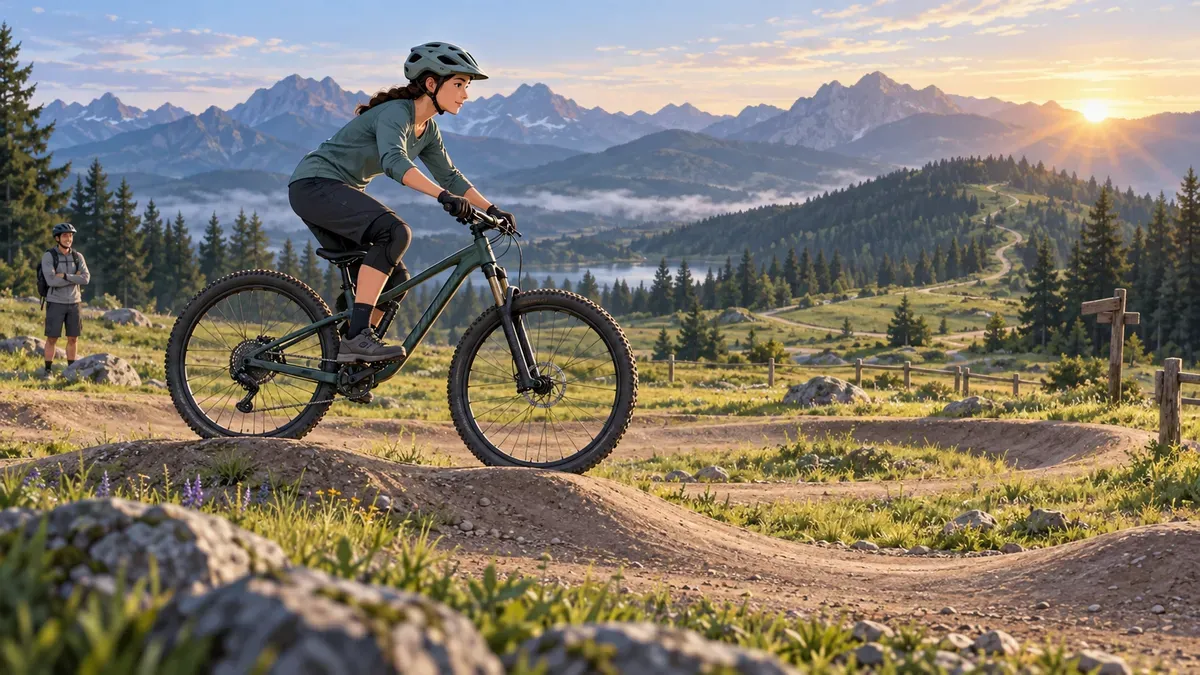
Mountain bike training for beginners: an eight-week plan
Build mountain bike fitness, strength, and trail skills with a clear eight-week beginner plan, practical effort cues, recovery checks, and safe progression.
Quick answer
A useful beginner mountain bike training plan combines two easy aerobic rides, one short skills practice, and two brief strength sessions most weeks. After two foundation weeks, add one controlled interval or hill session. Increase only one major variable at a time—duration, technical difficulty, or intensity—and keep at least one complete rest day. (How to ride a mountain bike: beginner technique guide)
The eight-week plan below is for a healthy adult who can already ride a bicycle for about 30 minutes and stop, steer, and change gears safely on easy ground. It is not a race prescription or a substitute for coaching, medical care, a bike fit, or trail-specific judgment. If you are completely inactive, returning after illness or injury, or have symptoms with exercise, start with easier activity and seek appropriate professional guidance.
Key facts
- Easy aerobic riding builds repeatable endurance by accumulating work you can recover from between sessions.
- Technical practice improves trail control by rehearsing braking, vision, balance, and gear choice before fatigue blurs them.
- Strength training raises force capacity by loading the legs, hips, trunk, and upper body beyond normal pedaling demands.
- Short intervals prepare changing terrain by exposing the rider to controlled surges without turning every ride into a test.
- Recovery converts training into adaptation by giving fatigue time to fall before the next demanding session.
What mountain bike training needs to prepare
Mountain biking is not simply road cycling on dirt. Loose surfaces, short climbs, repeated accelerations, steering corrections, and isometric work through the hands, trunk, and legs make the effort irregular. A contemporary systematic review of Olympic cross-country racing found a strong aerobic demand combined with frequent short, high-intensity efforts and technically demanding sections (Protzen et al., 2026). Those athletes are not a template for a beginner, but the demand pattern explains why only riding hard or only lifting weights leaves gaps.
A balanced beginner plan develops four qualities:
- Aerobic durability: enough easy riding to keep breathing and pedaling controlled over the planned trail time.
- Short-effort capacity: enough reserve for a steep ramp, restart, obstacle, or brief acceleration.
- Whole-body strength: force and position through the hips, legs, trunk, shoulders, and hands.
- Technical economy: the ability to brake, corner, shift, scan, and absorb terrain without wasting energy.
Skill changes the cost of the trail. A fit rider who brakes too late, selects a poor gear, or stiffens over every root can fatigue faster than a less powerful rider who moves smoothly. That is why skills belong inside the weekly plan, not after fitness is “finished.”
Check your starting point before week one
Use a low-consequence area rather than a technical trail. You are ready for this plan when you can:
- ride continuously for 30 minutes at a conversational effort;
- start, stop, and look behind while holding a predictable line;
- use both brakes progressively without locking a wheel;
- shift into an easier gear before a gentle climb;
- stand briefly with level pedals and relaxed elbows;
- turn both directions at low speed;
- finish with no chest pain, faintness, unusual breathlessness, or worsening joint pain.
If the riding skills are missing, spend the first two weeks on flat practice and traffic-free paths. If the physical effort is the barrier, begin with 15 to 25 minutes of easy cycling or another comfortable aerobic activity. The World Health Organization advises inactive adults to start with small amounts and gradually increase frequency, intensity, and duration; its broader health target is 150–300 minutes of moderate aerobic activity or 75–150 minutes of vigorous activity per week, plus strength work on at least two days (WHO physical activity guidelines). A new rider does not need to reach that range in week one.
Before every trail session, inspect brakes, tires, wheels, axles, cockpit, pedals, chain, and shifting. Wear a correctly fitted certified helmet and equipment appropriate to the trail and local rules. Mechanical confidence is part of training quality.
Use effort, not speed, to control training
Off-road speed changes with slope, surface, turns, wind, tires, and skill, so miles per hour is a poor universal target. Use breathing and a 1–10 rating of perceived exertion (RPE):
| Effort | RPE | Breathing cue | Purpose |
|---|---|---|---|
| Very easy | 1–2 | Full conversation feels effortless | Warm-up, cooldown, recovery |
| Easy endurance | 3–4 | You can speak in complete sentences | Aerobic base and longer rides |
| Steady | 5–6 | Short sentences are comfortable | Sustained climbs and controlled tempo |
| Hard | 7–8 | Only a few words at a time | Short intervals after a base is established |
| Very hard | 9–10 | Talking is not practical | Not needed in this beginner plan |
The Centers for Disease Control and Prevention describes moderate effort as being able to talk but not sing, while vigorous effort limits speech to a few words (CDC intensity guide). Our RPE guide explains how to use perceived effort when heart rate lags, drifts, or becomes distorted by heat and stress.
Most weekly riding should feel easy. Technical terrain can push heart rate and concentration upward even when average speed is low. If an “easy” trail forces repeated hard surges, use a smoother path, fire road, indoor bike, or flatter loop for the endurance session.
The weekly structure
The default week uses four training days, two optional easy days, and at least one full rest day:
| Day | Session | Typical duration |
|---|---|---|
| Monday | Rest or gentle mobility | 0–20 min |
| Tuesday | Easy endurance ride | 30–75 min |
| Wednesday | Strength A | 25–40 min |
| Thursday | Skills practice; later add intervals | 30–60 min |
| Friday | Rest | — |
| Saturday | Trail endurance ride | 45–120 min |
| Sunday | Strength B or easy recovery spin | 20–40 min |
This is a sequence, not a law. Move days around to fit work, sleep, weather, trail access, and family life. Keep the hard interval day away from the longest trail ride when possible, and avoid stacking hard intervals, heavy strength, and technical riding on three consecutive days.
If you have only three days, combine a short strength session with the easy ride and keep the skills day plus the longer ride. If you have more time, add easy volume before adding another hard workout. Consistency matters more than a perfect calendar; our exercise-consistency guide can help turn the minimum plan into a repeatable routine.
The eight-week beginner MTB plan
Each ride begins with 8–12 easy minutes and ends with 5–10 easy minutes. “Trail ride” means the easiest local route that lets you stay in control. Trail ratings are relative to each network, so check the map, surface, features, weather, and local advice rather than trusting a color alone. The IMBA difficulty system is designed to support informed choices, not to guarantee that every green trail is equivalent.
| Week | Easy endurance | Skills or quality session | Long trail ride | Strength | Main goal |
|---|---|---|---|---|---|
| 1 | 30–40 min, RPE 3 | 25–30 min basic control | 45–60 min easy | 2 light sessions | Establish technique and routine |
| 2 | 35–45 min, RPE 3–4 | 30 min shifting and cornering | 55–70 min easy | 2 sessions | Add a little duration |
| 3 | 40–50 min easy | 4 × 2 min uphill at RPE 6, 3 min easy | 60–75 min easy | 2 sessions | Introduce controlled work |
| 4 | 30–40 min easy | 25–35 min skills only | 50–65 min easy | 1–2 lighter sessions | Absorb the first block |
| 5 | 45–60 min easy | 5 × 2 min at RPE 7, 3 min easy | 75–90 min easy | 2 sessions | Build repeatable climbing effort |
| 6 | 50–65 min easy | 3 × 4 min at RPE 7, 4 min easy | 90–105 min easy | 2 sessions | Extend endurance and control |
| 7 | 45–60 min easy | 6 × 90 sec at RPE 7–8, 3 min easy | 100–120 min easy | 1–2 sessions | Peak volume without racing |
| 8 | 30–45 min easy | 20–30 min relaxed skills | 60–90 min enjoyable benchmark ride | 1 light session | Reduce fatigue and review |
The week-four reduction is deliberate. Lower volume by roughly 20–30%, keep movement familiar, and finish wanting more. In week eight, use a familiar route to compare control, pacing, and recovery—not just speed. A benchmark is successful if you brake earlier, climb with steadier breathing, make fewer emergency shifts, and finish with usable energy.
If any week produces accumulating soreness, poor sleep, unusual irritability, declining coordination, or a clear performance drop, repeat the week or reduce it. Do not advance duration and trail difficulty together. A beginner can make excellent progress while remaining on easy terrain for all eight weeks.
The skills session: practice fresh, then add complexity
British Cycling’s beginner coaching sequence includes ready position, braking, pedaling and gear selection, cornering, and group riding (British Cycling coaching outline). Practise one or two skills per session in a quiet, open area:
Braking and ready position
Stand with level pedals, softly bent arms and legs, eyes forward, and enough room for the bike to move beneath you. Mark a stopping point. Approach slowly, apply both brakes progressively while the bike is straight, and stop without skidding. Repeat only while the movement stays calm.
Vision and cornering
Set two wide turns with safe markers. Look through the exit rather than at the front tire. Control speed before the turn, keep pressure stable through the feet, and choose a smooth line. Tighten the turn only after both directions feel predictable.
Shifting before the terrain changes
On a gentle rise, scan ahead, soften pedal pressure, make one shift, let the chain engage, and then rebuild force. Our mountain bike gear-shifting guide covers the scan–soften–click–drive sequence and common drivetrain mistakes.
Small terrain and line choice
Use a smooth roller, shallow rut, or small root that can be ridden with both wheels on the ground. Inspect it, identify the exit, and ride at a speed that leaves braking room. Stop when repeated attempts become worse. Fatigued practice teaches compensation.
Skills should progress from simple to combined: first braking, then braking before a corner; first a gear change, then a gear change before a climb. Jumps, drops, steep features, and high-consequence terrain deserve qualified coaching and a suitable progression. The downhill mountain biking guide provides a separate control-first pathway for gravity riding.
Strength training twice per week
Strength work supports force production and position, but it should not leave you too sore to steer or brake. A 2025 systematic review found that heavy strength training can improve several performance-related outcomes in endurance cyclists, although the studies involved trained riders and do not define one perfect beginner program (Pallarés et al., 2025). Beginners can start with moderate loads and excellent technique.
Choose one movement from each row:
| Pattern | Examples | MTB purpose |
|---|---|---|
| Squat | Box squat, goblet squat, sit-to-stand | Leg force and repeated standing |
| Hinge | Hip hinge, Romanian deadlift, bridge | Hip strength and terrain absorption |
| Single leg | Step-up, split squat, supported lunge | Side-to-side control and climbing |
| Pull | Cable row, band row, supported dumbbell row | Upper-back and braking posture |
| Push | Incline push-up, push-up, dumbbell press | Shoulder and arm capacity |
| Trunk/carry | Dead bug, side plank, suitcase carry | Position under changing forces |
In weeks 1–2, perform two sets of 6–12 controlled repetitions, stopping with about three good repetitions still available. In weeks 3–7, add a third set to two or three movements or increase load slightly—not both at once. Week 8 returns to one or two easy sets. Our strength-training frequency guide explains how to distribute sessions without crowding recovery.
Grip is involved in riding, but endless squeezing is not the answer. Relax the hands when the trail allows, keep wrists neutral, and let the legs and trunk share the work. Persistent numbness, weakness, or pain deserves a fit and clinical assessment rather than more grip exercises.
Intervals: add them only after the foundation
Weeks 3–7 include one quality session. Use a steady hill, nontechnical dirt road, or indoor bicycle so intensity does not compete with obstacle avoidance. The work interval should feel controlled, not maximal. Pedaling and breathing should settle during each recovery.
Cross-country mountain biking can demand repeated hard efforts, but elite race data should not be copied into a novice week. Intervals are a small dose that prepares changes in grade and pace. If you cannot keep the final repetition close to the first, end the set. If technical control deteriorates, move the workout to easier ground.
Do not add sprint intervals, threshold tests, and a hard group ride in the same week. Riders who already have consistent endurance can use the progressions in our HIIT cycling guide; true beginners benefit more from completing the modest sessions above.
Recovery, food, and hydration
Training improves performance only when the workload is recoverable. Keep at least one full rest day and protect sleep. Easy spins are optional; they should leave you fresher, not satisfy a need to “earn” recovery. Our guide to recovery between workouts explains why readiness is better judged from several signals than from one score.
For rides under about an hour, ordinary meals and water are often enough in comfortable conditions. Longer, hotter, or more demanding rides may need planned fluid, carbohydrate, and sodium according to duration, climate, sweat rate, and individual tolerance. Practise food and drink on ordinary days, not for the first time on a remote trail. Carry an emergency reserve appropriate to the route.
After training, eat a normal meal with carbohydrate, protein, fluids, and micronutrient-rich foods. Supplements are not a substitute for sufficient energy, sleep, or a progressive plan. Seek individualized advice for diabetes, gastrointestinal disease, eating-disorder history, kidney or heart disease, pregnancy, or medication that changes fluid or glucose management.
Stop riding and seek urgent care for chest pressure, fainting, severe or unusual breathlessness, signs of heat illness, a serious crash, new neurological symptoms, or rapidly worsening pain. A local coach, mechanic, trail organization, and health professional answer different parts of the problem; no training table replaces them.
Where SuperAge fits
After the basic training question is solved, trends can help you adjust the plan. SuperAge can place activity, sleep, resting heart rate, and recovery signals beside your notes. The useful question is not “Did the app approve this ride?” but “Do several signals agree that the current dose is sustainable?”
Record session type, RPE, duration, trail difficulty, one skill observation, and how you felt the next morning. Over several weeks, look for patterns: hard climbing after poor sleep, declining control late in long rides, or strength soreness that spills into skills practice. A wearable trend can support that review, but it cannot certify trail safety, diagnose injury, or replace judgment.
Download SuperAge to review activity and recovery patterns around your riding while keeping trail choice, technique, and symptoms grounded in real-world judgment.
Key takeaways
- Build the week around easy endurance, fresh skills practice, and two short strength sessions.
- Add only one controlled interval session after two foundation weeks.
- Progress duration, intensity, and technical difficulty separately.
- Use RPE and breathing because off-road speed is highly context dependent.
- Reduce training in week four and week eight so adaptation can catch up.
- Choose trail difficulty by demonstrated control, not fitness, ego, or a calendar.
- Treat sleep, soreness, mood, coordination, and performance as a recovery pattern.
Frequently asked questions
How many days per week should a beginner train for mountain biking?
Three or four training days are enough for most beginners: two rides, one skills session, and one or two short strength sessions that may share days with easy riding. Add days only when the current week is consistent and recoverable.
Can I follow the plan with only three days available?
Yes. Keep one skills-plus-easy-ride day, one strength-plus-short-endurance day, and one longer trail ride. Do not compress every session into three hard days.
Do I need a heart-rate monitor or power meter?
No. Breathing, the talk test, and RPE are sufficient for this beginner plan. Devices can add context, but technical terrain, heat, stress, and fatigue can change heart rate independently of the planned workload.
Should I train on a road bike or indoor bike too?
Yes. Smooth riding is useful for controlled endurance and intervals because it removes some technical noise. It cannot replace off-road skill practice, so keep at least one regular session on the mountain bike in an appropriate environment.
When should I move from green to blue trails?
Move up only when you can stop before features, hold a chosen line, use both brakes smoothly, shift before climbs, and finish the current trail with control still intact. Local ratings are relative, so inspect the next trail and seek local advice.
Is strength training necessary for recreational riders?
It is not a ticket required to ride, but it can improve general strength, force reserve, and tolerance for whole-body demands. Begin with simple movements and loads that do not compromise the next ride.
What if my knees hurt during the plan?
Reduce intensity and duration, use an easier gear, and check saddle position and bike fit. Stop and seek assessment for swelling, locking, instability, acute trauma, or pain that persists or worsens.
What should I do after week eight?
Repeat the final four weeks with one modest progression, maintain the plan while exploring easier new trails, or choose a goal-specific plan. Change only one main variable and keep the skills and recovery structure.
References
- Protzen G, et al. The physiology of contemporary Olympic cross-country mountain biking: a systematic review. Sports Medicine - Open. 2026.
- Impellizzeri FM, Marcora SM. The physiology of mountain biking. Sports Medicine. 2007.
- Arriel RA, et al. Current perspectives of cross-country mountain biking. International Journal of Environmental Research and Public Health. 2022.
- World Health Organization. Guidelines on physical activity and sedentary behaviour.
- Centers for Disease Control and Prevention. Measuring physical activity intensity.
- British Cycling. First race fever: preparing riders.
- International Mountain Bicycling Association. Trail Difficulty Rating System.
- Pallarés JG, et al. Heavy strength training effects on physiological determinants of endurance cyclist performance. Biology of Sport. 2025.
Related Articles

Running for fat loss: intensity, mileage, and an eight-week plan
Use running for fat loss with a realistic eight-week plan, safe progression, strength work, recovery, nutrition, and smarter ways to track progress over time.