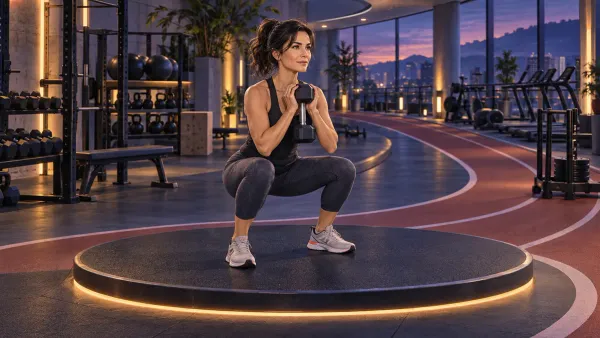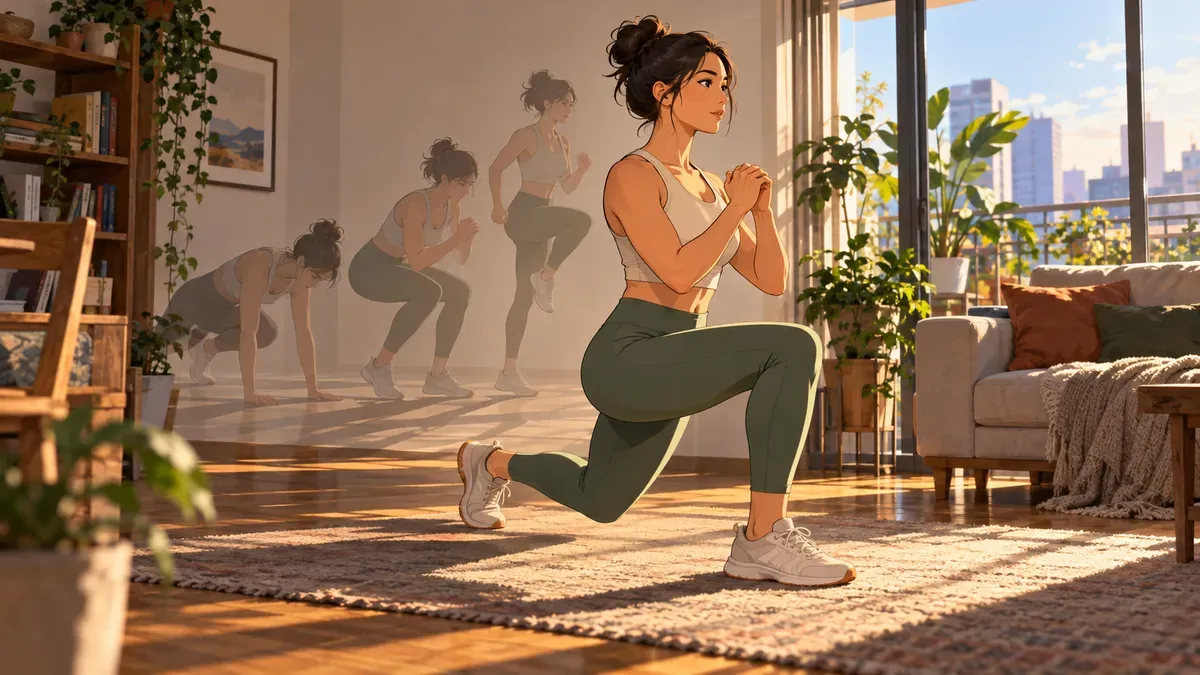
Home workout without equipment: a balanced strength and cardio plan
Build a home workout without equipment using a small space, simple strength moves, low-impact cardio, and a four-week plan you can adapt safely over time.
Quick answer
For a home workout without equipment, combine a squat or lunge, a hip hinge or bridge, a push, a trunk exercise, and a short aerobic block. Start with two full-body sessions per week. Do one or two controlled sets of each strength move, then add 5–10 minutes of marching, dancing, or step-free intervals. Increase one variable at a time as the sessions become easier. You need enough clear floor space to move safely, not a dedicated gym.
This plan is for generally healthy adults who want a practical routine when equipment, travel time, or a gym membership is unavailable. It combines strength and cardio in one small-space schedule. For a deeper skill progression in bodyweight strength, see the separate beginner calisthenics guide.
Key facts
- Bodyweight resistance trains major muscle groups when movements are challenging enough and progressed over time.
- Aerobic movement raises breathing and heart rate when the pace reaches a moderate or vigorous effort for that person.
- A balanced home session covers several movement patterns instead of repeating only squats or abdominal exercises.
- A repeatable weekly plan builds activity volume more reliably than an occasional maximal circuit.
What can an equipment-free workout accomplish?
A small apartment can support useful exercise. Squats and lunges train lower-body patterns; floor-based bridges train hip extension; wall or floor push-ups train pressing; and controlled trunk movements train stability. Marching briskly, dancing, or alternating faster and slower movement can add an aerobic stimulus. None of these requires a watch, a machine, or a branded program.
The key limitation is resistance: an exercise that is always easy will eventually provide little new strength stimulus. The 2026 American College of Sports Medicine (ACSM) position stand identifies bodyweight and home-based training as valid resistance-training options, while emphasizing regular practice and gradual progression (ACSM, 2026). As a movement becomes easy, change its range, tempo, leverage, repetitions, or sets before adding more exercise types.
An equipment-free room also has a pulling gap. Rows and pull-ups usually need a secure anchor or apparatus. Do not improvise with an unstable door, table, or towel. This plan uses prone shoulder-blade movements to practice upper-back control, but they do not replace progressively loaded pulling for long-term strength development. If your goal is maximal strength or muscle growth, later access to safe resistance may help. The major muscle groups guide explains how to assess that gap.
Set up the space and effort
Clear a space where you can extend your arms and take a step in each direction without touching furniture. Wear shoes with reliable traction, or exercise barefoot on a surface that is secure for you. Avoid loose rugs, slippery floors, low lights, and jumping when neighbors or joints make impact a poor fit. A wall can provide balance support; it is not training equipment.
Choose an effort you can repeat. During strength work, stop a set when you think only two or three smooth repetitions remain. If form deteriorates earlier, stop there. During cardio, the CDC talk test offers a simple check: at moderate effort you can talk but not sing; at vigorous effort, only a few words are comfortable. Your relative effort matters more than a universal pace. The weekly intensity-minutes guide gives more context for aerobic targets.
Start each session with three to five minutes of easy marching and gentle joint movements. End by slowing the pace and allowing your breathing to settle. Warm-ups need to prepare the movements ahead; they do not need a complicated ritual.
Six movements for a balanced home session
The following choices emphasize different jobs. Pick the easiest version that permits deliberate movement through a comfortable range. A chair is optional for a squat target, but the routine also works without one.
| Job | Equipment-free choice | Easier option | Progression |
|---|---|---|---|
| Knee-dominant leg work | Bodyweight squat | Shallow squat beside a wall | Deeper controlled squat or split squat |
| Hip-dominant leg work | Glute bridge | Short-range bridge | Single-leg bridge with level pelvis |
| Push | Wall push-up | Stand closer to the wall | Step feet back, then progress toward floor |
| Single-leg control | Reverse lunge | Supported step-back and return | Deeper lunge or longer pause |
| Trunk control | Dead bug | Heel slide with both hands on the floor | Longer lever while ribs stay quiet |
| Upper-back practice | Prone arm raise | Small shoulder-blade squeeze | Longer pause without arching the back |
For a squat, keep your feet planted and sit between them as far as your mobility allows. For a bridge, press through your feet and lift the pelvis without forcing an extreme back arch. For a wall push-up, let chest and hips travel together. For a reverse lunge, use a small backward step and bend only as far as balance and knee comfort allow. During a dead bug, lower one heel or arm slowly while the trunk remains steady. In a prone arm raise, lift the arms a little while the neck stays long; do not swing the torso.
There is no obligation to use the hardest version. If a joint hurts, reduce the range, switch the move, or pause and seek professional advice when pain persists. For detailed movement teaching, the calisthenics guide covers individual patterns and progression.
A 20-minute home workout without equipment
Use this as a starting template, not a race. The listed time includes a short warm-up and a comfortable finish. If you are returning after inactivity, begin with one round and use the 10-minute restart plan as your first step.
- Warm up for 3 minutes: easy marching, shoulder circles, and gentle squats.
- Strength round, about 6 minutes: 8–12 squats, 8–12 glute bridges, 6–10 wall push-ups, 6–8 reverse lunges per side, and 6–8 dead bugs per side. Rest as needed between moves.
- Repeat the strength round once if form remains steady. Otherwise stop at one round and use the remaining time for easy movement.
- Cardio for 5 minutes: alternate one minute of brisk marching or dancing with one minute at an easier pace. No jumping is required.
- Slow down for 2 minutes and note how the effort felt.
The exact clock time will vary with rest and movement speed. Do not remove all rest to force the routine into 20 minutes. Two quality strength rounds with a shorter aerobic finish are preferable to rushing through unstable repetitions. Conversely, if the strength moves feel easy but cardio is the main challenge, keep one round and gradually lengthen the aerobic block.
Low-impact cardio options
Marching in place, side steps, step-touch dancing, and controlled shadowboxing can all raise breathing without jumps. Move the arms naturally and select a pace that fits the talk test. If your space is very small, alternate 30–60 seconds of brisk marching with 30–60 seconds of easy marching. The room does not need to be large for the work to count.
A strength circuit can make breathing rise too, but that does not automatically mean it supplies the same aerobic dose as sustained moderate activity. Use the talk test and the time spent at that effort, and keep a separate aerobic block if your weekly cardio is otherwise low. The HIIT versus steady-state guide explains why neither interval speed nor one workout label determines your entire fitness outcome.
The dose matters: a 2025 randomized trial in 77 inactive adults found that very brief bodyweight exercise bouts were feasible, but did not improve aerobic fitness more than a stretching comparison over 12 weeks (Allison et al., 2025). That result does not test this exact routine; it cautions against assuming that any short burst automatically provides a meaningful cardio stimulus.
A four-week schedule that can grow with you
The World Health Organization recommends adults accumulate 150–300 minutes of moderate aerobic activity, or 75–150 minutes of vigorous activity, across a week, plus muscle-strengthening activity for major muscle groups on at least two days (WHO). This short session is a starting contribution, not a claim that two 20-minute workouts satisfy the full weekly aerobic target. Add walking, cycling, or another enjoyable activity when possible.
| Week | Strength sessions | Cardio inside each session | Main progression |
|---|---|---|---|
| 1 | Two sessions, one round each | 5 easy-to-moderate minutes | Learn positions and keep a repeatable effort |
| 2 | Two sessions, up to two rounds | 5–7 minutes | Add a round only when recovery is comfortable |
| 3 | Two sessions, two rounds | 7–10 minutes | Add time to the aerobic block |
| 4 | Two sessions, two rounds | 10 minutes | Make one movement slightly harder, not all six |
Place at least one easier day between demanding full-body sessions. An easy walk, gentle mobility, or relaxed dance session can fit between them. If you already exercise regularly, this can serve as a fallback session rather than replacing more specific training. If soreness, sleep disruption, or unusual fatigue accumulates, repeat a week instead of escalating it.
How to progress without buying anything
Progression can mean an extra controlled repetition, one more set, a slower lowering phase, a slightly larger comfortable range, a longer aerobic interval, or steadier form at the same workload. Change one of these at a time. Write down the movement version, repetitions, cardio minutes, and perceived effort so you can tell whether the routine actually changed.
If you can easily exceed the planned repetitions, make the exercise mechanically more challenging instead of doing endless fast repetitions. For example, move the feet farther from the wall during push-ups or choose a controlled split squat instead of another set of easy squats. Preserve movement quality. The exercise consistency guide can help make the schedule stick beyond the first enthusiastic week.
How SuperAge fits after the workout
Once the routine is useful on its own, tracking can help you see its place in your week. SuperAge brings activity and recovery trends together, so you can compare a repeatable home session with your wider movement pattern. Record the session and its effort, then look for gradual consistency and recovery rather than treating one day as a verdict on your fitness.
Download SuperAge on the App Store if you want to view activity and recovery in one place. The workout itself needs no app.
Safety and common mistakes
Do not use pain as a progress signal. Stop and seek urgent care for chest pain, fainting, severe shortness of breath, or other concerning symptoms. If you have a medical condition, are pregnant, or have a recent injury, ask an appropriate clinician how to adapt intensity and movements. Starting with less and building gradually is sensible when you have been inactive.
Common mistakes include choosing a high-impact circuit before learning the movements, turning every round into a maximal test, skipping lower-body or pulling work, and counting a few breathless seconds as an entire aerobic workout. A clear plan lets you adjust one constraint at a time. Equipment-free training is accessible, but it still benefits from rest, progression, and honest attention to technique.
Key takeaways
- Begin with two repeatable full-body sessions per week and add aerobic movement that suits your space.
- Train knee, hip, push, single-leg, trunk, and upper-back patterns; recognize that true pulling resistance is limited without safe equipment.
- Use the talk test for cardio and controlled repetitions for strength.
- Progress one variable at a time and build the rest of your weekly aerobic activity separately.
FAQ
Can a home workout without equipment build strength?
Yes, especially when you are new to resistance exercise or returning after a break. Bodyweight exercises must become sufficiently challenging and be progressed over time. Advanced strength goals may eventually require safe external resistance, particularly for pulling movements.
How often should I do this workout?
Two nonconsecutive full-body sessions per week are a practical start and align with the strength frequency in public-health guidance. Add aerobic activity on other days as your schedule and recovery permit.
Is 20 minutes enough for a home workout?
Twenty focused minutes can provide useful strength practice and some cardio. Two 20-minute sessions alone do not meet the WHO weekly aerobic recommendation; treat them as part of a wider active week.
Do I need to jump to get a cardio benefit indoors?
No. Brisk marching, step-touch movement, dancing, and other low-impact options can be aerobic if they bring your breathing into an appropriate effort range for long enough. Use the talk test to judge intensity.
What if a bodyweight exercise feels too easy?
Increase the comfortable range, slow the lowering phase, add controlled repetitions or a set, or choose a harder leverage. Change one variable at a time, and keep form consistent.
What if I cannot do a floor push-up?
Start at a wall. Step the feet gradually farther away as you get stronger. A controlled wall push-up is useful practice; a rushed floor repetition is not required.
Can this routine replace a gym program?
It can support general activity and early strength progress. People pursuing higher strength, muscle growth, or balanced upper-back loading may eventually need safe resistance beyond an equipment-free room.
Should I work out every day?
Daily movement can be helpful, but hard full-body strength sessions need recovery. Alternate demanding sessions with easier activity or rest, and adjust to soreness, sleep, and energy.
References
- World Health Organization. Physical activity recommendations.
- American College of Sports Medicine. Resistance training position stand summary, 2026.
- American College of Sports Medicine. Five things to know about an effective resistance training plan, 2026.
- Centers for Disease Control and Prevention. How to measure physical activity intensity, 2025.
- Allison MK, et al. Technology-enabled exercise snacks in a real-world randomized trial, 2025.
Related Articles

Mountain bike training for beginners: an eight-week plan
Build mountain bike fitness, strength, and trail skills with a clear eight-week beginner plan, practical effort cues, recovery checks, and safe progression.