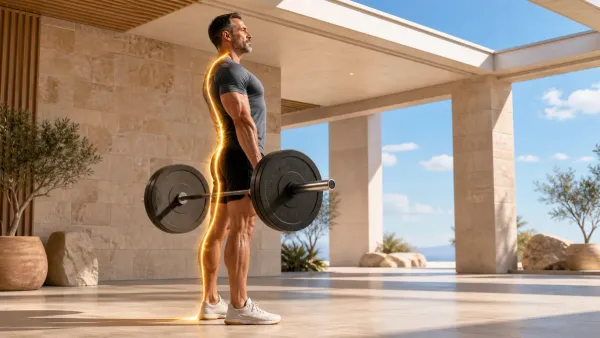
Trapezius exercises: build upper-back strength and scapular control
Learn trapezius exercises for upper, middle, and lower fibers, with clear form cues, progressions, programming, and shoulder-friendly safety advice.
Quick answer
The best trapezius exercises do more than make you shrug. The trapezius has upper, middle, and lower regions that work together to elevate, retract, depress, and upwardly rotate the shoulder blade. A balanced plan therefore combines a loaded shrug or carry, a row or reverse fly, and an upward-rotation exercise such as a wall slide or prone Y raise.
Start with two sessions per week. Choose three exercises, perform 2–3 controlled sets each, and stop with roughly 2–4 good repetitions in reserve. Progress range and control before load. You should feel muscular effort around the upper and middle back—not sharp shoulder pain, arm tingling, a new severe headache, or increasing neck pain. If symptoms are clearly one-sided, use this right-side neck pain guide to check warning signs before training through them.
The trapezius does not work alone. The serratus anterior, rhomboids, rotator-cuff muscles, deltoids, and trunk all help position the shoulder blade while the arm moves. The goal is coordinated capacity, not forcing the shoulders into one rigid “perfect posture.” For pressing, arm-raising, rotation, and complete deltoid coverage, use the balanced shoulder exercise guide.
The lat exercise guide separates arm-to-trunk pulling from trapezius-focused scapular work and shows how the two fit together.
Key facts
- The trapezius stabilizes and moves the scapula during pulling, carrying, and overhead motion.
- Upper fibers assist scapular elevation and upward rotation rather than merely creating neck tension.
- Middle fibers contribute scapular retraction during rows and reverse-fly patterns.
- Lower fibers assist scapular depression and upward rotation during controlled arm elevation.
- Progressive resistance develops strength when range, load, and weekly volume increase without sacrificing repeatable form.
This guide is for general exercise education, not diagnosis or rehabilitation. If you have recent shoulder or neck surgery, traumatic injury, unexplained weakness, visible shoulder-blade winging, numbness, loss of motion, or persistent pain, get an individualized assessment before loading these exercises.
What does the trapezius muscle do?
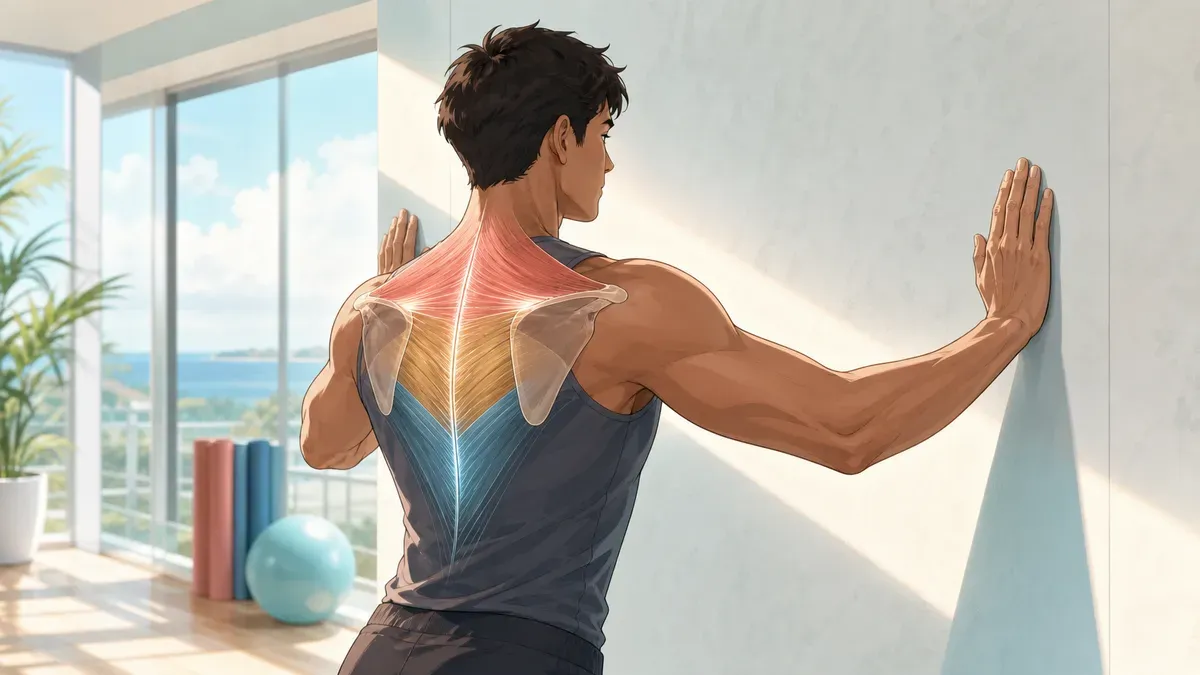
The trapezius is a broad, superficial muscle that runs from the base of the skull and cervical and thoracic spine to the clavicle, acromion, and spine of the scapula. Its long fibers let it influence the shoulder blade from several directions.
The common three-part description is useful, provided you remember that the regions cooperate:
| Region | Main scapular actions | Everyday and training examples |
|---|---|---|
| Upper trapezius | Elevation and assistance with upward rotation | Carrying a bag, shrugging, supporting overhead reach |
| Middle trapezius | Retraction and stabilization | Rowing, reverse fly, controlling the shoulder blade during a pull |
| Lower trapezius | Depression and assistance with upward rotation | Raising the arm, prone Y raise, overhead control |
The NCBI anatomy review describes the trapezius as a scapular stabilizer and mover, with upper, middle, and lower fiber groups. That regional model is not a set of three isolated muscles. During arm elevation, for example, upper and lower trapezius forces combine with the serratus anterior to rotate and position the scapula.
This is why “keep your shoulders down” is not a universal cue. The shoulder blade must move during a comfortable overhead reach. Holding it rigidly depressed can interfere with the motion you are trying to train. A better cue is to let the scapula rotate while keeping the neck comfortable and the rib cage controlled.
If functional muscle roles are new to you, the guide to agonist and antagonist muscles explains why one region can produce motion in one task and stabilize in another.
Do you need separate upper, middle, and lower trapezius exercises?
You cannot switch one region on while every neighboring fiber switches off. You can, however, choose movements whose force direction and arm position emphasize different jobs.
A shrug creates a large scapular-elevation demand and is a straightforward upper-trapezius strength exercise. A row or reverse fly emphasizes retraction and gives the middle trapezius a prominent role. A prone Y raise, wall slide, or selected external-rotation exercise can challenge lower-trapezius participation during arm elevation and scapular control.
Surface electromyography studies help show which muscles are active during an exercise, but EMG amplitude is not a direct score for long-term muscle growth or clinical benefit. Signal collection, electrode position, anatomy, crosstalk, and normalization all affect the result. A methodological review explains why surface EMG should be interpreted as one measurement of neuromuscular activity, not a universal exercise ranking (Felici and Del Vecchio, 2020).
Use laboratory findings to build a sensible menu, then judge an exercise by practical outcomes:
- Can you perform it through a useful, comfortable range?
- Does the intended area work without joint pain or neurological symptoms?
- Can you progress it in small steps?
- Does it complement the rest of your pushing, pulling, carrying, and overhead work?
- Can you recover before the next session?
Seven effective trapezius exercises
You do not need all seven in one workout. Pick one exercise from each functional group, then add a fourth only when it serves a specific goal.
1. Dumbbell shrug for loaded elevation
Primary emphasis: upper trapezius and grip.
- Stand tall with a dumbbell in each hand and the weights beside your thighs.
- Keep the head comfortably stacked over the trunk and the elbows long.
- Elevate the shoulders toward the ears without circling them forward or backward.
- Pause briefly, then lower through the available range under control.
Start with 2–3 sets of 8–12 repetitions. Use straps only if grip consistently ends the set before the target muscles and grip training is not the goal.
The shrug is not inherently harmful to the neck. In a small laboratory study of women with trapezius myalgia, shrugs produced high trapezius activation under the tested conditions (Andersen et al., 2008). That result establishes muscle activity, not a universal prescription for neck pain.
Common mistake: rolling the shoulders in large circles. The load is pulling downward; a controlled up-and-down path provides a clearer resistance direction and is easier to repeat.
2. Suitcase or farmer carry for isometric support
Primary emphasis: upper-trapezius endurance, grip, and trunk control.
- Hold one weight at your side for a suitcase carry or two for a farmer carry.
- Stand tall without leaning away from the load or pulling the shoulder unnaturally downward.
- Walk with quiet, controlled steps for 20–40 seconds.
- Set the weight down with a hinge rather than dropping it.
Begin with 2–3 carries. A one-sided carry adds a larger anti-lateral-flexion demand; alternate sides and keep the distance equal.
Loaded carries are useful when you need strength that transfers to holding bags, tools, or equipment. They are not mandatory for trapezius growth, and a static hold may aggravate symptoms when prolonged compression or gripping is already poorly tolerated.
3. Chest-supported row for retraction
Primary emphasis: middle trapezius, rhomboids, posterior shoulder, and elbow flexors.
- Set an incline bench so your chest is supported and your feet are stable.
- Begin with the arms long and the shoulder blades free to move around the rib cage.
- Pull the elbows back while the shoulder blades glide toward each other.
- Stop before the shoulders roll forward or the head cranes upward.
- Lower until the arms are long again without losing control.
Use 2–4 sets of 6–12 repetitions. A machine, cable, band, or one-arm dumbbell row can serve the same pattern when chest support is unavailable.
Do not squeeze the shoulder blades together as hard as possible before the arms move. Let retraction occur as part of the pull. The deadlift form guide shows the related but more isometric upper-back role used to keep a load close during a hip hinge.
4. Reverse fly for lighter horizontal abduction
Primary emphasis: middle trapezius and posterior shoulder.
- Use a reverse-fly machine, cables, bands, or light dumbbells with the trunk supported when possible.
- Keep a small elbow bend and move the arms outward in a wide arc.
- Allow the shoulder blades to retract without thrusting the ribs forward.
- Return slowly until the shoulder blades separate naturally.
Use 2–3 sets of 10–20 repetitions. Begin with 5–15 lb (2–7 kg) dumbbells or a light band if that is enough to make the final repetitions challenging.
Common mistake: turning the movement into a heavy row. If the elbows bend more as fatigue rises, reduce the load and restore the intended arc.
5. Prone Y raise for lower-trapezius control
Primary emphasis: lower trapezius during arm elevation.
- Lie face down on a flat or slightly inclined bench with the arms reaching in a Y shape.
- Point the thumbs upward and keep the neck relaxed.
- Raise the arms only as high as you can without shrugging abruptly or extending the lower back.
- Pause, then lower slowly.
Start with no external load or 1–5 lb (0.5–2 kg) per hand for 2–3 sets of 8–15 repetitions. This exercise usually needs much less weight than a row or shrug.
A repeated-measures EMG study in healthy adults found that the prone Y produced more lower-trapezius activity than several below-shoulder-height alternatives, while side-lying external rotation and wall slides provided lower-elevation options (MacAskill et al., 2023). Muscle activity in healthy participants does not establish the best rehabilitation exercise for a painful shoulder.
6. Wall slide for upward rotation
Primary emphasis: coordinated lower trapezius, upper trapezius, serratus anterior, and rotator cuff.
- Place your forearms against a wall with elbows around shoulder width.
- Apply gentle pressure into the wall and keep the ribs from flaring.
- Slide the forearms upward while allowing the shoulder blades to rotate.
- Stop at the highest comfortable point, then return with control.
Use 2–3 sets of 8–12 repetitions. Add a very light band around the wrists only if you can keep the hands, elbows, and shoulder blades coordinated.
The wall slide is not merely a “lower-trap isolation.” It trains a movement partnership. That makes it useful for warm-ups and control work, but it may not provide enough resistance by itself for someone whose main goal is upper-back strength or hypertrophy.
7. Side-lying external rotation for a low-load option
Primary emphasis: rotator cuff with lower- and middle-trapezius participation.
- Lie on your side with the working elbow bent to 90 degrees and supported against the ribs, using a small towel if comfortable.
- Hold a light dumbbell and rotate the forearm upward without letting the elbow drift away.
- Keep the trunk still and the shoulder away from an aggressive shrug.
- Lower slowly.
Use 2–3 sets of 10–15 repetitions. This is a shoulder-complex exercise rather than a high-load trapezius builder, so pair it with a row, carry, or shrug when strength is the main goal.
Laboratory studies have found moderate lower-trapezius activity with relatively low upper-trapezius activity during bilateral or side-lying external-rotation variations (McCabe et al., 2007; MacAskill et al., 2023). The useful lesson is that low-load shoulder work can train scapular control without imitating a heavy shrug.
A three-level trapezius exercise progression
Progression should increase the demand while preserving the purpose of the exercise. Adding weight is only one option.
| Level | Session structure | Starting dose | Progress when |
|---|---|---|---|
| 1: control | Wall slide, chest-supported row, unloaded prone Y | 2 sets each | Range is comfortable and the last repetition matches the first |
| 2: basic strength | Dumbbell shrug, row, prone Y or reverse fly | 2–3 sets each | You reach the top of the repetition range with 3 good reps in reserve |
| 3: integrated capacity | Carry, heavier row, shrug, wall slide or overhead pattern | 3 sets each | Weekly volume is recoverable and performance is stable for two sessions |
Change one variable at a time:
- Add one or two repetitions per set.
- Add a small amount of load.
- Add one set to one exercise.
- Increase the range when it is comfortable and controlled.
- Choose a harder variation only when it solves a real limitation.
For a broader view of range of motion, read flexibility versus mobility. More passive range is not automatically better; you also need strength and control in the range you use.
How to program trapezius training
Count the trapezius work already present in your program. Deadlifts, rows, strict pull-ups, overhead presses, carries, Olympic-lift variations, and many shoulder exercises create direct or indirect demand. Adding a high-volume “trap day” on top of all of them may solve nothing.
General strength and function
- Train the movement pattern 2 times per week.
- Perform 2–3 exercises per session.
- Use 2–4 sets of 6–15 repetitions, depending on the exercise.
- Rest 90–180 seconds after rows and shrugs; 45–90 seconds may be enough for light control work.
- Stop with 2–4 repetitions in reserve at first.
Muscle growth
- Build toward roughly 8–12 challenging weekly sets that directly involve the region you want to develop.
- Use both a heavier movement, such as a shrug or row, and a lighter higher-repetition movement.
- Spread the work over at least two sessions when one long session degrades technique or recovery.
- Add weekly sets only when performance, soreness, sleep, and joint response remain acceptable.
Shoulder-control accessory work
- Choose one or two low-load exercises such as a wall slide, prone Y, or external rotation.
- Perform 2–3 sets of 8–15 controlled repetitions.
- Prioritize smooth scapular motion and tolerable range over fatigue.
- If the exercise is part of rehabilitation, follow the clinician’s range, dose, and symptom rules.
The 2026 American College of Sports Medicine position stand synthesized 137 systematic reviews involving more than 30,000 participants. Resistance training improved strength, muscle size, power, endurance, balance, and physical function; for voluntary strength, complete range of motion, 2–3 sets, heavier loads when appropriate, and at least two weekly sessions were favorable (Currier et al., 2026). Those are whole-program findings, not a requirement to train the trapezius in isolation twice weekly.
Use the training-frequency guide to count overlapping sets across your week. The guide to training to failure explains why momentary failure is optional and often a poor target for technically demanding shoulder or neck-adjacent exercises.
How trapezius training fits healthy aging
Upper-back strength helps with tasks such as carrying groceries, stabilizing a load, pulling a door, supporting the arms, and maintaining confidence during resistance training. It is one component of physical capacity—not a shortcut to longevity and not a substitute for lower-body strength, aerobic activity, balance, mobility, or adequate recovery.
A complete weekly plan should cover squatting or rising, hinging, pushing, pulling, carrying, locomotion, and balance at a dose appropriate to your current capacity. The exercise and longevity guide puts those pieces into a broader framework, while strength training versus cardio after 40 explains why the two training modes complement rather than replace one another.
Do not use shoulder position in a mirror as your only progress measure. Track what you can do: load, repetitions, range, control, symptoms during and after training, and whether everyday tasks feel easier.
Track the whole training response with SuperAge
A stronger shrug or row is useful performance evidence. It does not reveal whether the full program is balanced or how activity interacts with sleep, recovery, cardiovascular fitness, and other health trends.
SuperAge helps you review those signals together. Pair app trends with a simple training log that records exercise, load, repetitions, effort, and symptom response. Look for patterns across weeks rather than interpreting one hard workout or one sore morning as a verdict.
Want to see how your training and recovery trends fit together? Download SuperAge and review the larger pattern over time.
Common trapezius-training mistakes
Training only shrugs
Shrugs are useful for loaded elevation, but they do not cover retraction, upward rotation, and lower-trapezius control. Combine them with a row and an arm-elevation pattern.
Pinning the shoulder blades down and back
The scapula must move during reaching and overhead motion. Use “down and back” only when it serves the specific exercise, not as a permanent posture.
Chasing posture correction
There is no single ideal resting shoulder position for every body and task. Exercise can build capacity and movement options, but it does not guarantee a cosmetic posture change or prove why pain exists.
Confusing muscle effort with joint pain
Local fatigue and a mild muscular burn can be normal. Sharp pain, catching, increasing night pain, arm numbness, progressive weakness, or loss of motion are reasons to stop and seek assessment.
Adding too much direct volume
Rows, deadlifts, carries, and overhead work already train the region. Count that overlap before adding shrugs, reverse flies, and Y raises.
Progressing load before control
If the range shortens, the neck cranes, the ribs flare, or the elbows change the movement, the current weight may be obscuring the exercise you intended to perform.
Can trapezius exercises help neck or shoulder pain?
Exercise can be part of care, but “trapezius pain” is not one diagnosis. Symptoms can involve muscle, joint, tendon, nerve, training load, sleep, stress, previous injury, or referred pain. A generic strengthening plan cannot identify the cause.
A 2024 meta-analysis of eight trials found that scapular therapeutic exercises improved shoulder function more than comparators overall, while pain reduction was not clearly superior. Programs lasting at least six weeks showed a more consistent functional effect, but study quality and protocols varied (Melo et al., 2024).
Small randomized trials have also reported improvements with targeted lower-trapezius or cervical-and-scapular resistance programs in selected people with chronic neck pain (Park and Lee, 2020; Kang and Kim, 2022). These findings do not mean everyone with neck pain should add heavy shrugs or self-diagnose a weak lower trapezius.
Seek prompt medical care after trauma, or if symptoms include chest pain, shortness of breath, sudden severe headache, fever, unexplained weight loss, rapidly worsening weakness, loss of coordination, or numbness in both arms. For persistent non-urgent symptoms, a qualified clinician can assess the neck, shoulder, nervous system, training history, and workload.
The home mobility-screen guide can help you observe general movement capacity, but it is not a diagnostic test.
Frequently asked questions
What is the best exercise for the trapezius?
There is no single best exercise for every region and goal. Shrugs emphasize loaded elevation, rows emphasize retraction, and Y raises or wall slides train control during arm elevation. A balanced program uses more than one movement direction.
Are shrugs enough to train the whole trapezius?
No. Shrugs can strongly train the upper trapezius, but they do not fully cover middle-trapezius retraction or lower-trapezius participation in upward rotation. Add a row and a controlled arm-elevation exercise.
How often should I train my trapezius?
Two weekly exposures are a practical starting point for most healthy adults. Count indirect work from rows, deadlifts, carries, and overhead exercises, then adjust direct sets according to progress and recovery.
Should I squeeze my shoulder blades together during every exercise?
No. Retraction is appropriate during many rows and reverse flies, but the shoulder blades should protract and upwardly rotate during other movements. Use the scapular motion required by the task rather than one permanent cue.
Can trapezius exercises fix rounded shoulders?
They can improve upper-back strength and movement capacity, but they cannot guarantee one resting posture or diagnose why your shoulders sit where they do. Daily habits, anatomy, mobility, symptoms, and other muscles also matter.
Why do I feel trapezius exercises in my neck?
The upper trapezius attaches near the neck, so local muscle effort can be expected. Reduce load and check head position if tension becomes excessive. Stop and seek assessment for sharp pain, radiating symptoms, numbness, weakness, or a severe headache.
Can I train the trapezius at home?
Yes. Wall slides, prone Y raises, band rows, reverse flies, and carries with securely held household loads can cover the main functions. Ensure the load is stable and the floor is clear.
Do I need heavy weights to build the trapezius?
Not for every exercise. Rows and shrugs can use progressively heavier loads, while Y raises and external-rotation work often require very light resistance. Sets across a wide load range can be effective when they are challenging and repeatable.
Key takeaways
- The trapezius has upper, middle, and lower regions that cooperate to move and stabilize the scapula.
- Use at least one elevation or carry exercise, one retraction exercise, and one upward-rotation or arm-elevation exercise.
- Train twice weekly to start, count indirect work, and progress only while form and recovery remain stable.
- Let the shoulder blades move according to the task instead of holding them permanently down and back.
- EMG can show muscle activity, but it does not identify a universal best exercise or predict long-term results by itself.
- Persistent pain, neurological symptoms, or loss of function needs assessment rather than a self-diagnosed trapezius imbalance.
References
- Ourieff J, Scheckel B, Agarwal A. Anatomy, back, trapezius. StatPearls. Updated 2023.
- Currier BS, et al. Resistance training prescription for muscle function, hypertrophy, and physical performance in healthy adults. Medicine & Science in Sports & Exercise. 2026.
- Felici F, Del Vecchio A. Surface electromyography: what limits its use in exercise and sport physiology?. Frontiers in Neurology. 2020.
- McCabe RA, et al. Surface electromygraphic analysis of the lower trapezius muscle during exercises below 90 degrees of shoulder elevation. North American Journal of Sports Physical Therapy. 2007.
- MacAskill MJ, et al. Variation of muscle recruitment during exercises performed below horizontal arm elevation that target the lower trapezius. Journal of Electromyography and Kinesiology. 2023.
- De Mey K, et al. Conscious correction of scapular orientation during selected shoulder exercises. Journal of Orthopaedic & Sports Physical Therapy. 2013.
- Andersen LL, et al. Muscle activation during selected strength exercises in women with chronic neck muscle pain. Physical Therapy. 2008.
- Melo ASC, et al. Effectiveness of specific scapular therapeutic exercises in patients with shoulder pain. Journal of Shoulder and Elbow Surgery International. 2024.
- Park SH, Lee MM. Effects of lower trapezius strengthening exercises in patients with neck pain. Medical Science Monitor. 2020.
- Kang T, Kim B. Cervical and scapula-focused resistance exercise versus trapezius massage in chronic neck pain. Medicine. 2022.
Related Articles
Shoulder exercises: strength, mobility, and safe progression
Learn shoulder exercises for balanced deltoid and rotator-cuff strength, better control, pain-aware technique, and a practical weekly progression plan.