Resistance band exercises: a full-body strength plan for beginners
Learn resistance band exercises for full-body strength, choose a workable tension, and progress a simple twice-weekly routine. Start with controlled technique.
Quick answer
Resistance band exercises can build strength when the band provides challenging, controllable resistance and you increase the training dose over time. Begin with a squat, hip hinge, row, chest press, lateral walk, and curl. Practice twice a week on nonconsecutive days, start with one set, and gradually build toward two sets of 8–15 smooth repetitions. Finish most sets with about 2–3 good repetitions still possible.
Choose tension by how the complete movement feels, rather than band color or a printed weight. Inspect the material, secure your grip and foot contact, and control the return. This guide uses body-held or foot-held bands so the starter session does not require a door or wall anchor.
Key facts
- Elastic resistance increases tension as a band stretches.
- Progressive resistance training improves muscle strength and physical function.
- A repeatable setup makes band workouts easier to compare.
- Controlled returns keep each repetition under muscular control.
- Damaged bands create a recoil hazard and need replacement.
This is an educational routine for generally healthy adults, not an injury rehabilitation prescription. Recent surgery, significant bone or joint disease, balance limitations, or exercise-related symptoms may require individual guidance. Use latex-free material if you have a latex allergy.
What bands can achieve—and where they have limits
Bands supply external resistance without a heavy stack of weights. Their practical advantage is access: a small space can accommodate pushing, pulling, and lower-body work. Their limitation is measurement. Resistance changes with stretch, and the force at your hand is not identical to the turning force at a joint.
A small 12-week controlled trial in 29 middle-aged to older healthy adults compared elastic tubing, weight machines, and a control group. Both training approaches improved strength; its size and population limit broad claims of equivalence (Lima et al., 2018). The broader 2026 ACSM position stand supports progressive resistance training and reports that equipment type does not consistently determine outcomes in healthy adults (Currier et al., 2026).
That supports bands as a useful option, not a promise that every band routine matches every gym program. Heavy strength goals may outgrow the resistance you can hold securely. A nearly slack first half and an uncontrollably hard finish are reasons to change the setup or exercise. The strength training methods guide explains how equipment fits inside a wider program.
Choose a band and calibrate the first set
Long flat bands, long loops, and tubing can support different exercises. A short loop is useful for lateral walks but cannot replace a long band for every press or row. Use equipment designed for the intended movement and follow its instructions; there is no universal safe stretch limit for every material.
| Setup question | Useful starting choice | Adjustment cue |
|---|---|---|
| Can I hold it without slipping? | Secure handles or a comfortable full-hand grip | Stop if your grip opens or material cuts into the hand |
| Can I finish the whole movement? | Light tension with a comfortable end position | Use less resistance if the final range disappears |
| Does it challenge the target muscles? | Last repetitions feel harder while technique stays stable | Increase resistance only after the full target feels controlled |
| Can I reproduce this next week? | Same band, stance, grip, and range | Record setup details before changing them |
Rehearse five easy repetitions. Then try eight controlled repetitions with a light band. If you could do many more, modestly increase tension next set. If you must hold your breath, swing, or shorten the movement, reduce it. The target of 2–3 repetitions in reserve is a practical estimate, not a precise test for a new lifter.
Color systems differ between manufacturers. A label such as 20 lb (9 kg) usually describes resistance under particular testing conditions, not a constant load throughout your repetition. Compare your own repeatable setup rather than converting the label directly into a dumbbell weight.
Make the setup safe before adding effort
Check the entire band and any handles before each session. Discard material with cuts, cracks, punctures, or other damage. Keep it away from sharp edges, and store it away from direct sunlight and extreme temperatures. Recoil can injure the face or eyes; avoid pulling along a line that would send a released band toward them (NHS band safety advice).
For foot-held exercises, use stable footwear and place the band under the middle of both feet. Check contact before loading it. Do not balance it under the toes or stand on a folded, unstable section. Keep hands below face level and use a clear area where nobody can step into the stretched band.
If you later use an external anchor, it must be designed and secured for that loading direction. A loose chair, door handle, or improvised knot is not a substitute. When uncertain, choose a different exercise or ask a qualified professional to check the setup.
Six movements for a simple band session
Warm up with several minutes of comfortable walking or marching, then rehearse squats, hinges, and arm movements without resistance. Begin with an easy version of each exercise. These are options to learn, not six compulsory tests. The major muscle groups and movement patterns guide explains why a useful session includes several movement families.
1. Band squat
Stand on a long band with both feet, holding the ends at your sides. Use a length that allows a comfortable squat without losing your grip. Keep the whole foot supported, bend the hips and knees, and rise while keeping the knees moving in line with the feet. Let the arms stay long rather than curling the hands toward the face.
If the setup pulls you off balance, practice an unresisted sit-to-stand instead. Start with 8–12 repetitions. Adding resistance is optional until the basic movement is steady.
2. Band hip hinge
Keep the band beneath both midfeet and hold it beside the legs. Soften the knees, move the hips backward, and let the trunk tip forward while the back stays comfortably organized. Stand by bringing the hips forward, without leaning backward at the top.
Use 8–12 repetitions through a range you control. A hinge should not become a squat with a deep knee bend or a reach forced through the lower back. Rehearse without the band if the distinction is unclear.
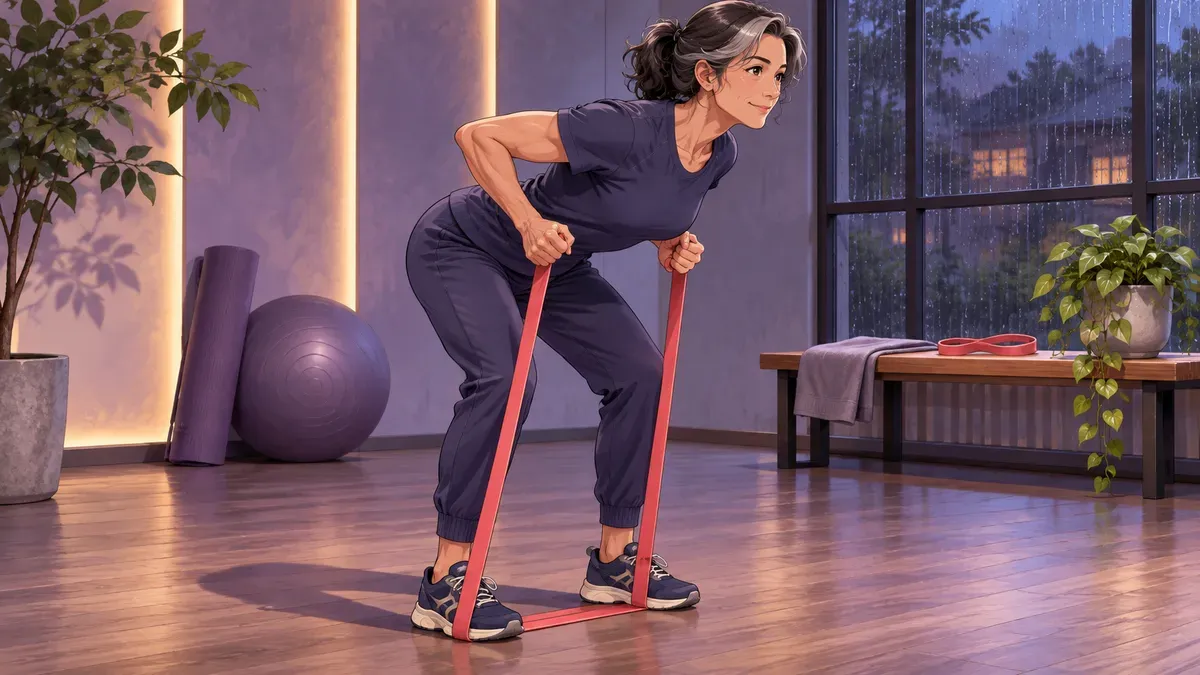
3. Foot-held bent-over row
From a stable shallow hinge, hold the band securely with the hands below the chest. Pull the elbows back toward the hips, pause briefly, then lengthen the arms under control. Keep the trunk still and the shoulders away from the ears.
Use 8–15 repetitions. If holding the hinge is the limiting task, reduce tension or use a professionally checked supported alternative. Do not compensate by jerking the torso upward. A secure foot contact matters throughout the return, too.
4. Chest press around the back
Place a suitable long band across the upper back below the shoulder blades, passing under the arms, and hold the ends securely. Keep the band away from the neck. With a stable stance, press forward through a comfortable path and return slowly; avoid forcing the elbows far behind the trunk.
Begin with 8–15 repetitions and light tension. The British Heart Foundation exercise guide illustrates this general pressing option. If material slips or irritates the skin, stop and change the setup. For persistent shoulder discomfort, use the principles in our shoulder exercise guide and seek assessment when needed.
5. Short-loop lateral walk
Place a light short loop above the knees, avoiding direct pressure on the joint. Take a shallow athletic stance and make small sideways steps. Keep the pelvis level and let the trailing foot follow without snapping inward.
Try 6–10 steps each way. This is hip work, not a speed drill. Use a wall nearby for balance if needed, or omit the exercise when stepping safely is uncertain. A long band tied into an improvised loop is unnecessary.
6. Standing band curl
With the band under both midfeet, hold the ends beside the body. Bend the elbows while keeping them close to the sides, then lower smoothly. Keep the wrists comfortable and avoid leaning back to finish.
Use 8–15 repetitions. Stop the upward movement before the band or hands approach the face. This accessory complements the row and press; it does not replace the larger movement patterns.
Put the movements into a twice-weekly plan
The following is a conservative example, not a clinically tested six-exercise protocol. Rest about 60–120 seconds between sets, and longer when needed to regain control. Complete one exercise before moving on rather than racing through a circuit.
| Stage | Weekly schedule | Sets per movement | Progression decision |
|---|---|---|---|
| First two sessions | Two nonconsecutive days | 1 easy working set | Learn the setup and find a comfortable range |
| Next two sessions | Two nonconsecutive days | 1–2 sets | Add a second set only if ordinary activity and recovery are normal |
| Established routine | Two sessions; optional later adaptation | 2 sets | Add repetitions within the listed range before increasing tension |
| When progress stalls | Keep the schedule stable | Adjust one movement at a time | Review effort, setup, range, rest, and recovery |
For lateral walks, use steps rather than repetitions. If six movements feel excessive, begin with the squat, hinge, row, and press, then add accessories later. After a longer break, the 10-minute exercise restart offers a smaller entry dose.
Strength sessions sit beside aerobic activity and everyday movement. WHO guidance includes muscle-strengthening work on at least two days weekly and 150–300 minutes of moderate aerobic activity for adults, adapted to ability and health (WHO physical activity guidance). Bands alone do not cover every fitness need.
Progress resistance without changing the whole workout
Use a simple double progression. Keep the same setup until every set reaches the top of its repetition range with stable technique and a few repetitions still available. Repeat that success at another session. Then make one small resistance change and return toward the lower end of the range.
You might move from 2 × 8 rows to 2 × 12 and eventually 2 × 15. A modestly harder band may then bring you back to 2 × 8–10. If the harder band prevents the full movement, the jump is too large. More stretch is not always a safe or useful substitute for a smaller resistance step.
Write down band identity, foot position, grip position, sets, repetitions, and perceived effort. Changing grip length, stance, tempo, range, and band together destroys the comparison. If tension becomes impractical, combine bands with suitable bodyweight or conventional resistance exercises instead of forcing the equipment to do everything.
Use SuperAge to put training in context
A band log records the mechanical training dose. Available Apple Health activity, sleep, and recovery trends in SuperAge can provide wider context alongside that log. If repetitions stall during a week of poor sleep and unusual fatigue, review the whole week before adding more work. Our recovery between workouts guide explains that decision in more detail.
A biological-age estimate, heart-rate trend, or recovery score cannot measure band tension, assess technique, diagnose pain, or certify that a setup is safe. Judge strength progress with repeatable movements and use health trends as supporting context.
When to reduce the dose or stop
Mild muscle fatigue is expected; sharp pain, tingling, unstable joints, dizziness, or loss of control are reasons to stop. Reduce the next session if soreness disrupts ordinary activity. Persistent or worsening symptoms deserve professional assessment. Seek urgent help for chest pain, fainting, or severe unexplained breathlessness.
Avoid treating a stronger burning sensation as proof of a better workout. When technique deteriorates, the set has reached its useful endpoint for this plan. The goal is a repeatable training stimulus that leaves you able to return.
FAQ
Can resistance bands build muscle and strength?
Yes, with sufficiently challenging resistance, repeatable technique, progression, and recovery. Results depend on the program and the person. Bands are useful equipment, while very heavy or highly specific strength goals may need other loading options.
What resistance should a beginner choose?
Choose a band that allows the complete movement for the starting repetitions with several good repetitions still possible. If the finish requires swinging or a shorter range, reduce tension. Color and printed weight are not universal measures.
Can I do band exercises every day?
Daily hard full-body sessions are unnecessary for this starting plan. Use two nonconsecutive strength days and assess recovery. Light practice can be different from a hard session, but persistent soreness or falling performance calls for less work.
Are bands safer than weights?
They avoid some hazards of a dropped weight but introduce recoil, slipping, and anchor risks. Neither tool is automatically safe. Inspect the equipment and choose a setup you can control throughout the movement.
Do I need a door anchor?
No. The six exercises here use the body or feet to hold the band. If you add anchored movements, use a suitable secure system and loading direction; do not improvise with loose furniture or a handle.
Why is the end of a repetition much harder?
Band tension generally rises with stretch, while your joint leverage also changes. Use lighter resistance if you cannot control the endpoint. A harder finish does not justify shortening every repetition or losing position.
How do I know when to increase resistance?
Reach the upper repetition target in every set with stable technique and about 2–3 repetitions in reserve, then repeat it at another session. Increase one variable slightly and rebuild from fewer repetitions.
Can older adults use resistance bands?
Many can, with an appropriate starting dose and stable setup. Age alone does not determine the exercise. Frailty, balance problems, recent injury, significant disease, or symptoms may require an individualized supervised version.
Key takeaways
- Train a squat, hinge, pull, and push before adding many accessories.
- Calibrate tension with the full movement and remaining repetitions.
- Begin with a small dose twice weekly and keep setup details consistent.
- Add repetitions before making a modest resistance change.
- Inspect bands and control recoil, foot contact, grip, and the return.
Start with one repeatable session
Choose your band, rehearse the four main patterns, and record a manageable first session. Adults who use Apple Health can download SuperAge to review available activity and recovery trends alongside their training notes.
References
- Lima FF, et al. Elastic tubing versus weight machines in middle-aged to older healthy adults: controlled clinical trial. 2018.
- Currier BS, et al. ACSM position stand on resistance training prescription in healthy adults. 2026.
- Aneurin Bevan University Health Board. Safety advice when exercising with resistance bands or tubing.
- British Heart Foundation. Resistance band exercises.
- World Health Organization. Physical activity.
This article provides general education and does not replace individual medical advice, exercise instruction, or rehabilitation care.
Related Articles
Gym workout for weight loss: strength, cardio, and a weekly plan
Build a gym workout for weight loss with strength, cardio, progression, and recovery. Follow a practical weekly plan designed for safe, lasting results.