Hamstring exercises: form, strength, and progression
Learn hamstring strengthening exercises with clear form, hip- and knee-dominant options, a beginner plan, progression, recovery, and safety limits.
Quick answer
A complete hamstring program combines one hip-dominant exercise, such as a Romanian deadlift, with one knee-flexion exercise, such as a sliding or seated leg curl. The hamstrings cross the hip, the knee, or both, so one movement cannot train every function equally. Start with two nonconsecutive sessions per week, 2–3 sets per exercise, and a load that leaves 2–3 technically clean repetitions available.
Control the lowering phase, use the largest comfortable range you can repeat, and progress only one variable at a time: repetitions, load, range, leverage, or weekly sets. Bridges and sliders make useful home options. Romanian deadlifts and seated curls make loading easier in a gym. Nordic hamstring curls are advanced eccentric knee-flexion work, not a required beginner test.
Key facts
- The hamstrings extend the hip and flex the knee through muscles with different joint actions.
- Hip-dominant hinges load the hamstrings differently from knee-dominant curls.
- Longer-muscle-length training can increase hamstring size and strength when range remains controlled.
- Eccentric exercise strengthens the hamstrings but does not need extreme soreness or maximal volume.
- Progressive resistance builds capacity when technique and recovery remain repeatable.
This guide is for generally healthy adults. It is not a rehabilitation plan for a recent strain, tendon pain, sciatica, a knee operation, or unexplained posterior-thigh symptoms.
What are the hamstrings?
The hamstrings are a group of muscles along the back of the thigh:
- the biceps femoris long head crosses the hip and knee;
- the biceps femoris short head crosses the knee but not the hip;
- the semitendinosus crosses the hip and knee;
- the semimembranosus crosses the hip and knee.
The two-joint muscles help extend the hip, flex the knee, and control both joints while the limb moves. The short head of biceps femoris contributes to knee flexion without acting as a hip extensor. The hamstrings also assist rotation of the lower leg when the knee is bent, although general training does not require a separate exercise for every anatomical action.
That anatomy explains why a balanced plan uses two movement families.
| Movement family | Main joint action | Common examples | Practical role |
|---|---|---|---|
| Hip dominant | Hip extension with a relatively fixed knee angle | Romanian deadlift, single-leg RDL, long-lever bridge | Builds the hinge and loads the hamstrings with the hip flexed |
| Knee dominant | Knee flexion with a relatively fixed hip position | Seated curl, slider curl, assisted Nordic curl | Trains the knee-flexor role directly |
| Combined | Hip and knee positions change together | Bridge curl, walkout, sprinting | Coordinates force across both joints but may be harder to standardize |
A review of hamstring force-length research found that muscle contribution changes with hip angle, knee angle, architecture, and exercise setup. It also warned that surface muscle activation should not be treated as proof that one exercise is universally superior (Hegyi et al., 2022). Exercise selection should therefore follow the movement and progression you need, not an activation ranking.
Why strengthen the hamstrings?
The hamstrings contribute to standing up, climbing, hinging, decelerating the lower leg during running, and controlling the pelvis and knee during many sport tasks. Stronger hamstrings can improve the force capacity available for those tasks, but strength alone does not guarantee faster sprinting, pain-free movement, or freedom from injury.
Direct work is useful when your program contains plenty of squatting but little hinging or knee flexion. Squats, lunges, and step-ups involve the hamstrings, yet their contribution differs from a loaded hinge or curl. A dedicated exercise makes the dose easier to control.
For field-sport athletes, exercise programs that include eccentric hamstring work have often reported fewer strains. A 2019 meta-analysis of 17 studies found lower injury incidence with exercise-based interventions, but those results came from athletes and combined different programs (Biz et al., 2021). Another methodological reappraisal judged the Nordic-specific randomized evidence inconclusive and supported only a conditional recommendation in soccer (Impellizzeri et al., 2021). The honest conclusion is that progressive hamstring training can be one useful component of preparation; no single exercise provides an injury guarantee.
Whole-body strength still matters. The strength-training guide after 40 shows how hinges, squats, pushes, pulls, carries, and aerobic work can share one week.
What current evidence says about exercise choice
Training at a longer muscle length
Hip flexion and knee extension generally lengthen the two-joint hamstrings. That makes seated knee flexion different from prone knee flexion: the seated position flexes the hip while the knee straightens under load.
In a 12-week within-person trial, 20 adults trained one leg with seated curls and the other with prone curls. Both conditions increased hamstring size, but the seated condition produced greater growth in the whole hamstring group and the three two-joint muscles (Maeo et al., 2021). This supports training the hamstrings in a longer position when muscle growth is a priority. It does not mean that everyone needs a seated machine or should force the knee straight through discomfort.
A 2025 systematic review found that training at longer muscle lengths can alter muscle size and fascicle length, but the number of eligible human studies was small and methods varied (Wolf et al., 2026). Use the finding as a reason to include a controlled lengthened position, not as a reason to chase extreme range.
Hip-dominant and knee-dominant work
You do not need to choose between hinges and curls. They solve related but different problems.
A 2025 randomized trial compared six weeks of eccentrically biased Romanian deadlifts with Nordic hamstring exercise twice per week. Both groups increased hamstring cross-sectional area and changed biceps femoris architecture, with no significant between-group difference for the main architectural outcomes (Crawford et al., 2025). The sample included 32 young healthy adults, so the result supports exercise choice rather than proving equivalence for every age, sport, or clinical situation.
The practical lesson is simple: a controllable RDL can be a serious hamstring exercise, and a Nordic curl is not the only route to adaptation. Combining a hinge with a curl covers both joint actions and gives you more ways to adjust equipment, symptoms, and skill.
Eccentric loading and Nordic curls
Eccentric action occurs while a muscle produces force as it lengthens—for example, during the lowering phase of a slider curl or Nordic curl. A systematic review of ten randomized trials found that eccentric hamstring training increased eccentric strength and produced changes in biceps femoris architecture (Gérard et al., 2020). These adaptations are specific enough that ordinary concentric strength should not be assumed to represent eccentric capacity perfectly.
More is not automatically better. A 2025 meta-analysis of 42 Nordic studies found meaningful eccentric-strength gains across a wide range of doses and no clear dose-response relationship in the available evidence. The authors emphasized progressive introduction and rated certainty low to very low for several conclusions (Franke et al., 2025). Beginners should start below the large weekly volumes often used by trained athletes.
A readiness check before training
Try a bodyweight bridge and an unloaded hip hinge before choosing harder exercises.
- Bridge: you can lift the hips without sharp posterior-thigh pain or immediate cramping.
- Hinge: you can send the hips backward while the trunk and pelvis move as one controlled unit.
- Knee flexion: you can bend and straighten the knee through a comfortable range.
- Walking: ordinary walking and stairs do not produce a new limp or escalating symptoms.
- Recovery: recent training soreness is settling rather than worsening every day.
Cramping in a bridge often means the leverage or effort is too high for the current starting point. Bring the heels closer, reduce the lift, use both legs, and stop before the hamstrings seize. Cramping is not proof of superior recruitment.
If a recent injury caused bruising, a pop, sudden weakness, or pain high near the sitting bone, use a clinician-guided assessment rather than testing advanced curls.
Seven hamstring exercises from beginner to advanced
You do not need all seven. Select one hip-dominant and one knee-dominant exercise, then earn harder variations through repeatable control.
1. Short-lever hamstring bridge
Lie on your back with knees bent and feet flat. Brace gently, press through the whole foot, and lift the pelvis until the trunk and thighs form a comfortable line. Lower without dropping.
- Start: 2 sets of 8–12 repetitions.
- Regress: reduce the lift or pause between repetitions.
- Progress: move the feet slightly farther away or add a one-second top pause.
- Watch for: arching the lower back to create height.
This version shares work with the gluteal muscles and introduces hip extension. It is a starting exercise, not an isolation test.
2. Heel-dig bridge or long-lever bridge
Place the heels farther from the hips with the knees more open. Dig the heels into the floor without sliding them and lift only as high as you can keep the pelvis controlled.
- Start: 2 sets of 6–10 repetitions or 15–25 second holds.
- Regress: bring the heels closer.
- Progress: use one leg only after the bilateral version is calm and symmetrical.
- Watch for: hamstring cramp, rib flare, or one hip rotating.
Longer leverage increases demand without adding equipment. Move the feet in small steps; one dramatic change can turn a useful progression into a cramp test.
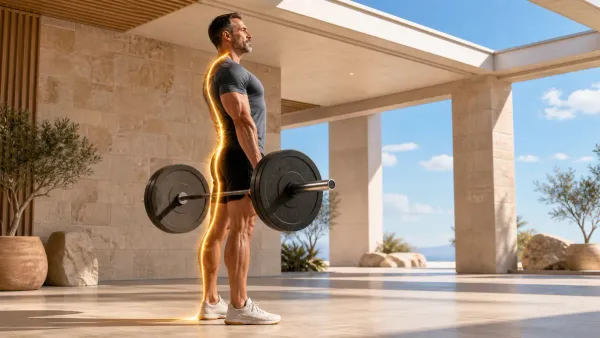
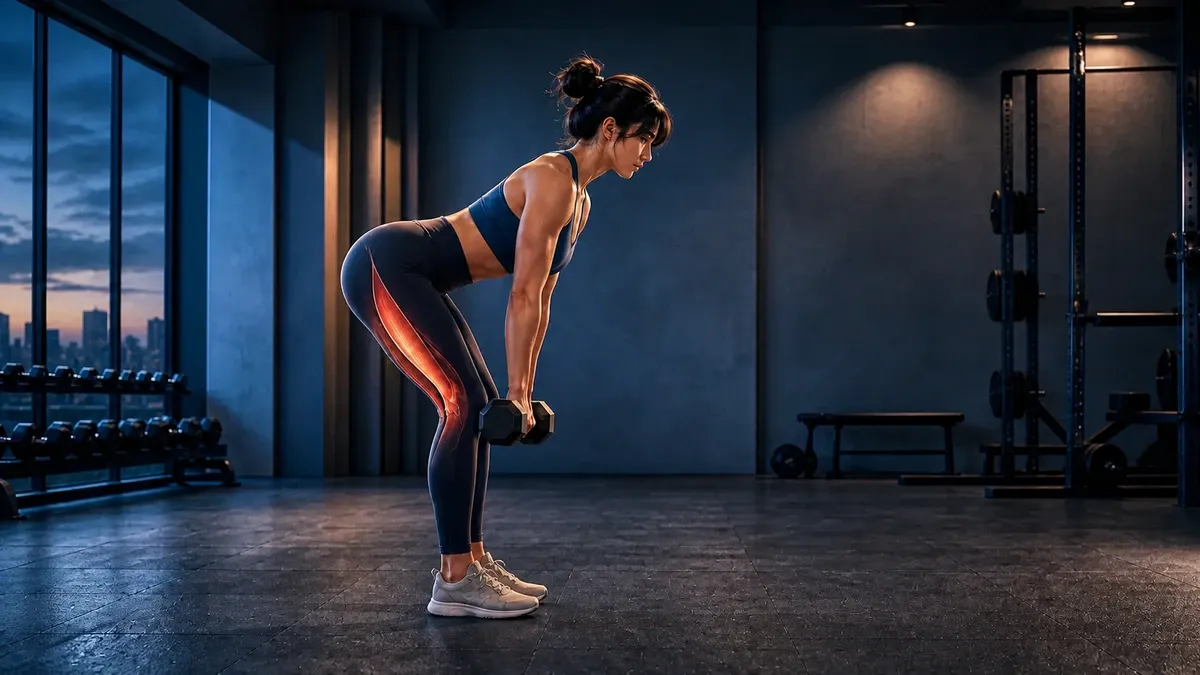
3. Romanian deadlift
Stand with a dumbbell in each hand or a bar close to the thighs. Soften the knees, brace, push the hips backward, and let the load travel close to the legs. Stop when the pelvis can no longer move backward without the spine or knees changing position, then drive the floor away and stand tall.
- Start: 2–3 sets of 6–10 repetitions.
- Regress: use a dowel hinge, elevate the load, or reduce range.
- Progress: add the smallest practical load while preserving the same bottom position.
- Watch for: turning the exercise into a squat or chasing the floor with a rounded back.
The bottom position depends on hamstring length, hip anatomy, load, and control. A vertical shin is a useful tendency, not a command to lock the knees. The complete deadlift guide explains bracing, load path, grip, and hinge variations in more detail.
4. Sliding hamstring curl
Lie on your back with the heels on sliders or towels on a smooth surface. Lift into a bridge, slowly slide the heels away, then pull them back while keeping the pelvis as level as your strength allows.
- Start: 2 sets of 5–8 repetitions with a short slide.
- Regress: lower the hips between repetitions or perform only the slow outward phase.
- Progress: extend farther, keep the hips higher, or use one leg for part of the range.
- Watch for: losing friction, snapping the knees straight, or forcing the pelvis high.
Test the surface before starting. A towel that stops suddenly or a slider that shoots away changes the exercise and can create a fall risk.
5. Seated band or machine leg curl
Sit with the hip flexed, align the machine or band so resistance acts through knee flexion, and pull the heels downward or backward without lifting the thighs. Return slowly toward knee extension without letting the stack crash or the band pull the joint abruptly.
- Start: 2–3 sets of 8–15 repetitions.
- Regress: reduce resistance or stop short of the longest position.
- Progress: add load after all sets retain the same range and tempo.
- Watch for: rocking the trunk or shortening every repetition as fatigue rises.
A machine makes resistance easy to measure. A band changes tension through the range, so compare band sessions by setup, band length, and body position rather than color alone.
6. Single-leg Romanian deadlift
Stand on one leg with light fingertip support. Reach the free leg backward as the pelvis hinges over the standing hip. Keep the pelvis mostly square, then return by pressing the working foot into the floor.
- Start: 2 sets of 5–8 repetitions per side.
- Regress: use a kickstand or hold a rail.
- Progress: add load in the opposite hand before removing useful balance support.
- Watch for: opening the pelvis, reaching with the shoulder, or turning wobble into the main challenge.
Balance difficulty can cap hamstring load. Support is not cheating when strength is the goal. For balance as a separate outcome, use the single-leg balance progression.
7. Assisted Nordic hamstring curl
Kneel on padding with the ankles secured by a stable partner or purpose-built setup. Keep the hips extended, lean forward from the knees, and resist the fall. Use a band, hands, raised target, or short range to control the descent, then push lightly from the floor to return.
- Start: 2 sets of 3–5 assisted repetitions once per week.
- Regress: increase band assistance or shorten the range substantially.
- Progress: add one repetition or a little range before reducing assistance.
- Watch for: bending sharply at the hips, free-falling, or using an unsafe ankle anchor.
The full unassisted Nordic is a high-demand exercise. If you cannot slow the first part of the descent, the setup is too difficult. A slider curl or loaded RDL can build meaningful hamstring capacity without forcing this variation.
Technique rules that transfer across exercises
Keep the pelvis and trunk organized
Hamstring exercises do not require a perfectly motionless spine, but the chosen movement should come from the intended joints. In a hinge, the hips move backward while the load stays close. In a curl, the knees move while the pelvis remains controlled. Reduce load when unrelated motion becomes the strategy.
Control the longest position
The bottom of an RDL, the extended position of a slider, and the forward position of a Nordic all place the hamstrings under greater length and leverage. Enter that position gradually and reverse it with muscular control. Do not bounce or use a partner to force range.
Count only comparable repetitions
A set of ten is meaningful only if the early and late repetitions use similar range, setup, and tempo. End the set or record partial repetitions separately when the hinge shortens, the hips drop, or the curl stops early.
Distinguish effort from pain
Muscular effort and later diffuse soreness can occur after unfamiliar training. Sharp pain, a sudden pulling sensation, focal tendon pain, tingling, numbness, or symptoms that change walking are not targets to push through.
A two-day beginner hamstring program
Place these sessions on nonconsecutive days. They can follow a full-body warm-up and come after your most technical compound lift. Begin with one easy rehearsal set for each exercise.
| Day A | Dose | Day B | Dose |
|---|---|---|---|
| Romanian deadlift | 2 × 8–10 | Long-lever bridge | 2 × 8–12 |
| Sliding hamstring curl | 2 × 6–10 | Seated band or machine curl | 2 × 10–15 |
| Optional split squat | 2 × 6–10 per side | Optional calf raise | 2 × 10–15 |
Finish most sets with 2–3 clean repetitions in reserve. Rest about 90–150 seconds between challenging sets and longer when breathing or grip prevents consistent technique. If four direct hamstring sets per session cause severe soreness, begin with one set of each exercise and build over several weeks.
The optional work keeps the lower body balanced. The Bulgarian split squat guide covers unilateral squat mechanics, while the calf exercise guide adds straight- and bent-knee plantar-flexor work.
How to program hamstrings for different goals
| Goal | Main emphasis | Practical starting structure | Important limit |
|---|---|---|---|
| General strength | RDL plus curl | 2 sessions, 4–8 direct work sets weekly | Do not let hinge fatigue degrade full-body lifts |
| Muscle growth | Multiple controlled sets at useful lengths | 6–10 direct sets weekly, built gradually | More volume is useful only when recovered |
| Home training | Bridges plus sliders or bands | 2–3 brief sessions | Progress leverage and range before endless reps |
| Running support | Heavy hinge or curl plus later eccentric work | 1–2 strength sessions away from key speed work | Count sprinting and hills as hamstring load |
| Field-sport preparation | Hip- and knee-dominant strength plus sprint exposure | Progress strength before high-speed demand | Gym work does not replace sprint preparation |
The 2026 American College of Sports Medicine position stand emphasizes consistency and individualization. For healthy adults, heavier loads tend to maximize strength, multiple sets support hypertrophy, and equipment choice or training to failure is less decisive than many people assume (ACSM, 2026). A large network meta-analysis likewise found that many resistance-training prescriptions improved strength and muscle size, with heavier loading ranking highly for strength and multiset training ranking highly for hypertrophy (Currier et al., 2023).
Beginners do not need to test a one-repetition maximum. Choose a load from repetition quality. When every set reaches the top of its range with the same technique on two sessions, add the smallest available load and return to the lower end.
A six-week progression
| Weeks | Main focus | Progression rule |
|---|---|---|
| 1–2 | Learn bridge, hinge, and curl positions | Add repetitions within the starting range |
| 3–4 | Build controlled range and modest load | Change one exercise variable at a time |
| 5 | Add a harder leverage or third set if recovered | Keep at least two clean repetitions available |
| 6 | Consolidate the new version | Repeat the dose before adding more complexity |
Use double progression for loaded exercises. If the range is 8–12 repetitions, begin with a load you can control for eight. Add repetitions over sessions. Once all sets reach 12 twice with stable form, add a small load and return to eight or nine.
For bodyweight exercises, the next step may be a longer lever, more range, less assistance, or a longer lowering phase. Change only one. Do not add a single-leg variation, extra weekly set, slower eccentric, and harder sport session together.
Recovery, soreness, and scheduling
Hamstrings can become very sore after unfamiliar lengthened or eccentric exercise. Soreness is not a score for workout quality. Begin with conservative volume before travel, a race, a long hike, sprint training, or any day when stiff movement would matter.
Track these signals:
- technique and load improve while soreness remains manageable;
- ordinary stiffness warms up and resolves rather than escalating;
- walking and stairs remain normal;
- sprint pace, hinge control, or sport skill is not repeatedly impaired;
- the same dose feels more repeatable over several weeks.
If soreness changes your gait or lasts longer than expected, repeat a smaller dose after recovery rather than proving toughness with another hard session. The DOMS recovery guide separates ordinary delayed soreness from symptoms that deserve more caution.
Common hamstring-training mistakes
Training only one joint action
Deadlifts do not directly train knee flexion through a large range, and curls do not teach a loaded standing hinge. Use one exercise from each family unless a clear reason narrows the plan.
Locking the knees during a hinge
Keep a small, stable knee bend. Forcing the knees backward can create discomfort and turn range of motion into the goal.
Chasing the floor in an RDL
The weight does not need to touch the ground. Stop when the hips stop moving backward with the trunk controlled. Depth changes with proportions and mobility.
Free-falling through eccentric work
If a Nordic or slider accelerates beyond control, increase assistance or shorten the range. An exercise labeled eccentric still requires active resistance.
Starting with too many Nordics
The Nordic curl can produce high effort and soreness. Start assisted and low volume. It is an option, not a rite of passage.
Confusing cramp with effective training
Cramp often means leverage, fatigue, hydration, position, or novelty exceeded current tolerance. Regress the setup and resume only when the muscle releases.
Adding strength after maximal sprint fatigue
High-speed running already places substantial demand on the hamstrings. Heavy curls performed after mechanics have deteriorated may add fatigue without useful quality. Coordinate strength and running rather than treating them as unrelated sessions.
Pain, previous injury, and red flags
Ordinary training soreness is usually diffuse, appears later, and improves over several days. A hamstring strain more often follows a distinct event and may cause sudden pain, tenderness, bruising, weakness, or pain with walking and resisted knee flexion. Stop loading and seek qualified assessment when symptoms suggest an acute injury.
Pain high under the buttock during sitting, hinging, or running may involve the proximal hamstring tendon, but self-diagnosis is unreliable. Rehabilitation depends on symptom behavior, load tolerance, sport demand, and differential diagnosis. A general exercise list should not replace that process.
Seek prompt medical evaluation after a pop with rapid bruising; a visible or palpable defect; marked weakness; inability to walk normally; severe pain after a fall; or symptoms that followed a forceful split. Urgent assessment is also appropriate for new leg swelling, warmth, or redness with shortness of breath or chest pain.
Tingling, numbness, pain traveling below the knee, new bowel or bladder symptoms, or progressive weakness can indicate nerve or spinal involvement rather than a simple muscle problem. Recent surgery, joint replacement, pregnancy, anticoagulant use, significant osteoporosis, cancer treatment, or a previous tendon avulsion warrants individualized guidance before aggressive loading.
Track hamstring progression with SuperAge
Hamstring training improves through consistent, interpretable sessions. Record the exercise family, variation, sets, repetitions, load, range, assistance, repetitions in reserve, and next-day response. For runners and field-sport athletes, add sprint distance, hills, accelerations, and match load so the gym dose is not viewed in isolation.
SuperAge can place those notes beside Apple Watch trends such as activity, resting heart rate, HRV, sleep, and cardio fitness. It cannot measure tendon integrity, diagnose a strain, or tell whether pain is safe. Its value is pattern recognition: strength rising while recovery stays stable, soreness following a sudden increase in Nordic volume, or performance flattening when hard running and hinge work repeatedly collide.
Download SuperAge to review training and recovery trends in one private timeline while keeping exercise progression grounded in technique, symptoms, and qualified care when needed.
Key takeaways
- Combine a hip-dominant hinge with a knee-flexion exercise for complete hamstring training.
- Start with bridges, controlled RDLs, sliders, or seated curls before treating Nordics as necessary.
- Use the largest comfortable repeatable range; longer is useful only when control remains intact.
- Train twice weekly at first with 2–3 sets per exercise and 2–3 clean repetitions in reserve.
- Progress repetitions, load, range, leverage, or weekly volume one variable at a time.
- Eccentric work builds strength, but extreme soreness and high volume are not prerequisites.
- Gym strength can support sport preparation but cannot guarantee injury prevention or replace progressive running exposure.
- Sudden pain, bruising, marked weakness, nerve symptoms, or gait change requires assessment rather than another workout.
FAQ
What are the best hamstring exercises?
Use one hip-dominant exercise, such as a Romanian deadlift, and one knee-dominant exercise, such as a sliding or seated leg curl. Bridges are useful for beginners and home training. The best pair is the one you can load progressively through a controlled, comfortable range.
How often should I train hamstrings?
Twice per week on nonconsecutive days is a practical starting point. One session can work when whole-body training already provides enough volume; three can work when the dose is divided. Running, sprinting, hills, and field sport also count toward recovery demand.
How many sets and repetitions should I do?
Begin with 2–3 sets of 6–10 repetitions for a loaded hinge and 2–3 sets of 8–15 for a curl or bridge. These are starting ranges, not biological rules. Stop when range, pelvic control, or tempo changes substantially.
Are deadlifts enough for hamstrings?
Romanian and other deadlift variations can load the hamstrings strongly in hip extension, but they do not train knee flexion directly. Add a curl, slider, or assisted Nordic when you want a more complete program.
Are Nordic hamstring curls safe for beginners?
Full Nordics are usually too difficult for a true beginner. Use strong band assistance, a short range, a raised target, or a different eccentric exercise. If you cannot slow the descent, increase assistance rather than falling farther.
Should I feel Romanian deadlifts in my hamstrings?
You may feel tension in the back of the thighs as the hips move backward, but sensation is not the only proof of a useful set. Keep the load close, use a small knee bend, stop at your controlled range, and track whether load and repetitions improve.
Do strong hamstrings prevent injury?
Strength training can be one useful part of injury-risk reduction, particularly in running and field sports, but no exercise guarantees prevention. Sprint exposure, workload, previous injury, fatigue, technique, adherence, and chance also matter.
Can I train hamstrings with back or knee pain?
Sometimes a different variation, range, resistance, or body position is tolerable, but the cause and behavior of pain matter. New, sharp, radiating, swelling-related, or gait-changing symptoms call for assessment. Do not force a popular exercise through worsening pain.
References
- Currier BS, et al. American College of Sports Medicine position stand: resistance training prescription for muscle function, hypertrophy, and physical performance in healthy adults. Medicine & Science in Sports & Exercise. 2026. ACSM summary
- Currier BS, et al. Resistance training prescription for muscle strength and hypertrophy in healthy adults: a systematic review and Bayesian network meta-analysis. British Journal of Sports Medicine. 2023. PubMed
- Hegyi A, et al. Hamstrings force-length relationships and their implications for angle-specific joint torques: a narrative review. Sports Medicine. 2022. PMC
- Maeo S, et al. Greater hamstrings muscle hypertrophy but similar damage protection after training at long versus short muscle lengths. Medicine & Science in Sports & Exercise. 2021. PubMed
- Wolf M, et al. Does longer-muscle length resistance training cause greater longitudinal growth in humans? A systematic review. Sports Medicine and Health Science. 2026. PubMed
- Crawford SK, et al. Hamstrings muscle architecture and morphology following six weeks of an eccentrically biased Romanian deadlift or Nordic hamstring exercise intervention. Medicine & Science in Sports & Exercise. 2025. PubMed
- Gérard R, et al. The effects of eccentric training on biceps femoris architecture and strength: a systematic review with meta-analysis. Journal of Athletic Training. 2020. PubMed
- Franke RA, et al. Dose-response relationship for strength gains from Nordic hamstring exercise: a systematic review, meta-analysis, and meta-regression. Journal of Strength and Conditioning Research. 2025. PubMed
- Biz C, et al. Exercise interventions to prevent hamstring injuries in athletes: a systematic review and meta-analysis. Sports Medicine. 2021. PubMed
- Impellizzeri FM, et al. Why methods matter in a meta-analysis: a reappraisal showed inconclusive injury preventive effect of Nordic hamstring exercise. Journal of Clinical Epidemiology. 2021. PubMed
Related Articles

Lat exercises: anatomy, form, and workout progression
Learn lat exercises with clear anatomy, vertical and horizontal pulling options, technique cues, a two-day workout, progression, and safety limits today.