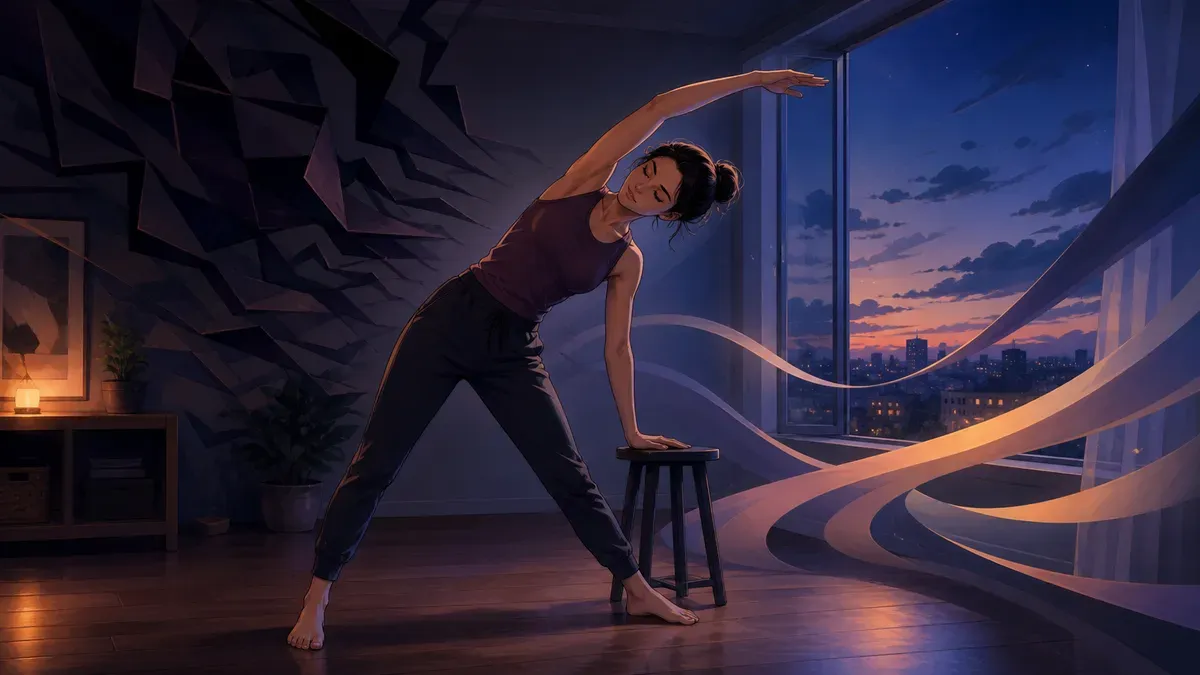
Can stretching improve mental health? What the evidence really shows
Stretching may briefly ease stress and lift mood, but it is not a mental health treatment. Learn what studies show and build a safe daily calming routine.
Stretching may help you feel calmer or more positive for a short time, especially when the session is slow, comfortable, and deliberate. Small trials also suggest that a regular stretching routine can reduce perceived stress or anxiety in some groups. But the evidence is not strong enough to call stretching a treatment for depression, an anxiety disorder, or cognitive decline.
That distinction is useful, not disappointing. Stretching can be a low-friction way to interrupt prolonged sitting, notice physical tension, and create a transition between demanding parts of the day. Its clearest established benefit is improved range of motion. Any mental benefit should be treated as a possible bonus rather than a promise about hormones, the brain, or long-term emotional health.
Quick answer
Yes, stretching can improve state mood and stress immediately after some sessions, but results vary and most studies are small. A 2026 review found promising changes in psychological stress, heart rate, blood pressure, cortisol, and autonomic measures across a mixed evidence base. A recent randomized study also found that 30 minutes of stretching reduced state anxiety and negative affect and increased positive affect in young adults.
Those findings do not prove that stretching treats a diagnosed mental illness or protects the brain from aging. Evidence for memory and executive function is much thinner: one small 2025 study found a brief improvement in reaction time but no improvement in working memory, short-term memory, or task accuracy. Use stretching as one supportive habit alongside aerobic activity, strength training, sleep, social connection, and professional care when needed.
Key facts
- Comfortable stretching increases joint range of motion, its best-established direct outcome.
- A stretching session may reduce short-term state anxiety, but the response is not universal or diagnostic.
- The autonomic nervous system changes during and after a stretch, so feeling briefly activated during a hold does not mean the session failed.
- Stretching does not establish broad cognitive improvement, because current human studies are small and task-specific.
- Persistent mental health symptoms require appropriate care, not a harder or longer stretching routine.
What mental health benefits have actually been measured?
“Mental health” can mean very different outcomes. A study that measures how tense someone feels ten minutes after a session cannot establish that the same routine treats major depression for months. The evidence makes more sense when separated by time scale and outcome.
| Outcome | What the evidence suggests | What it does not prove |
|---|---|---|
| State anxiety and affect | Some single sessions improve immediate anxiety, negative affect, or positive affect | Treatment of an anxiety disorder |
| Perceived stress | Some workplace and longer-term trials report modest reductions | A predictable cortisol reset for everyone |
| Autonomic signals | Heart rate, HRV, blood pressure, and vascular responses can change during or after stretching | That one wearable HRV reading measures emotional recovery |
| Attention | A small study found faster Stroop reaction time for 10 to 20 minutes | Better memory, accuracy, or long-term cognition |
| Depression | Stretching arms are sometimes useful active controls and may improve with the rest of care | That stretching alone is an antidepressant therapy |
| Brain health | Stretching-and-toning groups sometimes show vascular or functional change | Prevention of dementia or a broad neuroplastic effect |
Immediate mood: promising, but narrow
In a 2026 randomized study of 88 mostly young adults, stretching, yoga, and moderate aerobic exercise increased positive affect, while all tested exercise conditions reduced state anxiety and negative affect. Circulating BDNF did not change across conditions, and the endocannabinoid response was specific to moderate aerobic exercise. The practical reading is that people may feel better after stretching without needing a dramatic “brain chemical” explanation.
An older randomized workplace trial assigned 134 employees to a ten-minute after-work stretching program or no program for three months. Anxiety improved by a moderate amount in the stretching group, alongside pain, exhaustion, vitality, and flexibility. This is useful real-world evidence, but the intervention also created a scheduled break and a repeated ritual. The design cannot tell us how much came from the stretch itself, the pause from work, attention from the program, or expectation.
Longer stress outcomes: context matters
The PRYSMS trial compared restorative yoga with stretching in adults with metabolic syndrome over a six-month intervention and maintenance period. The stretching group showed favorable changes in waking and bedtime cortisol, chronic stress severity, and some measures of perseverative thinking compared with restorative yoga. Social support also appeared related to cortisol changes within that group.
That result is more interesting than a generic claim that stretching “lowers cortisol.” Cortisol follows a daily rhythm and responds to sleep, illness, medication, food, psychological demand, and measurement conditions. A group-average change across months cannot predict what one evening stretch will do to one person’s hormone level.
Clinical symptoms: stretching is not a replacement treatment
Exercise is a valuable complement in mental health care, but modality matters. A 2026 network meta-analysis of 30 randomized trials in adults with anxiety disorders or elevated symptoms found the most consistent support for resistance and mind-body exercise; it did not establish stretching as the leading treatment. Trials in depression have often used stretching as an active comparison group, and symptoms sometimes improve in both groups while patients continue standard care.
If low mood, anxiety, loss of interest, sleep disruption, or difficulty functioning persists, discuss it with a qualified health professional. A mobility routine can remain part of the day, but it should not delay psychotherapy, medication review, medical evaluation, or urgent help.
How could stretching change the stress response?
Several mechanisms are plausible, but none acts like an on-off switch.
Sensory attention interrupts mental load
A slow stretch directs attention toward pressure, position, breath, and the boundary between comfortable tension and pain. This can interrupt rumination for a few minutes. The effect may resemble a brief grounding exercise, particularly when the routine is performed without a screen or performance target.
That does not make stretching identical to mindfulness. If the routine includes deliberate breathing, silence, music, or guided attention, those components may contribute independently. A study of “stretching” may therefore test a small behavioral package rather than muscle lengthening in isolation. For a distinct practice that combines breathing, balance, and controlled transitions, use this 12-minute daily yoga routine rather than treating yoga as stretching alone.
Autonomic activity changes across the session
Stretching mechanically deforms muscle and blood vessels and activates sensory nerves. During a strong static hold, heart rate and blood pressure can rise and vagal measures can fall. After the stretch or after repeated training, some studies report lower heart rate, altered HRV, or reduced vascular stiffness.
This sequence explains why “stretching activates the parasympathetic nervous system” is too simple. The body may become more activated during the hold and settle afterward. A 2021 cardiovascular meta-analysis found favorable average effects on heart rate and arterial stiffness, but the authors also noted limited evidence for vascular adaptation. A review focused on HRV described stretching as a potentially useful adjunct while emphasizing that mechanisms remain uncertain.
If you track heart rate variability, do not judge the session from one immediate number. Posture, breathing rate, measurement timing, and device noise can move HRV independently of emotional state.
Reduced discomfort may improve mood indirectly
Physical discomfort consumes attention and can make a demanding day feel heavier. Stretching can temporarily increase range of motion and may feel relieving for someone who has been still for hours. Mood may improve because movement feels easier or because the person regained a sense of agency—not necessarily because a specific neurochemical pathway changed.
Stretching is not a reliable cure for soreness or injury. Our evidence review on stretching and injury prevention explains why load management, strength, and movement-specific preparation matter more than static stretching alone.
Does stretching improve memory or protect the brain?
The honest answer is: not proven.
A small 2025 self-controlled study tested 30 healthy adults after neck and shoulder stretching. Stroop reaction time improved at 10 and 20 minutes, but accuracy, working memory, and short-term memory did not. Without a separate non-stretching control group, practice effects, expectation, or a short break may explain part of the result.
Longer exercise trials offer an important comparison. In older adults with amnestic mild cognitive impairment, a 2026 randomized trial found that aerobic training produced a more sustained reduction in cerebrovascular impedance than stretching and toning. In another large trial, cognitively enhanced tai ji quan improved global cognition and dual-task walking more than standard tai ji quan or stretching.
Stretching still has value. Maintaining flexibility and mobility can make walking, training, and daily movement easier, which may help a person stay active. But that is an indirect path. For brain health, the stronger foundation remains sufficient aerobic activity, strength work, sleep, blood-pressure management, social and cognitive engagement, and treatment of relevant medical conditions.
A ten-minute calming stretching routine
There is no validated “mental health dose” of stretching. The routine below is a practical experiment, not a treatment protocol. Its purpose is to create a comfortable movement break and observe how you respond.
- Arrive for one minute. Stand or sit securely. Let your breathing settle without forcing deep breaths. Rate current tension and mood from 0 to 10.
- Move the shoulders and upper back for two minutes. Use slow shoulder circles, gentle reaching, and comfortable upper-back rotation. Keep the jaw relaxed.
- Open the chest for one minute. Move the arms behind or beside the body only as far as the shoulders allow without pinching.
- Alternate the hips for two minutes. Use a supported hip-flexor position or a gentle seated hip movement. Keep the range smaller if balance is uncertain.
- Alternate the calves and hamstrings for two minutes. Maintain a soft knee where needed and avoid rounding or pulling aggressively on the spine.
- Choose the tightest comfortable area for one minute. Repeat a movement that felt useful, not the one with the greatest range.
- Recheck for one minute. Notice mood, tension, breath, and any pain. A one-point shift is information; no shift is also information.
For static holds, use mild-to-moderate tension and keep breathing. Twenty to thirty seconds is a reasonable starting interval, repeated once if comfortable. A 2025 meta-analysis found that flexibility gains plateaued around four cumulative minutes per muscle group in a session and ten minutes per muscle group per week. Those numbers concern range of motion, not mood, so there is no reason to chase them during a calming break.
Do not stretch to prove flexibility. The same meta-analysis found no extra flexibility benefit from going beyond discomfort or pain. If mental decompression is the goal, intensity that makes you brace, hold your breath, or worry about the position defeats the purpose.
Match the routine to the moment
During a mentally dense workday
Use the routine as a boundary between tasks, not while continuing to read messages. Even two or three movements can break prolonged sitting. If neck or arm symptoms are caused by workstation setup, repeated stretching without changing the workload is only a temporary response.
After training
Stretch because you value range of motion or the sensation feels good—not because it guarantees faster muscle recovery. Long passive holds are better separated from explosive performance when maximal strength or power matters. Dynamic movement fits a warm-up more naturally.
Before sleep
Gentle stretching may be a useful wind-down cue when it remains comfortable and uncompetitive. Keep the room and routine quiet, and stop if a position increases pain or alertness. Our guide to evening exercise and sleep explains why low-intensity movement usually creates less sleep conflict than hard late training.
During acute anxiety
Choose stable, familiar positions and avoid holding the breath. Stretching may help with mild state tension, but chest pain, faintness, severe shortness of breath, new neurological symptoms, or a sense of immediate danger require appropriate medical assessment rather than a mobility routine.
How SuperAge helps track the habit without turning it into a test
Use a simple two-week log. Record when you stretched, approximate duration, perceived intensity, stress before and after, pain, and the next night’s sleep. Keep the interpretation modest: improvement after a session is a personal pattern, not proof of a hormone or brain change.
SuperAge can help you place that pattern beside activity, sleep duration and consistency, resting heart rate, and HRV-led recovery. The app cannot diagnose anxiety, depression, cognitive impairment, or a musculoskeletal condition. Its useful role is showing whether a small routine fits into a broader week of movement and recovery.
For the wider biological context, read our guide to mental health and biological aging. Chronic stress matters, but no single self-care technique determines biological age.
When to modify, stop, or get help
Stretching should create tension, not sharp pain. The National Institute on Aging advises warming the muscles, breathing normally, and not stretching so far that it hurts. Use support when balance is uncertain and progress gradually after illness or a break.
Stop the movement and seek advice if you develop:
- sharp, electric, radiating, or progressively worsening pain;
- numbness, new weakness, loss of coordination, or dizziness;
- joint instability, swelling, or pain after a recent injury;
- symptoms that repeatedly worsen after the same position;
- pain or mobility restriction that interferes with sleep or daily function.
People with recent surgery, a fracture, significant osteoporosis, joint hypermobility, neurological disease, or an individualized rehabilitation plan should follow their clinician’s movement guidance rather than a generic routine.
Mental health needs their own safety boundary. The U.S. National Institute of Mental Health advises professional help when severe symptoms last two weeks or more or impair daily tasks. If you may harm yourself or someone else, use the emergency or crisis service where you live now; do not wait for exercise to change the feeling.
Key takeaways
- Stretching may briefly improve state anxiety, tension, or mood, but the evidence base is still small and mixed.
- The clearest direct benefit is flexibility, not treatment of depression, anxiety disorders, or cognitive decline.
- Autonomic activity can rise during a hold and settle afterward; one HRV or cortisol story cannot explain every response.
- Cognitive findings are short-term and task-specific, while aerobic and cognitively enriched exercise has stronger evidence for brain outcomes.
- A comfortable ten-minute routine can be a useful movement break when it complements—not replaces—cardio, strength, sleep, connection, and care.
- Stop for sharp or neurological pain, and seek appropriate help for persistent or severe mental health symptoms.
Make the pattern visible
Want to see whether a short movement break fits your wider recovery pattern? Download SuperAge and compare the habit with sleep, activity, resting heart rate, and HRV trends over several weeks.
FAQ
Can stretching release trauma stored in the body?
There is no accepted biological mechanism by which a specific stretch releases stored trauma. Movement can change sensation, attention, arousal, and mood, and some people find body-based therapy helpful. Trauma symptoms deserve trauma-informed professional care; intense physical or emotional reactions are not proof that a muscle released a memory.
How long should I stretch for stress relief?
No mental health dose has been established. Try five to ten comfortable minutes and judge your response. Research on flexibility—not stress—suggests that benefits plateau around four cumulative minutes per muscle group in one session and ten minutes per muscle group per week, so longer is not automatically better.
Does stretching lower cortisol?
Some longer trials report favorable average changes in salivary cortisol and perceived stress, but results depend on the population, program, timing, and comparison group. Cortisol varies across the day and with sleep, illness, food, medication, and acute demand. Stretching is not a dependable way to “reset” an individual’s cortisol.
Is stretching as good as cardio for mental health?
No direct evidence supports treating them as equivalent. Stretching is accessible and may improve immediate affect, while aerobic activity and resistance or mind-body exercise have broader evidence across anxiety, depression, cardiovascular fitness, and brain-related outcomes. A balanced week can include all of them.
Can stretching improve focus before work?
Possibly for a short period. One small study found faster reaction time on an attention task for 10 to 20 minutes after self-stretching, but no improvement in accuracy or memory. A brief break, expectation, or movement itself could contribute, so treat it as a personal experiment rather than a cognitive hack.
Why do I sometimes feel more alert while stretching?
A static hold can briefly increase heart rate, blood pressure, and sympathetic activity through mechanical and sensory signals. Settling may occur after the hold rather than during it. Reduce the intensity if you brace or hold your breath, and stop if you feel dizzy, faint, or unwell.
Should I stretch when I feel depressed or anxious?
Gentle stretching can be one small supportive action if it feels safe and manageable. It is not a substitute for assessment or treatment. Seek professional help when symptoms persist, worsen, or impair daily life, and use local emergency or crisis services immediately if there is risk of harm.
Scientific references
- Behm DG, et al. Neurological, neurovascular, and psychological responses to stretching across the general population. European Journal of Applied Physiology. 2026.
- Crombie KM, et al. Yoga, aerobic exercise, acute affect, BDNF, endocannabinoids, and memory. Psychoneuroendocrinology. 2026.
- Montero-Marin J, et al. Effectiveness of a workplace stretching program on anxiety. Atencion Primaria. 2013.
- Corey SM, et al. Restorative yoga versus stretching on cortisol and psychosocial outcomes. Psychoneuroendocrinology. 2014.
- Wong A, Figueroa A. Acute stretching, training, and heart rate variability. Journal of Strength and Conditioning Research. 2021.
- Thomas E, et al. Cardiovascular responses to muscle stretching: systematic review and meta-analysis. International Journal of Sports Medicine. 2021.
- Costa E Silva G, et al. Acute static stretching order and cardiovascular and autonomic responses. Scientific Reports. 2019.
- Park SY, et al. Time course of cognitive changes following self-stretching. Brain Sciences. 2025.
- Sugawara J, et al. Exercise training and cerebrovascular impedance in amnestic mild cognitive impairment. Medicine & Science in Sports & Exercise. 2026.
- Li F, et al. Cognitively enhanced tai ji quan for cognition and dual-task walking. Annals of Internal Medicine. 2023.
- Ingram LA, et al. Optimising the dose of static stretching to improve flexibility. Sports Medicine. 2025.
- Ramos-Sanchez CP, et al. Exercise treatments for adults with anxiety disorders: systematic review and network meta-analysis. BMJ Open Sport & Exercise Medicine. 2026.
- U.S. Department of Health and Human Services. Physical Activity Guidelines for Americans, second edition. Accessed 2026.
- National Institute on Aging. Exercise types and flexibility safety. Updated 2025.
- National Institute of Mental Health. My mental health: do I need help?. Revised 2025.
Related Articles

Daily yoga routine: poses, safety, and progression
Build a daily yoga routine with a safe 12-minute sequence, clear modifications, recovery rules, and a four-week plan for steady progress and mobility at home.