Exercising at night and sleep quality: when timing backfires
Exercise at night can help or hurt sleep quality depending on intensity, timing, and recovery. Learn when evening workouts backfire and what to track.
Exercising at night is not automatically bad for sleep.
That is the most important correction. A calm evening walk, mobility session, or moderate workout can improve sleep for many people. Even vigorous evening exercise is not universally disruptive when it ends early enough and the person has time to cool down.
The problem is narrower: hard exercise close to bedtime.
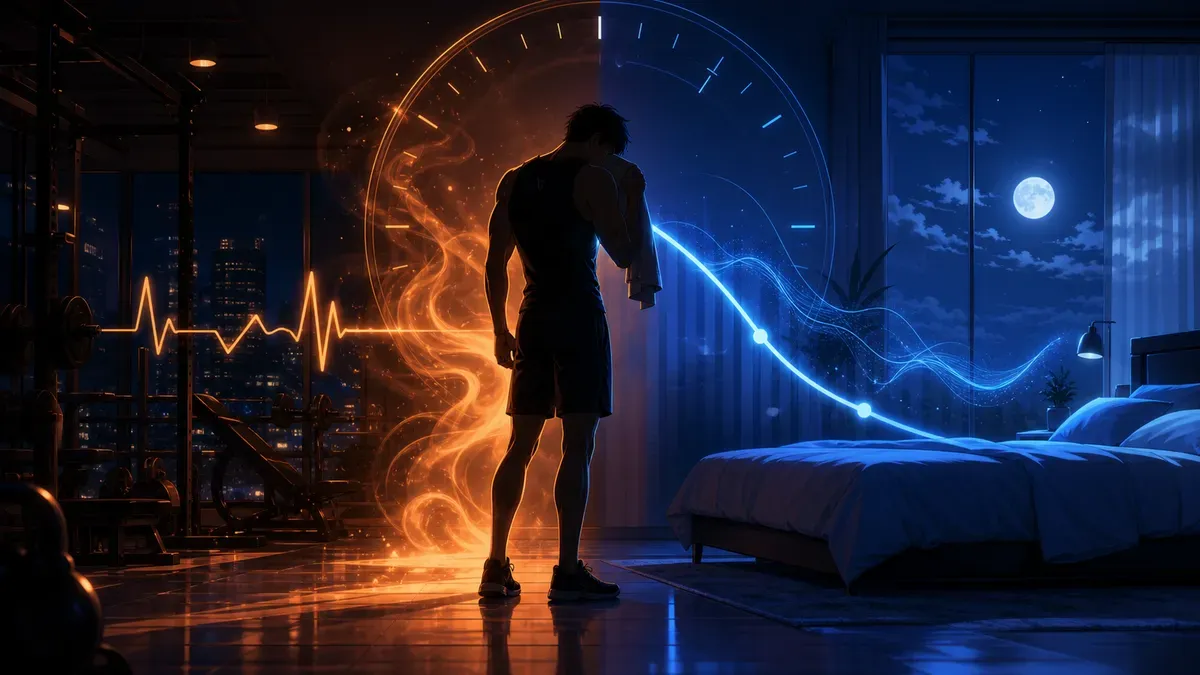
When intensity is high and the gap before sleep is short, the workout can keep core body temperature, heart rate, breathing rate, adrenaline, and mental alertness elevated at the exact moment your body is trying to downshift. That is when sleep latency gets longer, HRV drops, resting heart rate stays high, and the next morning’s readiness score looks worse than expected.
So the question is not “Can I exercise at night?” It is: What kind of night workout, ending how close to bedtime, fits your sleep physiology?
What you’ll learn:
- When evening exercise helps sleep and when it backfires
- Why intensity and finish time matter more than clock time alone
- How body temperature, sympathetic activation, chronotype, and light exposure change the answer
- What to track in Apple Health and wearables after night workouts
- A practical evening-training decision table for sleep quality and recovery
Quick verdict: how late is too late to exercise?
Use this rule.
Low-intensity movement is usually fine within 1 to 2 hours of bed. Walking, gentle cycling, easy yoga, mobility work, and stretching often support sleep by reducing stress and increasing total daily activity.
If stretching is part of your wind-down, keep the claim modest: it may help immediate tension or mood, but it is not a mental health treatment. Our evidence guide to stretching, stress, and brain health shows what has—and has not—been measured.
If sleep is disrupted by a sudden painful calf contraction rather than post-workout alertness, treat it as a separate problem. The night leg cramps guide covers safe release, a bedtime stretching trial, and symptoms that need prompt assessment.
Moderate workouts usually need a buffer of about 2 hours. Think steady lifting, easy-to-moderate cardio, zone 2 cycling, or technique work that does not leave you wired.
High-intensity workouts usually need a buffer of at least 3 hours, and sometimes more. HIIT, hard intervals, heavy lower-body lifting, late competitive sport, intense martial arts, and very hot classes are the most likely to backfire when they end close to bedtime.
| Workout near bedtime | Sleep risk | Better rule |
|---|---|---|
| Easy walk or gentle mobility | Low | Fine for most people |
| Relaxed yoga or stretching | Low to moderate | Keep it calming, not heated or strenuous |
| Zone 2 cardio | Moderate | Finish 2+ hours before bed if sleep is sensitive |
| Heavy strength training | Moderate to high | Finish 3+ hours before bed |
| HIIT or sprint intervals | High | Avoid in the final 3 hours before sleep |
| Late competitive sport | High | Watch HRV, resting heart rate, and sleep latency |
| Evening workout plus bright lights and late meal | High | Treat the whole routine as a circadian load |
If evening is your only realistic training window, do not skip exercise by default. Adjust the dose, intensity, cooldown, light, meal timing, and sleep window.
For the broader timing question, read best time to exercise for longevity. This article focuses specifically on sleep quality after night workouts.
Why night exercise can disrupt sleep
Sleep onset is not just a mental state. It is a coordinated physiological drop.
In the last few hours before sleep, your body normally begins to:
- lower core body temperature
- increase heat loss through the hands and feet
- reduce sympathetic nervous system tone
- increase parasympathetic activity
- allow melatonin to rise
- slow heart rate and breathing
- reduce alerting signals
A hard late workout pushes several of those systems in the opposite direction.
Core temperature stays elevated
Vigorous exercise raises core body temperature. That is useful for performance, but sleep onset depends on the opposite pattern: the body must shed heat and allow core temperature to fall. The body temperature and sleep guide explains why this temperature downslope is one of the strongest biological signals for sleep.
If you finish a hard workout at 9:30 p.m. and try to sleep at 10:15 p.m., your body may still be in heat-dissipation mode. You may feel tired but not sleepy. The brain is receiving mixed signals: high thermal load, elevated heart rate, and a clock that says it should be winding down.
Sympathetic tone remains high
High-intensity exercise increases catecholamines, breathing rate, heart rate, and central arousal. This is not a problem earlier in the day because the body has time to return to baseline.
Close to bed, the timing matters. If heart rate is still elevated, HRV is suppressed, or you feel mentally activated, the workout is competing with the parasympathetic shift that supports sleep.
Melatonin timing can be delayed
Exercise is a non-light time cue for the circadian system. Depending on timing, intensity, and chronotype, it can shift circadian phase. Add bright gym lights, screens, a late commute, and a late dinner, and the whole evening routine can push the body later.
This is why late exercise often backfires as a bundle, not as one isolated variable.
The workout may be only part of the issue. The real disruptors may be:
- bright light after sunset
- loud music and competitive arousal
- caffeine in a pre-workout drink
- a large late meal
- a hot shower immediately after training
- a delayed bedtime after the workout
- scrolling while still wired
If this sounds familiar, compare your routine with the blue light at night vs morning light guide. Light timing can decide whether evening exercise feels like a normal day cue or a circadian delay.
What the research actually says
The evidence is more nuanced than old sleep hygiene advice.
Evening exercise is not always harmful
A 2019 systematic review and meta-analysis in Sports Medicine found that evening exercise, on average, did not meaningfully disrupt sleep in healthy participants. In some cases, it was associated with better sleep architecture.
But there was an important exception: vigorous exercise ending within about 1 hour of bedtime could impair sleep onset latency, total sleep time, and sleep efficiency.
That exception is the practical takeaway. Evening exercise is not the problem. Late, hard, under-cooled exercise is the problem.
Higher strain close to bed has a dose-response pattern
A 2025 Nature Communications study used wearable data to examine the relationship between evening exercise and sleep. The strongest pattern was dose-response: later and more strenuous exercise was more likely to reduce sleep duration, delay sleep onset, lower sleep efficiency, and alter overnight recovery markers.
This matters because it moves the question beyond “morning or evening?” The more useful variables are:
- exercise strain
- time between workout end and habitual sleep onset
- individual sleep sensitivity
- baseline fitness
- chronotype
- whether the session delays the rest of the evening routine
High-intensity exercise is the most sensitive category
A 2021 systematic review in Sleep Medicine Reviews focused on evening high-intensity exercise. The conclusion was not that all evening high-intensity exercise ruins sleep. The concern was strongest when the session ended very close to bedtime, especially when heart rate and autonomic activation remained elevated.
A 2023 systematic review of exercise timing, circadian physiology, and sleep quality found that short-term evening exercise can delay melatonin rhythm and increase nocturnal core body temperature, even when some standard sleep-efficiency measures do not worsen. That is exactly why wearable recovery data can be useful: sleep may look acceptable by duration while HRV, resting heart rate, temperature, or latency reveal a cost.
Chronotype changes the answer
Chronotype matters. A late chronotype may tolerate or even benefit from some evening exercise because their biological night starts later. An early chronotype may experience the same workout as a stronger delay signal.
A JCI Insight study found that timed exercise shifted circadian phase differently by chronotype. Morning exercise advanced the circadian rhythm overall, while evening exercise effects depended on baseline timing. For early chronotypes, evening exercise could push the clock later.
That is why the best answer is personal but measurable.
If your bedtime is 11:30 p.m., a 6:30 p.m. strength session may be fine. If your bedtime is 9:45 p.m., the same session may be too close.
The three variables that decide whether night workouts backfire
1. Intensity
Intensity is the biggest lever.
Low-intensity movement tends to help sleep because it reduces stress without creating a major thermal or autonomic load. Moderate exercise is usually manageable if it ends early enough. High-intensity exercise is where timing becomes critical.
Use a simple intensity scale:
| Intensity | Examples | Sleep risk near bedtime |
|---|---|---|
| Low | walking, gentle mobility, relaxed yoga | Low |
| Moderate | zone 2 cardio, steady lifting, easy cycling | Moderate |
| High | intervals, heavy compound lifting, CrossFit-style workouts, hard sport | High |
| Maximal | sprints, testing, competition, all-out metabolic conditioning | Highest |
If the session leaves you hot, hungry, wired, or unable to speak comfortably for a while afterward, treat it as high intensity for sleep purposes.
2. Finish time relative to sleep
Clock time is less useful than the gap between workout end and your actual sleep onset.
The same 8:00 p.m. workout means different things:
- Bedtime 12:00 a.m.: 4-hour buffer
- Bedtime 10:00 p.m.: 2-hour buffer
- Bedtime 9:15 p.m.: 75-minute buffer
Use these starting buffers:
- Low intensity: 0 to 90 minutes can be fine
- Moderate intensity: 2 hours is a safer minimum
- High intensity: 3 hours is a safer minimum
- Maximal or competitive intensity: 3 to 4+ hours if you are sleep sensitive
Then verify with your data. Some people recover quickly. Others carry elevated heart rate for hours.
3. The rest of the evening routine
Night exercise rarely travels alone.
The sleep cost increases when it is paired with:
- pre-workout caffeine
- bright gym lighting
- long commute home
- late heavy dinner
- alcohol after training
- hot bedroom
- intense post-workout shower immediately before bed
- phone use while still physiologically activated
If the workout itself must stay late, modify the surrounding routine first. Dim lights when you get home. Eat a simpler recovery meal. Cool the room. Keep the shower warm, not scorching. Stop treating the workout finish as permission for a second evening.
The bedroom temperature and sleep quality guide is especially useful if your late workout leaves you warm during the first half of the night.
How to tell if exercising at night hurts your sleep
Do not judge by one night. Test the pattern for 2 to 4 weeks.
Track these signals after evening workouts:
| Metric | What to watch | Why it matters |
|---|---|---|
| Sleep onset latency | 20+ minutes longer than baseline | The body is not downshifting cleanly |
| Total sleep time | Shorter than usual | Late workout may compress the sleep window |
| Sleep efficiency | Lower than baseline | More time awake in bed |
| Overnight resting heart rate | 3 to 5+ bpm above baseline | Sympathetic load is still elevated |
| HRV | Suppressed versus baseline | Autonomic recovery is incomplete |
| Wrist or skin temperature | Higher than normal | Heat load or illness signal |
| Wake episodes | More frequent first half of night | Thermal or autonomic fragmentation |
| Next-day readiness | Lower after late workouts | Recovery cost exceeds training benefit |
The best comparison is within-person:
- Pick one workout type.
- Do it at the normal evening time for 2 sessions.
- Move the same workout 60 to 90 minutes earlier for 2 sessions.
- Compare sleep latency, resting heart rate, HRV, and next-day energy.
If sleep improves when the workout moves earlier, timing was part of the problem.
If sleep does not change, the issue may be training load, caffeine, alcohol, room temperature, stress, or insufficient total sleep.
Use training readiness score when the real question is whether the late session was worth the recovery cost. A good workout that creates poor next-day readiness too often is not a good weekly plan.
A decision table for evening workouts
Use this before training at night.
| Situation | Best choice |
|---|---|
| You have 4+ hours before bed | Most workouts are reasonable if total load fits your plan |
| You have 2 to 3 hours before bed | Keep intensity moderate unless your data says you tolerate hard sessions |
| You have under 2 hours before bed | Choose walking, mobility, light cycling, or stretching |
| You already slept poorly last night | Avoid high intensity; use recovery movement |
| HRV is low and resting heart rate is high | Move the hard session or reduce load |
| You need caffeine to train | Avoid late intensity or skip caffeine |
| You are training in a hot room | Add more cooldown time and protect bedroom temperature |
| You are an early chronotype | Be more conservative with evening intensity |
| You are a late chronotype | Evening training may fit, but still test sleep data |
| You have insomnia | Avoid treating late hard exercise as a sleep aid |
The goal is not to create rigid rules. It is to preserve the training benefit without stealing the recovery window that makes training work.
What to do if night exercise is your only option
Many people cannot train at the textbook ideal time. Work, family, commuting, and gym access decide the schedule.
If night is your only realistic option, use this hierarchy.
1. Keep the workout, lower the arousal
Swap the format before you skip the session.
Instead of:
- all-out intervals
- heavy lower-body maxes
- competitive sport until late
- long metabolic finishers
Use:
- moderate strength with more rest
- zone 2 cardio
- technique work
- mobility plus light carries
- easy incline walking
- shorter intervals earlier in the week
2. Build a real cooldown
Do not finish the last rep and walk straight into bed mode.
Use 10 to 20 minutes for:
- easy walking or cycling
- nasal breathing
- light stretching
- hydration
- lowering lights
- leaving the gym environment
The cooldown is not just for muscles. It is for the nervous system.
3. Avoid late caffeine
This is the easiest fix.
If your night workout requires a caffeinated pre-workout, it is no longer just an exercise-timing question. It is a caffeine and sleep question. Even if you fall asleep, caffeine can reduce deep sleep and raise overnight arousal.
For late sessions, use non-caffeinated performance cues: warm-up music, a clear plan, lower volume, and earlier nutrition.
4. Eat enough without making digestion the next problem
Under-eating after a late workout can wake you up hungry. Overeating can keep digestion active when you are trying to sleep.
Use a simple recovery meal:
- protein
- easy carbohydrate if the session was hard
- fluids and electrolytes if you sweated heavily
- moderate fat and fiber if bedtime is close
The goal is to support recovery without turning the meal into another sleep stressor.
5. Cool the environment
Late exercise plus a warm room is a bad combination.
Use:
- cooler bedroom temperature
- breathable bedding
- fan or airflow if noise is manageable
- light clothing
- a warm shower early enough to allow heat loss afterward
If fans or open windows add noise, check the sleep noise threshold guide so the cooling fix does not create another fragmentation problem.
When evening exercise may actually help sleep
Evening movement can be useful when the dose is right.
It may help if:
- you are sedentary most of the day
- stress is the main reason you cannot downshift
- the activity is light to moderate
- it ends with enough time to cool down
- it replaces scrolling, alcohol, or late snacking
- it helps you keep a consistent routine
For many people, a 20-minute evening walk is one of the best sleep interventions available. It lowers stress, supports glucose control after dinner, increases daily movement, and does not create the same thermal load as HIIT.
Even resistance training can fit at night if it is not too close to bed and does not repeatedly suppress next-day readiness.
The key is whether the session improves the weekly recovery pattern. If evening training helps you be consistent, sleep enough, and build fitness, it may be better than a theoretical morning plan you never follow.
For consistency across the week, pair this with sleep regularity vs sleep duration. A slightly later but stable routine may beat an ideal routine that collapses every weekend.
For the food decision after a late session, see what to eat before bed. It covers small, tolerable snacks and explains why overnight protein recovery research is different from evidence that a food improves sleep.
The SuperAge way to test your evening training window
SuperAge is useful here because the answer is individual.
One person can lift at 7:30 p.m. and sleep normally. Another can do the same workout and show a higher overnight heart rate, lower HRV, delayed sleep onset, and lower readiness.
Use SuperAge with Apple Health to test:
- workout start time
- workout end time
- intensity and heart-rate response
- sleep onset latency
- total sleep
- overnight resting heart rate
- HRV
- wrist temperature trend
- next-day readiness
Run a simple experiment:
- Keep the workout type the same.
- Change only timing or intensity.
- Compare 2 weeks of data.
- Choose the latest time that does not reduce sleep quality or next-day readiness.
That gives you a personal evening cutoff instead of a generic rule.
FAQ
Is it bad to exercise at night?
No. Exercising at night is not automatically bad. The risk rises when the workout is vigorous, ends close to bedtime, uses caffeine, keeps body temperature high, or delays your whole evening routine.
How many hours before bed should I stop working out?
As a starting point, finish low-intensity activity whenever it feels calming, moderate exercise at least 2 hours before bed, and high-intensity exercise at least 3 hours before bed. Adjust based on sleep latency, HRV, resting heart rate, and next-day readiness.
Does lifting weights at night hurt sleep?
It depends on intensity and timing. Moderate lifting with enough cooldown time may be fine. Heavy lower-body training, high-volume sessions, or max-effort lifting close to bedtime are more likely to keep heart rate and temperature elevated.
Is cardio at night worse than strength training?
Not necessarily. Easy cardio can be sleep-friendly. Hard intervals or long vigorous cardio close to bedtime carry more risk. Strength training can also disrupt sleep if it is heavy, competitive, or too close to bed.
What if I sleep better after night workouts?
Then your current dose may fit you. Keep tracking. The main warning signs are longer sleep latency, higher overnight resting heart rate, lower HRV, more wake episodes, and lower readiness the next day.
Should people with insomnia exercise at night?
People with insomnia should be more cautious with vigorous late exercise because arousal and clock-watching can worsen sleep anxiety. Light evening movement may help, but persistent insomnia is better handled with evidence-based care such as CBT-I.
Key takeaways
- Night exercise is not automatically harmful for sleep.
- The main risk is vigorous exercise that ends too close to bedtime.
- Intensity, finish time, chronotype, caffeine, light exposure, meal timing, and bedroom temperature all change the result.
- Start with a 2-hour buffer for moderate workouts and a 3-hour buffer for high-intensity sessions.
- Use HRV, resting heart rate, sleep latency, temperature, and readiness to find your personal cutoff.
- If night is your only training window, lower intensity, build a cooldown, avoid caffeine, simplify the recovery meal, and cool the room.
References
- Stutz J, Eiholzer R, Spengler CM. Effects of evening exercise on sleep in healthy participants: a systematic review and meta-analysis. Sports Medicine. 2019;49(2):269-287. doi: 10.1007/s40279-018-1015-0
- Leota J, et al. Dose-response relationship between evening exercise and sleep. Nature Communications. 2025;16:3297. doi: 10.1038/s41467-025-58271-x
- Frimpong E, Mograss M, Zvionow T, Dang-Vu TT. The effects of evening high-intensity exercise on sleep in healthy adults: a systematic review and meta-analysis. Sleep Medicine Reviews. 2021;60:101535. doi: 10.1016/j.smrv.2021.101535
- Kim N, Ka S, Park J. Effects of exercise timing and intensity on physiological circadian rhythm and sleep quality: a systematic review. Physical Activity and Nutrition. 2023;27(3):52-63. doi: 10.20463/pan.2023.0029
- Thomas JM, Kern PA, Bush HM, et al. Circadian rhythm phase shifts caused by timed exercise vary with chronotype. JCI Insight. 2020;5(3):e134270. doi: 10.1172/jci.insight.134270
- Yue T, Liu X, Gao Q, et al. Different intensities of evening exercise on sleep in healthy adults: a systematic review and network meta-analysis. Nature and Science of Sleep. 2022;14:2157-2177. doi: 10.2147/NSS.S388863
Related Articles
Body temperature and sleep: How the circadian curve controls your rest
Learn how body temperature shapes sleep, why the circadian cooling curve matters, and which room, bath, and light habits support deeper rest.