Bedroom temperature and sleep quality: what range supports recovery?
Bedroom temperature affects sleep quality, HRV, and recovery. Learn the best range by age, season, bedding, and wearable sleep pattern.
Bedroom temperature is one of the easiest sleep levers to change and one of the easiest to get wrong. Too warm, and your body struggles to release heat before sleep. Too cold, and you may tense up, wake more often, or bury yourself under bedding that creates a hot microclimate two hours later.
The practical target for most adults is 60-67°F (15.5-19.5°C), with many people landing near 65°F (18°C). But that is not a universal prescription. Older adults often sleep better a little warmer, closer to 68-77°F (20-25°C) in one home-based study. Bedding, pajamas, humidity, airflow, menopause symptoms, pain, body size, and whether you share a bed all change the actual temperature your body experiences.
So the useful question is not “What should I set the thermostat to forever?” It is: what bedroom range lets you fall asleep within 10-20 minutes, stay asleep, and wake with better recovery metrics?
If room comfort changes at the same time as day length and sleep timing, use the seasonal sleep changes guide to test temperature separately from light exposure and schedule drift.
What you’ll learn:
- The best bedroom temperature range for most adults and when to adjust it
- Why older adults may need a warmer room than generic sleep advice suggests
- How bedding and humidity change the real sleep temperature
- How to test your range using HRV, resting heart rate, wakeups, and sleep efficiency
The quick range: start here
Use this as a starting point:
| Sleeper pattern | Starting bedroom temperature | What to watch |
|---|---|---|
| Most healthy adults | 60-67°F (15.5-19.5°C) | Faster sleep onset, fewer warm wakeups |
| You wake hot or sweaty | 60-64°F (15.5-18°C) plus lighter bedding | Less wake after sleep onset |
| You wake cold or tense | 67-72°F (19.5-22°C) plus breathable layers | Less muscle tension, fewer early wakeups |
| Adults over 65 | 68-77°F (20-25°C) may work better | Comfort, restlessness, sleep efficiency |
| Perimenopause/menopause night sweats | Cooler room plus moisture control | Fewer hot flashes and bedding changes |
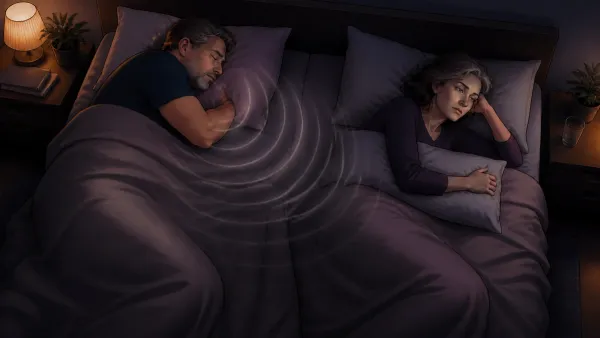
| Shared bed with different preferences | Cooler room plus individual blankets | Less partner-driven overheating |
For most people under 65, start at 65°F (18°C) for seven nights. If you wake cold, move up 1-2°F (0.5-1°C). If you wake hot, move down 1-2°F or lighten bedding before lowering the thermostat further.
That last point matters. Thermostat temperature is only the room. Your body sleeps inside a smaller environment made by sheets, pajamas, mattress, blanket, partner heat, and airflow. A 65°F room with a heavy duvet can feel warmer than a 70°F room with a light cotton sheet.
For the deeper physiology behind why your core temperature drops before sleep, see our guide to body temperature and sleep. This article focuses on the bedroom setup and decision thresholds.
Why bedroom temperature changes sleep quality
Sleep begins when the brain receives a coordinated set of signals: dim light, rising melatonin, falling alertness, and a gradual drop in core body temperature. The bedroom can support that drop or fight it.
When the room is too warm:
- Core temperature stays elevated longer
- Sleep onset can be delayed
- Deep sleep may become less stable
- REM sleep can fragment
- Resting heart rate often stays higher
- HRV may be lower because the body is still thermoregulating
When the room is too cold:
- Shivering or muscle tension can increase arousal
- Hands and feet may stay cold, blocking heat loss from the core
- You may add heavy bedding that later traps heat
- Pain or stiffness may feel worse, especially in older adults
The sweet spot is not “as cold as possible.” It is cool enough to help the body release heat, but comfortable enough that you do not need to defend against the cold.
Quick definition: Bedroom temperature is the ambient air temperature around your bed, but sleep temperature is the full thermal load created by the room, bedding, pajamas, mattress, airflow, humidity, and body heat.
The adult range: 60-67°F is a starting point, not a law
The common recommendation to keep a bedroom around 60-67°F (15.5-19.5°C) is reasonable for many adults because it supports the natural cooling curve before sleep. It also gives bedding room to do its job: the room stays cool, while sheets and blankets create comfort without overheating the core.
But if you treat 65°F as a moral rule, you can overshoot. Some people sleep worse when the room is too cold because they tense up, wake early, or pile on insulating bedding. Others need the room cooler because they run warm, train hard, drink alcohol, experience hot flashes, or sleep beside a partner.
Use the range as a test:
- Pick a starting temperature: 65°F (18°C).
- Keep bedtime, caffeine, alcohol, and bedding stable for one week.
- Track sleep onset, wakeups, HRV, resting heart rate, and morning energy.
- Adjust by 1-2°F (0.5-1°C) for the next week.
- Stop when comfort and recovery both improve.
Do not judge from one night. Stress, late meals, alcohol, travel, illness, and training load can overwhelm the signal. You are looking for a pattern across at least 7-14 nights.
Why older adults may need a warmer range
Sleep temperature advice often ignores age. That is a problem because thermoregulation changes with aging.
Older adults may have:
- Lower muscle mass and metabolic heat production
- Changes in circulation
- Lower tolerance for cold
- More pain or stiffness when chilled
- More fragmented sleep from medical conditions or medications
- Less robust circadian temperature amplitude
A 2023 longitudinal study of community-dwelling older adults found the most efficient and restful sleep when nighttime bedroom temperature was 20-25°C (68-77°F). Sleep efficiency dropped by roughly 5-10% as temperature rose from 25°C to 30°C (77°F to 86°F). That does not mean every older adult should sleep at 77°F. It means the one-size-fits-all “make the room cold” rule may be wrong for some older sleepers.
For adults over 65, a better starting range is often:
- 68-72°F (20-22°C) if you feel cold easily
- 65-68°F (18-20°C) if you run warm
- Avoid sustained temperatures above 77°F (25°C) unless you have a specific medical or comfort reason and sleep metrics remain stable
If you are over 65 and waking early, cold, stiff, or restless, test warmth before assuming your sleep problem is purely circadian. If your main issue is a shifting sleep phase or very early wake time, pair temperature changes with a review of sleep timing and light exposure.
Bedding changes the temperature more than people think
The thermostat sets the room. Bedding sets the microclimate.
Research on bedding thermal resistance shows why different studies find different “ideal” temperatures: people can sleep comfortably across a wider room-temperature range when bedding lets them regulate heat. A heavy duvet in a cool room can work well if you can vent heat by moving it. The same duvet in a warm room can trap heat and fragment sleep.
Use this practical matrix:
| Problem | First bedding change | Thermostat change |
|---|---|---|
| Waking hot at 2-4 a.m. | Lighter blanket or breathable duvet cover | Lower by 1-2°F only if needed |
| Sweating under a foam mattress | Add breathable mattress pad or change pajamas | Improve airflow before lowering more |
| Cold feet delaying sleep | Loose socks or warm foot bottle before bed | Do not necessarily heat the whole room |
| Partner runs hotter | Separate blankets | Keep room cooler and layer individually |
| Winter dry heat wakes you | Lighter insulation plus humidity control | Avoid overheating air to fix cold bedding |
The goal is flexibility. You want bedding that lets you add or remove heat without waking fully.
Mattress and pillow heat retention
Memory foam often retains heat. Latex, hybrid designs, breathable toppers, buckwheat pillows, and cotton or linen bedding can reduce heat buildup. You do not need to buy a new mattress to test this. Start with the layer closest to your skin: pajamas and sheets.
Pajamas matter
Loose cotton, merino, linen, or moisture-wicking sleepwear usually beats tight synthetic clothing. If you wake sweaty, change the fabric before dropping the room temperature aggressively.
Humidity and airflow: the hidden variables
Two bedrooms can both be 66°F and feel completely different.
Humidity changes how easily sweat evaporates. Airflow changes how quickly heat leaves the body and bedding. A stagnant, humid bedroom often feels warmer than the thermostat says.
Practical targets:
- Relative humidity: aim for roughly 40-60%
- Airflow: gentle circulation, not a fan blasting directly at your face all night
- CO2 and stuffiness: open a door, crack a window when safe, or improve ventilation
- Noise tradeoff: do not fix temperature by opening a window if street noise fragments sleep
If you wake with a dry throat, static, or nasal irritation, the room may be too dry. If you wake sweaty despite a moderate temperature, humidity and bedding may be the issue. If the room feels stale, ventilation may matter as much as cooling.
For noise tradeoffs, use the framework in our guide to noise pollution and cardiovascular aging: the best sleep environment is thermally comfortable and acoustically stable.
If your sleep duration looks adequate but recovery still dips after weekends or late nights, compare Social jet lag vs sleep debt: which ages recovery faster? to decide whether sleep timing or total sleep is the bigger limiter.
How temperature shows up in wearable data
Bedroom temperature affects recovery because thermoregulation costs energy. If your body spends the night fighting heat or cold, that can show up in the same metrics you use for training readiness.
Watch these signals:
| Metric | If the room is too warm | If the room is too cold |
|---|---|---|
| Sleep onset latency | Longer, especially after warm evenings | Longer if hands/feet stay cold |
| Wake after sleep onset | More frequent warm wakeups | Early waking or restlessness |
| Resting heart rate | Higher overnight baseline | Can rise if cold stress is strong |
| HRV | Lower from heat stress or fragmented sleep | Lower if cold causes arousal |
| Skin/wrist temperature | Elevated or unstable | Lower than baseline, sometimes with early wake |
| Deep sleep | Less stable first half | Reduced if cold blocks sleep onset |
| REM sleep | More fragmented in warm rooms | Can fragment if discomfort wakes you |
SuperAge can help here because it reads Apple Health and Apple Watch data in context. Do not react to one bad night. Look for repeated patterns:
- HRV drops on warm-room nights
- Resting heart rate rises when the room is hot or humid
- Sleep efficiency improves after lighter bedding
- Wakeups fall after a small temperature adjustment
- Recovery score improves without changing training load
If your training readiness keeps dropping despite good workouts, nutrition, and sleep duration, temperature is worth testing before blaming the training plan. See training readiness score for how recovery signals interact.
A 14-night bedroom temperature test
Use a simple experiment instead of guessing.
Nights 1-3: baseline
Do not change anything. Record:
- Thermostat setting
- Room thermometer reading near the bed
- Bedding used
- Pajamas
- Window/fan/airflow
- Alcohol and late meal status
- Sleep onset, wakeups, HRV, resting heart rate, sleep efficiency
Nights 4-7: cool-room test
Set the room to 65°F (18°C) or 2°F (1°C) cooler than baseline if you already sleep warmer. Keep bedding stable.
Good sign: faster sleep onset, fewer wakeups, lower resting heart rate.
Bad sign: cold feet, tension, early waking, worse HRV.
Nights 8-10: bedding test
Keep the room stable and change only bedding:
- Lighter blanket if you woke hot
- Socks or warmer foot layer if you woke cold
- More breathable sheets if you sweat
- Separate blanket if sharing a bed
Nights 11-14: personalized range
Choose your best setup and hold it for four nights. If metrics improve and comfort feels better, keep it. If not, temperature may not be the main sleep bottleneck. Look next at sleep debt, light timing, noise, caffeine, alcohol, or possible sleep apnea.
Temperature fixes can backfire if they require opening a noisy window. Pair this setup with how much noise during sleep is too much to choose the quieter recovery tradeoff.
Special situations
Perimenopause and menopause
Night sweats can make a normally good room temperature fail. Start with breathable bedding, moisture-wicking sleepwear, and easy venting. Cooler rooms can help, but an overly cold room plus heavy bedding can trigger a hot-cold cycle. If night sweats are new, severe, or paired with other symptoms, discuss them with a clinician.
High training load
Hard training raises heat production, inflammation, and overnight recovery demand. If you wake hot after intense sessions, test lighter bedding on hard-training nights rather than changing the room for every night.
Alcohol
Alcohol can make you feel warm, fragment sleep, and cause rebound wakeups. If you test bedroom temperature while drinking in the evening, you may misread the result. Run your 14-night test with alcohol held stable or removed.
Infants and children
This article is for adults. Infant sleep temperature has different safety considerations. Follow pediatric guidance rather than adult recovery targets.
Medical conditions
Thyroid disease, infection, menopause, autonomic disorders, sleep apnea, some medications, and pain conditions can all change temperature tolerance. If night sweats, chills, or heat intolerance are persistent, treat bedroom setup as context, not diagnosis.
Frequently asked questions
What is the best bedroom temperature for sleep quality?
For many adults, the best starting range is 60-67°F (15.5-19.5°C), with 65°F (18°C) as a practical first test. Older adults may sleep better closer to 68-77°F (20-25°C), especially if they wake cold or restless.
Is 70°F too warm for sleeping?
Not always. For a younger adult with heavy bedding, 70°F (21°C) may be too warm. For an older adult who wakes cold, 70°F may be ideal. Judge it by sleep onset, wakeups, HRV, resting heart rate, and morning recovery, not the number alone.
Is sleeping in a cold room good for recovery?
A cool room can support recovery when it helps core temperature fall without causing cold stress. Too cold can backfire if you tense up, wake early, or need heavy bedding that traps heat later.
Why do I wake up hot around 3 a.m.?
Common causes include a warm room, heat-trapping bedding, alcohol, late meals, high training load, hormonal changes, or a mattress that retains heat. Start by changing bedding and airflow before assuming the thermostat is the only problem.
Should older adults sleep in a warmer room?
Often, yes. A home-based study in adults 65+ found the most efficient sleep around 68-77°F (20-25°C). The right range still depends on bedding, humidity, health conditions, and personal comfort.
Does humidity affect sleep temperature?
Yes. High humidity makes it harder for sweat to evaporate, so a room can feel hotter than the thermostat suggests. Very low humidity can irritate airways and fragment sleep. A practical target is roughly 40-60% relative humidity.
If your total sleep looks adequate but recovery still swings with schedule changes, use sleep regularity vs sleep duration to decide whether consistency or more sleep is the better next fix.
If your only workout window is late, use exercising at night and sleep quality to choose the intensity, cutoff time, and cooldown that protect recovery.
Key takeaways
- Start around 65°F (18°C), but personalize: most adults do well in the 60-67°F range, while many older adults may need 68-77°F.
- Bedding is part of the temperature: sheets, pajamas, mattress, duvet, and partner heat can matter as much as the thermostat.
- Too warm and too cold both hurt recovery: the target is cool comfort, not cold exposure.
- Track trends for 14 nights: sleep onset, wakeups, HRV, resting heart rate, sleep efficiency, and morning energy reveal your real range.
- Adjust one variable at a time: room temperature first, then bedding, then humidity and airflow.
References
- Baniassadi A, Manor B, Yu W, Travison T, Lipsitz L. (2023). “Nighttime ambient temperature and sleep in community-dwelling older adults.” Science of the Total Environment, 899, 165623. https://www.sciencedirect.com/science/article/abs/pii/S0048969723042468
- Harding EC, Franks NP, Wisden W. (2019). “The temperature dependence of sleep.” Frontiers in Neuroscience, 13, 336. https://pubmed.ncbi.nlm.nih.gov/31105512/
- Haghayegh S, Khoshnevis S, Smolensky MH, Diller KR, Castriotta RJ. (2019). “Before-bedtime passive body heating by warm shower or bath to improve sleep: A systematic review and meta-analysis.” Sleep Medicine Reviews, 46, 124-135. https://pubmed.ncbi.nlm.nih.gov/31102877/
- Yan F, Zheng Q, Ke Y. (2023). “Effect of quilt thermal resistance on bedding system and sleep thermal comfort.” Journal of Thermal Biology, 117, 103713. https://pubmed.ncbi.nlm.nih.gov/37748286/
- Rifkin DI, Long MW, Perry MJ. (2018). “Climate change and sleep: A systematic review of the literature and conceptual framework.” Sleep Medicine Reviews, 42, 3-9. https://pubmed.ncbi.nlm.nih.gov/30177247/
- Sleep Foundation. (2023). “How bedroom temperatures and bedding choices impact your sleep.” https://www.sleepfoundation.org/sleep-news/bedroom-temperatures-and-bedding-choices-affect-sleep
Last updated: 2026-06-04. This article is reviewed regularly to ensure accuracy.
The information provided does not replace professional medical advice. Consult your doctor if night sweats, chills, insomnia, or temperature intolerance are persistent or severe.
Related Articles
Body temperature and sleep: How the circadian curve controls your rest
Learn how body temperature shapes sleep, why the circadian cooling curve matters, and which room, bath, and light habits support deeper rest.