Sleeping next to a snorer: health effects and what actually helps
Sleeping next to a snorer can fragment rest, but brain-aging claims go too far. Learn what evidence shows, what helps tonight, and when to seek care now.
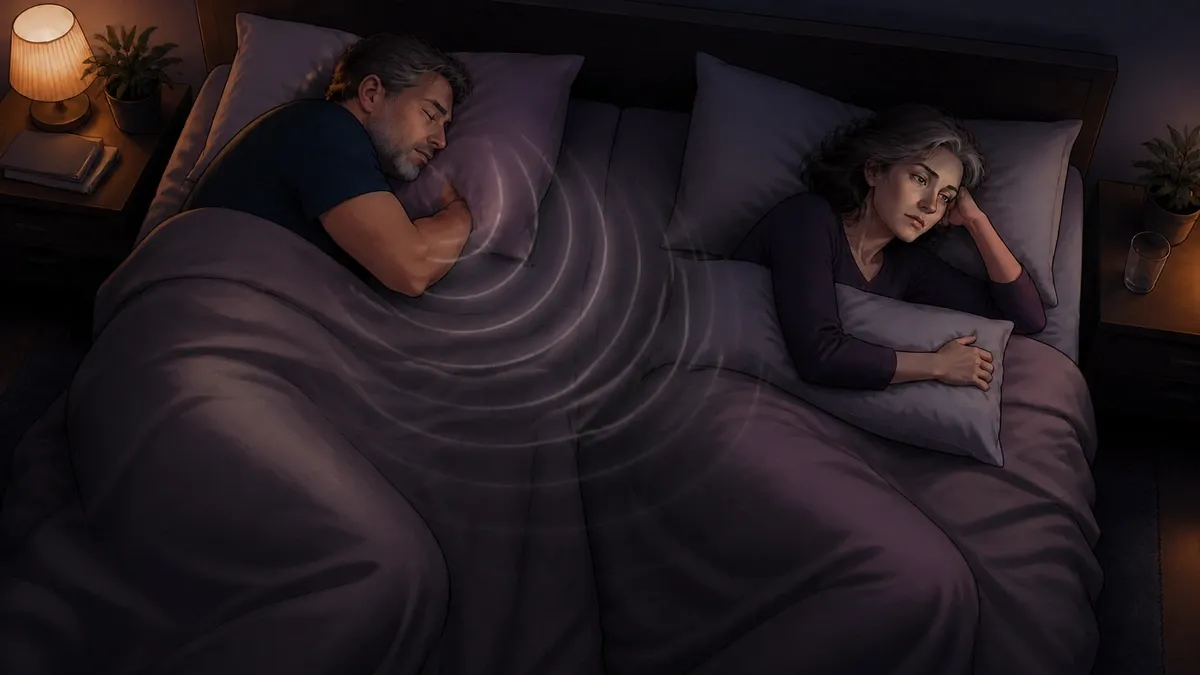
Sleeping next to a snorer can disturb your sleep even when you do not remember fully waking. Irregular sound, movement, and concern about breathing pauses can trigger brief arousals, delay sleep, or send you to another room. The likely health pathway is indirect: snoring disrupts your rest, and repeated insufficient or fragmented sleep affects daytime function and long-term health.
That does not prove that another person’s snoring directly “ages your brain.” Research on bed partners is still limited, and the strongest studies measure sleep continuity, symptoms, or relationship effects—not dementia or biological age. The useful response is to protect the listener’s sleep while helping the person who snores rule out obstructive sleep apnea.
Quick answer
If a partner’s snoring repeatedly wakes you, leaves you tired, or reduces your sleep below your normal need, treat it as a real sleep problem. Start with a shared seven-night record, reduce sound exposure safely, and look for apnea warning signs such as breathing pauses, gasping, choking, morning headaches, or excessive daytime sleepiness. Persistent loud snoring deserves clinical evaluation before either person relies on gadgets or over-the-counter mouthpieces.
Key facts
- Irregular snoring triggers brief arousals in some bed partners and can reduce sleep continuity.
- Chronic sleep disruption impairs daytime function and can weaken healthy overnight blood-pressure regulation.
- Treating diagnosed sleep apnea can improve partner-reported sleep, although objective results vary across small studies.
- Witnessed breathing pauses require medical evaluation because snoring alone cannot distinguish primary snoring from obstructive sleep apnea.
- Current evidence does not show that partner snoring directly accelerates brain aging; that claim goes beyond available bed-partner research.
What sleeping beside a snorer can do
Snoring is not steady background sound. It can change in volume, rhythm, and pitch, then stop abruptly before a gasp or body movement. The sleeping brain is more likely to react to a sound that is unpredictable or meaningful than to a quiet, stable hum.
A 2026 systematic review of partner disturbance and co-sleeping found evidence that partners disturb one another, but it also highlighted small samples, inconsistent actigraphy methods, and substantial differences among studies. In other words, partner effects are real enough to investigate, but no single mechanism or universal outcome explains every couple’s night.
For the person listening, four patterns matter most:
- Micro-arousals: the brain briefly shifts toward wakefulness without creating a memory of being awake.
- Full awakenings: the sound, a body movement, or concern about a breathing pause wakes you long enough to notice.
- Anticipatory alertness: you lie awake waiting for the next snore, especially after several difficult nights.
- Shortened sleep: you go to bed later, get up earlier, or move rooms and lose sleep opportunity during the transition.
The distinction matters. A wearable may show seven hours “in bed” while repeated arousals leave sleep less restorative. Conversely, a phone recording that captures loud sound does not tell you how many cortical arousals occurred or diagnose apnea.
For the broader acoustics and decibel context, see how much noise during sleep is too much. Partner snoring needs an extra layer because the sound may also be a medical clue.
What the bed-partner studies actually found
The direct evidence is useful but narrower than many headlines imply.
| Study | What it measured | What it found | Important limit |
|---|---|---|---|
| Beninati et al., 1999 | Simultaneous sleep studies in 10 couples during a split CPAP night | Partner arousal index fell and sleep efficiency rose when snoring and obstructive events were reduced | Tiny sample; all people treated were men; one laboratory night |
| McArdle et al., 2001 | Questionnaires and home polysomnography in partners of people with sleep apnea | Partners reported less disturbance and better subjective sleep with CPAP, but objective sleep quality did not clearly differ from placebo | Small randomized crossover group and mixed objective/subjective results |
| Rayward et al., 2026 | Systematic review of co-sleeping, partner disturbance, and sleep architecture | All four studies addressing general partner disturbance found evidence of it | Heterogeneous methods prevent a simple effect estimate |
| Moulin et al., 2025 | Prospective study of 54 couples after CPAP initiation | Sleep and relationship measures improved over follow-up | No untreated control group; applies to diagnosed apnea treatment |
These studies support a practical conclusion: a snorer’s breathing disorder can become a two-person sleep problem, and effective treatment may help both people. They do not prove that every snore harms the listener, that CPAP is appropriate without a diagnosis, or that sleeping beside a snorer causes neurodegeneration.
Does partner snoring age your brain?
There is no good direct evidence that exposure to a partner’s snoring accelerates the listener’s brain aging. That statement would require long-term studies comparing verified snoring exposure with cognitive trajectories, brain imaging, or validated biological-age measures while accounting for the listener’s own sleep disorders, age, health, stress, and environment. Current bed-partner studies do not provide that chain of evidence.
What researchers can say is more modest:
- Nocturnal sound can produce EEG-defined arousals; a recent randomized laboratory experiment found that the likelihood of arousal increased with louder noise exposures, although it studied wind-farm and road noise rather than snoring (Liebich et al., 2025).
- Repetitive experimental arousals can blunt the normal fall in blood pressure during early sleep in small laboratory studies (Carrington and Trinder, 2008).
- Adults generally need at least seven hours of sleep, and regularly sleeping less is associated with poorer health and daytime safety (AASM and Sleep Research Society consensus).
This is a plausible sleep-disruption pathway, not proof of a snoring-to-brain-aging pathway. If your sleep is repeatedly interrupted, the reason to act is already strong: you feel and function better when sleep duration, continuity, timing, and safety are protected. There is no need to inflate the evidence.
Signs that your sleep is being affected
Look for a pattern across several nights rather than one unusually noisy evening.
- You take longer than usual to fall asleep because you are listening for the next sound.
- You remember multiple awakenings or regularly move to another room.
- You wake earlier than planned and cannot return to sleep.
- You feel sleepy, irritable, foggy, or less steady behind the wheel the next day.
- Your normal training, appetite, mood, or recovery worsens after louder nights.
- You need more caffeine to compensate or begin dreading bedtime.
- The problem persists even when the person who snores is away, suggesting conditioned insomnia may now be part of the picture.
Wearable trends can support this history, but they cannot prove that a particular snore caused a particular sleep-stage change. Use symptoms and repeated patterns first. If the problem has become persistent insomnia, address that directly rather than endlessly optimizing the bedroom.
Red flags in the person who snores
Not all snoring is obstructive sleep apnea, and loudness alone cannot diagnose it. A bed partner is often the only person who can report what happens between snores, so these observations are clinically useful:
- repeated breathing pauses followed by gasping, choking, or a loud recovery breath
- loud, persistent, or markedly irregular snoring
- excessive daytime sleepiness or dozing during driving or work
- morning headaches, dry mouth, or unrefreshing sleep
- resistant high blood pressure, atrial fibrillation, or other cardiometabolic risk
- abrupt new snoring with nasal obstruction or another health change
The AASM diagnostic guideline states that obstructive sleep apnea testing should follow a comprehensive sleep evaluation. Polysomnography is the standard diagnostic test when OSA is suspected; a home sleep apnea test can be appropriate for some uncomplicated adults, but a negative or inconclusive home test may need follow-up.
If there is severe breathing difficulty, chest pain, blue or gray discoloration, or inability to wake normally, seek emergency help. Otherwise, document what you observed without trying to count every event, and arrange a routine sleep or primary-care evaluation.
For a deeper explanation of diagnosis and treatment, use the sleep apnea guide.
What to try tonight without hiding the problem
The goal is two-track: protect the listener’s rest and reduce the source safely.
1. Talk in daylight
Do not start the conversation at 2 a.m. Frame it as a shared health problem: “We are both losing sleep, and I noticed pauses” is more useful than “You kept me awake again.” Agree on what happens if either person needs to move rooms.
2. Try side sleeping when the pattern is positional
Snoring and obstructive events are often worse on the back for some people. A side-sleep trial is reasonable if the pattern clearly changes with position, but it is not a substitute for evaluation when apnea signs are present.
3. Remove obvious evening amplifiers
Alcohol close to bedtime can relax upper-airway tissues and worsen snoring or obstructive events. Sedatives can also affect breathing and arousal. Do not stop prescribed medication on your own; ask the prescriber if timing or breathing risk is a concern.
4. Address simple nasal blockage
Saline, allergy management recommended by a clinician, or treatment of a temporary respiratory illness may help when nasal congestion is the main driver. Persistent obstruction, one-sided blockage, bleeding, pain, or a major change in breathing deserves clinical review.
5. Reduce exposure safely
Comfortable earplugs or low-volume masking may reduce disruptive contrast. Keep alarms, children, caregiving needs, smoke alarms, and emergency awareness in mind. Masking should be quiet enough that it does not become another noise exposure. The World Health Organization’s bedroom guidance uses below 30 dB(A) indoors at night as a good-quality-sleep anchor for continuous environmental noise, not as a pass/fail test for an individual snore.
6. Use separate sleep as a temporary tool when needed
Sleeping separately for part or all of a night can protect function while assessment or treatment is underway. It is not a diagnosis and does not have to mean relationship failure. Decide together whether it is a short recovery measure, a work-night arrangement, or a temporary safety step for severe daytime sleepiness.
What can actually treat snoring?
Treatment depends on whether the person has primary snoring, obstructive sleep apnea, nasal disease, medication effects, or another cause.
- Diagnosed OSA: positive airway pressure is a standard treatment; alternatives depend on severity, anatomy, preference, and clinical assessment.
- Primary snoring without OSA: conservative measures may be enough. If not, a prescribed oral appliance can reduce snoring in selected adults.
- Oral appliances: the joint AASM/AADSM guideline recommends clinician-led oral-appliance therapy for adults who request treatment of primary snoring and qualified dental oversight for custom devices. It also stresses that primary snoring should be distinguished from OSA first.
- Surgery or specialist treatment: this may be appropriate for selected anatomical problems, but it is not the default answer to a sound recording.
Avoid treating an untested person with a random mouthguard, taping method, or unregulated device. A quieter room is not evidence that oxygen and breathing are normal.
A 14-night plan for both partners
Use a simple shared experiment rather than changing five things at once.
| Nights | Listener tracks | Snorer tracks | Shared action |
|---|---|---|---|
| 1-3 | Bedtime, estimated awakenings, final wake time, next-day sleepiness | Sleep position, alcohol timing, congestion, morning symptoms | Establish the pattern without blame |
| 4-7 | Same measures plus any room change or earplug use | Trial side sleeping if appropriate | Compare, do not chase one wearable score |
| 8-10 | Protect adequate sleep opportunity | Arrange evaluation if red flags or persistent loud snoring exist | Keep temporary separate-sleep rules explicit |
| 11-14 | Note whether sleep and daytime function improve | Follow clinician advice; do not self-diagnose from an app | Decide whether the problem is improving or needs formal care |
Escalate sooner if driving safety, work errors, severe sleepiness, or witnessed breathing pauses are present. Fourteen nights is a tracking window, not a requirement to endure a dangerous pattern.
Use recovery data as context, not a verdict
SuperAge can help you organize the listener’s side of the story: sleep duration, resting heart rate, HRV trends, activity, and how recovered you feel. Compare several quieter and noisier nights while keeping bedtime, alcohol, illness, and training load in view.
The useful question is not “Did this one snore lower my deep sleep by 12 minutes?” Consumer wearables cannot answer that with clinical precision. Ask instead:
- Is adequate sleep opportunity repeatedly turning into short sleep?
- Do next-day energy and alertness improve when the sound is reduced?
- Do resting heart rate or HRV move consistently, not just once?
- Are symptoms severe enough that waiting for more data would be unsafe?
Use sleep and longevity as the broader recovery hub, and compare sleep regularity versus sleep duration if moving rooms is shifting your schedule.
Download SuperAge to review sleep and recovery trends in one place while keeping diagnosis and treatment decisions with a qualified clinician.
Key takeaways
- A partner’s snoring can fragment sleep through sound, movement, worry, and shortened sleep opportunity.
- Bed-partner evidence supports real disturbance, but studies are small and do not establish direct brain aging.
- Protecting the listener and evaluating the snorer are complementary, not competing, goals.
- Breathing pauses, gasping, choking, or severe daytime sleepiness move the issue from annoyance to medical assessment.
- Earplugs, masking, position changes, or temporary separate sleep can help, but they should not conceal possible apnea.
- Diagnose the cause before choosing CPAP, an oral appliance, surgery, or any commercial device.
FAQ
Can sleeping next to a snorer damage your health?
It can harm your sleep if the sound repeatedly causes arousals, awakenings, or shorter sleep. Chronic insufficient sleep is associated with health and safety risks. Direct long-term health studies specifically isolating partner snoring are limited, so the strongest conclusion is an indirect sleep-disruption pathway.
Does a snoring partner cause brain aging or dementia?
No direct evidence shows that partner snoring causes brain aging or dementia. Poor sleep is relevant to brain health, but current bed-partner studies do not establish that causal chain. Treat persistent disruption without presenting an unproven outcome as certain.
Is it okay to sleep in another room?
Yes. Temporary or planned separate sleep can protect rest and daytime safety while the cause is assessed. Discuss the arrangement during the day, keep intimacy and connection intentional, and revisit the plan instead of using a midnight move as punishment.
Should I wear earplugs when my partner snores?
Earplugs can reduce sound if they are comfortable and you can still meet safety or caregiving needs. Stop if they cause pain or worsen an ear problem. They protect the listener but do not evaluate the snorer’s breathing.
How can I tell snoring from sleep apnea?
You cannot diagnose apnea from loudness alone. Pauses, gasping, choking, marked irregularity, morning headaches, unrefreshing sleep, and excessive daytime sleepiness raise concern. A comprehensive sleep evaluation and appropriate sleep testing establish the diagnosis.
Can a phone app or smartwatch diagnose the problem?
No. Recordings and wearable trends can document a pattern and support a clinical conversation, but they do not replace a sleep evaluation or validated diagnostic testing. A quiet recording also cannot confirm normal breathing or oxygen.
References
- Rayward L, Green D, Little JP. Partner disturbance in co-sleeping and effects on sleep architecture: a systematic review. Sleep Health. 2026.
- Beninati W, Harris CD, Herold DL, Shepard JW Jr. The effect of snoring and obstructive sleep apnea on the sleep quality of bed partners. Mayo Clinic Proceedings. 1999.
- McArdle N, et al. Partners of patients with sleep apnoea/hypopnoea syndrome: effect of CPAP treatment on sleep quality and quality of life. Thorax. 2001.
- Moulin C, et al. Continuous positive airway pressure improves marital relationship and sexual satisfaction in obstructive sleep apnea patients and partners. Sleep and Breathing. 2025.
- Carrington MJ, Trinder J. Blood pressure and heart rate during continuous experimental sleep fragmentation in healthy adults. Sleep. 2008.
- Liebich T, et al. Acute effects of wind-farm versus road-traffic noise onset on EEG-defined arousal from sleep. Sleep. 2025.
- American Academy of Sleep Medicine. Clinical practice guideline for diagnostic testing for adult obstructive sleep apnea. Journal of Clinical Sleep Medicine. 2017.
- Ramar K, et al. Clinical practice guideline for treatment of obstructive sleep apnea and snoring with oral appliance therapy. Journal of Clinical Sleep Medicine. 2015.
- Watson NF, et al. Recommended amount of sleep for a healthy adult. Journal of Clinical Sleep Medicine. 2015.
- World Health Organization. Noise and sleep guidance.
- Centers for Disease Control and Prevention. About sleep. Updated 2024.
This article is for education and cannot diagnose snoring, insomnia, or sleep apnea. Seek urgent help for severe breathing difficulty, chest pain, blue or gray discoloration, or inability to wake normally; seek clinical assessment for persistent loud snoring, witnessed breathing pauses, or dangerous daytime sleepiness.
Related Articles

Sleep apnea: The silent condition that can accelerate biological aging
Untreated sleep apnea is linked to higher mortality risk and faster biological-aging signals. Learn the warning signs, how it damages your body at the cellular level, and evidence-based treatment options.