How much noise during sleep is too much?
Noise during sleep is too much when it fragments sleep stages or recovery. Learn dB thresholds, bedroom testing, earplugs, and masking rules.
Noise during sleep is too much when it does one of three things: raises your bedroom background above a quiet-sleep range, creates repeated peaks that your brain must monitor, or leaves a pattern in your recovery data the next morning.
The tricky part is that “too much” does not always mean loud enough to wake you. The sleeping brain still listens. A delivery truck, elevator motor, barking dog, snoring partner, aircraft pass, or HVAC rattle can trigger brief arousals, heart-rate jumps, body movements, or a shift from deep sleep into lighter sleep without creating a memory of being awake.
For most adults, a practical target is below 30 dB(A) inside the bedroom for good sleep quality. If your bedroom repeatedly sits around 35 to 40 dB(A), focus on reducing peaks and improving sound stability. If it is often above 40 dB(A) at night, noise is worth treating as a likely sleep-quality and recovery bottleneck.
This article is about sleep fragmentation and bedroom decisions. For the broader vascular and public-health evidence, use the companion guide to noise pollution and cardiovascular aging.
What you’ll learn:
- The practical dB ranges that matter for sleep
- Why intermittent noise is often worse than steady background sound
- How to test your bedroom without overreacting to one reading
- When earplugs, white noise, pink noise, room changes, or source reduction make sense
- How to confirm whether noise is affecting HRV, resting heart rate, deep sleep, or readiness
The short answer: what dB level is too much?
Use this as a practical sleep-noise decision table.
| Bedroom sound pattern | Practical interpretation | What to do |
|---|---|---|
| Under 30 dB(A) most of the night | Good quiet-sleep target | Protect the setup; look at light, temperature, sleep debt, or schedule if sleep is still poor |
| 30 to 35 dB(A) steady background | Usually workable for many adults | Reduce sharp peaks; avoid adding unnecessary masking noise |
| 35 to 40 dB(A) or frequent audible events | Borderline zone where sleep fragmentation becomes more likely | Test earplugs, window sealing, room repositioning, or low-volume masking for 4 to 7 nights |
| Over 40 dB(A) indoors or outdoor night average near bedroom consistently high | Treat as a likely sleep-environment problem | Prioritize source reduction, acoustic barriers, earplugs, and recovery-data tracking |
| Peaks above 45 to 50 dB(A) even if the average is low | Intermittent arousal risk | Reduce the contrast between silence and noise events; fix the source if possible |
| Masking noise above 50 to 55 dB(A) at the pillow | May become its own exposure | Lower it, move the speaker farther away, use a timer only if it does not create wakeups |
Quick definition: dB(A) means A-weighted decibels, a measurement adjusted to approximate how the human ear responds to different sound frequencies. It is the most common unit for sleep and environmental-noise guidance.
The World Health Organization’s community-noise guidance recommends keeping bedrooms below 30 dB(A) at night for good sleep quality and keeping annual average night noise outside bedrooms below 40 dB(A) to prevent adverse health effects. Those are not magic lines where everything below is safe and everything above is harmful. They are useful anchors for decision-making.
Sleep is affected by more than the average. A bedroom that averages 32 dB(A) but has ten garbage-truck peaks can be worse than a room that holds a steady 36 dB(A) from a fan. Your brain reacts to contrast, novelty, meaning, and timing.
Why noise can harm sleep even when you do not wake up
Sleep is not unconscious shutdown. It is an active biological state in which the auditory system continues scanning the environment.
That scanning has survival value. Your brain is more likely to react to sounds that are sudden, meaningful, irregular, or different from the background: a door closing, your name, a baby crying, a truck braking, a partner coughing, a dog barking. A low steady hum is often less disruptive than a quieter but unpredictable sound.
Noise can disturb sleep through four pathways.
1. Cortical arousals
A cortical arousal is a brief shift in brain activity toward wakefulness. You may not remember it. The consequence is still real: your sleep becomes more fragmented, and you may spend more time in lighter stages.
The WHO sleep-noise evidence review found that, in pooled polysomnography studies, each 10 dB increase in indoor maximum noise level increased the odds of awakening for aircraft, road, and rail events. The exact risk varies by person and noise source, but the direction is consistent: louder single events wake the sleeping brain more often.
2. Autonomic arousals
Noise can raise heart rate, blood pressure, and sympathetic nervous system activity without causing a full awakening. This is why a person can say “I slept through it” while their wearable shows lower HRV, higher overnight heart rate, or less restorative sleep.
That matters for people who track recovery. If noise repeatedly pushes your physiology toward alertness, your night becomes less parasympathetic. It can look similar to the pattern described in training readiness and daily recovery: sleep may be long enough, but the body did not fully recover.
3. Sleep-stage disruption
Deep sleep and REM sleep are not equally distributed across the night. Deep sleep is concentrated earlier; REM becomes more prominent later. A noise pattern at 11:30 p.m. can cost deep sleep. A noise pattern at 5:00 a.m. can cut REM or create early waking.
If your wearable shows adequate time in bed but chronically low deep sleep, use the framework in how to improve deep sleep and include acoustic stability in the checklist. Noise is not always the cause, but it is often easier to test than hormones, supplements, or elaborate sleep routines.
4. Conditioned vigilance
Some sounds train the brain to stay alert. A neighbor’s late-night footsteps, a partner’s irregular snoring, a street where motorcycles pass unpredictably, or a baby monitor can create anticipatory wakefulness. In that case, the problem is not only decibels. It is the brain learning that the bedroom is not fully safe or predictable.
That is why “I got used to it” can be misleading. You may stop noticing the sound consciously while your autonomic system still responds to it.
Average noise vs. peak noise: which matters more?
For sleep, peaks often matter more than averages.
Public-health guidelines use long-term averages such as Lnight because they are useful for city planning, airport policy, road traffic, and population risk. Your bedroom problem is more immediate: how many events cross your personal arousal threshold tonight?
Imagine two rooms:
- Room A averages 34 dB(A) with a smooth fan-like background.
- Room B averages 29 dB(A) but has 12 peaks at 48 dB(A) from trucks, doors, or upstairs footsteps.
Room B may feel “quieter” when you first lie down, but it can be more fragmenting because the sleeping brain reacts to the contrast between quiet and sudden peaks.
That is also why a masking sound can sometimes help. It raises the background floor enough that a noise event becomes less distinct. But it is a tradeoff: if the masking sound is too loud, too close to the pillow, or unpleasant, it becomes another exposure instead of a solution.
How to measure bedroom noise without obsessing
You do not need laboratory equipment to decide whether noise deserves attention. You need a repeatable, good-enough test.
Step 1: measure the room, not the phone
Use a reputable sound meter app or a dedicated sound meter. Phone microphones are imperfect at very low levels, but they can still reveal patterns.
Place the phone:
- near pillow height
- at least 3 feet (1 m) from the wall if possible
- away from bedding that blocks the microphone
- not directly next to a fan, speaker, or open window
Measure during the real sleep window, not at 9 p.m. when traffic may be different. A 2 a.m. reading on a weekday is often more useful than a daytime reading.
Step 2: record three numbers
For three to five nights, write down:
- Background level: the quiet baseline when nothing obvious is happening
- Typical peaks: common events such as traffic, HVAC, doors, elevators, snoring, or barking
- Worst peaks: the few events that clearly stand out
Do not overinterpret one strange night. Weather, trash pickup, parties, aircraft routing, and open windows can all change exposure.
Step 3: match noise to recovery data
The most useful question is not “Was my bedroom perfectly quiet?” It is “Do noisy nights create a measurable pattern?”
Compare your noise notes with:
- sleep efficiency
- awakenings or restless periods
- deep sleep and REM trend
- overnight resting heart rate
- HRV
- next-day readiness or energy
If noisy nights repeatedly coincide with lower HRV, higher sleeping heart rate, or lower sleep efficiency, the environment is worth changing. For context, use resting heart rate by age and sleep stages vs. sleep score to avoid reading too much into a single wearable metric.
What to fix first: a practical decision tree
Start with the source if you control it. Use masking only when source reduction is not realistic.
If the noise is inside the room
Fix the source first.
- Move a rattling fan or purifier away from the bed.
- Put rubber pads under vibrating devices.
- Replace clicking chargers, ticking clocks, or noisy humidifiers.
- Tighten HVAC vents or use a quieter fan speed.
- Ask a partner to evaluate snoring or possible sleep apnea if the sound is irregular and loud.
Do not mask a fixable mechanical problem with louder white noise. That only adds sound energy.
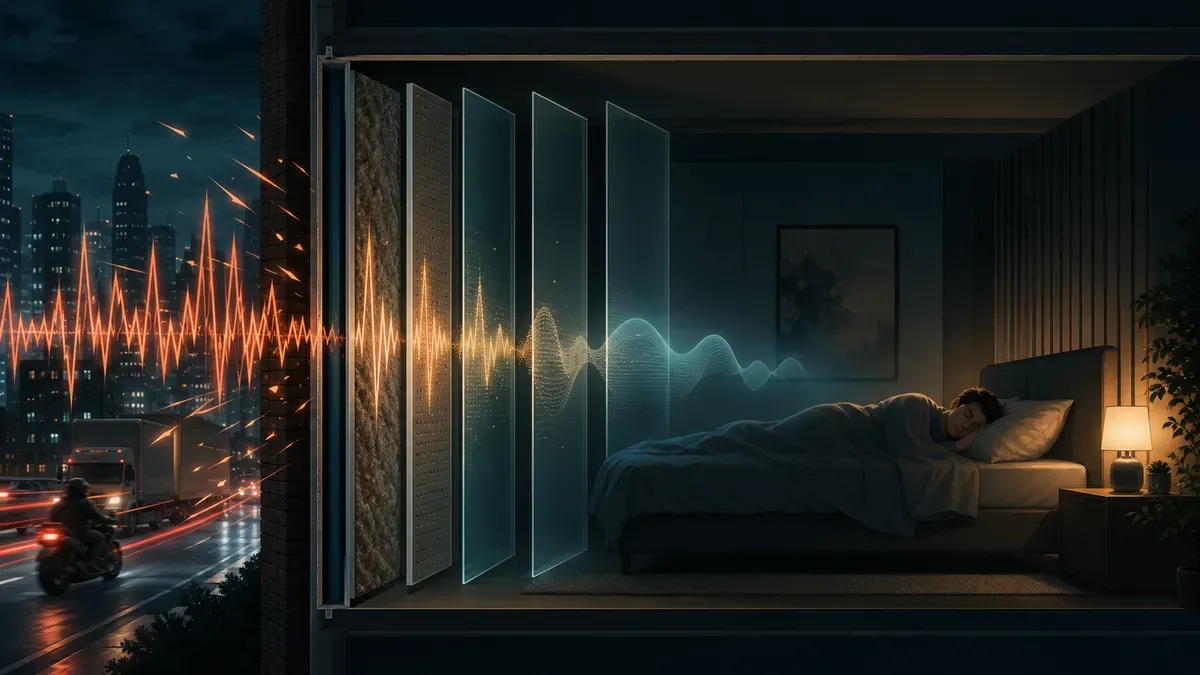
If the noise comes through a window
Windows are usually the weakest acoustic point.
- Close and latch the window fully.
- Add weather stripping if air leaks are obvious.
- Use heavy curtains for modest improvement.
- Consider acoustic window inserts if the bedroom faces traffic or rail.
- Move the bed to the quieter wall if peaks are strongest near the window.
Be careful with the tradeoff described in bedroom temperature and sleep quality: opening a window may cool the room but worsen sleep if street noise rises.
If the noise comes from the building
Shared-wall, upstairs, elevator, plumbing, or hallway noise often travels through structure rather than air.
- Move the bed away from the shared wall.
- Add a dense rug if noise comes from below or reflection is high.
- Use a door sweep for hallway sound.
- Seal gaps around bedroom doors.
- Use earplugs if the noise is intermittent and hard to control.
For footsteps or impact noise, soft furnishings help a little but rarely solve the problem alone. If you rent, documenting timing and type of noise may be more useful than buying more acoustic foam.
If the noise is unpredictable
Use a layered strategy:
- Lower the source if possible.
- Reduce the path with window or door sealing.
- Protect the receiver with earplugs or strategic bed position.
- Use low-volume masking only if peaks remain.
That order matters. Masking should be a targeted tool, not the first and only intervention.
Earplugs, white noise, pink noise, or silence?
There is no universal best option. The right tool depends on the noise pattern.
| Situation | Best first tool | Why |
|---|---|---|
| Sudden traffic, hallway, dog, or aircraft peaks | Earplugs or source/path reduction | Reduces the peak before your auditory system processes it |
| Mild but irregular background noise | Low-volume masking | Reduces contrast between quiet and noise events |
| Partner snoring | Snoring evaluation plus earplugs | Irregular biological sound is hard to mask safely |
| Constant HVAC hum | Fix or move the source | A constant machine may be easy to quiet mechanically |
| Very quiet room but anxious listening | Gentle sound cue at low volume | May reduce conditioned vigilance |
| Need to hear alarms, children, or caregiving sounds | Avoid strong earplugs; use room/source changes | Safety and caregiving override perfect quiet |
If the recurring noise comes from another person, use the guide to sleeping next to a snorer to protect the listener’s rest without overlooking breathing pauses or other apnea warning signs.
Earplugs
Foam, wax, silicone, and custom-molded sleep earplugs can reduce perceived sound substantially. The labeled Noise Reduction Rating is measured under ideal conditions, so real-world reduction is usually lower. Comfort matters more than the maximum rating if you will not wear them consistently.
Use caution if you have ear pain, recurrent infections, earwax impaction, tinnitus changes, or dizziness. In those cases, ask a clinician or audiologist before making earplugs a nightly habit.
White noise and pink noise
Continuous noise as a sleep aid has mixed evidence. A systematic review in Sleep Medicine Reviews found very low-certainty evidence for continuous white noise improving sleep and warned that it could also disrupt sleep or affect hearing if used poorly.
That does not mean masking is useless. It means the goal should be narrow: use the quietest level that reduces disruptive contrast. Place the speaker across the room, not next to your pillow. If you measure the sound at the pillow and it is above 50 to 55 dB(A), lower it.
Pink noise, rainfall, fan noise, and brown noise may feel smoother than white noise for some people. The best choice is the lowest-volume sound you can tolerate all night without creating irritation or morning grogginess.
Silence
Silence is best when your room is naturally quiet and your brain does not become hypervigilant. If a quiet room makes you listen for every small sound, a soft steady cue may help. But do not assume that more sound equals better sleep.
If your sleep duration looks adequate but recovery still dips after weekends or late nights, compare Social jet lag vs sleep debt: which ages recovery faster? to decide whether sleep timing or total sleep is the bigger limiter.
How noise interacts with light, temperature, and sleep debt
Noise rarely acts alone. It often becomes visible only when the rest of the sleep environment is already stressed.
- A warm room increases awakenings, making you more vulnerable to noise.
- Evening light delays melatonin, making it harder to return to sleep after a sound.
- Sleep debt raises pressure to sleep but can also make sleep architecture more unstable.
- Alcohol may help sleep onset while increasing second-half awakenings, when noise can finish the job.
This is why sleep optimization should be a stack, not a single hack. Use sleep and longevity as the hub, then test one lever at a time: light timing, temperature, noise, caffeine, alcohol, schedule, and possible sleep-disordered breathing.
If you already improved light timing with blue light at night vs. morning light and temperature with the bedroom-temperature guide, noise is the next high-yield environmental variable to test. If noise is only one part of a larger home-exposure review, use the healthy home audit for longevity to rank it against air, water, light, mold, and dust.
A 7-night noise experiment
Use this if you suspect noise is hurting sleep but are not sure.
Nights 1 and 2: baseline
Do not change anything. Record:
- bedtime and wake time
- obvious noise events
- estimated background dB(A)
- worst peaks if you can capture them
- HRV, sleeping heart rate, sleep efficiency, and subjective energy
Nights 3 and 4: source or path reduction
Change only one thing:
- close the window
- seal a door gap
- move the bed
- turn off a machine
- change fan position
- add earplugs
Keep caffeine, alcohol, bedtime, and room temperature as stable as possible.
Nights 5 and 6: masking test
If peaks remain, test low-volume masking. Use the lowest setting that makes sudden sounds less sharp. Measure near the pillow if possible.
Do not combine a new sound machine, a new bedtime, no alcohol, and a new workout schedule at once. You will not know what worked.
Night 7: choose the winner
Compare the week. Keep the setup that improves both subjective sleep and objective recovery. If nothing changes, noise may not be your main bottleneck. Look next at sleep debt, sleep apnea symptoms, light timing, temperature, medications, stress, or late exercise.
How SuperAge helps you see whether noise is affecting recovery
Noise is hard to judge by memory because many arousals never become conscious awakenings. SuperAge helps by making the physiological pattern visible.
With Apple Watch and HealthKit data, SuperAge tracks sleep duration, sleep stages, HRV, resting heart rate, activity, and recovery trends. A noisy night often shows up as a cluster rather than one metric: lower sleep efficiency, more restless periods, higher overnight heart rate, lower HRV, and weaker next-day readiness.
The useful signal is not one bad night. It is the before-and-after pattern when you change the room. If earplugs, acoustic sealing, or a quieter sleep setup improves HRV and sleep efficiency over 7 to 14 nights, you have evidence that your bedroom environment was part of your recovery problem.
That feedback loop keeps the article practical: do not chase perfect silence. Chase a measurable improvement in sleep quality and biological-age inputs.
Download SuperAge to track the sleep, HRV, and recovery trends that show whether your environment is helping or hurting your biological age.
Frequently asked questions
Is 40 dB too loud for sleep?
It depends on whether it is steady or intermittent, but 40 dB(A) is high enough to investigate. WHO community-noise guidance uses below 30 dB(A) inside bedrooms as a good-quality sleep target, and night-noise guidance uses below 40 dB(A) outside bedrooms as a public-health target. If your bedroom is near 40 dB(A) indoors, reduce peaks and test whether HRV, sleeping heart rate, or sleep efficiency improves.
Is white noise safe all night?
Usually, if it is kept low and comfortable. The risk is using it too loudly or too close to the pillow. Use the quietest level that masks disruptive peaks, keep it across the room, and avoid pushing pillow-level sound above roughly 50 to 55 dB(A). If you wake with ear discomfort, tinnitus changes, or morning fatigue, lower it or stop.
Are earplugs better than white noise?
Earplugs are usually better for sudden peaks because they reduce sound before your auditory system processes it. White or pink noise is better when the problem is mild contrast from irregular background sound. Many people do best with source reduction first, then earplugs or low-volume masking only if needed.
Can noise affect sleep even if I do not remember waking up?
Yes. Noise can trigger cortical arousals, body movements, heart-rate changes, or shifts into lighter sleep without leaving a memory. That is why wearable trends can be useful: if noisy nights repeatedly show worse HRV, higher overnight heart rate, or lower sleep efficiency, the effect is likely real.
What is the best bedroom noise level for sleep?
Aim for under 30 dB(A) indoors if possible. If that is unrealistic, prioritize stability: fewer sudden peaks, less rattling, lower contrast, and a setup that improves recovery data. A steady 34 dB(A) may be less disruptive than a room that is silent most of the time but gets repeated 50 dB(A) peaks.
If your total sleep looks adequate but recovery still swings with schedule changes, use sleep regularity vs sleep duration to decide whether consistency or more sleep is the better next fix.
Key takeaways
- The best practical target is under 30 dB(A) inside the bedroom. Treat 35 to 40 dB(A) as a testing zone and repeated levels above 40 dB(A) as a likely sleep-environment problem.
- Peaks matter more than averages. Sudden, meaningful, or irregular sounds fragment sleep more than a smooth low background.
- Do not start with loud masking. Reduce the source or sound path first, then use earplugs or low-volume masking when needed.
- Use recovery data to confirm the effect. HRV, sleeping heart rate, sleep efficiency, and readiness trends are more useful than one memory of a noisy night.
- Noise is one piece of the sleep stack. It interacts with light, temperature, sleep debt, alcohol, stress, and sleep disorders.
References
- World Health Organization Regional Office for Europe. Noise fact sheet. WHO.
- Basner M, McGuire S. WHO Environmental Noise Guidelines for the European Region: a systematic review on environmental noise and effects on sleep. International Journal of Environmental Research and Public Health. 2018.
- Smith MG, Cordoza M, Basner M. Environmental noise and effects on sleep: an update to the WHO systematic review and meta-analysis. Environmental Health Perspectives. 2022.
- Basner M, Babisch W, Davis A, et al. Auditory and non-auditory effects of noise on health. The Lancet. 2014.
- Riedy SM, Smith MG, Rocha S, Basner M. Noise as a sleep aid: a systematic review. Sleep Medicine Reviews. 2021.
- American Academy of Sleep Medicine. Sleep prioritization survey: light and noise disrupting sleep. AASM. 2023.
Related Articles
Sleeping next to a snorer: health effects and what actually helps
Sleeping next to a snorer can fragment rest, but brain-aging claims go too far. Learn what evidence shows, what helps tonight, and when to seek care now.