Healthy home audit for longevity: air, water, light, and noise
A healthy home audit for longevity ranks air, water, light, noise, mold, and chemical risks without duplicating every single-exposure guide.
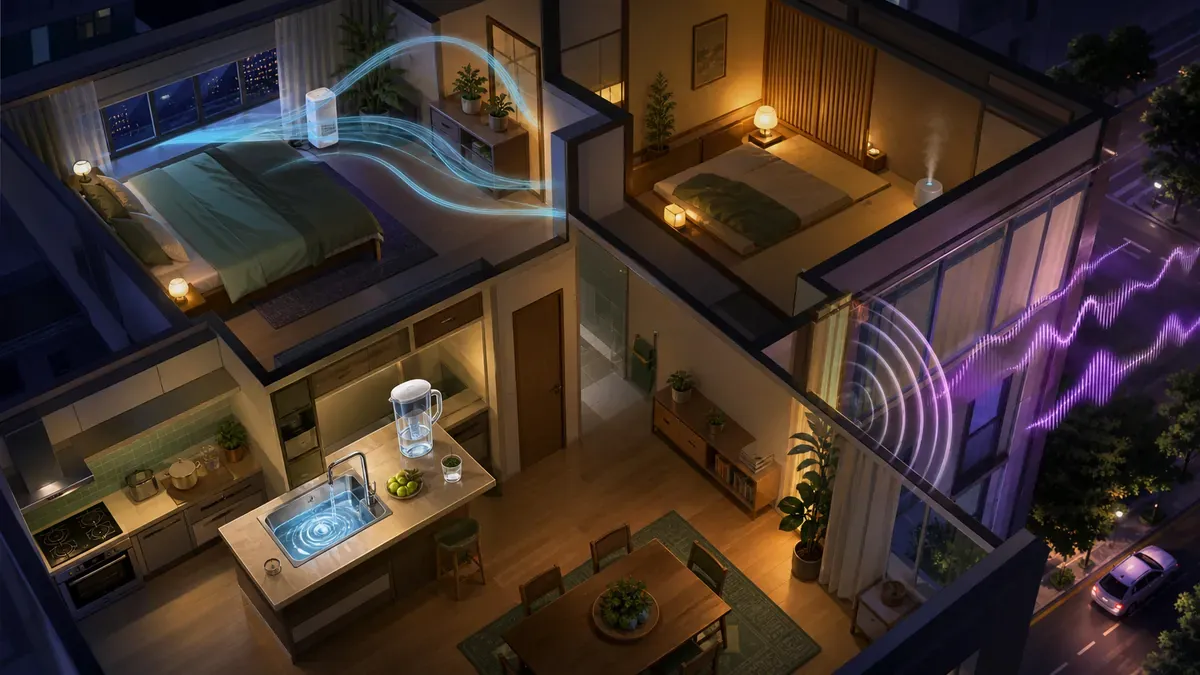
A healthy home audit for longevity is not a hunt for every possible toxin in your house. It is a ranking exercise: which indoor exposures are most likely to affect sleep, cardiovascular load, respiratory stress, hydration, recovery, and long-term risk, and which fixes give the most benefit for the least effort?
Start with the exposures you live with for the most hours. Bedroom air, nighttime light, sleep noise, drinking water, dampness, dust, and cooking emissions usually matter more than rare one-off exposures. The goal is not a sterile home. The goal is a lower-load home where the basics support recovery instead of quietly working against it.
This audit deliberately stays broad. If your main question is filtration versus fresh air, use air purifier vs ventilation as the hub. If you already know the problem is PFAS, mold, blue light, or sleep noise, the linked single-exposure guides go deeper. This article helps you decide what to fix first.
Quick answer
For most homes, the best longevity audit sequence is: fix active moisture and combustion risks, improve bedroom air and ventilation, check drinking-water reports and certified filters, make the sleep window dark and quiet, reduce dust and high-contact chemicals, then track whether sleep, HRV, resting heart rate, and recovery improve over 2 to 4 weeks. Do not buy devices before naming the exposure they are meant to reduce.
Key facts
- Healthy home audit ranks exposure by dose, duration, vulnerability, and fixability.
- Source control removes pollutants before filtration or ventilation tries to dilute them.
- Bedroom air, light, and noise shape overnight recovery signals.
- Certified filters reduce specific water contaminants only when maintained.
- SuperAge tracks body-side trends after home-environment changes.
The audit scorecard
Use this table before buying anything.
| Domain | First question | High-priority signal | Best first move |
|---|---|---|---|
| Air | What pollutant is present? | Smoke, PM2.5, stale CO2, cooking particles, odors, dampness | Source control, exhaust, clean ventilation, or particle filtration |
| Water | What does the report or test show? | Lead service-line risk, PFAS detection, private well, local advisory | Certified point-of-use filter or targeted testing |
| Light | Is the bedroom dark during sleep? | Streetlight, TV, phone glow, late overhead light | Dim evening light and block bedroom light |
| Noise | Are there repeated nighttime peaks? | Traffic, aircraft, hallway, HVAC, snoring, pets | Source/path reduction, earplugs, or low-volume masking |
| Moisture | Is anything wet, musty, or recurring? | Leak, condensation, visible mold, damp basement | Stop water and dry materials before using devices |
| Dust and chemicals | What touches food, skin, or lungs often? | Hot food in plastic, receipts, fragrance, dusty floors | Swap high-contact habits and capture dust |
The scorecard works because it separates risk from annoyance. A smell can be annoying but low-risk if it is brief and source-controlled. A quiet bedroom can still be a recovery problem if CO2 rises all night. A water pitcher can improve taste while doing little for lead or PFAS unless the exact model has the right certification.
Step 1: fix active hazards before optimizing
Longevity optimization starts with ordinary home-health basics.
Radon
Radon is invisible, odorless, and testable. CDC notes that testing is the only way to know whether home radon is high, and EPA recommends a radon reduction system when levels are at or above 4 pCi/L. If your home has never been tested, especially if you have a basement or lower-level living space, radon belongs near the top of the audit.
Combustion and carbon monoxide
Gas appliances, attached garages, fireplaces, and generators create a different category of risk than ordinary indoor-air quality. Make sure carbon monoxide alarms are installed and working. Use kitchen exhaust that vents outdoors when available. Never run generators, grills, or fuel-burning equipment indoors or in attached spaces.
Water intrusion and mold
If a wall, ceiling, carpet, crawlspace, or basement is wet, do not start with an air purifier. CDC says mold growth should be cleaned up and the moisture problem fixed. EPA’s indoor air guidance puts source control first for the same reason: a device cannot solve an active source. Use the mold remediation vs air purifier hierarchy if the decision is unclear.
These are not “biohacks.” They are source-control problems. Treat them before smaller upgrades.
Step 2: audit air by pollutant, not by product
EPA describes three basic indoor-air strategies: source control, improved ventilation, and air cleaners or filtration. The order matters. Remove or reduce the source when possible, bring in clean outdoor air when dilution is needed, and use filtration for pollutants a filter can actually remove.
If the problem is particles
Particles include PM2.5, wildfire smoke that leaks indoors, cooking particles, pollen, dust, pet dander, and many airborne mold fragments. For these, a right-sized HEPA or high-efficiency particle purifier can help, especially in the bedroom. Compare HEPA vs carbon filters if gases or odors are part of the problem too.
Practical checks:
- Does PM2.5 rise during cooking or when windows open?
- Does the bedroom face traffic, wildfire smoke, or pollen sources?
- Is the purifier sized by CADR for the room, not marketing language?
- Can you tolerate the fan speed you need overnight?
If the problem is stale air, humidity, or CO2
Ordinary air purifiers do not meaningfully remove CO2. If a closed bedroom, office, or living room becomes stale, the first lever is ventilation: outdoor air, mechanical ventilation, exhaust fans, or lower occupancy. EPA also warns that ventilation can backfire when outdoor air contains smoke or nearby pollution, so the answer changes by season and location.
The simplest air audit is a PM2.5 sensor plus a CO2 sensor for a week. PM2.5 tells you whether particle filtration is working. CO2 tells you whether ventilation is adequate. You do not need perfect sensors to see large patterns.
Step 3: check water by report, age, and route
For drinking water, do not start in the filter aisle. Start with evidence.
- Read your utility’s Consumer Confidence Report.
- Check whether your area has lead service-line risk or recent advisories.
- Look for PFAS testing from the utility, state, or local health department.
- If you use a private well, consider targeted testing because public reports do not cover you.
- Decide whether the main route is drinking and cooking water or whole-home exposure.
EPA’s PFAS page summarizes the national drinking-water rule for several PFAS and explains why these chemicals are a public-health focus. EPA’s filter guidance also warns that current PFAS filter certifications do not automatically prove removal down to every regulatory level. That is why model-specific claims matter.
For most households, the first practical move is point-of-use treatment for drinking and cooking water, not a whole-home system. Look for certified claims that match the contaminant: NSF/ANSI 53 or 58 for relevant PFAS claims, NSF/ANSI 53 and 42 lead-reduction claims when lead is the concern, or reverse osmosis when you need a broader barrier. The water filters for PFAS and microplastics guide walks through the tradeoffs without brand recommendations.
Step 4: make the sleep window dark
Light is not just visibility. It is timing information for the circadian system. NIH and NHLBI sleep resources describe how light helps set the sleep-wake cycle and how bright artificial light in the late evening can disrupt melatonin timing. NIH research also links artificial light during sleep with metabolic risk signals in large observational cohorts, which is enough reason to treat bedroom light as a real exposure rather than a design preference.
Audit light in three windows:
- Morning: get outdoor light early enough to anchor the day when your schedule allows.
- Evening: dim overhead light and reduce bright screens in the last 60 to 90 minutes.
- Sleep: block streetlight, device glow, TV standby lights, and bathroom spillover.
If you are deciding whether to prioritize night dimming or morning light, use blue light at night vs morning light. For this home audit, the bedroom standard is simple: when your eyes are closed, the room should not keep sending “daytime” signals.
Step 5: treat sleep noise as recovery load
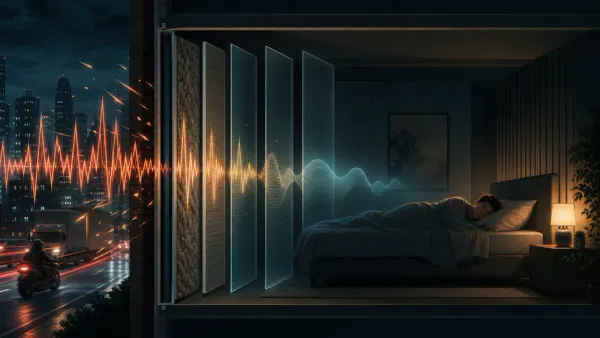
Noise can fragment sleep even when you do not remember waking. WHO’s noise guidance identifies sleep disturbance and cardiovascular effects as major health concerns. Its community-noise guidance recommends quiet bedrooms for good sleep quality, and its 2018 environmental-noise guidelines summarize evidence linking transportation noise with sleep, annoyance, and cardiometabolic outcomes.
A practical bedroom audit asks three questions:
- What is the steady background level?
- What peaks happen repeatedly during the sleep window?
- Do noisy nights line up with worse sleep efficiency, HRV, resting heart rate, or next-day readiness?
If the room is quiet except for sharp peaks, reducing contrast matters: seal windows, move the bed, use earplugs, fix rattling HVAC, or add very low-volume masking. If the room is constantly loud, masking may only add more sound. Use how much noise during sleep is too much for the dB ranges and a 7-night experiment.
Step 6: reduce dust and high-contact chemicals
Dust is a reservoir. It can carry outdoor soil, indoor particles, plastic additives, flame retardants, pesticides, biological fragments, and residues from consumer products. Chemical exposure is not one thing either. Food contact, heat, skin contact, inhalation, and frequency all change priority.
Start with easy, repeated routes:
- do not microwave or store hot food in plastic
- decline unnecessary thermal receipts
- leave shoes near the door
- damp-dust instead of dry-dusting
- vacuum carpets and upholstery with HEPA filtration when possible
- reduce fragrance products used daily or in bedrooms
- avoid optional stain-resistant treatments indoors
This is not a purity project. It is a frequency project. The endocrine disruptors in receipts, plastics, and dust article gives the narrower chemical-priority sequence.
A 14-day healthy home audit plan
Days 1 to 2: map the home
Walk through the house with a notebook. Mark bedrooms, kitchen, bathrooms, basement, laundry, water entry point, HVAC return, windows facing traffic, and any musty or damp areas. Write down what you already know: private well, older plumbing, gas stove, wildfire smoke season, loud road, bright streetlight, recent renovation, pets, candles, or damp basement.
Days 3 to 5: measure only the useful basics
Do not buy a dozen sensors. Start with what changes decisions:
- PM2.5 near cooking, bedroom, and windows
- CO2 overnight in the bedroom or workday office
- bedroom noise pattern for several nights
- bedroom light leaks after lights-out
- indoor humidity in damp rooms
- water report or targeted water test if risk is plausible
Days 6 to 10: fix the top three controllable exposures
Choose the three fixes with the best dose-duration payoff. Examples:
- run the range hood every time you cook
- put a right-sized purifier in the bedroom
- stop microwaving plastic
- fix a bathroom fan or dehumidifier schedule
- block streetlight with curtains or a sleep mask
- set a filter replacement reminder
- schedule radon testing
- reduce hallway or traffic noise during sleep
Days 11 to 14: watch body-side signals
A home audit is not complete when the room looks better. Watch whether the body responds. Track sleep efficiency, awakenings, resting heart rate, HRV, respiratory rate, morning energy, headaches, congestion, and training readiness. Look for trends, not one-night miracles.
This is where environmental aging and the biological clock becomes practical. The home is one of the places where environmental load repeats every day.
How SuperAge fits into the audit
SuperAge does not test radon, PFAS, mold, CO2, PM2.5, lux, or decibels. It helps you track the body-side signals that can improve when environmental load falls: sleep quality, HRV, resting heart rate, respiratory patterns, recovery, activity, and biological-age trends.
Use it like an experiment log. Change one or two home variables at a time, then watch 14- to 28-day trends. If bedroom filtration during smoke season improves overnight heart rate and morning readiness, that is useful. If blackout curtains shorten sleep onset but HRV stays flat, the change may still help sleep timing even if it is not the only bottleneck. If mold remediation or noise reduction coincides with fewer wakeups, the audit has moved from theory to signal.
The point is not to medicalize your house. It is to stop guessing which exposures matter and focus on changes that your recovery data can actually test.
FAQ
What is the first thing to check in a healthy home audit?
Start with active hazards and high-duration exposures: radon if never tested, combustion safety, water intrusion or mold, bedroom air, drinking-water evidence, nighttime light, and sleep noise. These affect risk or recovery for many hours at a time.
Should I buy an air purifier before testing anything?
Only if the particle problem is obvious, such as smoke, pollen, dust, or cooking particles, and the purifier is correctly sized. If the problem is CO2, moisture, gases, or mold growth, ventilation, exhaust, drying, or source control may matter more than filtration.
Which room matters most for longevity?
The bedroom is usually the highest-leverage room because exposure lasts 7 to 9 hours during sleep and recovery. Prioritize air quality, darkness, noise stability, temperature, and moisture control there before optimizing low-use rooms.
Is filtered water always necessary?
No. It depends on your water source, plumbing, local results, and contaminant risk. A certified point-of-use filter is sensible when lead, PFAS, or other specific concerns are plausible, but taste improvement is not the same as health-contaminant reduction.
How do I avoid overreacting to every home exposure?
Rank by dose, duration, evidence, vulnerability, and ease of control. Fix repeated high-contact exposures first. Ignore low-frequency exposures until the big levers are handled. The audit should reduce stress, not create a permanent risk ritual.
Key takeaways
- A healthy home audit is a priority map. It ranks air, water, light, noise, moisture, dust, and chemicals instead of chasing every possible exposure.
- Source control comes first. Fix water, combustion, mold, and strong pollutant sources before relying on devices.
- Bedrooms deserve special attention. Air, darkness, and noise affect sleep architecture, HRV, resting heart rate, and recovery.
- Certified claims matter. Water and air devices should match the specific pollutant you are trying to reduce.
- Track trends after changes. Use sleep and recovery data to see whether lower environmental load is translating into better physiology.
Try SuperAge
To test whether healthier home changes show up in sleep, HRV, recovery, and biological-age trends, download SuperAge.
References
- U.S. Environmental Protection Agency. Improving indoor air quality.
- U.S. Environmental Protection Agency. Air cleaners and air filters in the home.
- Centers for Disease Control and Prevention. Testing for radon in your home.
- U.S. Environmental Protection Agency. Per- and polyfluoroalkyl substances in drinking water.
- U.S. Environmental Protection Agency. Identifying drinking water filters certified to reduce PFAS.
- U.S. Environmental Protection Agency. Point-of-use and pitcher filters certified to reduce lead in drinking water.
- Centers for Disease Control and Prevention. Mold.
- World Health Organization. Noise fact sheet.
- World Health Organization. Environmental noise guidelines for the European Region.
- National Institutes of Health. Artificial light during sleep linked to obesity.
Related Articles
Bedroom temperature and sleep quality: what range supports recovery?
Bedroom temperature affects sleep quality, HRV, and recovery. Learn the best range by age, season, bedding, and wearable sleep pattern.