Water filters for PFAS and microplastics: what actually helps?
Water filters for PFAS and microplastics are not interchangeable. Learn when carbon, ion exchange, reverse osmosis, and certifications matter.
The phrase water filters for PFAS and microplastics sounds like one shopping problem. It is really two different filtration problems.
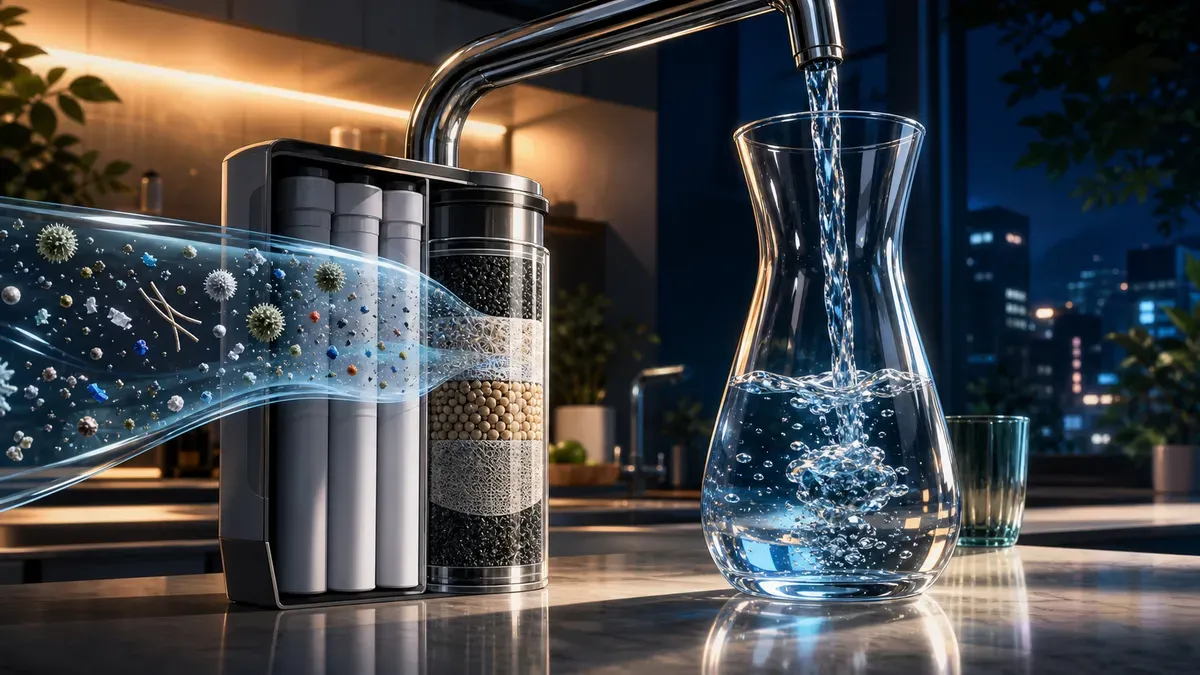
PFAS are chemical contaminants. The better-supported home technologies are granular activated carbon, ion exchange resin, and reverse osmosis, with certification and maintenance doing most of the practical work. Microplastics are particles that vary enormously in size, from visible fragments down into nano-scale ranges. For them, physical separation and membrane performance matter more than broad “carbon filter” language.
The mistake is buying a filter by category name alone. A pitcher that improves taste is not automatically a PFAS filter. A refrigerator cartridge with carbon is not automatically certified for PFAS. A reverse-osmosis system is not automatically maintained, correctly installed, or ideal for every household. A microplastics claim may not tell you the particle sizes tested.
This guide compares the practical options without naming brands. For household endocrine-disruptor priorities beyond water, see endocrine disruptors in receipts, plastics, and dust.
Quick answer: what actually helps?
For PFAS, look for point-of-use systems certified for PFAS reduction under NSF/ANSI 53 or reverse-osmosis systems certified under NSF/ANSI 58, then maintain them on schedule. For microplastics, membrane-based systems such as reverse osmosis, nanofiltration, ultrafiltration, or certified fine physical filtration are more plausible than taste-only carbon. If you want one conservative drinking-water setup for both, an under-sink reverse-osmosis system with verified PFAS claims is usually the strongest starting point, but it costs more, wastes some water, and needs maintenance.
| Concern | More relevant technologies | Main caveat |
|---|---|---|
| PFAS | Granular activated carbon, ion exchange, reverse osmosis | Certification and replacement schedule matter |
| Longer-chain PFAS such as PFOA/PFOS | GAC, ion exchange, RO | GAC performance depends on bed depth, flow, water chemistry, and time |
| Shorter-chain PFAS | RO or ion exchange often stronger | Check certified claims for the actual contaminants |
| Microplastics | RO, nanofiltration, ultrafiltration, fine physical filtration | Claims should specify particle size or standard |
| Taste and chlorine | NSF/ANSI 42 carbon filters | Not the same as health-contaminant reduction |
| Whole-home exposure | Point-of-entry systems | More costly; may be unnecessary if concern is drinking/cooking water |
EPA notes that current PFAS filter certifications, as of April 2024, do not yet prove removal down to the new EPA drinking-water standard levels. That does not mean certified filters are useless. It means you should read certification as verified reduction, not a guarantee of zero or regulatory-level compliance in every home.
Start with your water report, not the filter aisle
Before buying, find out what problem you actually have.
- Check your water utility’s annual Consumer Confidence Report.
- Search for PFAS testing from your utility, state environmental agency, or local health department.
- If you use a private well, consider testing because municipal reports will not cover you.
- Look for local advisories, especially near airports, military bases, industrial sites, landfills, firefighting foam use, or known PFAS contamination zones.
- Decide whether you need drinking-water treatment only or whole-home treatment.
The CDC gives a simple but important rule: different filters have different functions. What a filter removes depends on pore size, contaminant size, and chemical/electrical properties. Always check the label for the specific substances the filter can remove.
For most households worried about PFAS and microplastics, point-of-use filtration at the kitchen sink is the practical first step because it treats the water you drink and cook with. Whole-home treatment makes more sense when the contaminant creates meaningful exposure through bathing, cleaning, or all taps, or when a local health department recommends it.
If you are deciding whether water filtration should come before bedroom air, light, noise, mold, or dust fixes, use the healthy home audit for longevity to rank exposures by dose, duration, and fixability.
PFAS: what technologies have evidence?
EPA identifies three main treatment categories for reducing PFAS in drinking water: activated carbon adsorption, ion exchange resins, and high-pressure membranes such as nanofiltration and reverse osmosis.
Granular activated carbon
Granular activated carbon, or GAC, traps chemicals as water passes through porous carbon. It is widely used for taste, odor, natural organic compounds, and some synthetic organic chemicals. For PFAS, EPA notes that GAC can be effective, especially for longer-chain PFAS such as PFOA and PFOS, but performance depends on the carbon type, bed depth, flow rate, water temperature, organic matter, background contaminants, and which PFAS are present.
That makes maintenance central. A carbon filter has limited capacity. Once it is exhausted, it can stop reducing the contaminant effectively. For PFAS, do not stretch replacement intervals to save money.
Ion exchange resin
Ion exchange resin uses small beads that attract and hold charged contaminants. EPA describes anion exchange resins as effective for negatively charged contaminants such as PFAS. Ion exchange can have high capacity for many PFAS, though systems can be more expensive and claims still need product-level verification.
Reverse osmosis and nanofiltration
Reverse osmosis and nanofiltration use high-pressure membranes. EPA describes these membranes as extremely effective for PFAS, with research generally showing more than 90% removal across a wide range of PFAS, including shorter-chain compounds. RO is typically the tightest consumer-facing option, but it creates a wastewater stream and requires cartridge and membrane replacement.
EPA’s home-filter page estimates that RO wastes about one gallon of water for every gallon treated in typical systems. That tradeoff may be worth it for high-concern drinking water, but it should be understood upfront.
Certifications: what to look for
For PFAS, EPA tells consumers to look for certification under:
- NSF/ANSI 53 for PFAS reduction
- NSF/ANSI 58 for reverse osmosis systems
The packaging is not enough if the claim is vague. Check the manufacturer’s performance data sheet and, when possible, verify the exact model in an accredited certification body’s directory, such as NSF, WQA, IAPMO, CSA, or UL. EPA’s fact sheet emphasizes that independent certification verifies effectiveness and the accuracy of contaminant reduction claims.
Watch for weak language:
- “tested to NSF standards” without certification
- certification for NSF/ANSI 42 only when your concern is PFAS
- claims for taste and odor presented as health-contaminant reduction
- no performance data sheet
- no model-specific listing
- no replacement schedule
NSF also warns that certification to a standard does not mean a system reduces every possible contaminant. The model must be certified for the specific contaminant or claim you care about.
Microplastics: what filters can and cannot promise
Microplastics are not one size. EPA researchers define microplastics as plastic particles ranging from 5 millimeters down to 1 nanometer. WHO’s drinking-water report concluded that more research is needed, and that well-managed water systems and treatment can reduce many microplastics, but the evidence base is still developing.
For home filters, the practical issue is particle size. Larger microplastics are easier to remove than nanoplastics. A coarse sediment filter may reduce visible particles but say little about very small fragments. A carbon filter may mechanically trap some particles but is not necessarily a precision particle barrier unless the product is designed and tested that way.
More plausible options for microplastic reduction include:
- reverse osmosis
- nanofiltration
- ultrafiltration
- absolute-rated fine physical filters
- multi-stage systems with sediment and membrane stages
The label should tell you what particle size or standard was tested. If the product only says “reduces microplastics” without a test method, particle-size range, or certification, treat the claim cautiously.
Carbon vs RO: which is the better first buy?
Choose based on the main concern.
Carbon-first makes sense when:
- your primary concern is chlorine taste and odor
- you want lower-cost PFAS reduction with verified NSF/ANSI 53 claims
- water pressure, under-sink space, or wastewater is a major constraint
- local PFAS levels are low but you want a reduction layer
- you can replace cartridges on schedule
RO-first makes sense when:
- PFAS concern is high or local contamination is documented
- you also care about microplastics, many dissolved contaminants, or multiple unknowns
- you want a stronger point-of-use barrier for drinking and cooking water
- you accept wastewater, lower flow, installation, and maintenance costs
- the exact model has relevant NSF/ANSI 58 and PFAS claims
If you rent, a certified countertop or under-sink option may be more realistic than whole-home treatment. If you own and have private-well contamination, consult your state health department or a qualified water-treatment professional.
Maintenance is not optional
Filters are only as good as their replacement schedule. EPA and CDC both emphasize maintenance. A PFAS filter has finite capacity. An RO membrane ages. Carbon can exhaust. Plumbing and storage tanks can grow microbes if neglected.
Practical rules:
- write the installation date on the filter housing
- set calendar reminders for replacement
- use gallons treated when the system tracks it
- replace after unusual water events or advisories if recommended
- sanitize storage tanks according to instructions
- do not buy a system whose replacement filters are too expensive to maintain
The worst filter is the one you buy once and then run far beyond its useful life.
A practical decision path
- Check your water report or test. Do not guess.
- Name the priority: PFAS, microplastics, lead, taste, microbes, nitrate, or multiple concerns.
- Choose point-of-use first if drinking and cooking water are the main route.
- Look for certified claims: NSF/ANSI 53 for PFAS reduction, NSF/ANSI 58 for RO, and model-specific performance data.
- Match technology to concern: GAC/IX/RO for PFAS; membrane/fine physical filtration for microplastics.
- Plan maintenance before purchase.
- Retest if contamination is known or stakes are high.
Do not rely on a refrigerator filter or taste pitcher unless it is certified for the contaminant you care about. Many are designed primarily for taste and odor.
How SuperAge fits the bigger picture
SuperAge does not test drinking water. It helps you connect environmental decisions to the larger healthspan system: sleep, recovery, metabolic health, cardiovascular fitness, inflammation, and biological-age trends.
Water filtration is not a standalone longevity hack. It is one layer of exposure reduction, alongside food-contact choices, indoor dust control, air filtration, sleep quality, and metabolic health. The point is to reduce avoidable background load without turning daily life into a risk-control project.
For adjacent household exposure priorities, use the receipts, plastics, and dust checklist. For filter media in air rather than water, see HEPA vs carbon filters.
Frequently asked questions
Do pitcher filters remove PFAS?
Some may, but only trust model-specific certified claims. A pitcher that improves taste or chlorine odor is not automatically certified for PFAS reduction.
Is reverse osmosis always best?
No. RO is a strong point-of-use barrier for many contaminants, including PFAS and small particles, but it costs more, requires maintenance, may reduce minerals, slows flow, and creates wastewater. It is strongest when you have multiple drinking-water concerns.
Do carbon filters remove microplastics?
Some carbon systems may trap some particles, especially larger ones, but carbon is not automatically a reliable microplastic barrier. For microplastics, look for membrane or fine physical filtration claims with a particle-size basis.
Should I filter all water in the house?
Usually not if your main concern is drinking and cooking water. Point-of-use filtration is cheaper and easier to maintain. Whole-home treatment is more relevant for private wells, volatile chemicals, or local health-department recommendations.
What certification should I look for?
For PFAS, start with NSF/ANSI 53 for PFAS reduction or NSF/ANSI 58 for reverse osmosis systems with PFAS claims. Then verify the exact model and contaminant claims in a certification directory or performance data sheet.
Key takeaways
- PFAS and microplastics are different problems. PFAS are chemicals; microplastics are particles with a wide size range.
- For PFAS, certification matters. Look for NSF/ANSI 53 or 58 claims specific to PFAS reduction.
- RO is the broadest point-of-use option. It is often the strongest single choice for PFAS plus microplastics, but it has cost, maintenance, and wastewater tradeoffs.
- Carbon can help, but do not overread it. Taste-and-odor carbon is not the same as certified PFAS reduction.
- Maintenance is part of performance. An expired filter can turn a good purchase into false reassurance.
References
- U.S. Environmental Protection Agency. Identifying Drinking Water Filters Certified to Reduce PFAS.
- U.S. Environmental Protection Agency. Reducing PFAS in Drinking Water with Treatment Technologies.
- U.S. Environmental Protection Agency. Water Filter Fact Sheet for PFAS.
- Centers for Disease Control and Prevention. About Choosing Home Water Filters.
- U.S. Environmental Protection Agency. Microplastics Research.
- World Health Organization. Microplastics in drinking-water.
Related Articles

Healthy home audit for longevity: air, water, light, and noise
A healthy home audit for longevity ranks air, water, light, noise, mold, and chemical risks without duplicating every single-exposure guide.