HEPA vs carbon filters: which removes the pollutants that matter?
HEPA vs carbon filters is really particles vs gases. Learn what each filter removes, where CADR matters, and when you need both.
The HEPA vs carbon filters question is usually asked as if one filter is better. The practical answer is narrower: HEPA and activated carbon target different pollutant families.
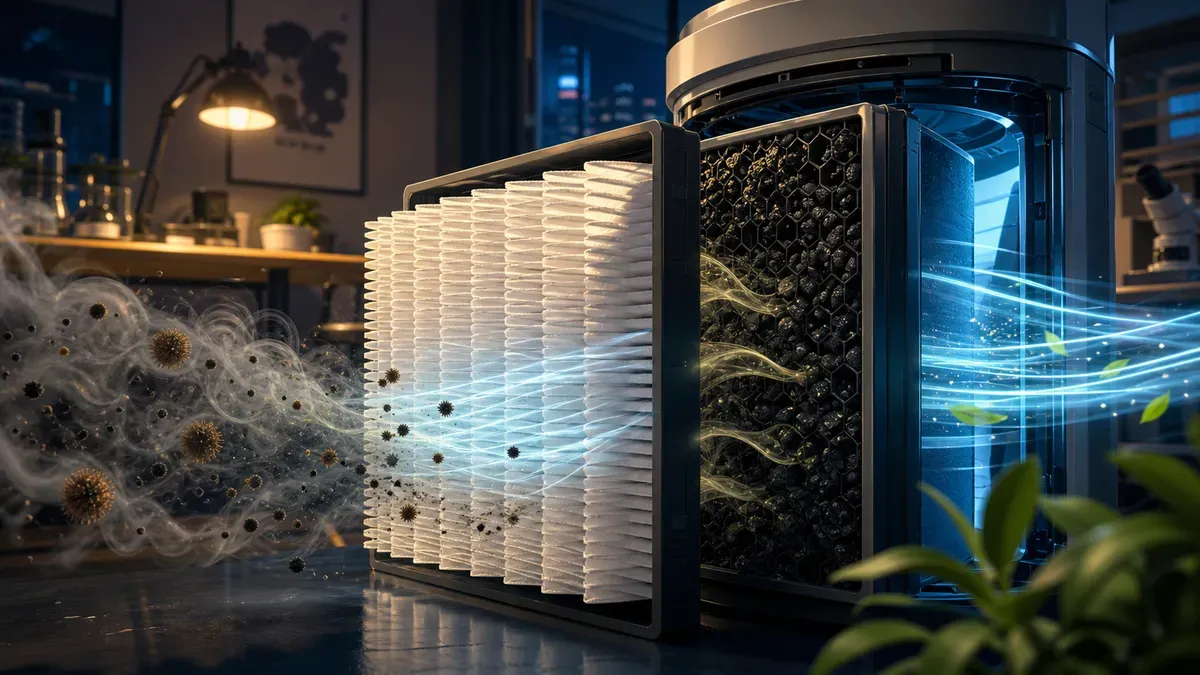
HEPA is a particle filter. It is useful for PM2.5, wildfire smoke particles, dust, pollen, many airborne mold fragments, pet dander, and respiratory aerosol particles when the air cleaner moves enough air through the filter. Activated carbon is a gas-phase sorbent. It is useful for some odors and volatile organic compounds when there is enough carbon, enough contact time, and regular replacement.
That means the best filter depends on the pollutant you are trying to reduce. A strong HEPA purifier can make a smoky room’s particle count fall quickly while doing little for solvent fumes. A thin carbon sheet may reduce a mild odor for a while while doing little for pollen or PM2.5. A device that combines high particle CADR with substantial carbon can address both categories, but it still cannot replace source control or clean ventilation.
For the broader intervention comparison, see air purifier vs ventilation. This guide stays focused on filter media: which pollutants each filter can remove, what labels matter, and how to avoid buying the wrong solution for your exposure.
Quick answer: particles or gases?
If the problem is particles, prioritize HEPA or another high-efficiency particle filter with enough clean air delivery rate for the room. If the problem is gases, odors, or many VOCs, particle filtration alone is not enough; you need source control, ventilation, and, when appropriate, a purifier with enough activated carbon or other gas-phase sorbent.
| Pollutant or concern | HEPA/high-efficiency particle filter | Activated carbon/gas-phase filter |
|---|---|---|
| PM2.5 and wildfire smoke particles | Strong choice when CADR is adequate | Does not remove particles by itself |
| Dust, pollen, pet dander | Strong choice | Not the main tool |
| Many airborne mold fragments | Can reduce airborne particles | Does not fix moisture or mold source |
| Cooking particles | Helpful after source exhaust | Not the main particle tool |
| Odors | May reduce particle-associated odor slightly | Better fit if enough carbon is present |
| VOCs from paint, solvents, fragrance, new furniture | Not meaningful for gases | Can help for some gases, but capacity matters |
| Carbon monoxide, radon, high CO2 | Not appropriate | Not a reliable solution; source control and ventilation are primary |
EPA’s consumer guide makes the same practical distinction: most filters are designed for particles or gases, and many air cleaners use two filters when they are intended to address both. CADR is the practical rating system for particles, not for gases.
What HEPA filters actually remove
HEPA stands for high-efficiency particulate air. In home air cleaners, the practical point is not the acronym; it is whether the unit can move enough air through a high-efficiency particle filter.
Particle filters work by physically capturing particles in fibrous media. They are strongest for:
- PM2.5 from wildfire smoke, traffic infiltration, combustion, and some cooking
- dust and dust mite particles
- pollen
- pet dander
- many airborne mold fragments and spores
- respiratory aerosol particles
HEPA does not mean the purifier is automatically powerful enough for the room. A very efficient filter attached to a weak fan may clean slowly. A less dramatic marketing label with a high verified CADR may reduce room particle levels faster than a premium-sounding filter in an undersized machine.
That is why CADR matters. AHAM describes CADR as the volume of filtered air delivered by an air cleaner, with separate numbers for tobacco smoke, pollen, and dust. The higher those numbers are relative to the room, the faster the unit filters particles. EPA’s guide also uses smoke CADR as the small-particle sizing anchor and gives a simple room-size table: roughly 65 cfm for 100 square feet, 130 cfm for 200 square feet, and 195 cfm for 300 square feet when ceilings are about 8 feet high.
For health-relevant particles, tobacco-smoke CADR is often the most useful of the three because it represents smaller particles. Wildfire smoke and combustion-related PM2.5 are closer to that problem than to large pollen grains.
What activated carbon filters actually remove
Activated carbon is not a particle filter in the same way. It is a porous sorbent that can trap some gas molecules on its surface. Carbon filters are used for some odors, some VOCs, and some gaseous pollutants.
The key phrase is “some.” Gas-phase filtration is more complicated than particle filtration. Molecules differ in size, polarity, boiling point, concentration, humidity sensitivity, and how strongly they bind to a sorbent. A carbon filter that helps with one odor may not handle formaldehyde well. A filter that smells fresh on day one may saturate quickly if the carbon bed is thin.
EPA’s guide is blunt about the practical shopping problem: there is no widely used performance rating system for portable air cleaners or filters designed to remove gases, and CADR is for particles only. It also notes that activated carbon filters can be effective when a large amount of material is used.
That is the carbon-filter trap. Many consumer purifiers include a black prefilter or thin carbon sheet. It may catch lint and reduce a mild odor briefly, but it is not the same as a deep carbon bed designed for gas-phase adsorption. If your main exposure is VOCs from painting, solvents, strong fragrances, new furniture, cleaning products, or combustion gases, source control and ventilation usually matter more than a small carbon layer.
The pollutant-first decision table
Start with the pollutant, not the product category.
| Situation | Better first filter | What else matters |
|---|---|---|
| Wildfire smoke entering indoors | HEPA/high CADR particle filtration | Close windows, reduce indoor combustion, run continuously |
| Traffic PM2.5 near a road | HEPA/high CADR particle filtration | Time ventilation away from peaks when possible |
| Pollen allergy | HEPA/high CADR particle filtration | Keep windows strategic during high pollen periods |
| Pet dander and dust | HEPA/high CADR particle filtration | Cleaning, bedding, humidity, and source control still matter |
| Musty odor with visible dampness | Source control first, then HEPA support | Fix moisture; see mold remediation vs air purifier before treating filtration as the solution |
| New paint, solvents, cleaning fumes | Ventilation/source control, carbon as support | Use low-emission products; exhaust outdoors when safe |
| Fragrance or deodorizer odor | Remove source; carbon may help | Avoid masking odor with more chemicals |
| Cooking particles | Exhaust hood first, HEPA after | Carbon may help odor, but not the particle spike |
| High CO2 overnight | Ventilation | Neither HEPA nor ordinary carbon meaningfully removes CO2 |
The common mistake is treating indoor air quality as one problem. It is not. PM2.5, pollen, VOCs, humidity, CO2, nitrogen dioxide, ozone, mold, and combustion byproducts behave differently. A filter that solves one category may be nearly irrelevant for another.
Where CADR matters, and where it does not
CADR is one of the few consumer-facing air-cleaner numbers that is genuinely useful. It combines filtration efficiency and airflow into a practical room-cleaning rate. A high CADR means the machine delivers more clean particle-filtered air per minute.
Use CADR for:
- smoke particles
- dust
- pollen
- room sizing
- comparing particle-cleaning speed between units
- estimating whether one purifier or multiple purifiers are needed
Do not use CADR for:
- VOC removal
- odor capacity
- carbon filter life
- CO2
- radon
- carbon monoxide
This is why “has HEPA” is not enough. A purifier needs enough CADR for the room and enough runtime. EPA emphasizes that higher fan speeds and longer runtime increase the amount of air filtered. If noise makes you run the unit on its lowest setting, the real CADR may be much lower than the number advertised at high speed.
AHAM’s consumer sizing rule is simple: tobacco-smoke CADR should be at least two-thirds of the room’s square footage for standard 8-foot ceilings. A 300-square-foot room therefore needs roughly 200 cfm smoke CADR. If ceilings are higher, or if the room is open to other rooms, size up or combine units.
How much carbon is enough?
There is no simple consumer equivalent of CADR for gases, so you have to read carbon claims more skeptically.
Better signs:
- the product discloses carbon weight or substantial sorbent media
- the filter is thick, heavy, or cartridge-style rather than a thin sheet
- replacement intervals are conservative and realistic
- the manufacturer specifies which gas or odor challenge the filter targets
- particle CADR is still adequate if you also need PM2.5 removal
Weaker signs:
- “deodorizing” language with no carbon amount
- a washable mesh marketed as a gas filter
- no replacement schedule
- a tiny carbon layer behind a powerful fan
- claims that one filter removes all VOCs, all odors, smoke, mold, viruses, and gases equally
Carbon is a capacity-limited material. Once binding sites are full, performance falls. Humidity and competing gases can also reduce real-world effectiveness. If a room has a strong ongoing source, carbon can become a temporary buffer rather than a solution.
When you need both HEPA and carbon
Many real exposures mix particles and gases.
Wildfire smoke contains fine particles plus gas-phase compounds and odors. HEPA/high-CADR filtration is the priority because PM2.5 is the dominant acute health concern indoors, but meaningful carbon can reduce some smell and gas-phase irritants. Cooking produces particles, odors, moisture, and sometimes combustion gases. A vented range hood is first; HEPA can reduce particles that escape; carbon may help residual odors. Renovation can produce dust plus VOCs. Dust control and HEPA matter for particles; source control, curing time, and ventilation matter for gases.
A combined purifier can be useful when it has both:
- adequate particle CADR for the room
- a real carbon or sorbent stage with enough media
- acceptable noise at the fan speed you will actually use
- replacement filters you can afford to change on schedule
If one of those is missing, performance drops. A purifier with strong carbon but weak airflow may not protect against smoke particles. A high-CADR HEPA machine with a thin carbon sheet may not do much for VOCs.
What not to expect from either filter
Neither HEPA nor activated carbon is a magic indoor-air reset.
They do not replace source control
EPA consistently places source reduction and clean ventilation ahead of filtration. If a product, leak, appliance, candle, fragrance, damp wall, or combustion source is creating pollution, fix or reduce that source first. Filtration is a supplement, not permission to keep producing pollutants.
They do not solve moisture
Mold prevention is a moisture problem. HEPA may reduce airborne fragments; carbon may reduce some odor. Neither dries a wall, fixes a leak, or prevents growth in damp material.
They do not make ozone generators safe
Avoid devices that intentionally produce ozone as an air-cleaning strategy. EPA’s technical summary separates air-cleaning technologies and notes that some gas-phase or electronic approaches can produce potentially harmful byproducts. For homes, proven mechanical filtration and source control are the conservative default.
They do not ventilate a room
HEPA does not add outdoor air. Carbon does not meaningfully lower CO2 in normal home use. If a room is stale, crowded, or high in CO2, you need ventilation or fewer occupants, not just a purifier.
A buying checklist that avoids common mistakes
Use this order before buying:
- Name the pollutant. PM2.5, pollen, dust, pet dander, VOCs, odor, moisture, or CO2?
- Control the source. Stop burning, spraying, leaking, or storing the pollutant indoors when possible.
- Pick the filter media. HEPA/high-efficiency filtration for particles; carbon or other sorbent for some gases.
- Size for the room. Use smoke CADR for particle problems, not just the marketing room size.
- Check noise at real speed. A purifier you cannot tolerate running will underperform.
- Budget for replacements. Dirty or saturated filters do not work well.
- Measure if you can. A PM2.5 sensor tests particle filtration; a CO2 sensor tests ventilation needs.
For many homes, the first purchase should be a quiet high-CADR purifier for the bedroom, because overnight exposure is long and sleep recovery is biologically important. The second priority depends on source: kitchen exhaust, filtration for a living area, dehumidification, or ventilation improvements.
How SuperAge fits the bigger picture
SuperAge does not measure HEPA performance, carbon saturation, PM2.5, VOCs, or CO2 directly. Its role is to connect environmental decisions to body-side signals: sleep quality, resting heart rate, HRV, recovery, activity, and biological-age trends.
That matters because indoor air interventions should be judged by more than smell. A room can smell clean while PM2.5 remains high. A room can have low particles while CO2 rises overnight. A bedroom purifier during smoke season, better kitchen exhaust, or cleaner nighttime ventilation may show up as steadier sleep and recovery over several weeks.
This is the same environmental-health logic behind air pollution and accelerated aging and environmental aging: the built environment changes the load your body has to manage. The goal is not sterile air. The goal is to remove the avoidable spikes that make recovery harder.
Frequently asked questions
Is HEPA better than activated carbon?
For particles, yes. For gases and odors, no. HEPA and carbon do different jobs. HEPA targets particles such as PM2.5, smoke particles, dust, pollen, dander, and many airborne fragments. Carbon targets some gas-phase pollutants and odors when enough sorbent is present.
Do carbon filters remove wildfire smoke?
They can help with some smoke odor and gas-phase compounds, but HEPA or another high-CADR particle filter is the priority for indoor PM2.5 from wildfire smoke. The best setup during smoke events is usually windows closed, indoor sources reduced, and particle filtration running continuously, with carbon as a useful but secondary layer.
Do HEPA filters remove VOCs?
No, not meaningfully. HEPA filters remove particles. VOCs are gases. Some purifiers combine HEPA with activated carbon or other sorbent media, but VOC performance depends on the type and amount of sorbent and the source strength.
Why does my carbon filter stop reducing odor?
Carbon has finite adsorption capacity. Once the available sites fill, performance drops. High humidity, strong sources, and competing gases can shorten useful life. If the source remains in the room, replacing carbon may only create a short-term improvement.
Should I choose HEPA, carbon, or both for allergies?
For pollen, dust, and pet dander, prioritize HEPA/high-CADR particle filtration. Carbon is not the main allergy tool unless odors or irritant gases are also part of the problem.
What is the biggest buying mistake?
Buying by filter buzzword instead of pollutant and room size. “HEPA” does not guarantee enough CADR. “Carbon” does not guarantee enough gas capacity. Match the filter to the pollutant, then size it for the room and fan speed you will actually use.
Key takeaways
- HEPA is for particles. It is the first filter to prioritize for PM2.5, smoke particles, dust, pollen, dander, and many airborne fragments.
- Activated carbon is for some gases and odors. It can help, but only when there is enough sorbent and the source is controlled.
- CADR is a particle metric. Use smoke CADR to size purifiers for small-particle problems; do not use CADR to judge VOC removal.
- Many homes need both, but not equally. High particle CADR usually matters most for smoke and allergens; meaningful carbon matters when gas or odor sources are real.
- Source control still wins. Remove or reduce the pollutant first, ventilate with clean outdoor air when appropriate, then use filtration as a targeted supplement.
References
- U.S. Environmental Protection Agency. Air Cleaners and Air Filters in the Home.
- U.S. Environmental Protection Agency. Guide to Air Cleaners in the Home.
- U.S. Environmental Protection Agency. Residential Air Cleaners: A Technical Summary.
- AHAM Verifide. Find a Certified Room Air Cleaner.
- ASHRAE Journal. Debunking Myths About MERV, Air Filtration.
Related Articles
Mold remediation vs air purifier: what fixes exposure first?
Mold remediation vs air purifier is really source control vs support. Learn when to fix moisture, remove materials, and use HEPA filtration.