Mold remediation vs air purifier: what fixes exposure first?
Mold remediation vs air purifier is really source control vs support. Learn when to fix moisture, remove materials, and use HEPA filtration.
The mold remediation vs air purifier question has a short answer: remediation fixes the exposure source; an air purifier can only reduce some airborne particles while the source is being fixed.
That distinction matters because mold is not mainly an “air problem.” It is a moisture and material problem that becomes an air problem when spores, fragments, odors, and dust move through the home. A high-CADR HEPA purifier may lower airborne fragments in one room. It cannot dry a wall cavity, remove colonized drywall, stop a roof leak, replace wet carpet padding, or prove the building is safe after a flood.
The practical hierarchy is: stop water, dry quickly, remove or clean contaminated materials, contain the work area when needed, then use filtration as support. If you reverse that order, the air may smell better while the exposure continues.
For the broader biology of damp buildings, inflammation, and aging, start with mold exposure and accelerated aging. This guide is narrower: what to do first when you are comparing remediation with an air purifier.
Quick answer: what fixes exposure first?
If there is active water intrusion, visible mold growth, wet porous material, musty odor that returns after cleaning, or mold linked to a known leak, remediation comes first. An air purifier is useful as a temporary support tool, especially a true HEPA or high-efficiency particle unit sized for the room, but it does not solve the mold problem.
| Situation | First move | Role of air purifier |
|---|---|---|
| Active leak or flood | Stop water and dry materials | Support only after safety and moisture control |
| Visible mold on porous material | Remove or remediate material | Reduce airborne particles during/after cleanup if contained properly |
| Musty smell with no visible mold | Find moisture source | May reduce particles but can mask the signal |
| Allergy symptoms in a clean, dry home | Filter bedroom air | Useful if moisture inspection is negative |
| Small surface mold on hard material | Clean safely and fix moisture | Optional support |
| More than about 10 sq ft of growth | Consider professional remediation | Support outside the containment zone |
| HVAC suspected contaminated | Professional HVAC/mold evaluation | Do not run system until assessed if contamination is plausible |
The key test is whether the source is still present. If yes, filtration is a support. If no, filtration can help clean residual particles and improve bedroom air.
Why remediation beats filtration when mold is growing
EPA’s mold guidance is blunt: the way to control indoor mold growth is to control moisture. Mold spores exist indoors and outdoors, so the goal is not sterile air. The goal is a dry building where spores do not have wet material to colonize.
An air purifier works on air that passes through it. Mold growth often sits inside building materials, behind baseboards, under carpet, inside wall cavities, around window frames, on sheathing, or in HVAC components. If that material stays damp, particles and microbial odors can keep re-entering the room after every filtration cycle.
That is why a purifier can create false reassurance. Particle counts may fall while the unit is running, but the building still contains an active reservoir. Once the purifier is off, a door opens, humidity rises, or work disturbs dust, exposure can resume.
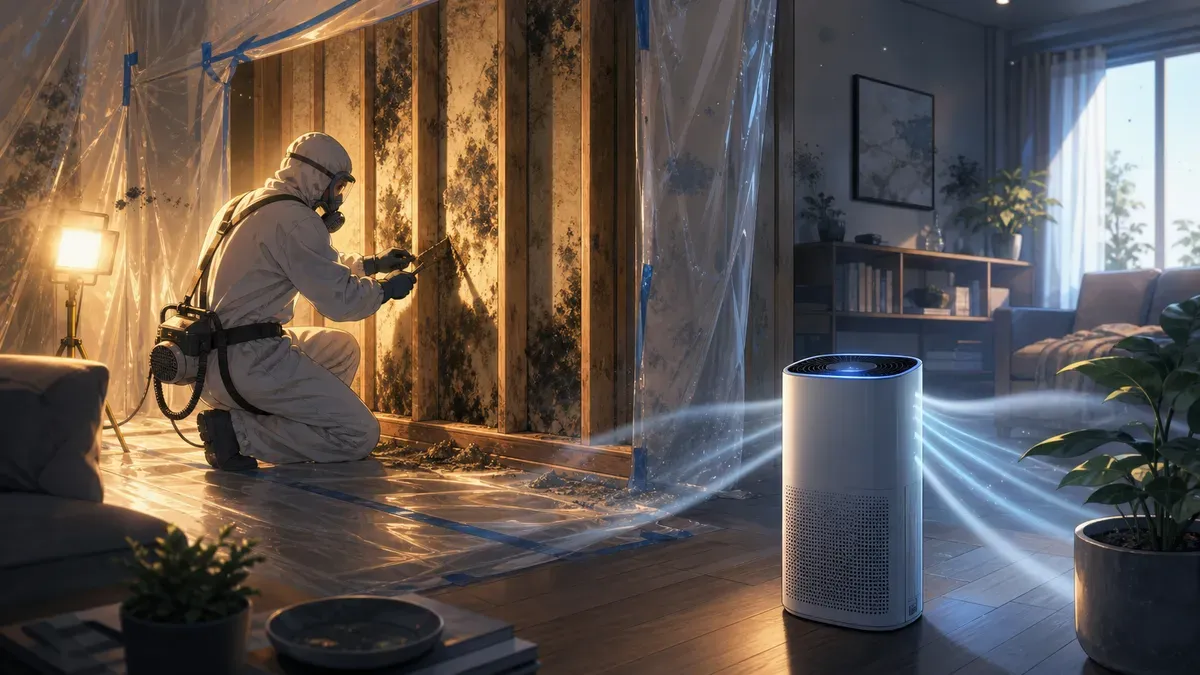
Remediation is not always dramatic. For a small patch on a hard bathroom surface, it may mean cleaning the material and fixing ventilation. For wet drywall after a plumbing leak, it may mean cutting out material, drying framing, and verifying moisture. For a flood or large contaminated area, it may require containment, negative air, personal protective equipment, and professional disposal.
The first 24 to 48 hours after water damage
Speed matters because mold can grow quickly when moisture remains. CDC and EPA disaster-cleanup guidance both emphasize drying the home and removing wet material promptly when it cannot be dried safely.
Use this order:
- Make it safe. Avoid electrical hazards, sewage contamination, structural damage, and contaminated floodwater.
- Stop the water source. A leak, drainage problem, roof issue, condensation pattern, or HVAC moisture problem must be fixed.
- Remove standing water. Wet-vacuum, pump, or professional extraction may be needed.
- Dry aggressively. Use ventilation, dehumidification, and fans when safe and appropriate.
- Separate salvageable from unsalvageable. Hard nonporous materials are easier to clean; porous materials can hold contamination.
- Document moisture. A cheap pin or pinless moisture meter can show whether surfaces are actually drying.
- Avoid spreading dust. Do not aggressively fan a moldy area into the rest of the home.
The phrase “just run a purifier” is weakest during this window. The building needs drying and source control first.
When an air purifier helps with mold
Air purifiers are not useless. They are just often asked to do the wrong job.
A properly sized HEPA or high-efficiency particle purifier can reduce airborne mold spores, fragments, dust, and other particles in the room where it runs. That can be valuable:
- while you are arranging remediation and need to reduce bedroom exposure
- after the source is fixed, to lower residual airborne particles
- during pollen, dust, smoke, or pet-allergen seasons when mold is not the only particle source
- in a dry home where symptoms appear particle-triggered and inspection does not show a moisture source
- as part of a temporary clean-room strategy for a vulnerable occupant
Sizing matters. A tiny purifier in a large open-plan room is mostly symbolic. Look for CADR appropriate to the room volume and run the unit long enough to matter. For the broader particle-vs-gas distinction, read HEPA vs carbon filters.
Carbon can help with some odors, but a musty odor is not a problem to perfume away. If the smell keeps returning, treat it as a moisture clue, not a fragrance problem.
When a purifier is the wrong answer
A purifier should not be the primary plan when any of these are true:
- there is visible mold growth that keeps returning
- drywall, carpet, insulation, ceiling tile, or wood stayed wet
- indoor relative humidity remains high
- the room has a musty smell after rain, showering, or HVAC use
- the problem started after a roof leak, plumbing leak, flood, or basement seepage
- symptoms improve when leaving the building and return after re-entry
- mold may be inside the HVAC system
- cleaning disturbs dust or releases visible debris
In those cases, the purifier is not fixing exposure. It may reduce what floats through the air in one room, but the reservoir remains. The better question is: where is moisture entering or condensing, and what material is already contaminated?
DIY cleanup vs professional remediation
EPA’s home guidance uses a practical threshold: if mold growth covers more than about 10 square feet, or about 0.9 square meters, consider professional guidance. The threshold is not magic. It is a risk signal because larger areas are more likely to involve hidden moisture, dust spread, porous materials, and containment needs.
DIY may be reasonable when:
- the area is small
- the material is hard and nonporous
- the water source is already fixed
- no one in the home is immunocompromised or severely affected
- you can ventilate and protect yourself
- the mold is not in HVAC equipment
Professional remediation is more appropriate when:
- growth is large or recurring
- porous materials are contaminated
- there was flooding or sewage
- occupants have asthma, immune compromise, or severe symptoms
- the source is hidden or structural
- the HVAC system may be involved
- you need containment and clearance documentation
The goal of a professional job is not just “kill mold.” Dead mold fragments can still be allergenic or irritating. The job is moisture correction, safe removal or cleaning, dust control, containment when needed, and verification that materials are dry.
The remediation hierarchy
Use this sequence before spending heavily on devices:
- Identify moisture. Leaks, condensation, high humidity, drainage, roof, window, plumbing, or HVAC.
- Stop moisture. Repair the source and keep indoor humidity controlled.
- Dry materials. Confirm with moisture readings, not only touch or smell.
- Remove unsalvageable porous material. Carpet padding, contaminated drywall, insulation, and ceiling tile often cannot be cleaned adequately.
- Clean hard surfaces safely. Use appropriate protective equipment and avoid mixing chemicals.
- Control dust spread. Containment matters more as the area gets larger.
- Filter residual air. Use appropriately sized HEPA filtration after or during controlled work.
- Monitor recurrence. Watch humidity, odors, stains, and symptoms.
This hierarchy is similar to broader indoor-air decision making: source control first, then ventilation and filtration. The air purifier vs ventilation guide covers that tradeoff across PM2.5, CO2, odors, cooking, and humidity.
What to measure before deciding
You do not need a perfect mold test to make a first decision. You need to know whether there is moisture and whether contaminated material remains.
Useful checks:
- Relative humidity: sustained high humidity supports growth. Many homes do best around the middle range rather than damp extremes.
- Moisture meter: helps confirm whether drywall, trim, subfloor, or framing is still wet.
- Visual inspection: staining, bubbling paint, warped baseboards, condensation, and recurring spots matter.
- Smell pattern: musty odor after rain, HVAC cycles, or showering points toward moisture.
- HVAC context: if mold is near an intake or the system was part of the moisture event, get experienced help before spreading material through ducts.
Air sampling alone can mislead because it captures one moment. A low sample does not prove a wall cavity is clean. A high sample may reflect outdoor spores, dust disturbance, or sampling conditions. Building context matters more than a single number.
Health and biological-age context
WHO concluded that occupants of damp or moldy buildings have increased risk of respiratory symptoms, asthma problems, cough, wheeze, and related outcomes. That is enough reason to fix dampness even before making stronger claims about longevity.
For biological age, the most credible bridge is chronic load: poor sleep, respiratory irritation, inflammation, stress physiology, and reduced recovery. If a damp home is worsening sleep, raising resting heart rate, lowering HRV, or keeping hs-CRP elevated, it can matter to the same systems SuperAge tracks. But the app cannot tell you whether mold is present. The building still needs inspection.
SuperAge is useful after the environmental work starts. Track sleep, resting heart rate, HRV, respiratory rate, symptoms, and lab markers such as hs-CRP over several weeks. Improvement after true source control is more meaningful than a single good night with a purifier running.
For a wider built-environment checklist, see environmental aging and the biological clock.
Practical decision path
Use this if you are standing in the room trying to decide what to buy or book.
- Is water still entering or condensing? Fix that first.
- Is material wet or visibly colonized? Dry, remove, or remediate before relying on filtration.
- Is the area small, hard, and nonporous? DIY cleaning may be enough if moisture is fixed.
- Is the area large, porous, recurrent, or hidden? Get professional remediation advice.
- Is someone medically vulnerable? Lower the threshold for professional help and temporary relocation.
- Do you need cleaner air while work is arranged? Use a right-sized HEPA purifier in a sleeping room as support.
- After cleanup, does odor or moisture return? The source is not solved.
The right purchase may be a moisture meter, dehumidifier, exhaust fan repair, plumber, roofer, or remediation contractor before it is an air purifier.
Frequently asked questions
Can an air purifier remove mold spores?
Yes, a true HEPA or high-efficiency particle purifier can reduce airborne mold spores and fragments that pass through the unit. It does not remove mold growing on or inside materials.
Should I run a purifier during mold cleanup?
Only if it is part of a controlled plan. Running a room purifier may help outside the work zone, but aggressive airflow can also spread disturbed dust if containment is poor. Large or dusty cleanup needs proper containment and professional methods.
Does a purifier fix musty smell?
It may reduce some airborne particles and, with enough carbon, some odor compounds. But a recurring musty smell is a moisture clue. Do not use deodorizing as a substitute for finding the source.
Is bleach enough to solve mold?
Not by itself. The more important questions are whether the material is cleanable, whether the moisture source is fixed, and whether contaminated dust or porous material remains. Do not mix cleaning chemicals.
When should I call a professional?
Call sooner when the area is larger than about 10 square feet, the material is porous, flooding was involved, occupants are vulnerable, growth keeps returning, or HVAC contamination is possible.
Key takeaways
- Remediation fixes the source. Air purifiers reduce airborne particles; they do not dry or remove contaminated material.
- Moisture control comes first. Without fixing water, mold can keep returning.
- HEPA can be useful support. It is best for airborne particles during the waiting, cleanup, and post-cleanup phases.
- Musty odor is a clue, not a target. If it returns, look for moisture.
- Measure the building and the body. Moisture readings, humidity, odor patterns, HRV, sleep, and inflammation trends together tell a better story than any single device.
References
- U.S. Environmental Protection Agency. Ten Things You Should Know about Mold.
- U.S. Environmental Protection Agency. A Brief Guide to Mold, Moisture and Your Home.
- Centers for Disease Control and Prevention. Homeowners and Renters Guide to Mold Cleanup After Disasters.
- U.S. Environmental Protection Agency. Air Cleaners and Air Filters in the Home.
- U.S. Environmental Protection Agency. Guide to Air Cleaners in the Home.
- World Health Organization. WHO guidelines for indoor air quality: dampness and mould.
Related Articles
Air purifier vs ventilation: which improves indoor air quality more?
Air purifier vs ventilation: compare when filtration, outdoor air, or both improve indoor air quality, from PM2.5 to CO2 and cooking emissions at home.