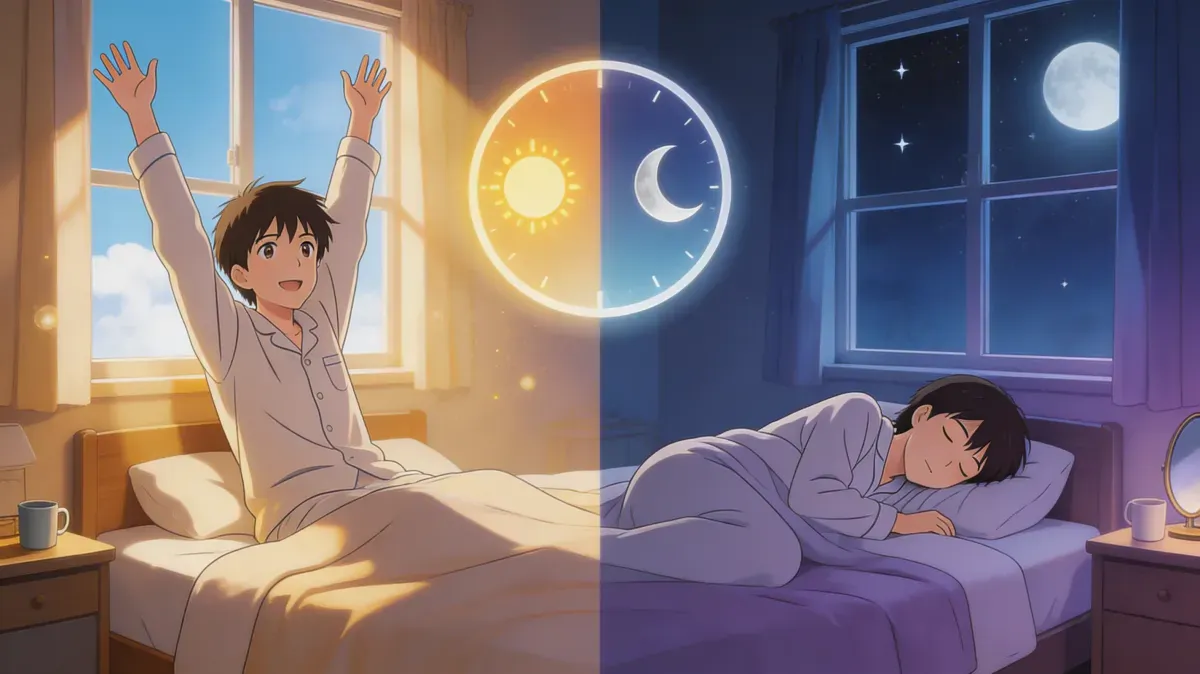
Body temperature and sleep: How the circadian curve controls your rest
Learn how body temperature shapes sleep, why the circadian cooling curve matters, and which room, bath, and light habits support deeper rest.
Your body temperature drops by nearly 2°F (1°C) every single night — and this decline isn’t random. It’s one of the strongest biological signals your brain uses to initiate sleep. A 1999 study published in Nature found that the rate of core body temperature decline before bed predicts how quickly you fall asleep more accurately than any other physiological variable.
Yet most people focus on mattresses, blackout curtains, and white noise machines while ignoring the thermal environment that directly controls their sleep architecture. If you’ve ever tossed and turned on a hot night, woken up drenched in sweat, or struggled to fall asleep even when exhausted, your body’s thermoregulation system is likely the missing piece.
This guide explains exactly how the circadian temperature curve works, why it matters for sleep quality, and 8 evidence-based strategies to harness it — so you can fall asleep faster, sleep deeper, and wake up genuinely rested.
Quick answer
The circadian temperature curve is the predictable 24-hour pattern of core body temperature (CBT) fluctuation driven by your suprachiasmatic nucleus (SCN) — the brain’s master clock.
Key facts
- 6:00 AM: Rising from nadir (~97.0°F / 36.1°C) — Cortisol surge triggers waking
- 10:00 AM: Approaching baseline (~98.2°F / 36.8°C) — Alertness and focus increase
- 4:00–6:00 PM: Daily peak (~99.0°F / 37.2°C) — Physical performance at its best
- 9:00 PM: Beginning decline (~98.4°F / 36.9°C) — Melatonin onset begins
- 2:00–4:00 AM: Nadir (~97.0°F / 36.1°C) — Deepest sleep occurs
What you’ll learn:
- How your body temperature follows a predictable 24-hour curve that triggers sleep
- Why the 2°F nighttime drop is essential for deep sleep and REM
- 8 science-backed strategies to optimize your thermal environment
- How temperature disruption accelerates biological aging
What is the circadian temperature curve?
The circadian temperature curve is the predictable 24-hour pattern of core body temperature (CBT) fluctuation driven by your suprachiasmatic nucleus (SCN) — the brain’s master clock.
Quick definition: The circadian temperature curve is your body’s natural daily cycle of rising and falling core temperature, peaking in the late afternoon and reaching its lowest point during early-morning sleep.
The temperature timeline
Your body doesn’t maintain a flat 98.6°F (37°C) throughout the day. Instead, it follows a precise rhythm:
| Time of Day | Core Body Temperature | What Happens |
|---|---|---|
| 6:00 AM | Rising from nadir (~97.0°F / 36.1°C) | Cortisol surge triggers waking |
| 10:00 AM | Approaching baseline (~98.2°F / 36.8°C) | Alertness and focus increase |
| 4:00–6:00 PM | Daily peak (~99.0°F / 37.2°C) | Physical performance at its best |
| 9:00 PM | Beginning decline (~98.4°F / 36.9°C) | Melatonin onset begins |
| 2:00–4:00 AM | Nadir (~97.0°F / 36.1°C) | Deepest sleep occurs |
This rhythm is so reliable that researchers use it as a gold-standard marker of circadian function. When the curve flattens, shifts, or loses amplitude, sleep quality degrades — often before you notice any symptoms.
Why your body cools down for sleep
Sleep onset doesn’t happen despite the temperature drop — it happens because of it. The decline in core temperature is a prerequisite, not a side effect.
Here’s the mechanism: about two hours before your natural bedtime, the SCN signals blood vessels in your hands and feet to dilate — a process called distal vasodilation. Blood flows to the extremities, radiating heat outward through the skin. Core temperature falls, and this decline triggers the release of melatonin from the pineal gland.
A 2019 review in Frontiers in Neuroscience confirmed that the onset of melatonin secretion is tightly coupled to the downslope of core body temperature. Block the cooling process — with a hot room, heavy blankets, or late-night exercise — and you delay both melatonin release and sleep onset.
The science: how temperature shapes your sleep stages
Temperature doesn’t just affect when you fall asleep — it determines how well you sleep through the night.
Deep sleep requires a cool core
Slow-wave sleep (SWS) — the most physically restorative stage — is highly temperature-dependent. Your brain enters SWS most efficiently when core body temperature is near its circadian nadir. A 2024 study in Scientific Reports demonstrated that enhanced body heat loss during sleep increased slow-wave activity by 14% and simultaneously reduced heart rate, indicating deeper parasympathetic activation. A 2025 study in Building and Environment extended these findings by showing that a dynamic bedroom environment mimicking the natural circadian drop in ambient temperature throughout the night supports thermoregulation more effectively than a fixed setpoint, improving subjective sleep quality and reducing nighttime awakenings.
In practical terms: the cooler your core stays during the first half of the night, the more deep sleep you accumulate.
REM sleep and the thermoregulatory tradeoff
Here’s something most people don’t realize: during REM sleep, your body essentially stops thermoregulating. Sweating and shivering cease, and your core temperature drifts toward the ambient room temperature.
A 2019 Current Biology animal study showed that REM sleep is temperature-sensitive within a narrow thermoneutral zone, with ambient temperature changing REM expression through melanin-concentrating hormone signaling. The practical takeaway is more cautious than “colder is always better”: avoid overheating, but keep the room cool enough for comfort rather than aggressively cold.
The skin temperature paradox
While your core needs to cool down, your skin temperature actually needs to rise slightly for optimal sleep. This sounds contradictory, but it’s the heat-dissipation mechanism at work: warm skin means blood vessels are open and heat is leaving the core efficiently.
A Dutch study found that increasing skin temperature by just 0.7°F (0.4°C) — through warm socks or a gentle warm bath before bed — shifted the percentage of time in deep sleep from 26% to 34% in healthy young adults. In elderly participants with insomnia, the effect was even more dramatic.
8 proven strategies to optimize body temperature for sleep
1. Set your bedroom to 65°F (18°C)
Why it works: This temperature allows your core to cool naturally without triggering shivering. The Sleep Foundation, Healthline, and Cleveland Clinic all converge on 60–67°F (15–19°C) as the ideal range, with 65°F as the sweet spot for most adults.
How to do it:
- Use a room thermometer — your perception of temperature is unreliable after dark
- Lower the thermostat 1–2 hours before bed, not at the moment you climb in
- If you can’t control room temperature, use a fan for airflow and a thin cotton sheet
Expected results: Most people notice faster sleep onset within 2–3 nights of adjusting room temperature.
2. Take a warm bath or shower 1–2 hours before bed
Why it works: This is called the “warm bath effect.” Hot water dilates peripheral blood vessels. When you step out, the rapid heat dissipation from the skin accelerates the core temperature drop — pulling it down faster than it would decline naturally.
How to do it:
- Water temperature: 104–109°F (40–43°C)
- Duration: 10–15 minutes
- Timing: 60–90 minutes before your target sleep time (not immediately before)
Expected results: A 2019 meta-analysis of 5,322 participants found that a warm bath 1–2 hours before bed reduced sleep onset latency by an average of 10 minutes and improved self-reported sleep quality.
3. Wear socks to bed (seriously)
Why it works: Warming the feet promotes distal vasodilation — the exact mechanism the SCN uses to initiate core cooling. Warm extremities = faster heat loss from the core = faster sleep onset.
How to do it:
- Wear loose, breathable socks made of natural fibers (wool or cotton)
- Alternatively, place a hot water bottle near your feet for 15 minutes before sleep
- Remove the socks during the night if you overheat
Expected results: A Korean study found that participants wearing socks fell asleep 7.5 minutes faster and experienced 30 minutes more total sleep than barefoot sleepers.
4. Avoid intense exercise within 3 hours of bed
Why it works: Vigorous exercise raises core body temperature by 1.5–2°F (0.8–1.1°C), and it can take 2–3 hours for the body to return to baseline. Exercising too close to bed delays the natural temperature decline and pushes back melatonin onset.
How to do it:
- Complete high-intensity workouts (HIIT, running, heavy resistance training) at least 3 hours before bed
- Low-intensity activities like stretching, yoga, or walking are generally fine within 2 hours of bed
- Morning or afternoon exercise actually improves nighttime cooling dynamics
Expected results: Athletes who shifted training to morning or early afternoon reported 12% more deep sleep compared to evening exercisers in a 2021 study.
5. Choose breathable bedding materials
Why it works: Synthetic fabrics trap heat and moisture against the skin, disrupting the body’s natural cooling process. Natural fibers wick moisture and allow airflow, supporting efficient thermoregulation throughout the night.
How to do it:
- Sheets: 100% cotton percale, linen, or bamboo-derived fabrics
- Pajamas: loose-fitting cotton or moisture-wicking athletic fabrics
- Avoid memory foam pillows that retain heat — consider buckwheat or latex alternatives
Expected results: Switching from polyester to cotton bedding can reduce skin temperature by 1–2°F overnight, which accumulates into measurably better sleep architecture over weeks.
6. Limit alcohol and spicy food in the evening
Why it works: Alcohol is a potent vasodilator that initially causes heat loss, but then disrupts thermoregulation during the second half of the night — causing rebound overheating, night sweats, and fragmented sleep. Capsaicin from spicy foods raises core temperature for up to 3 hours post-ingestion.
How to do it:
- Stop alcohol consumption at least 3 hours before bed
- Avoid capsaicin-heavy meals after 7 PM
- A light, cooling snack (tart cherry juice, banana, or kiwi) is a better pre-bed choice
Expected results: Eliminating evening alcohol alone can increase deep sleep percentage by 15–25%, according to data from wearable sleep trackers across 25,000+ users.
7. Use the “cooling window” for faster sleep
Why it works: The 2-hour window before your natural bedtime is when your body is actively trying to cool down. Supporting this process — rather than fighting it — dramatically accelerates sleep onset.
How to do it:
- Dim lights at least 1 hour before bed (bright light suppresses melatonin and delays temperature decline) — the blue light spectrum at 460–480 nm emitted by screens is particularly disruptive, suppressing melatonin twice as powerfully as other wavelengths and directly blocking the temperature drop that initiates sleep. The full biology of blue light and circadian disruption shows how evening screens delay both melatonin onset and the core temperature nadir that deep sleep depends on.
- Open a window for 15 minutes to lower room temperature, even in winter
- Avoid heavy blankets or heated rooms during this window
Expected results: Aligning your behavior with the cooling window can reduce sleep onset latency by 15–20 minutes on average.
8. Try deliberate cold exposure in the morning (not at night)
Why it works: Cold showers or cold water immersion in the morning create a temporary temperature dip followed by a strong rebound — raising core temperature and cortisol at the right time. This amplifies the amplitude of your circadian temperature curve, which means a steeper evening decline and better sleep that night.
How to do it:
- Cold shower: 2–5 minutes at 50–60°F (10–15°C) within 1 hour of waking
- Cold plunge: 1–3 minutes if available
- Never do cold exposure within 3 hours of bedtime — it can delay the natural cooling process
Expected results: Human evidence for morning cold exposure as a sleep intervention is still early. Use it, if it suits you, as a daytime alertness and circadian-contrast cue; do not treat it as a proven way to raise evening melatonin.
Light timing and temperature timing work together: morning brightness helps start the daily curve, while dim evenings protect the temperature drop before sleep. Use the blue light at night vs morning light guide when the light side of the routine is unclear.
For room-level setup, use the practical bedroom temperature and sleep quality guide to choose a starting range, adjust bedding, and test whether your recovery data improves.
Cooling the room is only helpful if the acoustic tradeoff stays manageable. Use how much noise during sleep is too much when fans, open windows, or street noise change your recovery data.
If your sleep duration looks adequate but recovery still dips after weekends or late nights, compare Social jet lag vs sleep debt: which ages recovery faster? to decide whether sleep timing or total sleep is the bigger limiter.
How to track your body temperature for sleep
You can’t optimize what you don’t measure. Fortunately, modern wearables have made overnight temperature tracking accessible.
Key metrics to monitor
| Metric | Optimal Range | What It Indicates |
|---|---|---|
| Nightly skin temperature variation | ±0.2°F (0.1°C) from baseline | Stable circadian rhythm |
| Pre-sleep temperature decline | 1.5–2°F (0.8–1°C) drop over 2 hours | Healthy melatonin onset |
| Temperature nadir timing | 2:00–4:00 AM | Properly aligned circadian clock |
| Morning temperature rebound | Rise beginning 4:00–5:00 AM | Normal cortisol awakening response |
What disrupted patterns look like
- Flat curve (minimal overnight drop): indicates circadian disruption, often from irregular sleep schedules, jet lag, or shift work
- Delayed nadir (lowest point after 5 AM): suggests a late chronotype or excessive evening light exposure
- Early nadir (lowest point before 1 AM): may indicate advanced sleep phase — common in older adults
- Erratic fluctuations: can signal alcohol use, illness, hormonal changes, or sleep apnea
Apple Watch Series 8 and later models track wrist temperature nightly and display deviations from your personal baseline. Over time, trends in this data reveal whether your circadian curve is strengthening or degrading.
Body temperature, sleep, and biological age: what the research says
Here’s a layer most sleep guides never mention: the amplitude and regularity of your circadian temperature curve is itself a biomarker of aging.
A landmark 2021 paper in Nature Communications established that circadian rhythm disruption directly influences biological aging and longevity. The researchers found that animals with restored circadian function — including temperature rhythms — exhibited increased lifespan compared to those with degraded rhythms.
What happens to your temperature curve as you age
With each passing decade, three things happen to the circadian temperature curve:
- The amplitude shrinks. The difference between daytime peak and nighttime nadir gets smaller. A young adult might have a 2°F (1.1°C) swing; by age 70, this can narrow to 1°F (0.6°C) or less.
- The phase advances. The entire curve shifts earlier — both the temperature peak and nadir occur sooner. This is why older adults tend to feel sleepy earlier and wake before dawn.
- The curve becomes less stable. Night-to-night variability increases, reflecting a weakening SCN signal.
These changes aren’t just markers of aging — they actively drive it. A flattened temperature rhythm reduces deep sleep, impairs nocturnal growth hormone release, weakens immune surveillance, and disrupts cellular repair processes that depend on circadian timing.
SIRT1: the molecular link
MIT and Harvard researchers identified that SIRT1 — a protein already implicated in longevity research — directly regulates the circadian clock genes BMAL1 and CLOCK. As SIRT1 activity declines with age, circadian temperature amplitude decreases. Interventions that boost SIRT1 (caloric restriction, exercise, NAD+ precursors) may help preserve a robust temperature rhythm.
The practical implication
Every strategy in this article that strengthens your circadian temperature curve — consistent sleep timing, morning light, evening cooling, regular exercise — isn’t just improving tonight’s sleep. It’s potentially slowing the pace of biological aging by maintaining the circadian machinery that coordinates repair, recovery, and resilience across every organ system.
How SuperAge helps you track sleep and temperature
Monitoring your body temperature overnight used to require a lab. Now your Apple Watch captures it every night — but raw data without context is just noise.
Automatic overnight temperature tracking
SuperAge integrates directly with Apple Health to pull your nightly wrist temperature data from Apple Watch Series 8 and later. Instead of checking raw deviations manually, the app surfaces trends that reveal whether your circadian curve is strengthening or weakening over weeks and months.
Sleep quality in the context of biological age
SuperAge doesn’t just track sleep in isolation. It combines your sleep data — including temperature trends, HRV patterns, and sleep stage distribution — with other biomarkers to calculate your biological age. This means you can see how improving your sleep temperature habits directly influences your overall aging trajectory.
Personalized insights
Based on your data patterns, SuperAge can highlight when your temperature rhythm is drifting — perhaps due to travel, seasonal changes, or lifestyle shifts — so you can course-correct before sleep quality degrades.
Frequently asked questions
What is the ideal room temperature for sleeping?
The ideal bedroom temperature for most adults is 65°F (18°C), within a range of 60–67°F (15–19°C). This range allows your body to naturally lower its core temperature without triggering shivering, supporting healthy melatonin release and entry into deep sleep.
Why do I get so hot during sleep?
Nighttime overheating can result from a room that’s too warm, synthetic bedding that traps heat, alcohol consumption before bed, hormonal fluctuations (including perimenopause and menopause), or an ambient temperature that prevents your body from completing its natural heat dissipation cycle.
Does body temperature actually drop during sleep?
Yes. Core body temperature drops by approximately 1.5–2°F (0.8–1°C) during normal sleep, reaching its lowest point between 2:00 and 4:00 AM. This decline is triggered by the circadian clock and is essential for initiating and maintaining deep sleep.
Can a warm bath really help you sleep better?
Yes — but timing matters. A warm bath 60–90 minutes before bed accelerates the core temperature drop by promoting blood flow to the skin surface. The rapid cooling after you step out mimics and amplifies the natural pre-sleep temperature decline, reducing the time it takes to fall asleep by an average of 10 minutes.
Does sleeping with socks on improve sleep quality?
Research supports it. Wearing socks promotes vasodilation in the feet, which helps the core cool down faster. A study found that sock-wearing participants fell asleep 7.5 minutes faster and slept 30 minutes longer than those with bare feet.
If your total sleep looks adequate but recovery still swings with schedule changes, use sleep regularity vs sleep duration to decide whether consistency or more sleep is the better next fix.
If your only workout window is late, use exercising at night and sleep quality to choose the intensity, cutoff time, and cooldown that protect recovery.
Key takeaways
- Your body’s temperature curve is the master switch for sleep: the 2°F nighttime decline triggers melatonin release and determines how much deep sleep and REM you get.
- 65°F (18°C) is the target: set your bedroom within the 60–67°F range, and support cooling with breathable bedding and pre-bed warm baths.
- Timing matters as much as temperature: the 2-hour “cooling window” before bed is critical — avoid bright lights, hot rooms, and intense exercise during this period.
- A strong temperature curve slows biological aging: circadian amplitude directly correlates with SIRT1 activity, growth hormone release, and cellular repair processes.
- Track to optimize: wrist temperature from Apple Watch, combined with SuperAge’s biological age tracking, lets you see how thermal habits influence your aging trajectory.
Start sleeping cooler tonight
Your body already knows how to prepare for great sleep — it’s been doing it for millions of years through the circadian temperature curve. The problem isn’t your biology. It’s the modern environment fighting against it: overheated bedrooms, late-night screens, evening workouts, and synthetic fabrics.
Fix the thermal environment, and your sleep architecture responds within days.
Ready to see how sleep quality affects your biological age? Download SuperAge and start tracking your nightly temperature patterns alongside your overall aging trajectory.
References
- Kräuchi K et al. (1999). “Warm feet promote the rapid onset of sleep.” Nature, 401, 36-37. https://doi.org/10.1038/43366
- Harding EC et al. (2019). “The Temperature Dependence of Sleep.” Frontiers in Neuroscience, 13, 336. https://doi.org/10.3389/fnins.2019.00336
- Haghayegh S et al. (2019). “Before-bedtime passive body heating by warm shower or bath to improve sleep: A systematic review and meta-analysis.” Sleep Medicine Reviews, 46, 124-135. https://doi.org/10.1016/j.smrv.2019.04.008
- Van Someren EJW. (2006). “Mechanisms and functions of coupling between sleep and temperature rhythms.” Progress in Brain Research, 153, 309-324. https://doi.org/10.1016/S0079-6123(06)53019-3
- Solinski HJ et al. (2024). “Enhanced conductive body heat loss during sleep increases slow-wave sleep and calms the heart.” Scientific Reports, 14, 2468. https://doi.org/10.1038/s41598-024-53839-x
- Bigalke JA et al. (2023). “Core body temperature changes before sleep are associated with nocturnal heart rate variability.” Journal of Applied Physiology, 135(1), 136-145. https://doi.org/10.1152/japplphysiol.00020.2023
- Ko Y and Lee JY. (2018). “Effects of feet warming using bed socks on sleep quality and thermoregulatory responses in a cool environment.” Journal of Physiological Anthropology, 37, 13. https://doi.org/10.1186/s40101-018-0172-z
- Komagata N et al. (2019). “Dynamic REM Sleep Modulation by Ambient Temperature and the Critical Role of the Melanin-Concentrating Hormone System.” Current Biology, 29(12), 1976-1987.e4. https://doi.org/10.1016/j.cub.2019.05.009
- Manella G et al. (2021). “Importance of circadian timing for aging and longevity.” Nature Communications, 12, 2862. https://doi.org/10.1038/s41467-021-22922-6
- Hood S and Amir S. (2017). “The aging clock: circadian rhythms and later life.” Journal of Clinical Investigation, 127(2), 437-446. https://doi.org/10.1172/JCI90328
- Nakahata Y et al. (2008). “The NAD+-Dependent Deacetylase SIRT1 Modulates CLOCK-Mediated Chromatin Remodeling and Circadian Control.” Cell, 134(2), 329-340. https://doi.org/10.1016/j.cell.2008.07.002
- Lan L et al. (2025). “Effects of environmental temperature mimicking circadian rhythms on thermal comfort and sleep quality.” Building and Environment, 269, 113196. https://doi.org/10.1016/j.buildenv.2025.113196
Last updated: 2026-06-07. This article is regularly reviewed to ensure accuracy.
Related Articles
Bedroom temperature and sleep quality: what range supports recovery?
Bedroom temperature affects sleep quality, HRV, and recovery. Learn the best range by age, season, bedding, and wearable sleep pattern.